BPSC TRE 2.0 (2023) Music Class 11-12 — Previous Year Paper
All 150 questions of BPSC TRE 2.0 (2023) Music Class 11-12 — Previous Year Paper with the correct answer from the official answer key and a solution, in English and Hindi. Read them free on UTpaper, or attempt the paper as a timed online test.
Q1BPSC TRE 2.0 (2023) Music Class 11-12 · Language
Fill in the blank with a suitable article (‘a’, ‘an’ or ‘the’):
There are 30 or 31 days in _____ month.
Athe
Ba
Can
DMore than one of the above
ENone of the above
Show answerHide answer
Correct answer: (B) a
Explanation
"Month" begins with a consonant sound and here means any one month, so the indefinite article "a" is used.
Q2BPSC TRE 2.0 (2023) Music Class 11-12 · Language
Fill in the blank with a suitable article (‘a’, ‘an’ or ‘the’):
My father is _____ engineer in the Water Works Department.
Athe
Ban
Ca
DMore than one of the above
ENone of the above
Show answerHide answer
Correct answer: (B) an
Explanation
"Engineer" begins with a vowel sound, so "an engineer".
Q3BPSC TRE 2.0 (2023) Music Class 11-12 · Language
Which of the following is a part of bedroom?
APillow
BTable lamp
CCurtains
DMore than one of the above
ENone of the above
Show answerHide answer
Correct answer: (D) More than one of the above
Explanation
A pillow, a table lamp and curtains are all things found in a bedroom, so more than one option is correct.
Q4BPSC TRE 2.0 (2023) Music Class 11-12 · Language
Which of the following is a part of a room?
AWindow
BCeiling
CFloor
DMore than one of the above
ENone of the above
Show answerHide answer
Correct answer: (D) More than one of the above
Explanation
Window, ceiling and floor are all parts of a room, so more than one option is correct.
Q5BPSC TRE 2.0 (2023) Music Class 11-12 · Language
Rainy season comes before
Awinter
Bspring
Csummer
DMore than one of the above
ENone of the above
Show answerHide answer
Correct answer: (A) winter
Explanation
In the Indian season cycle the rainy season (monsoon) is followed by autumn and then winter, so it comes before winter, not spring or summer.
Q6BPSC TRE 2.0 (2023) Music Class 11-12 · Language
The eighth month of the year is
AJuly
BSeptember
COctober
DMore than one of the above
ENone of the above
Show answerHide answer
Correct answer: (E) None of the above
Explanation
The eighth month of the year is August, which is not among the options.
Q7BPSC TRE 2.0 (2023) Music Class 11-12 · Language
Sister-in-law is
Ahusband’s sister
Bwife’s sister
Cbrother’s wife
DMore than one of the above
ENone of the above
Show answerHide answer
Correct answer: (D) More than one of the above
Explanation
A sister-in-law can be your husband's sister, your wife's sister or your brother's wife, so all three are correct.
Q8BPSC TRE 2.0 (2023) Music Class 11-12 · Language
Cousins are
Amaternal
Bpaternal
Csiblings
DMore than one of the above
ENone of the above
Show answerHide answer
Correct answer: (D) More than one of the above
Explanation
Cousins are the children of one's uncles and aunts, on the mother's side (maternal) or the father's side (paternal). They are not siblings, so (A) and (B) are correct.
Q9BPSC TRE 2.0 (2023) Music Class 11-12 · Language
‘चाँदी’ शब्द में कौन-सी संज्ञा है?
Aद्रव्यवाचक संज्ञा
Bजातिवाचक संज्ञा
Cभाववाचक संज्ञा
Dउपर्युक्त में से एक से अधिक
Eउपर्युक्त में से कोई नहीं
Show answerHide answer
Correct answer: (A) द्रव्यवाचक संज्ञा
Explanation
जिस संज्ञा से किसी द्रव्य या पदार्थ (धातु, अनाज, तरल आदि) का बोध हो, उसे द्रव्यवाचक संज्ञा कहते हैं; 'चाँदी' एक धातु है।
Q10BPSC TRE 2.0 (2023) Music Class 11-12 · Language
निम्नलिखित शब्दों में से कौन-सा ‘एकवचन’ है?
Aहस्ताक्षर
Bछाया
Cआँसू
Dउपर्युक्त में से एक से अधिक
Eउपर्युक्त में से कोई नहीं
Show answerHide answer
Correct answer: (B) छाया
Explanation
'छाया' एकवचन है। 'हस्ताक्षर' और 'आँसू' सदा बहुवचन में प्रयुक्त होने वाले शब्द हैं।
Q11BPSC TRE 2.0 (2023) Music Class 11-12 · Language
हिन्दी शब्दकोश में ‘क्ष’ का क्रम किस वर्ण के बाद आता है?
Aत्र के पश्चात्
Bज्ञ के पश्चात्
Cक के पश्चात्
Dउपर्युक्त में से एक से अधिक
Eउपर्युक्त में से कोई नहीं
Show answerHide answer
Correct answer: (C) क के पश्चात्
Explanation
'क्ष' संयुक्त व्यंजन (क् + ष) है, इसलिए शब्दकोश में यह 'क' वर्ण के अंतर्गत, 'क' के बाद आता है।
Q12BPSC TRE 2.0 (2023) Music Class 11-12 · Language
“जिसकी यह पुस्तक है, उसे लौटा दो।” इस वाक्य में कौन-सा सर्वनाम है?
Aनिश्चयवाचक
Bसंबंधवाचक
Cपुरुषवाचक
Dउपर्युक्त में से एक से अधिक
Eउपर्युक्त में से कोई नहीं
Show answerHide answer
Correct answer: (B) संबंधवाचक
Explanation
'जिसकी ... उसे' में 'जिसकी' एक वाक्यांश को दूसरे से जोड़ता है, अतः यह संबंधवाचक सर्वनाम है।
Q13BPSC TRE 2.0 (2023) Music Class 11-12 · Language
विशेषण का प्रमुख भेद कौन-सा नहीं है?
Aअसार्वनामिक विशेषण
Bगुणवाचक विशेषण
Cपरिमाणवाचक विशेषण
Dउपर्युक्त में से एक से अधिक
Eउपर्युक्त में से कोई नहीं
Show answerHide answer
Correct answer: (A) असार्वनामिक विशेषण
Explanation
विशेषण के मुख्य भेद हैं – गुणवाचक, संख्यावाचक, परिमाणवाचक और सार्वनामिक। 'असार्वनामिक' विशेषण का कोई भेद नहीं है।
Q14BPSC TRE 2.0 (2023) Music Class 11-12 · Language
निम्नलिखित में से कौन-सा अशुद्ध शब्द है?
Aवीभत्स
Bलगान
Cआगामी
Dउपर्युक्त में से एक से अधिक
Eउपर्युक्त में से कोई नहीं
Show answerHide answer
Correct answer: (A) वीभत्स
Explanation
'वीभत्स' अशुद्ध है, शुद्ध रूप 'बीभत्स' है। 'लगान' और 'आगामी' शुद्ध हैं।
Q15BPSC TRE 2.0 (2023) Music Class 11-12 · Language
निम्नलिखित में से कौन-सा शुद्ध वर्तनी वाला शब्द है?
Aक्षत्रिय
Bक्षत्रीय
Cउज्जवल
Dउपर्युक्त में से एक से अधिक
Eउपर्युक्त में से कोई नहीं
Show answerHide answer
Correct answer: (A) क्षत्रिय
Explanation
'क्षत्रिय' शुद्ध है। 'क्षत्रीय' अशुद्ध है और 'उज्जवल' का शुद्ध रूप 'उज्ज्वल' है।
Q16BPSC TRE 2.0 (2023) Music Class 11-12 · Language
निम्नलिखित में से कौन-सा ‘तत्सम’ शब्द है?
Aघर
Bस्नेह
Cछेद
Dउपर्युक्त में से एक से अधिक
Eउपर्युक्त में से कोई नहीं
Show answerHide answer
Correct answer: (B) स्नेह
Explanation
'स्नेह' संस्कृत का तत्सम शब्द है। 'घर' (गृह से) और 'छेद' (छिद्र से) तद्भव हैं।
Q17BPSC TRE 2.0 (2023) Music Class 11-12 · Language
निम्नलिखित में से कौन-सा विदेशी शब्द है?
Aबाघ
Bपरीक्षा
Cचाय
Dउपर्युक्त में से एक से अधिक
Eउपर्युक्त में से कोई नहीं
Show answerHide answer
Correct answer: (C) चाय
Explanation
'चाय' चीनी भाषा से आया विदेशी शब्द है। 'परीक्षा' तत्सम और 'बाघ' (व्याघ्र से) तद्भव है।
Q18BPSC TRE 2.0 (2023) Music Class 11-12 · Language
रचना के आधार पर ‘जिन शब्दों के खंड सार्थक न हों’ उन्हें कौन-सा शब्द कहा जाता है?
Aरूढ़
Bयौगिक
Cयोगरूढ़
Dउपर्युक्त में से एक से अधिक
Eउपर्युक्त में से कोई नहीं
Show answerHide answer
Correct answer: (A) रूढ़
Explanation
जिन शब्दों के खंड करने पर उनका कोई अर्थ न निकले, वे रूढ़ शब्द कहलाते हैं, जैसे – घर, कमल।
Q19BPSC TRE 2.0 (2023) Music Class 11-12 · Language
निम्नलिखित में से किस वाक्य में ‘अकर्मक क्रिया’ है?
Aउसे मत लजाओ।
Bबालिका लजाती है।
Cसेवक नदी से गागर भरता है।
Dउपर्युक्त में से एक से अधिक
Eउपर्युक्त में से कोई नहीं
Show answerHide answer
Correct answer: (B) बालिका लजाती है।
Explanation
'बालिका लजाती है' में कोई कर्म नहीं है, क्रिया का फल कर्ता पर ही पड़ता है, अतः अकर्मक क्रिया है। अन्य वाक्यों में कर्म ('उसे', 'गागर') है।
Q20BPSC TRE 2.0 (2023) Music Class 11-12 · Language
निम्नलिखित में से कौन-सा देशज शब्द है?
Aआवारा
Bभौंरा
Cपरवल
Dउपर्युक्त में से एक से अधिक
Eउपर्युक्त में से कोई नहीं
Show answerHide answer
Correct answer: (C) परवल
Explanation
'परवल' लोकभाषा से आया देशज शब्द है। 'आवारा' फारसी का और 'भौंरा' (भ्रमर से) तद्भव शब्द है।
Q21BPSC TRE 2.0 (2023) Music Class 11-12 · Language
निम्नलिखित में से कौन-सा शब्द रूढ़ शब्द नहीं है?
Aलकड़ी
Bजलधारा
Cमहर्षि
Dउपर्युक्त में से एक से अधिक
Eउपर्युक्त में से कोई नहीं
Show answerHide answer
Correct answer: (D) उपर्युक्त में से एक से अधिक
Explanation
'जलधारा' (जल + धारा) और 'महर्षि' (महा + ऋषि) सार्थक खंडों से बने यौगिक शब्द हैं, जबकि 'लकड़ी' रूढ़ है; अतः एक से अधिक विकल्प सही हैं।
Q22BPSC TRE 2.0 (2023) Music Class 11-12 · Language
‘खारिज’ किस भाषा का शब्द है?
Aअरबी
Bफारसी
Cतुर्की
Dउपर्युक्त में से एक से अधिक
Eउपर्युक्त में से कोई नहीं
Show answerHide answer
Correct answer: (A) अरबी
Explanation
'खारिज' (रद्द, अस्वीकृत) अरबी भाषा का शब्द है।
Q23BPSC TRE 2.0 (2023) Music Class 11-12 · Language
अशुद्ध और शुद्ध वर्तनी का कौन-सा युग्म सही नहीं है?
Aकोमलांगिनी—कोमलांगी
Bसुश्रूषा—शुश्रूषा
Cमाहात्म—महात्म्य
Dउपर्युक्त में से एक से अधिक
Eउपर्युक्त में से कोई नहीं
Show answerHide answer
Correct answer: (E) उपर्युक्त में से कोई नहीं
Explanation
कुंजी के अनुसार तीनों युग्म सही हैं: 'कोमलांगिनी' का शुद्ध रूप 'कोमलांगी', 'सुश्रूषा' का 'शुश्रूषा' और 'माहात्म' का शुद्ध रूप 'माहात्म्य' है (विकल्प में 'महात्म्य' छपा है, जिसे मुद्रण-त्रुटि माना गया है)।
Q24BPSC TRE 2.0 (2023) Music Class 11-12 · Language
“उसका भविष्य उजवल है।” इस वाक्य में रेखांकित शब्द (उजवल) की शुद्ध वर्तनी कौन-सी है?
Aउज्ज्वल
Bउज्वल
Cउज्जवल
Dउपर्युक्त में से एक से अधिक
Eउपर्युक्त में से कोई नहीं
Show answerHide answer
Correct answer: (A) उज्ज्वल
Explanation
'उज्ज्वल' (उत् + ज्वल) शुद्ध वर्तनी है, जिसमें ज् + ज्व आता है। 'उज्वल' और 'उज्जवल' अशुद्ध हैं।
Q25BPSC TRE 2.0 (2023) Music Class 11-12 · Language
एक छोटी आकृति का चमकीला वर्ग, जो स्क्रीन पर किसी चिह्न की स्थिति को स्पष्ट करता है, उसे क्या कहते हैं?
Aकरसर
Bचिप
Cकमांड
Dउपर्युक्त में से एक से अधिक
Eउपर्युक्त में से कोई नहीं
Show answerHide answer
Correct answer: (A) करसर
Explanation
स्क्रीन पर वर्तमान स्थिति बताने वाला टिमटिमाता छोटा चिह्न 'करसर' (cursor) कहलाता है।
Q26BPSC TRE 2.0 (2023) Music Class 11-12 · Language
‘कुरुक्षेत्र’ के लेखक का क्या नाम है?
Aहरिऔध
Bश्रीधर पाठक
Cमैथिलीशरण गुप्त
Dउपर्युक्त में से एक से अधिक
Eउपर्युक्त में से कोई नहीं
Show answerHide answer
Correct answer: (E) उपर्युक्त में से कोई नहीं
Explanation
'कुरुक्षेत्र' (1946) प्रबंध काव्य के रचयिता रामधारी सिंह 'दिनकर' हैं, जो किसी विकल्प में नहीं हैं।
Q27BPSC TRE 2.0 (2023) Music Class 11-12 · Language
“जसोदा हरि पालनै झुलावै।
हलरावै दुलराइ मल्हावैं, जोइ-सोइ कछु गावैं॥”
उक्त काव्य-पंक्तियों में कौन-सा रस है?
Aशृंगार
Bवीर
Cवात्सल्य
Dउपर्युक्त में से एक से अधिक
Eउपर्युक्त में से कोई नहीं
Show answerHide answer
Correct answer: (C) वात्सल्य
Explanation
इन पंक्तियों में यशोदा का बालक कृष्ण के प्रति स्नेह (पालना झुलाना, दुलारना) वर्णित है; संतान-स्नेह का रस वात्सल्य है।
Q28BPSC TRE 2.0 (2023) Music Class 11-12 · Language
हिन्दी भाषा के उद्भव का काल माना जाता है
A500 ई॰ पू॰
B500 ई॰
C1000 ई॰
Dउपर्युक्त में से एक से अधिक
Eउपर्युक्त में से कोई नहीं
Show answerHide answer
Correct answer: (C) 1000 ई॰
Explanation
अपभ्रंश से आधुनिक भारतीय भाषाओं के विकास के साथ हिन्दी का उद्भव लगभग 1000 ई॰ के आसपास माना जाता है।
Q29BPSC TRE 2.0 (2023) Music Class 11-12 · Language
भारतीय काव्यशास्त्र में क्षमाशील, गम्भीर, स्थिरचित्त, स्वाभिमानी एवं दृढ़ प्रतिज्ञ नायक को कहा गया है
Aधीरललित
Bधीरोदात्त
Cधीर प्रशांत
Dउपर्युक्त में से एक से अधिक
Eउपर्युक्त में से कोई नहीं
Show answerHide answer
Correct answer: (B) धीरोदात्त
Explanation
क्षमाशील, गम्भीर, स्थिरचित्त, स्वाभिमानी और दृढ़व्रत नायक 'धीरोदात्त' कहलाता है, जैसे राम।
Q30BPSC TRE 2.0 (2023) Music Class 11-12 · Language
जिन शब्दों पर लिंग, वचन, कारक का कोई प्रभाव न पड़े, वे कहलाते हैं
Aव्यय
Bविकारी
Cअविकारी
Dउपर्युक्त में से एक से अधिक
Eउपर्युक्त में से कोई नहीं
Show answerHide answer
Correct answer: (C) अविकारी
Explanation
जिन शब्दों पर लिंग, वचन, कारक का प्रभाव नहीं पड़ता और रूप नहीं बदलता, वे अविकारी (अव्यय) शब्द कहलाते हैं।
General Studies 40 questions
Q31BPSC TRE 2.0 (2023) Music Class 11-12 · General Studies
The floor of a rectangular hall has a perimeter 250 meters. If the cost of painting the four walls at the rate of ₹10 per (meter)² is ₹15,000, then the height of the hall isएक आयताकार हॉल के फर्श की परिधि 250 मीटर है। यदि ₹10 प्रति वर्ग मीटर की दर से चारों दीवारों को पेंट करने की लागत ₹15,000 है, तो हॉल की ऊँचाई है
A7 meters7 मीटर
B16 meters16 मीटर
C6 meters6 मीटर
DMore than one of the aboveउपर्युक्त में से एक से अधिक
ENone of the aboveउपर्युक्त में से कोई नहीं
Show answerHide answer
Correct answer: (C)6 meters6 मीटर
Explanation
Area of four walls = 15000/10 = 1500 m². Wall area = perimeter × height, so 250 × h = 1500 and h = 6 m.चारों दीवारों का क्षेत्रफल = 15000/10 = 1500 वर्ग मीटर। दीवारों का क्षेत्रफल = परिधि × ऊँचाई, अतः 250 × h = 1500 और h = 6 मीटर।
Q32BPSC TRE 2.0 (2023) Music Class 11-12 · General Studies
Which of the following statements is not true?निम्नलिखित में से कौन-सा कथन सत्य नहीं है?
AEvery natural number is a whole number.प्रत्येक प्राकृत संख्या, एक पूर्ण संख्या है।
BEvery integer is a whole number.प्रत्येक पूर्णांक, एक पूर्ण संख्या है।
CEvery natural number is an integer number.प्रत्येक प्राकृत संख्या, एक पूर्णांक संख्या है।
DMore than one of the aboveउपर्युक्त में से एक से अधिक
ENone of the aboveउपर्युक्त में से कोई नहीं
Show answerHide answer
Correct answer: (B)Every integer is a whole number.प्रत्येक पूर्णांक, एक पूर्ण संख्या है।
Explanation
Negative integers like −3 are not whole numbers, so 'every integer is a whole number' is false. The other two statements are true.−3 जैसे ऋणात्मक पूर्णांक पूर्ण संख्याएँ नहीं होते, इसलिए 'प्रत्येक पूर्णांक एक पूर्ण संख्या है' असत्य है। अन्य दोनों कथन सत्य हैं।
Q33BPSC TRE 2.0 (2023) Music Class 11-12 · General Studies
The average of 7 consecutive numbers is 20. The largest of these numbers is7 क्रमागत संख्याओं का औसत 20 है। इनमें से सबसे बड़ी संख्या है
A2020
B2121
C2323
DMore than one of the aboveउपर्युक्त में से एक से अधिक
ENone of the aboveउपर्युक्त में से कोई नहीं
Show answerHide answer
Correct answer: (C)2323
Explanation
Official BPSC answer key: (A). By calculation the 7 consecutive numbers are 17, 18, …, 23 (average 20), so the largest is 23, option (C).नोट: आधिकारिक उत्तर कुंजी: (A)। गणना से 7 क्रमागत संख्याएँ 17, 18, …, 23 हैं (औसत 20), इसलिए सबसे बड़ी संख्या 23 है, यानी विकल्प (C)।
Q34BPSC TRE 2.0 (2023) Music Class 11-12 · General Studies
The equation ax² + bx + c = 0 has two distinct real roots, ifसमीकरण ax² + bx + c = 0 के दो भिन्न वास्तविक मूल होंगे, यदि
Ab² − 4ac < 0b² − 4ac < 0
Bb² − 4ac > 0b² − 4ac > 0
Cb² − 4ac = 0b² − 4ac = 0
DMore than one of the aboveउपर्युक्त में से एक से अधिक
ENone of the aboveउपर्युक्त में से कोई नहीं
Show answerHide answer
Correct answer: (B)b² − 4ac > 0b² − 4ac > 0
Explanation
A quadratic has two distinct real roots when the discriminant b² − 4ac > 0; = 0 gives equal roots and < 0 gives no real roots.एक द्विघात समीकरण के दो भिन्न वास्तविक मूल तब होते हैं जब विविक्तकर b² − 4ac > 0 हो; = 0 होने पर मूल बराबर होते हैं और < 0 होने पर कोई वास्तविक मूल नहीं होता।
Q35BPSC TRE 2.0 (2023) Music Class 11-12 · General Studies
Mohan can do a bit of work in 25 days which can be completed by Sohan in 20 days. Both together labour for 5 days and afterward Mohan leaves off. How long will Sohan take to complete the remaining work?मोहन 25 दिनों में एक काम कर सकता है जिसे सोहन 20 दिनों में पूरा कर सकता है। दोनों एक साथ 5 दिनों के लिए श्रम करते हैं और उसके बाद मोहन काम छोड़ देता है। शेष कार्य को पूरा करने में सोहन को कितना समय लगेगा?
A20 days20 दिन
B11 days11 दिन
C14 days14 दिन
DMore than one of the aboveउपर्युक्त में से एक से अधिक
ENone of the aboveउपर्युक्त में से कोई नहीं
Show answerHide answer
Correct answer: (B)11 days11 दिन
Explanation
Together per day: 1/25 + 1/20 = 9/100; in 5 days 45/100 is done. The remaining 55/100 at Sohan's rate 1/20 per day takes 55/100 × 20 = 11 days.दोनों मिलकर एक दिन में: 1/25 + 1/20 = 9/100; 5 दिनों में 45/100 काम होता है। शेष 55/100 काम सोहन की दर 1/20 प्रति दिन से करने में 55/100 × 20 = 11 दिन लगेंगे।
Q36BPSC TRE 2.0 (2023) Music Class 11-12 · General Studies
If X = a² − b², Y = 30 and a + b = 15, thenयदि X = a² − b², Y = 30 तथा a + b = 15 हो, तो
AX is lesser than Y if a = bX छोटा है Y से यदि a = b
BX is greater than Y if a > bX बड़ा है Y से यदि a > b
CY is greater than X if a = bY बड़ा है X से यदि a = b
DMore than one of the aboveउपर्युक्त में से एक से अधिक
ENone of the aboveउपर्युक्त में से कोई नहीं
Show answerHide answer
Correct answer: (D)More than one of the aboveउपर्युक्त में से एक से अधिक
Explanation
X = (a + b)(a − b) = 15(a − b). If a = b, X = 0 < 30 = Y, so (A) and (C) are both true. If a > b, X can still be less than 30 (e.g. a − b = 1), so (B) is not always true.X = (a + b)(a − b) = 15(a − b)। यदि a = b, तो X = 0 < 30 = Y, इसलिए (A) और (C) दोनों सत्य हैं। यदि a > b, तब भी X, 30 से छोटा हो सकता है (जैसे a − b = 1), इसलिए (B) हमेशा सत्य नहीं है।
Q37BPSC TRE 2.0 (2023) Music Class 11-12 · General Studies
The probability of a non leap year selected at random will contain 53 Sundays isयादृच्छिक रूप से चुने गए एक गैर-लीप वर्ष में 53 रविवार होने की प्रायिकता है
A1/71/7
B2/532/53
C1/531/53
DMore than one of the aboveउपर्युक्त में से एक से अधिक
ENone of the aboveउपर्युक्त में से कोई नहीं
Show answerHide answer
Correct answer: (A)1/71/7
Explanation
A non-leap year has 365 days = 52 weeks + 1 day. That one extra day must be a Sunday, probability 1/7.एक गैर-लीप वर्ष में 365 दिन = 52 सप्ताह + 1 दिन होते हैं। वह एक अतिरिक्त दिन रविवार होना चाहिए, जिसकी प्रायिकता 1/7 है।
Q38BPSC TRE 2.0 (2023) Music Class 11-12 · General Studies
If 7¹²ˣ⁺⁶ = 49³ˣ⁺¹², then the value of x isयदि 7¹²ˣ⁺⁶ = 49³ˣ⁺¹² हो, तो x का मान है
A33
B44
C77
DMore than one of the aboveउपर्युक्त में से एक से अधिक
ENone of the aboveउपर्युक्त में से कोई नहीं
Show answerHide answer
Correct answer: (A)33
Explanation
49 = 7², so 12x + 6 = 2(3x + 12) = 6x + 24, giving 6x = 18 and x = 3.49 = 7², इसलिए 12x + 6 = 2(3x + 12) = 6x + 24, जिससे 6x = 18 और x = 3।
Q39BPSC TRE 2.0 (2023) Music Class 11-12 · General Studies
Myopia is a disease in which a person cannot seeमायोपिया वह बीमारी है, जिसमें व्यक्ति देख नहीं पाता है
Adistant objects clearlyदूर की वस्तुएँ स्पष्ट रूप से
Bnearby objects clearlyपास की वस्तुएँ स्पष्ट रूप से
Cnearby as well as distant objects clearlyपास की तथा दूर की वस्तुएँ स्पष्ट रूप से
DMore than one of the aboveउपर्युक्त में से एक से अधिक
ENone of the aboveउपर्युक्त में से कोई नहीं
Show answerHide answer
Correct answer: (A)distant objects clearlyदूर की वस्तुएँ स्पष्ट रूप से
Explanation
In myopia (short-sightedness) the image of distant objects forms in front of the retina, so distant objects look blurred; it is corrected with a concave lens.मायोपिया (निकट-दृष्टि दोष) में दूर की वस्तुओं का प्रतिबिंब रेटिना के आगे बनता है, इसलिए दूर की वस्तुएँ धुँधली दिखती हैं; इसे अवतल लेंस से ठीक किया जाता है।
Q40BPSC TRE 2.0 (2023) Music Class 11-12 · General Studies
The term ‘heredity’ chiefly refers to‘आनुवंशिकता’ शब्द मुख्य रूप से किसे संदर्भित करता है?
Aanatomyशरीर-रचना
Bmeiosisअर्धसूत्री विभाजन
Cgeneticsआनुवंशिकी
DMore than one of the aboveउपर्युक्त में से एक से अधिक
ENone of the aboveउपर्युक्त में से कोई नहीं
Show answerHide answer
Correct answer: (C)geneticsआनुवंशिकी
Explanation
Heredity, the passing of traits from parents to offspring, is studied in genetics.आनुवंशिकता, यानी माता-पिता से संतान में लक्षणों का स्थानांतरण, का अध्ययन आनुवंशिकी में किया जाता है।
Q41BPSC TRE 2.0 (2023) Music Class 11-12 · General Studies
The cans in which food is packed are coated with tin and not zinc becauseजिन डिब्बों में खाना पैक किया जाता है, उन पर टिन की परत चढ़ी होती है न कि जिंक की, क्योंकि
Atin is more reactive than zincटिन, जिंक की तुलना में अधिक प्रतिक्रियाशील है
Bzinc is more reactive than tinजिंक, टिन की तुलना में अधिक प्रतिक्रियाशील है
Czinc is costlier than tinजिंक, टिन से महँगा है
DMore than one of the aboveउपर्युक्त में से एक से अधिक
ENone of the aboveउपर्युक्त में से कोई नहीं
Show answerHide answer
Correct answer: (B)zinc is more reactive than tinजिंक, टिन की तुलना में अधिक प्रतिक्रियाशील है
Explanation
Zinc is more reactive than tin and would react with acids in food to form harmful compounds, so the less reactive tin is used.जिंक, टिन से अधिक प्रतिक्रियाशील है और भोजन के अम्लों से अभिक्रिया करके हानिकारक यौगिक बना देगा, इसलिए कम प्रतिक्रियाशील टिन का उपयोग किया जाता है।
Q42BPSC TRE 2.0 (2023) Music Class 11-12 · General Studies
The process in which atmospheric carbon dioxide is converted into carbohydrates during photosynthesis isवह प्रक्रिया, जिसमें प्रकाश-संश्लेषण के दौरान वायुमण्डलीय कार्बन डाइऑक्साइड को कार्बोहाइड्रेट में परिवर्तित किया जाता है, है
Aoxidationऑक्सीकरण
Breductionअपचयन
Chydrolysisजलीय-विश्लेषण
DMore than one of the aboveउपर्युक्त में से एक से अधिक
ENone of the aboveउपर्युक्त में से कोई नहीं
Show answerHide answer
Correct answer: (B)reductionअपचयन
Explanation
In photosynthesis CO₂ gains hydrogen (and loses oxygen) to form carbohydrates, so it is reduced.प्रकाश-संश्लेषण में CO₂ हाइड्रोजन ग्रहण करती है (और ऑक्सीजन खोती है) तथा कार्बोहाइड्रेट बनाती है, अतः उसका अपचयन होता है।
Q43BPSC TRE 2.0 (2023) Music Class 11-12 · General Studies
The quality of a printer is determined asएक प्रिन्टर की गुणवत्ता किससे निर्धारित की जाती है?
Awords per inchशब्द प्रति इंच
Bstrike per inchप्रहार प्रति इंच
Cdots per inchबिन्दु प्रति इंच
DMore than one of the aboveउपर्युक्त में से एक से अधिक
ENone of the aboveउपर्युक्त में से कोई नहीं
Show answerHide answer
Correct answer: (C)dots per inchबिन्दु प्रति इंच
Explanation
Printer resolution and print quality are measured in dots per inch (dpi).प्रिंटर का रिज़ॉल्यूशन और प्रिंट की गुणवत्ता बिन्दु प्रति इंच (dpi) में मापी जाती है।
Q44BPSC TRE 2.0 (2023) Music Class 11-12 · General Studies
Trachoma disease is related toट्रैकोमा रोग का सम्बन्ध है
Alungsफेफड़ों से
Bearsकान से
Ceyesआँखों से
DMore than one of the aboveउपर्युक्त में से एक से अधिक
ENone of the aboveउपर्युक्त में से कोई नहीं
Show answerHide answer
Correct answer: (C)eyesआँखों से
Explanation
Trachoma is a bacterial (Chlamydia trachomatis) infection of the eyes that can cause blindness.ट्रैकोमा आँखों का एक जीवाणु (क्लैमाइडिया ट्रैकोमैटिस) संक्रमण है, जिससे अंधापन हो सकता है।
Q45BPSC TRE 2.0 (2023) Music Class 11-12 · General Studies
Which of the following makes use of Newton’s third law of motion?
AArchery
BSpace rocket
CVenturimeter
DMore than one of the above
ENone of the above
Show answerHide answer
Correct answer: (D) More than one of the above
Explanation
A rocket pushes exhaust gases backward and the gases push it forward. In archery the bowstring and arrow push on each other (the bow recoils), so both use the third law; a venturimeter works on Bernoulli's principle.
Q46BPSC TRE 2.0 (2023) Music Class 11-12 · General Studies
Particles which can be added to the nucleus of an atom without changing its chemical properties areरासायनिक गुणों को अपरिवर्तित रखते हुए एक परमाणु के नाभिक में जोड़े जाने वाले कण हैं
Aneutronsन्यूट्रॉन
Belectronsइलेक्ट्रॉन
Cprotonsप्रोटॉन
DMore than one of the aboveउपर्युक्त में से एक से अधिक
ENone of the aboveउपर्युक्त में से कोई नहीं
Show answerHide answer
Correct answer: (A)neutronsन्यूट्रॉन
Explanation
Chemical properties depend on the number of protons and electrons. Adding neutrons only makes an isotope of the same element.रासायनिक गुण प्रोटॉनों और इलेक्ट्रॉनों की संख्या पर निर्भर करते हैं। न्यूट्रॉन जोड़ने से उसी तत्व का केवल एक समस्थानिक बनता है।
Q47BPSC TRE 2.0 (2023) Music Class 11-12 · General Studies
Before Elon Musk announced change of the signature Blue Bird logo to Sign ‘X’ logo, who is regarded as the creator of Twitter’s iconic Bird in its final version in 2012?एलन मस्क द्वारा सिग्नेचर ब्लू बर्ड लोगो को बदलकर ‘X’ लोगो की घोषणा करने से पहले, 2012 में अपने अन्तिम संस्करण में ट्विटर के प्रतिष्ठित बर्ड के निर्माता के रूप में किसे माना जाता है?
AJack Dorseyजैक डोर्सी
BMartin Grasserमार्टिन ग्रासर
CNoah Glassनोआह ग्लास
DMore than one of the aboveउपर्युक्त में से एक से अधिक
ENone of the aboveउपर्युक्त में से कोई नहीं
Show answerHide answer
Correct answer: (B)Martin Grasserमार्टिन ग्रासर
Explanation
Designer Martin Grasser created the final version of Twitter's blue bird logo in 2012, before it was replaced by 'X' in 2023.डिज़ाइनर मार्टिन ग्रासर ने 2012 में ट्विटर के ब्लू बर्ड लोगो का अन्तिम संस्करण बनाया था, जिसे 2023 में ‘X’ से बदल दिया गया।
Q48BPSC TRE 2.0 (2023) Music Class 11-12 · General Studies
Who is the Director of the famous film Oppenheimer, a film about high-concept science, released this year?इस वर्ष रिलीज़ हुई उच्च-अवधारणा विज्ञान के बारे में प्रसिद्ध फिल्म ‘ओपेनहाइमर’ के निर्देशक कौन हैं?
AChristopher Nolanक्रिस्टोफर नोलन
BGuy Ritchieगाइ रिची
CLaura McGannलौरा मैकगैन
DMore than one of the aboveउपर्युक्त में से एक से अधिक
Oppenheimer (2023), about J. Robert Oppenheimer and the atomic bomb, was written and directed by Christopher Nolan.जे. रॉबर्ट ओपेनहाइमर और परमाणु बम पर आधारित फिल्म ‘ओपेनहाइमर’ (2023) का लेखन और निर्देशन क्रिस्टोफर नोलन ने किया था।
Q49BPSC TRE 2.0 (2023) Music Class 11-12 · General Studies
Which one of the following has pulled out from hosting the 2026 edition of Commonwealth Games due to huge estimated expenditure on its organization?निम्नलिखित में से किसने राष्ट्रमण्डल खेलों के 2026 संस्करण की मेजबानी से इसके आयोजन पर भारी अनुमानित व्यय के कारण अपना नाम वापस ले लिया है?
ALondon, UKलंदन, यू.के.
BKuala Lumpur, Malaysiaकुआलालंपुर, मलेशिया
CVictoria, Australiaविक्टोरिया, ऑस्ट्रेलिया
DMore than one of the aboveउपर्युक्त में से एक से अधिक
ENone of the aboveउपर्युक्त में से कोई नहीं
Show answerHide answer
Correct answer: (C)Victoria, Australiaविक्टोरिया, ऑस्ट्रेलिया
Explanation
In July 2023 the Australian state of Victoria withdrew from hosting the 2026 Commonwealth Games, citing costs that had risen far above the estimate.जुलाई 2023 में ऑस्ट्रेलिया के विक्टोरिया राज्य ने अनुमान से कहीं अधिक बढ़ी लागत का हवाला देते हुए 2026 राष्ट्रमण्डल खेलों की मेजबानी से अपना नाम वापस ले लिया।
Q50BPSC TRE 2.0 (2023) Music Class 11-12 · General Studies
What is the full form of INDIA, a recently formed alliance of opposition political parties?हाल ही में बने विपक्षी राजनीतिक दलों के गठबंधन INDIA का पूर्णरूप क्या है?
AIndian National Developmental Inclusive Allianceइंडियन नेशनल डेवलपमेंटल इंक्लूसिव अलायन्स
BIndian National Development for Improvement Allianceइंडियन नेशनल डेवलपमेंट फॉर इम्प्रूवमेंट अलायन्स
CIndian National Developmental Inclusive Associationइंडियन नेशनल डेवलपमेंटल इंक्लूसिव ऐसोसिएशन
DMore than one of the aboveउपर्युक्त में से एक से अधिक
The opposition alliance formed in July 2023 is the Indian National Developmental Inclusive Alliance (I.N.D.I.A.).जुलाई 2023 में बना विपक्षी गठबंधन इंडियन नेशनल डेवलपमेंटल इंक्लूसिव अलायन्स (I.N.D.I.A.) है।
Q51BPSC TRE 2.0 (2023) Music Class 11-12 · General Studies
What message was sent by Chandrayaan–2 lunar orbiter to Chandrayaan–3’s lander module when it established contact with it in August 2023?अगस्त 2023 में जब चन्द्रयान–2 चंद्र ऑर्बिटर ने चन्द्रयान–3 के लैंडर मॉड्यूल से सम्पर्क स्थापित किया, तो उसने उसे क्या संदेश भेजा था?
A“Welcome home”“वेलकम होम”
B“Chalo chand ke paar chalein”“चलो चाँद के पार चलें”
C“Welcome, buddy”“वेलकम, बडी”
DMore than one of the aboveउपर्युक्त में से एक से अधिक
ENone of the aboveउपर्युक्त में से कोई नहीं
Show answerHide answer
Correct answer: (C)“Welcome, buddy”“वेलकम, बडी”
Explanation
When the Chandrayaan-2 orbiter made two-way contact with the Chandrayaan-3 lander Vikram in August 2023, ISRO reported its message as 'Welcome, buddy!'.अगस्त 2023 में जब चन्द्रयान–2 ऑर्बिटर ने चन्द्रयान–3 के लैंडर विक्रम से दो-तरफा सम्पर्क स्थापित किया, तो इसरो के अनुसार उसका संदेश ‘वेलकम, बडी!’ था।
Q52BPSC TRE 2.0 (2023) Music Class 11-12 · General Studies
Name the former President of China who crushed the pro-democracy movement in 1989.1989 में लोकतन्त्र समर्थक आन्दोलन को कुचलने वाले चीन के पूर्व राष्ट्रपति का नाम लिखिए।
AMao Tse Tungमाओ त्से तुंग
BYang Shangkunयांग शांगकुन
CJiang Zeminजियांग जेमिन
DMore than one of the aboveउपर्युक्त में से एक से अधिक
ENone of the aboveउपर्युक्त में से कोई नहीं
Show answerHide answer
Correct answer: (C)Jiang Zeminजियांग जेमिन
Explanation
Official BPSC answer key: (C) Jiang Zemin. Note: the President of China in 1989 was Yang Shangkun (B).नोट: आधिकारिक उत्तर कुंजी: (C) जियांग जेमिन। नोट: 1989 में चीन के राष्ट्रपति यांग शांगकुन (B) थे।
Q53BPSC TRE 2.0 (2023) Music Class 11-12 · General Studies
Who has elected for the second term as Ireland’s Prime Minister?आयरलैंड के प्रधानमंत्री के रूप में दूसरे कार्यकाल के लिए किसे चुना गया है?
ASanna Marinसन्ना मरीन
BRobert Abelaरॉबर्ट अबेला
CLeo Varadkarलियो वराडकर
DMore than one of the aboveउपर्युक्त में से एक से अधिक
ENone of the aboveउपर्युक्त में से कोई नहीं
Show answerHide answer
Correct answer: (C)Leo Varadkarलियो वराडकर
Explanation
Leo Varadkar became Taoiseach (Prime Minister) of Ireland for a second time in December 2022. Sanna Marin was Finland's PM and Robert Abela is Malta's PM.लियो वराडकर दिसंबर 2022 में दूसरी बार आयरलैंड के टैओसीच (प्रधानमंत्री) बने। सन्ना मरीन फिनलैंड की और रॉबर्ट अबेला माल्टा के प्रधानमंत्री हैं।
Q54BPSC TRE 2.0 (2023) Music Class 11-12 · General Studies
African Union was made a permanent member in the G–20 Summit held in India. Who is the Chairman of the African Union?भारत में आयोजित जी–20 शिखर सम्मेलन में अफ्रीकी संघ को स्थायी सदस्य बनाया गया। अफ्रीकी संघ के अध्यक्ष कौन हैं?
AAzali Assoumaniअजाली असौमनी
BJustin Trudeauजस्टिन ट्रूडो
CUrsula von der Leyenउर्सुला वॉन डेर लेन
DMore than one of the aboveउपर्युक्त में से एक से अधिक
ENone of the aboveउपर्युक्त में से कोई नहीं
Show answerHide answer
Correct answer: (A)Azali Assoumaniअजाली असौमनी
Explanation
Official BPSC answer key: (C). Note: the African Union chairperson at the 2023 G-20 summit was Azali Assoumani (A); Ursula von der Leyen heads the European Commission.नोट: आधिकारिक उत्तर कुंजी: (C)। नोट: 2023 के जी-20 शिखर सम्मेलन के समय अफ्रीकी संघ के अध्यक्ष अजाली असौमनी (A) थे; उर्सुला वॉन डेर लेन यूरोपीय आयोग की प्रमुख हैं।
Q55BPSC TRE 2.0 (2023) Music Class 11-12 · General Studies
As per geographical area, arrange the following physiographic units of India in ascending order:
1. Central highlands
2. Great plains
3. Coastal plains
4. Northern Mountains
Select the correct answer using the codes given below.भौगोलिक क्षेत्रफल के अनुसार, भारत की निम्नलिखित भौतिक (फिजियोग्राफिक) इकाइयों को आरोही क्रम में व्यवस्थित कीजिए :
1. केन्द्रीय उच्चभाग
2. महान मैदान
3. तटीय मैदान
4. उत्तरी पर्वत
नीचे दिए गए कूट का प्रयोग कर सही उत्तर चुनिए।
A3, 1, 2, 43, 1, 2, 4
B1, 2, 3, 41, 2, 3, 4
C2, 4, 1, 32, 4, 1, 3
DMore than one of the aboveउपर्युक्त में से एक से अधिक
ENone of the aboveउपर्युक्त में से कोई नहीं
Show answerHide answer
Correct answer: (A)3, 1, 2, 43, 1, 2, 4
Explanation
By area, the coastal plains are the smallest unit, followed by the central highlands and the Great Plains, with the northern mountains the largest, as per the official key.क्षेत्रफल के अनुसार तटीय मैदान सबसे छोटी इकाई हैं, उसके बाद केन्द्रीय उच्चभाग और महान मैदान आते हैं, तथा उत्तरी पर्वत सबसे बड़े हैं, जैसा कि आधिकारिक कुंजी में है।
Q56BPSC TRE 2.0 (2023) Music Class 11-12 · General Studies
Arrange the following ranges from North to South in sequence:
1. Ladakh
2. Karakoram
3. Pir Panjal
4. Zanskar
Select the correct answer using the codes given below.निम्नलिखित श्रेणियों को उत्तर से दक्षिण की ओर क्रम में व्यवस्थित कीजिए :
1. लद्दाख
2. कराकोरम
3. पीर पन्जाल
4. जांस्कर
नीचे दिए गए कूट का प्रयोग कर सही उत्तर चुनिए।
A1, 3, 2, 41, 3, 2, 4
B2, 1, 4, 32, 1, 4, 3
C3, 4, 1, 23, 4, 1, 2
DMore than one of the aboveउपर्युक्त में से एक से अधिक
ENone of the aboveउपर्युक्त में से कोई नहीं
Show answerHide answer
Correct answer: (B)2, 1, 4, 32, 1, 4, 3
Explanation
From north to south the ranges are Karakoram, Ladakh, Zanskar and then Pir Panjal (the Lesser Himalaya, south of the Kashmir valley).उत्तर से दक्षिण की ओर श्रेणियाँ कराकोरम, लद्दाख, जांस्कर और फिर पीर पन्जाल (कश्मीर घाटी के दक्षिण में लघु हिमालय) हैं।
Q57BPSC TRE 2.0 (2023) Music Class 11-12 · General Studies
During the monsoon season in India, most of the cyclones have their originभारत में मॉनसून सीजन में अधिकांश चक्रवातों की उत्पत्ति होती है
Abetween 8° N and 13° N latitude8° उ॰ और 13° उ॰ अक्षांश के मध्य
Bbetween 10° N and 15° N latitude10° उ॰ और 15° उ॰ अक्षांश के मध्य
Cbetween 16° N and 21° N latitude16° उ॰ और 21° उ॰ अक्षांश के मध्य
DMore than one of the aboveउपर्युक्त में से एक से अधिक
ENone of the aboveउपर्युक्त में से कोई नहीं
Show answerHide answer
Correct answer: (B)between 10° N and 15° N latitude10° उ॰ और 15° उ॰ अक्षांश के मध्य
Explanation
As per the standard textbook statement and the official key, most cyclones of the monsoon season originate between 10°N and 15°N latitude, mainly over the Bay of Bengal.मानक पाठ्यपुस्तक कथन और आधिकारिक कुंजी के अनुसार, मॉनसून सीजन के अधिकांश चक्रवात मुख्यतः बंगाल की खाड़ी के ऊपर 10° उ॰ और 15° उ॰ अक्षांश के मध्य उत्पन्न होते हैं।
Q58BPSC TRE 2.0 (2023) Music Class 11-12 · General Studies
Which of the following areas is not landslide-prone area?निम्नलिखित क्षेत्रों में से कौन-सा भूस्खलन-प्रवृत्त (प्रोन) नहीं है?
AWestern Ghatsपश्चिमी घाट
BEastern Ghatsपूर्वी घाट
CHimalayan Regionsहिमालयी क्षेत्र
DMore than one of the aboveउपर्युक्त में से एक से अधिक
ENone of the aboveउपर्युक्त में से कोई नहीं
Show answerHide answer
Correct answer: (B)Eastern Ghatsपूर्वी घाट
Explanation
The Eastern Ghats are old, low and worn-down hills with relatively low landslide risk. The Himalaya and the steep, heavy-rainfall Western Ghats are highly landslide-prone.पूर्वी घाट पुरानी, नीची और घिसी हुई पहाड़ियाँ हैं, जहाँ भूस्खलन का खतरा अपेक्षाकृत कम है। हिमालय तथा तीखी ढलान व भारी वर्षा वाले पश्चिमी घाट अत्यधिक भूस्खलन-प्रवृत्त हैं।
Q59BPSC TRE 2.0 (2023) Music Class 11-12 · General Studies
Which of the following coasts of India is most affected by violent tropical cyclones?निम्नलिखित में से भारत का कौन-सा तट उग्र उष्णकटिबंधीय चक्रवातों से सबसे अधिक प्रभावित है?
AMalabarमालाबार
BCoromandelकोरोमंडल
CKonkanकोंकण
DMore than one of the aboveउपर्युक्त में से एक से अधिक
ENone of the aboveउपर्युक्त में से कोई नहीं
Show answerHide answer
Correct answer: (B)Coromandelकोरोमंडल
Explanation
The Coromandel (east) coast faces the Bay of Bengal, where most violent tropical cyclones form, especially in October-November. Malabar and Konkan are on the west coast.कोरोमंडल (पूर्वी) तट बंगाल की खाड़ी के सामने है, जहाँ अधिकांश उग्र उष्णकटिबंधीय चक्रवात बनते हैं, विशेषकर अक्तूबर-नवम्बर में। मालाबार और कोंकण पश्चिमी तट पर हैं।
Q60BPSC TRE 2.0 (2023) Music Class 11-12 · General Studies
When running water cuts through clayey soils and makes deep channels, they lead toजब बहता पानी चिकनी मिट्टी को काटता है और गहरे चैनल बनाता है, तो क्या होता है?
Agully erosionगली कटाव
Bsheet erosionशीट क्षरण
Cdeforestationवनों की कटाई
DMore than one of the aboveउपर्युक्त में से एक से अधिक
ENone of the aboveउपर्युक्त में से कोई नहीं
Show answerHide answer
Correct answer: (A)gully erosionगली कटाव
Explanation
Running water cutting deep channels (gullies) in clayey soil is gully erosion, which creates badlands like the Chambal ravines. Sheet erosion removes a thin top layer over a large area.बहता पानी चिकनी मिट्टी में गहरे चैनल (गली) काटता है तो इसे गली कटाव कहते हैं, जिससे चंबल के बीहड़ जैसी उत्खात भूमि बनती है। शीट क्षरण में बड़े क्षेत्र की ऊपरी पतली परत बह जाती है।
Q61BPSC TRE 2.0 (2023) Music Class 11-12 · General Studies
Which of the following receives heavy rainfall in the month of October and November?निम्नलिखित में से कहाँ अक्तूबर और नवम्बर के महीने में भारी वर्षा होती है?
AHills of Garo, Khasi and Jaintiaगारो, खासी और जैंतिया की पहाड़ियाँ
BCoromandel Coastsकोरोमंडल तट
CPlateau of Chota Nagpurछोटानागपुर का पठार
DMore than one of the aboveउपर्युक्त में से एक से अधिक
ENone of the aboveउपर्युक्त में से कोई नहीं
Show answerHide answer
Correct answer: (B)Coromandel Coastsकोरोमंडल तट
Explanation
The Coromandel coast (Tamil Nadu) gets most of its rain in October-November from the retreating (north-east) monsoon.कोरोमंडल तट (तमिलनाडु) में अधिकांश वर्षा लौटते (उत्तर-पूर्वी) मॉनसून से अक्तूबर-नवम्बर में होती है।
Q62BPSC TRE 2.0 (2023) Music Class 11-12 · General Studies
Cultivation of fruits and vegetables is calledफलों एवं सब्जियों की खेती कहलाती है
Afloricultureफूलों की खेती
Bagricultureकृषि
Chorticultureबागवानी
DMore than one of the aboveउपर्युक्त में से एक से अधिक
ENone of the aboveउपर्युक्त में से कोई नहीं
Show answerHide answer
Correct answer: (C)horticultureबागवानी
Explanation
Horticulture is the cultivation of fruits, vegetables and flowers; floriculture is only flowers.बागवानी फलों, सब्जियों और फूलों की खेती है; पुष्प-कृषि केवल फूलों की खेती है।
Q63BPSC TRE 2.0 (2023) Music Class 11-12 · General Studies
Who provided leadership in the districts of Patna, Ara and Shahabad during the Revolt of 1857 in Bihar?बिहार में 1857 की क्रान्ति के दौरान पटना, आरा और शाहाबाद जिलों में किसने नेतृत्व प्रदान किया?
ARaj Kumar Shuklaराजकुमार शुक्ला
BNamdar Khanनामदार खाँ
CKunwar Singhकुँवर सिंह
DMore than one of the aboveउपर्युक्त में से एक से अधिक
ENone of the aboveउपर्युक्त में से कोई नहीं
Show answerHide answer
Correct answer: (C)Kunwar Singhकुँवर सिंह
Explanation
Kunwar Singh of Jagdishpur led the 1857 revolt in the Ara-Shahabad region of Bihar, at about 80 years of age.जगदीशपुर के कुँवर सिंह ने लगभग 80 वर्ष की आयु में बिहार के आरा-शाहाबाद क्षेत्र में 1857 की क्रान्ति का नेतृत्व किया।
Q64BPSC TRE 2.0 (2023) Music Class 11-12 · General Studies
The Partition of Bengal was made effective onबंगाल का विभाजन प्रभावी हुआ
A14 October, 190514 अक्तूबर, 1905 को
B15 October, 190515 अक्तूबर, 1905 को
C16 October, 190516 अक्तूबर, 1905 को
DMore than one of the aboveउपर्युक्त में से एक से अधिक
ENone of the aboveउपर्युक्त में से कोई नहीं
Show answerHide answer
Correct answer: (C)16 October, 190516 अक्तूबर, 1905 को
Explanation
The Partition of Bengal announced by Lord Curzon came into effect on 16 October 1905, which was observed as a day of mourning.लॉर्ड कर्जन द्वारा घोषित बंगाल का विभाजन 16 अक्तूबर 1905 को प्रभावी हुआ, जिसे शोक दिवस के रूप में मनाया गया।
Q65BPSC TRE 2.0 (2023) Music Class 11-12 · General Studies
The Quit India Resolution was adopted by the Congress in Bombay onबम्बई में काँग्रेस द्वारा भारत छोड़ो प्रस्ताव पास किया गया
A7 August, 19427 अगस्त, 1942 को
B8 August, 19428 अगस्त, 1942 को
C9 August, 19429 अगस्त, 1942 को
DMore than one of the aboveउपर्युक्त में से एक से अधिक
ENone of the aboveउपर्युक्त में से कोई नहीं
Show answerHide answer
Correct answer: (B)8 August, 19428 अगस्त, 1942 को
Explanation
The AICC adopted the Quit India Resolution at Gowalia Tank, Bombay, on 8 August 1942; the leaders were arrested early on 9 August.अखिल भारतीय काँग्रेस कमेटी ने 8 अगस्त 1942 को बम्बई के गोवालिया टैंक में भारत छोड़ो प्रस्ताव पास किया; नेताओं को 9 अगस्त की सुबह गिरफ्तार कर लिया गया।
Q66BPSC TRE 2.0 (2023) Music Class 11-12 · General Studies
The British ruled India for a long period due to theअंग्रेजों ने भारत पर लम्बे समय तक राज्य कैसे किया?
Aliberal policies of the Congressकाँग्रेस की उदारवादी नीतियों के कारण
Bimprisonment of Indian leadersभारतीय नेताओं की गिरफ्तारी के कारण
Cpolicy of Divide and Rule‘बाँटो और राज करो’ की नीति के कारण
DMore than one of the aboveउपर्युक्त में से एक से अधिक
ENone of the aboveउपर्युक्त में से कोई नहीं
Show answerHide answer
Correct answer: (C)policy of Divide and Rule‘बाँटो और राज करो’ की नीति के कारण
Explanation
The British kept power by setting communities against each other, the 'Divide and Rule' policy (e.g. partition of Bengal, separate electorates).अंग्रेजों ने समुदायों को आपस में लड़ाकर सत्ता बनाए रखी, यही ‘बाँटो और राज करो’ की नीति थी (जैसे बंगाल का विभाजन, पृथक निर्वाचन मंडल)।
Q67BPSC TRE 2.0 (2023) Music Class 11-12 · General Studies
Queen Victoria’s Proclamation was issued on which of the following dates?निम्नलिखित में से किस तिथि को रानी विक्टोरिया की उद्घोषणा जारी हुई?
A1 November, 18571 नवम्बर, 1857
B27 March, 185827 मार्च, 1858
C1 November, 18581 नवम्बर, 1858
DMore than one of the aboveउपर्युक्त में से एक से अधिक
ENone of the aboveउपर्युक्त में से कोई नहीं
Show answerHide answer
Correct answer: (C)1 November, 18581 नवम्बर, 1858
Explanation
Queen Victoria's Proclamation, which transferred rule from the East India Company to the Crown, was read by Lord Canning at Allahabad on 1 November 1858.रानी विक्टोरिया की उद्घोषणा, जिसने शासन ईस्ट इंडिया कंपनी से ताज को हस्तांतरित किया, लॉर्ड कैनिंग ने 1 नवम्बर 1858 को इलाहाबाद में पढ़कर सुनाई।
Q68BPSC TRE 2.0 (2023) Music Class 11-12 · General Studies
Which of the following statements is/are correct?निम्नलिखित में से कौन-सा कथन सही है?
ARaja Rammohan Roy was the pioneer of modern education.राजा राममोहन राय नवीन शिक्षा के अग्रणी थे।
BSwami Dayanand proclaimed India for Indians.स्वामी दयानन्द ने ‘भारत भारतीयों के लिए’ का नारा दिया।
CVivekananda participated in the Parliament of World Religions.विवेकानन्द ने विश्व धर्म संसद में भाग लिया।
DMore than one of the aboveउपर्युक्त में से एक से अधिक
ENone of the aboveउपर्युक्त में से कोई नहीं
Show answerHide answer
Correct answer: (D)More than one of the aboveउपर्युक्त में से एक से अधिक
Explanation
All three statements are correct: Ram Mohan Roy pioneered modern (English) education, Dayanand gave the call 'India for Indians', and Vivekananda spoke at the Parliament of World Religions, Chicago (1893).तीनों कथन सही हैं: राममोहन राय ने आधुनिक (अंग्रेजी) शिक्षा का मार्ग प्रशस्त किया, दयानन्द ने ‘भारत भारतीयों के लिए’ का आह्वान किया, और विवेकानन्द ने शिकागो (1893) में विश्व धर्म संसद में भाषण दिया।
Q69BPSC TRE 2.0 (2023) Music Class 11-12 · General Studies
Who among the following became India’s unofficial Ambassador to England?इनमें से कौन इंग्लैंड में भारत के अनाधिकारिक दूत बने?
ASurendranath Banerjeeसुरेन्द्रनाथ बनर्जी
BDadabhai Naorojiदादाभाई नौरोजी
CSwami Vivekanandaस्वामी विवेकानन्द
DMore than one of the aboveउपर्युक्त में से एक से अधिक
ENone of the aboveउपर्युक्त में से कोई नहीं
Show answerHide answer
Correct answer: (B)Dadabhai Naorojiदादाभाई नौरोजी
Explanation
Dadabhai Naoroji lived in England for many years, became the first Indian member of the British House of Commons (1892), and put India's case there, so he is called India's unofficial ambassador.दादाभाई नौरोजी कई वर्षों तक इंग्लैंड में रहे, ब्रिटिश हाउस ऑफ कॉमन्स के पहले भारतीय सदस्य (1892) बने और वहाँ भारत का पक्ष रखा, इसलिए उन्हें भारत का अनाधिकारिक दूत कहा जाता है।
Q70BPSC TRE 2.0 (2023) Music Class 11-12 · General Studies
Who described the Government of India Act, 1935 as a ‘Charter of Slavery’ ?भारत सरकार अधिनियम, 1935 को किसने ‘गुलामी का चार्टर’ बताया?
AMahatma Gandhiमहात्मा गाँधी
BNetaji Subhas Chandra Boseनेताजी सुभाष चन्द्र बोस
CMaulana Hasrat Mohaniमौलाना हसरत मोहानी
DMore than one of the aboveउपर्युक्त में से एक से अधिक
ENone of the aboveउपर्युक्त में से कोई नहीं
Show answerHide answer
Correct answer: (E)None of the aboveउपर्युक्त में से कोई नहीं
Explanation
Official BPSC answer key: (B). Note: the “Charter of Slavery” remark is most often attributed to Jawaharlal Nehru, who is not among the options.नोट: आधिकारिक उत्तर कुंजी: (B)। नोट: ‘गुलामी का चार्टर’ की टिप्पणी प्रायः जवाहरलाल नेहरू के नाम से जोड़ी जाती है, जो विकल्पों में नहीं हैं।
Which treatise of music first mentioned the ‘Gram’?‘ग्राम’ का उल्लेख सर्वप्रथम किस संगीत-ग्रंथ में किया गया है?
ABrihaddeshiबृहद्देशी
BNatyashastraनाट्यशास्त्र
CSangita Ratnakaraसंगीतरत्नाकर
DMore than one of the aboveउपर्युक्त में से एक से अधिक
ENone of the aboveउपर्युक्त में से कोई नहीं
Show answerHide answer
Correct answer: (B)Natyashastraनाट्यशास्त्र
Explanation
Bharata's Natyashastra (c. 2nd century BCE - 2nd century CE) is the earliest treatise to describe the Grama system (Shadja and Madhyama grama) with its shrutis and murchhanas.भरत का नाट्यशास्त्र (लगभग ईसा पूर्व दूसरी शताब्दी से ईसा की दूसरी शताब्दी) ग्राम पद्धति (षडज और मध्यम ग्राम) का श्रुतियों और मूर्च्छनाओं सहित वर्णन करने वाला सबसे प्राचीन ग्रंथ है।
DMore than one of the aboveउपर्युक्त में से एक से अधिक
ENone of the aboveउपर्युक्त में से कोई नहीं
Show answerHide answer
Correct answer: (A)Swaras of Gramग्राम के स्वरों से
Explanation
A murchhana is the ascending-descending series of the seven swaras of a grama, started in turn from each note. So it belongs to the swaras of the Gram.मूर्च्छना किसी ग्राम के सात स्वरों की आरोह-अवरोह श्रेणी है, जो बारी-बारी से हर स्वर से आरंभ की जाती है। इसलिए यह ग्राम के स्वरों से संबंधित है।
What is ‘Varna’ in Music?संगीत में ‘वर्ण’ किसे कहते हैं?
AAction of Taanतान की क्रिया
BAction of singingगान की क्रिया
CAction of danceनृत्य की क्रिया
DMore than one of the aboveउपर्युक्त में से एक से अधिक
ENone of the aboveउपर्युक्त में से कोई नहीं
Show answerHide answer
Correct answer: (B)Action of singingगान की क्रिया
Explanation
Varna is the 'gana kriya', the act of singing, i.e. the way the voice moves through the notes (sthayi, arohi, avarohi, sanchari).वर्ण 'गान क्रिया' है, यानी गाने की क्रिया, अर्थात आवाज़ का स्वरों में चलने का ढंग (स्थायी, आरोही, अवरोही, संचारी)।
BSequence cluster of the Swarasस्वरों का क्रमिक समूह
CSargam Geetसरगम गीत
DMore than one of the aboveउपर्युक्त में से एक से अधिक
ENone of the aboveउपर्युक्त में से कोई नहीं
Show answerHide answer
Correct answer: (B)Sequence cluster of the Swarasस्वरों का क्रमिक समूह
Explanation
An alankar is a patterned sequence of swaras (e.g. Sa Re Ga, Re Ga Ma ...) repeated up and down the scale, used for practice and ornamentation.अलंकार स्वरों का एक निश्चित क्रमबद्ध समूह है (जैसे सा रे ग, रे ग म ...) जो सप्तक में ऊपर-नीचे दोहराया जाता है और अभ्यास तथा सजावट के लिए प्रयुक्त होता है।
DMore than one of the aboveउपर्युक्त में से एक से अधिक
ENone of the aboveउपर्युक्त में से कोई नहीं
Show answerHide answer
Correct answer: (C)Raga musicराग संगीत में
Explanation
Gamak is an oscillating, shaken ornamentation of swaras used in the rendering of ragas, in both vocal and instrumental raga music.गमक स्वरों की कंपनयुक्त, हिलती हुई अलंकरण-क्रिया है, जो गायन और वादन दोनों में राग संगीत के प्रस्तुतीकरण में प्रयुक्त होती है।
The total types of Laya areलय के कुल कितने प्रकार हैं?
Atwoदो
Bthreeतीन
Cfourचार
DMore than one of the aboveउपर्युक्त में से एक से अधिक
ENone of the aboveउपर्युक्त में से कोई नहीं
Show answerHide answer
Correct answer: (B)threeतीन
Explanation
Laya (tempo) is of three types: vilambit (slow), madhya (medium) and drut (fast).लय (गति) तीन प्रकार की है: विलम्बित (धीमी), मध्य (मध्यम) और द्रुत (तेज़)।
Which treatise mentioned the Dashavidha Raga-Vargikaran?दशविध राग-वर्गीकरण का उल्लेख किस ग्रंथ में किया गया है?
ADattilamदत्तिलम्
BRaag Darpanराग दर्पण
CSangita Ratnakaraसंगीतरत्नाकर
DMore than one of the aboveउपर्युक्त में से एक से अधिक
ENone of the aboveउपर्युक्त में से कोई नहीं
Show answerHide answer
Correct answer: (C)Sangita Ratnakaraसंगीतरत्नाकर
Explanation
Sharangdev's Sangita Ratnakara (13th century) classifies ragas into ten classes (dashavidha raga vargikaran): grama raga, uparaga, raga, bhasha, vibhasha, antarbhasha, ragang, bhashang, kriyang and upang.शारंगदेव के संगीत रत्नाकर (13वीं शताब्दी) में रागों को दस वर्गों में बाँटा गया है (दशविध राग वर्गीकरण): ग्राम राग, उपराग, राग, भाषा, विभाषा, अंतरभाषा, रागांग, भाषांग, क्रियांग और उपांग।
Which music style adopted the Mela Raga-Vargikaran?मेल राग-वर्गीकरण को किस संगीत पद्धति ने अपनाया?
AWestern musicपाश्चात्य संगीत
BCarnatic musicकर्नाटक संगीत
CHindustani musicहिंदुस्तानी संगीत
DMore than one of the aboveउपर्युक्त में से एक से अधिक
ENone of the aboveउपर्युक्त में से कोई नहीं
Show answerHide answer
Correct answer: (B)Carnatic musicकर्नाटक संगीत
Explanation
The mela system (72 melakartas, systematised by Venkatamakhin) is the raga classification of Carnatic music. Hindustani music uses thaats.मेल पद्धति (72 मेलकर्ता, जिन्हें वेंकटमखी ने व्यवस्थित किया) कर्नाटक संगीत का राग वर्गीकरण है। हिंदुस्तानी संगीत में थाट प्रयुक्त होते हैं।
DMore than one of the aboveउपर्युक्त में से एक से अधिक
ENone of the aboveउपर्युक्त में से कोई नहीं
Show answerHide answer
Correct answer: (C)vibrationकंपन से
Explanation
Gamak is produced by a shaking or vibration (kampan) of the swara. So it is related to vibration.गमक स्वर के हिलाने या कंपन (कंपन) से उत्पन्न होता है। इसलिए यह कंपन से संबंधित है।
According to the time theory of Ragas, the singing time of the Ragas having the Re, Dha Komal and Shuddha Ma isरागों के समय सिद्धान्त के अनुसार, रे, ध कोमल एवं शुद्ध म वाले रागों का गायन समय है
Afour to seven amप्रातः चार से सात बजे तक
Bseven to ten pmसायं सात से दस बजे तक
Cten pm to four amरात्रि दस से प्रातः चार बजे तक
DMore than one of the aboveउपर्युक्त में से एक से अधिक
ENone of the aboveउपर्युक्त में से कोई नहीं
Show answerHide answer
Correct answer: (A)four to seven amप्रातः चार से सात बजे तक
Explanation
Ragas with komal Re and komal Dha and shuddha Ma (e.g. Bhairav) are sandhiprakash ragas of dawn. Their time is about 4 to 7 am.कोमल रे और कोमल ध तथा शुद्ध म वाले राग (जैसे भैरव) प्रातःकाल के संधिप्रकाश राग हैं। इनका समय लगभग प्रातः 4 से 7 बजे है।
The time of Ragas with Shuddha Re, Ga, Dha isरे, ग, ध शुद्ध स्वरों वाले रागों का समय है
Afour to seven amप्रातः चार से सात बजे तक
Bseven to ten pmसायं सात से दस बजे तक
Cten pm to four amरात्रि दस से प्रातः चार बजे तक
DMore than one of the aboveउपर्युक्त में से एक से अधिक
ENone of the aboveउपर्युक्त में से कोई नहीं
Show answerHide answer
Correct answer: (B)seven to ten pmसायं सात से दस बजे तक
Explanation
Ragas with shuddha Re, Ga and Dha (e.g. Bilawal, Yaman, Kalyan) are sung after the sandhiprakash period, i.e. 7 to 10 (am or pm). The key takes 7 to 10 pm.शुद्ध रे, ग और ध वाले राग (जैसे बिलावल, यमन, कल्याण) संधिप्रकाश काल के बाद, यानी 7 से 10 (प्रातः या सायं) गाए जाते हैं। उत्तर कुंजी में सायं 7 से 10 बजे लिया गया है।
The time of the Ragas with Komal Ga-Ni isकोमल ग-नि स्वरों वाले रागों का समय है
Afour to seven amप्रातः चार से सात बजे तक
Bseven to ten pmसायं सात से दस बजे तक
Cten pm to four amरात्रि दस से प्रातः चार बजे तक
DMore than one of the aboveउपर्युक्त में से एक से अधिक
ENone of the aboveउपर्युक्त में से कोई नहीं
Show answerHide answer
Correct answer: (C)ten pm to four amरात्रि दस से प्रातः चार बजे तक
Explanation
Ragas with komal Ga and komal Ni (e.g. Kafi-group ragas like Bageshri, Malkauns) belong to the period 10 pm to 4 am (and 10 am to 4 pm).कोमल ग और कोमल नि वाले राग (जैसे काफ़ी वर्ग के राग बागेश्री, मालकौंस) रात्रि 10 बजे से प्रातः 4 बजे (और दिन 10 से 4 बजे) के समय के हैं।
Sangita Ratnakara was written in the period ofसंगीतरत्नाकर का रचना-काल है
A14th century14वीं शताब्दी
B13th century13वीं शताब्दी
C12th century12वीं शताब्दी
DMore than one of the aboveउपर्युक्त में से एक से अधिक
ENone of the aboveउपर्युक्त में से कोई नहीं
Show answerHide answer
Correct answer: (B)13th century13वीं शताब्दी
Explanation
Sangita Ratnakara was written by Sharangdev in the 13th century (c. 1210-1247) at the Yadava court of Devagiri.संगीत रत्नाकर की रचना शारंगदेव ने 13वीं शताब्दी (लगभग 1210-1247) में देवगिरि के यादव दरबार में की थी।
Who is the author of Sangita Ratnakara treatise?संगीतरत्नाकर ग्रंथ के रचयिता कौन हैं?
ABharata Muniभरत मुनि
BSharangdevशारंगदेव
CNarada Muniनारद मुनि
DMore than one of the aboveउपर्युक्त में से एक से अधिक
ENone of the aboveउपर्युक्त में से कोई नहीं
Show answerHide answer
Correct answer: (B)Sharangdevशारंगदेव
Explanation
Sangita Ratnakara was written by Sharangdev (Sharngadeva), a scholar at the Yadava court of Devagiri.संगीत रत्नाकर के रचयिता शारंगदेव हैं, जो देवगिरि के यादव दरबार के विद्वान थे।
How many chapters are there in Sangita Ratnakara text?संगीतरत्नाकर में कितने अध्याय हैं?
ANineनौ
BEightआठ
CSevenसात
DMore than one of the aboveउपर्युक्त में से एक से अधिक
ENone of the aboveउपर्युक्त में से कोई नहीं
Show answerHide answer
Correct answer: (C)Sevenसात
Explanation
Sangita Ratnakara has seven chapters (adhyayas): swaragata, ragaviveka, prakirnaka, prabandha, tala, vadya and nartana. It is therefore also called 'Saptadhyayi'.संगीत रत्नाकर में सात अध्याय हैं: स्वरगताध्याय, रागविवेकाध्याय, प्रकीर्णकाध्याय, प्रबंधाध्याय, तालाध्याय, वाद्याध्याय और नर्तनाध्याय। इसीलिए इसे 'सप्ताध्यायी' भी कहते हैं।
The author of Sangeet Parijat isसंगीत पारिजात के रचयिता हैं
APandit Lochanपंडित लोचन
BPandit Shrinivasपंडित श्रीनिवास
CPandit Ahobalपंडित अहोबल
DMore than one of the aboveउपर्युक्त में से एक से अधिक
ENone of the aboveउपर्युक्त में से कोई नहीं
Show answerHide answer
Correct answer: (C)Pandit Ahobalपंडित अहोबल
Explanation
Sangeet Parijat was written by Pandit Ahobal. It is known for fixing the positions of the shuddha and vikrit swaras on the length of the veena string.संगीत पारिजात के रचयिता पंडित अहोबल हैं। यह ग्रंथ शुद्ध और विकृत स्वरों को वीणा के तार की लंबाई के आधार पर स्थापित करने के लिए प्रसिद्ध है।
Sangeet Parijat text was written in the period ofसंगीत पारिजात का रचना-काल है
A15th century15वीं शताब्दी
B17th century17वीं शताब्दी
C16th century16वीं शताब्दी
DMore than one of the aboveउपर्युक्त में से एक से अधिक
ENone of the aboveउपर्युक्त में से कोई नहीं
Show answerHide answer
Correct answer: (B)17th century17वीं शताब्दी
Explanation
Pandit Ahobal wrote Sangeet Parijat in the 17th century (around 1650 CE). It was later translated into Persian (1724).पंडित अहोबल ने संगीत पारिजात की रचना 17वीं शताब्दी (लगभग 1650 ई.) में की थी। बाद में इसका फ़ारसी अनुवाद (1724) हुआ।
BPandit Vishnu Narayan Bhatkhandeपंडित विष्णु नारायण भातखंडे
CAacharya Brihaspatiआचार्य बृहस्पति
DMore than one of the aboveउपर्युक्त में से एक से अधिक
ENone of the aboveउपर्युक्त में से कोई नहीं
Show answerHide answer
Correct answer: (B)Pandit Vishnu Narayan Bhatkhandeपंडित विष्णु नारायण भातखंडे
Explanation
Pandit Vishnu Narayan Bhatkhande proposed the thaat-raga classification of Hindustani ragas into ten thaats.पंडित विष्णु नारायण भातखंडे ने हिंदुस्तानी रागों को दस थाटों में बाँटने वाला थाट-राग वर्गीकरण प्रस्तुत किया।
How many types of Varna are there?वर्ण के कितने प्रकार हैं?
AFourचार
BSixछह
CEightआठ
DMore than one of the aboveउपर्युक्त में से एक से अधिक
ENone of the aboveउपर्युक्त में से कोई नहीं
Show answerHide answer
Correct answer: (A)Fourचार
Explanation
There are four varnas: sthayi (staying on a note), arohi (ascending), avarohi (descending) and sanchari (a mix of all).वर्ण चार हैं: स्थायी (एक स्वर पर ठहरना), आरोही (चढ़ना), अवरोही (उतरना) और संचारी (सबका मिश्रण)।
Raga Bhimpalasi belongs to which Thaat?राग भीमपलासी किस थाट का राग है?
AKafiकाफी
BKhamajखमाज
CPoorviपूर्वी
DMore than one of the aboveउपर्युक्त में से एक से अधिक
ENone of the aboveउपर्युक्त में से कोई नहीं
Show answerHide answer
Correct answer: (A)Kafiकाफी
Explanation
Raga Bhimpalasi uses komal Ga and komal Ni, which are the notes of Kafi thaat. So it belongs to Kafi thaat.राग भीमपलासी में कोमल ग और कोमल नि लगते हैं, जो काफ़ी थाट के स्वर हैं। इसलिए यह काफ़ी थाट का राग है।
DMore than one of the aboveउपर्युक्त में से एक से अधिक
ENone of the aboveउपर्युक्त में से कोई नहीं
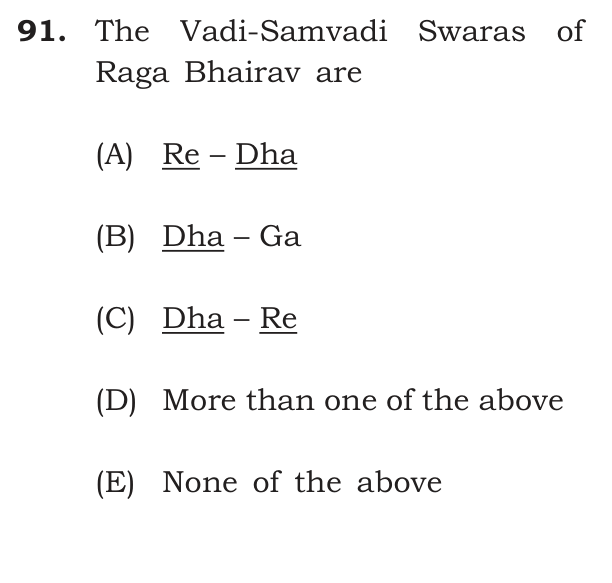
Show answerHide answer
Correct answer: (C)komal Dha – komal Reकोमल ध – कोमल रे
Explanation
In Raga Bhairav the vadi is komal Dha and the samvadi is komal Re, as option (C) shows.राग भैरव में वादी कोमल ध और संवादी कोमल रे है, जैसा विकल्प (C) में दिखाया गया है।
DMore than one of the aboveउपर्युक्त में से एक से अधिक
ENone of the aboveउपर्युक्त में से कोई नहीं
Show answerHide answer
Correct answer: (A)Audav – Shadavऔडव – षाडव
Explanation
In the commonly taught form of Raga Kedar, Re and Ga are omitted in the ascent (Sa Ma, Ma Pa, Dha Pa, Ni Dha Sa: five notes) and Ga is weak or omitted in the descent (six notes), so its jati is Audav-Shadav.राग केदार के प्रचलित रूप में आरोह में रे और ग वर्जित हैं (सा म, म प, ध प, नि ध सा: पाँच स्वर) और अवरोह में ग दुर्बल या वर्जित है (छह स्वर), इसलिए इसकी जाति औडव-षाडव है।
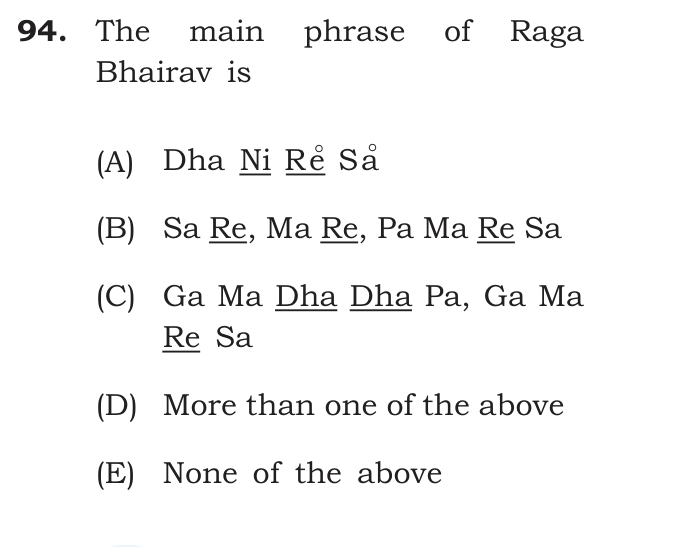
BSa komal-Re, Ma komal-Re, Pa Ma komal-Re Saसा कोमल-रे, म कोमल-रे, प म कोमल-रे सा
CGa Ma komal-Dha komal-Dha Pa, Ga Ma komal-Re Saग म कोमल-ध कोमल-ध प, ग म कोमल-रे सा
DMore than one of the aboveउपर्युक्त में से एक से अधिक
ENone of the aboveउपर्युक्त में से कोई नहीं
Show answerHide answer
Correct answer: (C)Ga Ma komal-Dha komal-Dha Pa, Ga Ma komal-Re Saग म कोमल-ध कोमल-ध प, ग म कोमल-रे सा
Explanation
The pakad of Bhairav is 'Ga Ma Dha Dha Pa, Ga Ma Re Re Sa' with komal Dha and komal Re, as in option (C).भैरव का पकड़ 'ग म ध ध प, ग म रे रे सा' है, जिसमें कोमल ध और कोमल रे हैं, जैसा विकल्प (C) में है।
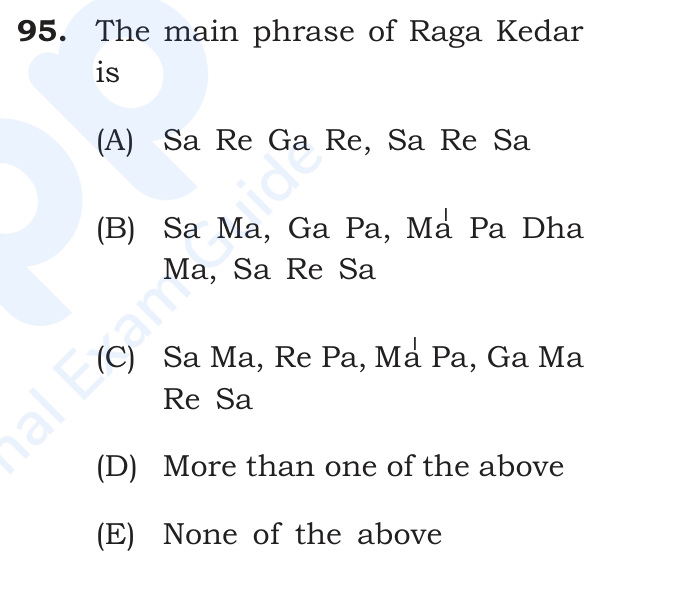
BSa Ma, Ga Pa, tivra-Ma Pa Dha Ma, Sa Re Saसा म, ग प, तीव्र-म प ध म, सा रे सा
CSa Ma, Re Pa, tivra-Ma Pa, Ga Ma Re Saसा म, रे प, तीव्र-म प, ग म रे सा
DMore than one of the aboveउपर्युक्त में से एक से अधिक
ENone of the aboveउपर्युक्त में से कोई नहीं
Show answerHide answer
Correct answer: (B)Sa Ma, Ga Pa, tivra-Ma Pa Dha Ma, Sa Re Saसा म, ग प, तीव्र-म प ध म, सा रे सा
Explanation
The characteristic phrase of Raga Kedar is 'Sa Ma, Ga Pa, tivra Ma Pa Dha Pa Ma, Sa Re Sa', which matches option (B).राग केदार का विशिष्ट स्वर-समूह 'सा म, ग प, तीव्र म प ध प म, सा रे सा' है, जो विकल्प (B) से मेल खाता है।
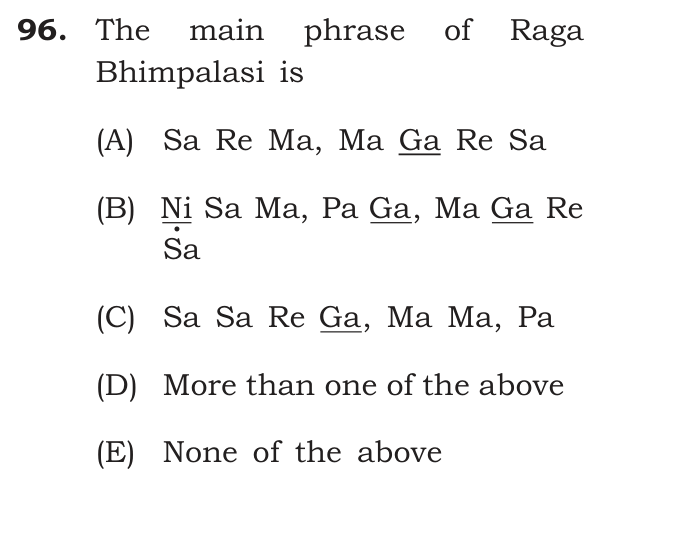
ASa Re Ma, Ma komal-Ga Re Saसा रे म, म कोमल-ग रे सा
Bmandra-komal-Ni Sa Ma, Pa komal-Ga, Ma komal-Ga Re Saमंद्र-कोमल-नि सा म, प कोमल-ग, म कोमल-ग रे सा
CSa Sa Re komal-Ga, Ma Ma, Paसा सा रे कोमल-ग, म म, प
DMore than one of the aboveउपर्युक्त में से एक से अधिक
ENone of the aboveउपर्युक्त में से कोई नहीं
Show answerHide answer
Correct answer: (B)mandra-komal-Ni Sa Ma, Pa komal-Ga, Ma komal-Ga Re Saमंद्र-कोमल-नि सा म, प कोमल-ग, म कोमल-ग रे सा
Explanation
The pakad of Bhimpalasi is 'mandra komal Ni Sa Ma, Pa komal Ga, Ma komal Ga Re Sa', as in option (B).भीमपलासी का पकड़ 'मंद्र कोमल नि सा म, प कोमल ग, म कोमल ग रे सा' है, जैसा विकल्प (B) में है।
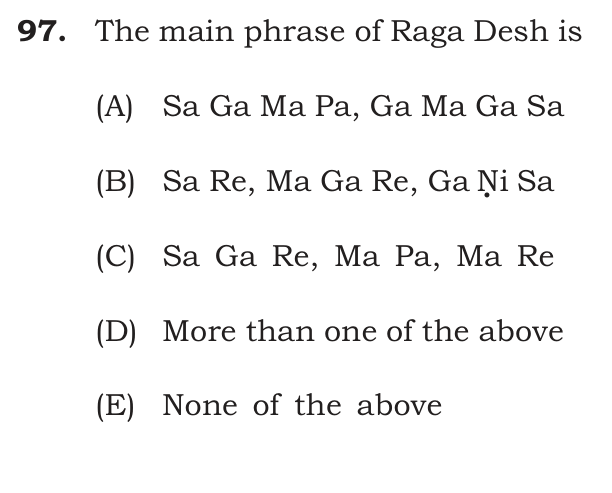
BSa Re, Ma Ga Re, Ga mandra-Ni Saसा रे, म ग रे, ग मंद्र-नि सा
CSa Ga Re, Ma Pa, Ma Reसा ग रे, म प, म रे
DMore than one of the aboveउपर्युक्त में से एक से अधिक
ENone of the aboveउपर्युक्त में से कोई नहीं
Show answerHide answer
Correct answer: (B)Sa Re, Ma Ga Re, Ga mandra-Ni Saसा रे, म ग रे, ग मंद्र-नि सा
Explanation
Raga Desh is recognised by the phrase 'Re Ma Ga Re, Ga Ni Sa' (descending Ma Ga Re and then Ga to mandra Ni Sa). Option (B) 'Sa Re, Ma Ga Re, Ga mandra-Ni Sa' is this pakad.राग देस की पहचान 'रे म ग रे, ग नि सा' स्वर-समूह से होती है (अवरोह में म ग रे और फिर ग से मंद्र नि सा)। विकल्प (B) 'सा रे, म ग रे, ग मंद्र नि सा' यही पकड़ है।
Bmandra-Ni Sa, Ga tivra-Ma Pa, tivra-Ma Ga, tivra-Ma Ga Re Saमंद्र-नि सा, ग तीव्र-म प, तीव्र-म ग, तीव्र-म ग रे सा
Cmandra-Ni Sa, Ga Ma Pa, Ga Ma Ga, Re Saमंद्र-नि सा, ग म प, ग म ग, रे सा
DMore than one of the aboveउपर्युक्त में से एक से अधिक
ENone of the aboveउपर्युक्त में से कोई नहीं
Show answerHide answer
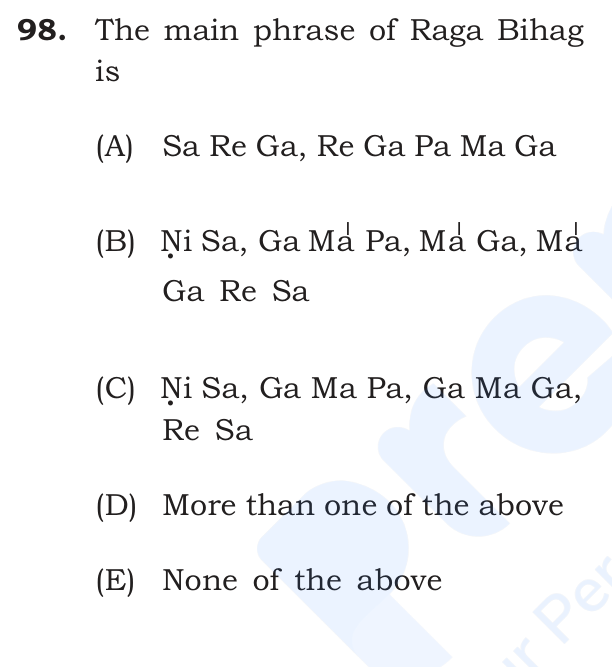
Correct answer: (C)mandra-Ni Sa, Ga Ma Pa, Ga Ma Ga, Re Saमंद्र-नि सा, ग म प, ग म ग, रे सा
Explanation
The pakad of Bihag is 'mandra Ni Sa, Ga Ma Pa, Ga Ma Ga, Re Sa' with shuddha Ma, as in option (C).बिहाग का पकड़ 'मंद्र नि सा, ग म प, ग म ग, रे सा' है, जिसमें शुद्ध म है, जैसा विकल्प (C) में है।
How many Matras are there in Taal Tilwada?ताल तिलवाड़ा में कितनी मात्राएँ हैं?
ATwelveबारह
BFifteenपंद्रह
CSixteenसोलह
DMore than one of the aboveउपर्युक्त में से एक से अधिक
ENone of the aboveउपर्युक्त में से कोई नहीं
Show answerHide answer
Correct answer: (C)Sixteenसोलह
Explanation
Tilwada taal has 16 matras divided into four vibhags of 4 each (like Teentaal, but with a different theka).तिलवाड़ा ताल में 16 मात्राएँ हैं, जो चार-चार मात्राओं के चार विभागों में बँटी हैं (तीनताल जैसी, पर ठेका अलग)।
What is the correct sequence of the Matras in four divisions of Taal Dhamar?ताल धमार के चार विभागों में मात्राओं का सही क्रम है
A4–3–5–24–3–5–2
B5–2–3–45–2–3–4
C5–4–3–25–4–3–2
DMore than one of the aboveउपर्युक्त में से एक से अधिक
ENone of the aboveउपर्युक्त में से कोई नहीं
Show answerHide answer
Correct answer: (B)5–2–3–45–2–3–4
Explanation
Dhamar taal has 14 matras divided into four vibhags of 5, 2, 3 and 4 matras.धमार ताल में 14 मात्राएँ हैं, जो 5, 2, 3 और 4 मात्राओं के चार विभागों में बँटी हैं।
What is the synonym for Alankar in Music?संगीत में अलंकार के लिए प्रयुक्त होने वाला पर्यायी शब्द है
ATukdaटुकड़ा
BMukhdaमुखड़ा
CPaltaपलटा
DMore than one of the aboveउपर्युक्त में से एक से अधिक
ENone of the aboveउपर्युक्त में से कोई नहीं
Show answerHide answer
Correct answer: (C)Paltaपलटा
Explanation
An alankar is also called a palta: a fixed pattern of swaras practised up and down the scale.अलंकार को पलटा भी कहते हैं: स्वरों का एक निश्चित रूप, जिसका सप्तक में ऊपर-नीचे अभ्यास किया जाता है।
On which Matra is the Khali in Taal Rupak?ताल रूपक में खाली किस मात्रा पर है?
AFourthचौथी
BSixthछठी
CFirstपहली
DMore than one of the aboveउपर्युक्त में से एक से अधिक
ENone of the aboveउपर्युक्त में से कोई नहीं
Show answerHide answer
Correct answer: (C)Firstपहली
Explanation
Rupak taal has 7 matras (3-2-2) and, unusually, its first matra (sam) is shown as khali.रूपक ताल में 7 मात्राएँ (3-2-2) होती हैं और, असामान्य रूप से, इसकी पहली मात्रा (सम) खाली से दिखाई जाती है।
In whose regime the Dhrupad genre got popularized?ध्रुपद शैली का प्रसार किसके शासनकाल में हुआ?
AAkbarअक़बर
BShah Jahanशाहजहाँ
CMan Singh Tomarमान सिंह तोमर
DMore than one of the aboveउपर्युक्त में से एक से अधिक
ENone of the aboveउपर्युक्त में से कोई नहीं
Show answerHide answer
Correct answer: (C)Man Singh Tomarमान सिंह तोमर
Explanation
Dhrupad was developed and popularised in the court of Raja Man Singh Tomar of Gwalior (late 15th - early 16th century).ध्रुपद का विकास और प्रसार ग्वालियर के राजा मानसिंह तोमर (15वीं शताब्दी के अंत से 16वीं के आरंभ) के दरबार में हुआ।
How many Banis are there in Dhrupad?ध्रुपद की कितनी बानियाँ हैं?
AFourचार
BEightआठ
CTwelveबारह
DMore than one of the aboveउपर्युक्त में से एक से अधिक
ENone of the aboveउपर्युक्त में से कोई नहीं
Show answerHide answer
Correct answer: (A)Fourचार
Explanation
Dhrupad has four banis (styles): Gauhar (Gobarhari), Khandar, Nauhar and Dagar.ध्रुपद की चार बानियाँ (शैलियाँ) हैं: गौहर (गोबरहारी), खंडार, नौहार और डागर।
The alternative word for Dhamar style of singing isधमार गायन शैली का अन्य नाम है
AThumriठुमरी
BTappaटप्पा
CHoriहोरी
DMore than one of the aboveउपर्युक्त में से एक से अधिक
ENone of the aboveउपर्युक्त में से कोई नहीं
Show answerHide answer
Correct answer: (C)Horiहोरी
Explanation
Dhamar songs mostly describe Holi, Krishna and the Gopis playing with colours, so the Dhamar style is also called Hori.धमार के गीतों में अधिकतर होली, कृष्ण और गोपियों के रंग खेलने का वर्णन होता है, इसलिए धमार शैली को होरी भी कहा जाता है।
What is not included in a Tarana?तराने में क्या प्रयुक्त नहीं होता?
ALyrics of Bandishबंदिश के बोल
BSyllables of Tablaतबले के बोल
CNom-Tom, Da-Dir syllablesनोम-तोम, दा-दिर के बोल
DMore than one of the aboveउपर्युक्त में से एक से अधिक
ENone of the aboveउपर्युक्त में से कोई नहीं
Show answerHide answer
Correct answer: (A)Lyrics of Bandishबंदिश के बोल
Explanation
A tarana uses meaningless syllables like nom, tom, ta, na, dir, dani and sometimes tabla or pakhawaj bols; it does not have the meaningful lyrics of a bandish.तराना में नोम, तोम, ता, ना, दिर, दानी जैसे निरर्थक अक्षर और कभी-कभी तबला या पखावज के बोल होते हैं; इसमें बंदिश के सार्थक शब्द नहीं होते।
Who is believed to be the creator of Tarana?तराने का आविष्कारक किसे माना जाता है?
ATansenतानसेन
BAmir Khusrowअमीर ख़ुसरो
CSadarang-Adarangसदारंग-अदारंग
DMore than one of the aboveउपर्युक्त में से एक से अधिक
ENone of the aboveउपर्युक्त में से कोई नहीं
Show answerHide answer
Correct answer: (B)Amir Khusrowअमीर ख़ुसरो
Explanation
Tarana is traditionally credited to Amir Khusrow (13th-14th century), who used Persian-style syllables in place of words.तराना का रचयिता परंपरागत रूप से अमीर खुसरो (13वीं-14वीं शताब्दी) को माना जाता है, जिन्होंने शब्दों के स्थान पर फ़ारसी ढंग के अक्षरों का प्रयोग किया।
CGroup of Swaras indicating a Ragaराग दर्शक स्वरसमूह
DMore than one of the aboveउपर्युक्त में से एक से अधिक
ENone of the aboveउपर्युक्त में से कोई नहीं
Show answerHide answer
Correct answer: (C)Group of Swaras indicating a Ragaराग दर्शक स्वरसमूह
Explanation
Pakad is the small group of swaras that captures the identity of a raga, so that the raga can be recognised from it.पकड़ स्वरों का वह छोटा समूह है जो राग की पहचान करा देता है, जिससे राग को पहचाना जा सके।
How many Talis are there in Tala Kaharva?ताल कहरवा में कितनी तालियाँ हैं?
AOneएक
BTwoदो
CThreeतीन
DMore than one of the aboveउपर्युक्त में से एक से अधिक
ENone of the aboveउपर्युक्त में से कोई नहीं
Show answerHide answer
Correct answer: (A)Oneएक
Explanation
Kaharva taal has 8 matras in two vibhags (4-4): a taali on the 1st matra (sam) and a khali on the 5th. So it has one taali.कहरवा ताल में 8 मात्राएँ दो विभागों (4-4) में होती हैं: पहली मात्रा (सम) पर ताली और पाँचवीं पर खाली। इसलिए इसमें एक ताली है।
The total number of Shuddha and Vikrit Swaras in an octave isएक सप्तक में कुल शुद्ध एवं विकृत स्वरों की संख्या है
Asevenसात
Btwelveबारह
Csixteenसोलह
DMore than one of the aboveउपर्युक्त में से एक से अधिक
ENone of the aboveउपर्युक्त में से कोई नहीं
Show answerHide answer
Correct answer: (B)twelveबारह
Explanation
An octave has 7 shuddha swaras and 5 vikrit swaras (komal Re, Ga, Dha, Ni and tivra Ma), making 12 in all.एक सप्तक में 7 शुद्ध और 5 विकृत स्वर (कोमल रे, ग, ध, नि और तीव्र म) होते हैं, यानी कुल 12।
Apart from Khayal, in which genre was Ut. Bade Ghulam Ali Khan well-versed?उ॰ बड़े ग़ुलाम अली खाँ ख़्याल के अलावा किस शैली में पारंगत थे?
ANatya Sangeetनाट्य संगीत
BThumriठुमरी
CDhrupadध्रुपद
DMore than one of the aboveउपर्युक्त में से एक से अधिक
ENone of the aboveउपर्युक्त में से कोई नहीं
Show answerHide answer
Correct answer: (B)Thumriठुमरी
Explanation
Ustad Bade Ghulam Ali Khan of the Patiala gharana was famous both for khayal and for his Punjab-ang thumri.पटियाला घराने के उस्ताद बड़े ग़ुलाम अली खान ख्याल के साथ-साथ अपनी पंजाब अंग की ठुमरी के लिए भी प्रसिद्ध थे।
In which film did Ut. Bade Ghulam Ali Khan sing a song?उ॰ बड़े ग़ुलाम अली खाँ ने किस फ़िल्म के लिए गायन किया है?
ASur Sangamसुर-संगम
BMughal-E-Azamमुग़ल-ए-आज़म
CBaiju Bawraबैजू बावरा
DMore than one of the aboveउपर्युक्त में से एक से अधिक
ENone of the aboveउपर्युक्त में से कोई नहीं
Show answerHide answer
Correct answer: (B)Mughal-E-Azamमुग़ल-ए-आज़म
Explanation
Bade Ghulam Ali Khan sang 'Prem Jogan Ban Ke' and 'Shubh Din Aayo' (Raga Sohini and Rageshri) for the film Mughal-E-Azam (1960).बड़े ग़ुलाम अली खान ने फ़िल्म मुग़ल-ए-आज़म (1960) के लिए 'प्रेम जोगन बन के' और 'शुभ दिन आयो' (राग सोहनी और रागेश्री) गाए।
Raga Bihag belongs to which Thaat?राग बिहाग किस थाट का राग है?
AKafiकाफी
BPoorviपूर्वी
CBhairavभैरव
DMore than one of the aboveउपर्युक्त में से एक से अधिक
ENone of the aboveउपर्युक्त में से कोई नहीं
Show answerHide answer
Correct answer: (E)None of the aboveउपर्युक्त में से कोई नहीं
Explanation
Raga Bihag belongs to Bilawal thaat (in Bhatkhande's system). None of Kafi, Poorvi or Bhairav is correct.राग बिहाग बिलावल थाट (भातखंडे पद्धति में) का राग है। काफ़ी, पूर्वी और भैरव में से कोई विकल्प सही नहीं है।
What is the time to perform Raga Bihag?राग बिहाग की प्रस्तुति का समय क्या है?
AFirst Prahar of the nightरात्रि का प्रथम प्रहर
BFirst Prahar of the morningप्रातःकाल का प्रथम प्रहर
CFirst Prahar of the dayदिन का प्रथम प्रहर
DMore than one of the aboveउपर्युक्त में से एक से अधिक
ENone of the aboveउपर्युक्त में से कोई नहीं
Show answerHide answer
Correct answer: (E)None of the aboveउपर्युक्त में से कोई नहीं
Explanation
Raga Bihag is sung in the second prahar of the night (about 9 pm to midnight), so none of the given options is correct.राग बिहाग रात्रि के दूसरे प्रहर (लगभग रात 9 बजे से मध्यरात्रि तक) में गाया जाता है, इसलिए दिए गए विकल्पों में से कोई भी सही नहीं है।
DMore than one of the aboveउपर्युक्त में से एक से अधिक
ENone of the aboveउपर्युक्त में से कोई नहीं
Show answerHide answer
Correct answer: (B)Audav – Sampoornaऔडव – संपूर्ण
Explanation
Raga Desh omits Ga and Dha in the ascent (5 notes) and uses all seven in the descent, so its jati is Audav-Sampoorna.राग देस में आरोह में ग और ध वर्जित हैं (5 स्वर) और अवरोह में सातों स्वर लगते हैं, इसलिए इसकी जाति औडव-संपूर्ण है।
What is the Thaat of Raga Desh?राग देस का थाट कौन-सा है?
ABilawalबिलावल
BKhamajखमाज
CKafiकाफी
DMore than one of the aboveउपर्युक्त में से एक से अधिक
ENone of the aboveउपर्युक्त में से कोई नहीं
Show answerHide answer
Correct answer: (B)Khamajखमाज
Explanation
Raga Desh uses shuddha Ni in the ascent and komal Ni in the descent, and is placed in Khamaj thaat.राग देस में आरोह में शुद्ध नि और अवरोह में कोमल नि लगता है, और इसे खमाज थाट में रखा गया है।
Flautist Pannalal Ghosh received advanced training from Ustad Alauddin Khan of the Maihar gharana. The key gives (C).बाँसुरी वादक पन्नालाल घोष ने मैहर घराने के उस्ताद अलाउद्दीन खान से उच्च प्रशिक्षण प्राप्त किया। उत्तर कुंजी में (C) दिया गया है।
Ut. Faiyaz Khan belonged to which vocal Gharana?उ॰ फ़ैयाज़ खाँ किस घराने के गायक थे?
AKirana Gharanaकिराना घराना
BAgra Gharanaआगरा घराना
CPatiala Gharanaपटियाला घराना
DMore than one of the aboveउपर्युक्त में से एक से अधिक
ENone of the aboveउपर्युक्त में से कोई नहीं
Show answerHide answer
Correct answer: (B)Agra Gharanaआगरा घराना
Explanation
Ustad Faiyaz Khan ('Aftab-e-Mausiqui') was the leading singer of the Agra gharana.उस्ताद फ़ैयाज़ खान ('आफ़ताब-ए-मौसीक़ी') आगरा घराने के प्रमुख गायक थे।
Pt. Krishnarao Shankar Pandit belonged to which Gharana?पं॰ कृष्णराव शंकर पंडित किस घराने के थे?
AAgra Gharanaआगरा घराना
BRampur Gharanaरामपुर घराना
CGwalior Gharanaग्वालियर घराना
DMore than one of the aboveउपर्युक्त में से एक से अधिक
ENone of the aboveउपर्युक्त में से कोई नहीं
Show answerHide answer
Correct answer: (C)Gwalior Gharanaग्वालियर घराना
Explanation
Pandit Krishnarao Shankar Pandit was a leading singer of the Gwalior gharana, trained by his father Shankar Pandit.पंडित कृष्णराव शंकर पंडित ग्वालियर घराने के प्रमुख गायक थे, जिन्होंने अपने पिता शंकर पंडित से शिक्षा पाई।
Which one of the following is used in Tanpura making?तानपुरा वाद्य बनाने में निम्नलिखित में से किसका प्रयोग होता है?
ASoilमिट्टी
BIronलोहा
CTumbaतुंबा
DMore than one of the aboveउपर्युक्त में से एक से अधिक
ENone of the aboveउपर्युक्त में से कोई नहीं
Show answerHide answer
Correct answer: (C)Tumbaतुंबा
Explanation
The resonator of a tanpura is made from a dried gourd (tumba), joined to a wooden neck (dand).तानपुरा का अनुनादक (तुंबा) सूखी लौकी से बनता है, जो लकड़ी के डाँड से जुड़ा होता है।
Which one of the following is a part of Tanpura instrument?निम्नलिखित में से तानपुरा वाद्य से संबंधित भाग कौन-सा है?
APegखूँटी
BTuning Blockगट्टा
CMizrabमिज़राब
DMore than one of the aboveउपर्युक्त में से एक से अधिक
ENone of the aboveउपर्युक्त में से कोई नहीं
Show answerHide answer
Correct answer: (A)Pegखूँटी
Explanation
Pegs (khunti) are the tuning keys of the tanpura. A mizrab is the wire plectrum of the sitar, not a part of the tanpura.खूँटियाँ (खूँटी) तानपुरा की स्वर मिलाने की कीलें हैं। मिज़राब सितार का तार-वादन का छल्ला है, तानपुरा का भाग नहीं।
Under which one of the following is the Tabla categorized?तबला किस श्रेणी का वाद्य है?
AAvanaddha Vadyaअवनद्ध वाद्य
BGhana Vadyaघन वाद्य
CTantri Vadyaतंत्री वाद्य
DMore than one of the aboveउपर्युक्त में से एक से अधिक
ENone of the aboveउपर्युक्त में से कोई नहीं
Show answerHide answer
Correct answer: (A)Avanaddha Vadyaअवनद्ध वाद्य
Explanation
The tabla is a drum with a skin stretched over it, so it is an Avanaddha vadya (membranophone).तबला एक ऐसा ताल-वाद्य है जिस पर चमड़ा मढ़ा होता है, इसलिए यह अवनद्ध वाद्य (झिल्ली वाद्य) है।
How many major parts the Tabla has?तबले के मुख्य कितने भाग हैं?
ATwoदो
BFourचार
CEightआठ
DMore than one of the aboveउपर्युक्त में से एक से अधिक
ENone of the aboveउपर्युक्त में से कोई नहीं
Show answerHide answer
Correct answer: (A)Twoदो
Explanation
The tabla has two main parts: the dayan (right-hand drum, also called tabla) and the bayan (left-hand drum, duggi).तबले के दो मुख्य भाग हैं: दायाँ (दाहिने हाथ का, जिसे तबला भी कहते हैं) और बायाँ (बाएँ हाथ का, डुग्गी)।
DMore than one of the aboveउपर्युक्त में से एक से अधिक
ENone of the aboveउपर्युक्त में से कोई नहीं
Show answerHide answer
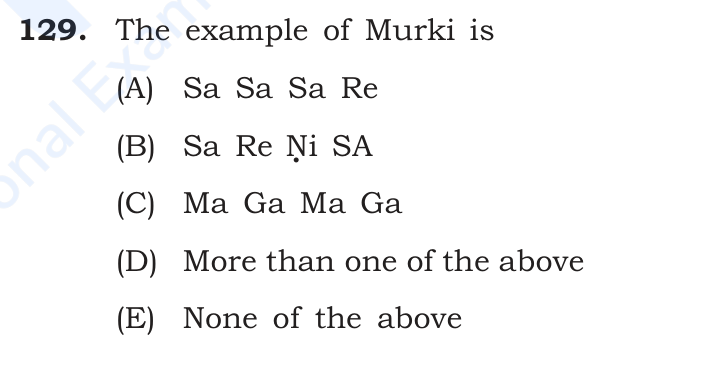
Correct answer: (B)Sa Re mandra-Ni Saसा रे मंद्र-नि सा
Explanation
Murki is a quick, light ornament in which a few swaras are touched rapidly around a note, like 'Sa Re mandra Ni Sa' in option (B).मुर्की एक तेज़, हल्का अलंकरण है जिसमें किसी स्वर के आसपास कुछ स्वरों को शीघ्रता से छुआ जाता है, जैसे विकल्प (B) में 'सा रे मंद्र नि सा'।
What is the meaning of Aalap?आलाप का क्या अर्थ है?
APeshkarपेशकार
BGroup of Swaras in slow tempoविलंबित गति के स्वरसमूह
CGroup of Swaras in fast tempoद्रुत गति के स्वरसमूह
DMore than one of the aboveउपर्युक्त में से एक से अधिक
ENone of the aboveउपर्युक्त में से कोई नहीं
Show answerHide answer
Correct answer: (B)Group of Swaras in slow tempoविलंबित गति के स्वरसमूह
Explanation
Aalap is the slow, unmetred elaboration of a raga using groups of swaras in slow tempo.आलाप राग का धीमी गति में स्वर-समूहों द्वारा किया जाने वाला, ताल-रहित विस्तार है।
The unit of measuring time in music isसंगीत में समय मापने की इकाई है
ALayaलय
BTaalताल
CGatगत
DMore than one of the aboveउपर्युक्त में से एक से अधिक
ENone of the aboveउपर्युक्त में से कोई नहीं
Show answerHide answer
Correct answer: (B)Taalताल
Explanation
The key treats Taal as the measure of time in music: a taal is a fixed cycle of matras by which musical time is measured.उत्तर कुंजी ताल को संगीत में समय मापने की इकाई मानती है: ताल मात्राओं का एक निश्चित चक्र है जिससे संगीत का समय मापा जाता है।
Which one of the following is the correct sign of Murki according to Bhatkhande Notation system?भातखंडे स्वरलिपि के अनुसार मुर्की का सही चिह्न कौन-सा है?
A“Sa”“सा”
B^Sa^^सा^
C(Sa)(सा)
DMore than one of the aboveउपर्युक्त में से एक से अधिक
ENone of the aboveउपर्युक्त में से कोई नहीं
Show answerHide answer
Correct answer: (C)(Sa)(सा)
Explanation
In Bhatkhande notation a murki is written by putting the swara in round brackets, e.g. (Sa), which stands for a quick turn around that note.भातखंडे स्वरलिपि में मुर्की स्वर को गोल कोष्ठक में रखकर लिखी जाती है, जैसे (सा), जो उस स्वर के आसपास तेज़ घुमाव को दर्शाता है।
What is the period of Sangeet Parijat text?संगीत पारिजात किस काल का ग्रंथ है?
AAadi Kaalआदि काल
BMadhya Kaalमध्य काल
CAadhunik Kaalआधुनिक काल
DMore than one of the aboveउपर्युक्त में से एक से अधिक
ENone of the aboveउपर्युक्त में से कोई नहीं
Show answerHide answer
Correct answer: (B)Madhya Kaalमध्य काल
Explanation
Sangeet Parijat (17th century) belongs to the medieval period (Madhya Kaal) of Indian music history.संगीत पारिजात (17वीं शताब्दी) भारतीय संगीत के इतिहास के मध्यकाल का ग्रंथ है।
DMore than one of the aboveउपर्युक्त में से एक से अधिक
ENone of the aboveउपर्युक्त में से कोई नहीं
Show answerHide answer
Correct answer: (A)Swarस्वर से
Explanation
Kan (kan swar or sparsh swar) is a grace note: a swara touched lightly before or after the main swara. So it is related to swar.कण (कण स्वर या स्पर्श स्वर) एक अलंकार-स्वर है: मुख्य स्वर से पहले या बाद में हल्के से छुआ जाने वाला स्वर। इसलिए यह स्वर से संबंधित है।
DMore than one of the aboveउपर्युक्त में से एक से अधिक
ENone of the aboveउपर्युक्त में से कोई नहीं
Show answerHide answer
Correct answer: (B)Ragaराग से
Explanation
Aaroh (ascent) and avaroh (descent) are features of a raga that define which notes it uses going up and down.आरोह (चढ़ाव) और अवरोह (उतार) राग के लक्षण हैं जो बताते हैं कि राग में ऊपर और नीचे जाते समय कौन-से स्वर लगते हैं।
Sangeet traditionally includes the three arts of geet (song), vadya (instrumental music) and nritya (dance).संगीत में परंपरागत रूप से तीन कलाएँ सम्मिलित हैं: गीत (गायन), वाद्य (वादन) और नृत्य।
ASa komal-Re komal-Ga Ma Pa Dha Niसा कोमल-रे कोमल-ग म प ध नि
BSa komal-Re komal-Ga Ma Pa komal-Dha Niसा कोमल-रे कोमल-ग म प कोमल-ध नि
CSa komal-Re komal-Ga Ma Pa komal-Dha komal-Niसा कोमल-रे कोमल-ग म प कोमल-ध कोमल-नि
DMore than one of the aboveउपर्युक्त में से एक से अधिक
ENone of the aboveउपर्युक्त में से कोई नहीं
Show answerHide answer
Correct answer: (C)Sa komal-Re komal-Ga Ma Pa komal-Dha komal-Niसा कोमल-रे कोमल-ग म प कोमल-ध कोमल-नि
Explanation
Bhairavi thaat uses komal Re, Ga, Dha and Ni with shuddha Ma, i.e. Sa, komal Re, komal Ga, Ma, Pa, komal Dha, komal Ni, as in option (C).भैरवी थाट में कोमल रे, ग, ध और नि तथा शुद्ध म लगते हैं, यानी सा, कोमल रे, कोमल ग, म, प, कोमल ध, कोमल नि, जैसा विकल्प (C) में है।
In which style are the compositions of Saint Tyagaraja?संत त्यागराज की रचनाएँ किस शैली में हैं?
AHindustani Sangeet styleहिंदुस्तानी संगीत शैली
BCarnatic Sangeet styleकर्नाटक संगीत शैली
COdissi Sangeet styleओडिसी संगीत शैली
DMore than one of the aboveउपर्युक्त में से एक से अधिक
ENone of the aboveउपर्युक्त में से कोई नहीं
Show answerHide answer
Correct answer: (B)Carnatic Sangeet styleकर्नाटक संगीत शैली
Explanation
Saint Tyagaraja (1767-1847) was one of the trinity of Carnatic music; his kritis are in the Carnatic style.संत त्यागराज (1767-1847) कर्नाटक संगीत की त्रिमूर्ति में से एक थे; उनकी कृतियाँ कर्नाटक संगीत शैली में हैं।
Which Taal is used with Dhrupad?ध्रुपद में किस ताल का प्रयोग किया जाता है?
ARupakरूपक
BChautalचौताल
CDadraदादरा
DMore than one of the aboveउपर्युक्त में से एक से अधिक
ENone of the aboveउपर्युक्त में से कोई नहीं
Show answerHide answer
Correct answer: (B)Chautalचौताल
Explanation
Dhrupad is sung mainly in Chautal (12 matras), and also in taals like Sooltaal and Teevra.ध्रुपद मुख्यतः चौताल (12 मात्राएँ) में गाया जाता है, और सूलताल तथा तीव्रा जैसे तालों में भी।
In Bihar, the historical narrative songs are calledऐतिहासिक वर्णन वाले गीतों को बिहार में कहा जाता है
AKuvar – Vijayकुवार-विजय
BMalharमल्हार
CSoharसोहर
DMore than one of the aboveउपर्युक्त में से एक से अधिक
ENone of the aboveउपर्युक्त में से कोई नहीं
Show answerHide answer
Correct answer: (A)Kuvar – Vijayकुवार-विजय
Explanation
In Bihar, historical narrative ballads (gathas) such as 'Kunwar Vijay' (on Babu Kunwar Singh) are sung. Malhar and Sohar are seasonal and birth songs.बिहार में ऐतिहासिक कथागीत (गाथाएँ) गाए जाते हैं, जैसे 'कुँवर विजय' (बाबू कुँवर सिंह पर)। मल्हार और सोहर क्रमशः ऋतु और जन्म के गीत हैं।
Which one is the Nihshabd Kriya of Taal?ताल में निःशब्द क्रिया कौन-सी है?
ASamसम
BTaaliताली
CKhaliखाली
DMore than one of the aboveउपर्युक्त में से एक से अधिक
ENone of the aboveउपर्युक्त में से कोई नहीं
Show answerHide answer
Correct answer: (C)Khaliखाली
Explanation
Khali is shown by a wave of the hand without a clap, so it is the soundless (nihshabd) action of a taal.खाली में हाथ की लहर से, बिना ताली के, दिखाई जाती है, इसलिए खाली ताल की निःशब्द क्रिया है।
CPandit Vishnu Narayan Bhatkhandeपंडित विष्णु नारायण भातखंडे
DMore than one of the aboveउपर्युक्त में से एक से अधिक
ENone of the aboveउपर्युक्त में से कोई नहीं
Show answerHide answer
Correct answer: (C)Pandit Vishnu Narayan Bhatkhandeपंडित विष्णु नारायण भातखंडे
Explanation
Pandit Vishnu Narayan Bhatkhande wrote some of his works under the pen names 'Chatur Pandit' (e.g. Lakshya Sangeet) and 'Vishnu Sharma'.पंडित विष्णु नारायण भातखंडे ने अपनी कुछ रचनाएँ 'चतुर पंडित' (जैसे लक्ष्य संगीत) और 'विष्णु शर्मा' उपनामों से लिखीं।
Which instrument is played to accompany Dhrupad-Dhamar?ध्रुपद-धमार की संगति में कौन-सा वाद्य बजाया जाता है?
APanavaपणव
BPakhawajपखावज
CDholakढोलक
DMore than one of the aboveउपर्युक्त में से एक से अधिक
ENone of the aboveउपर्युक्त में से कोई नहीं
Show answerHide answer
Correct answer: (B)Pakhawajपखावज
Explanation
Dhrupad and Dhamar are accompanied by the pakhawaj, a barrel-shaped two-headed drum.ध्रुपद और धमार के साथ पखावज की संगत होती है, जो दोनों ओर मुख वाला पीपे के आकार का ताल-वाद्य है।
Who categorized the Ragas of Hindustani music into Ten Thaats?हिंदुस्तानी रागों को दस थाटों में किसने वर्गीकृत किया?
APandit Omkarnath Thakurपंडित ओंकारनाथ ठाकुर
BPandit Vishnu Narayan Bhatkhandeपंडित विष्णु नारायण भातखंडे
CTansenतानसेन
DMore than one of the aboveउपर्युक्त में से एक से अधिक
ENone of the aboveउपर्युक्त में से कोई नहीं
Show answerHide answer
Correct answer: (B)Pandit Vishnu Narayan Bhatkhandeपंडित विष्णु नारायण भातखंडे
Explanation
Pandit Vishnu Narayan Bhatkhande grouped Hindustani ragas into ten thaats: Bilawal, Kalyan, Khamaj, Bhairav, Poorvi, Marwa, Kafi, Asavari, Bhairavi and Todi.पंडित विष्णु नारायण भातखंडे ने हिंदुस्तानी रागों को दस थाटों में बाँटा: बिलावल, कल्याण, खमाज, भैरव, पूर्वी, मारवा, काफ़ी, आसावरी, भैरवी और तोड़ी।
Who is the author of Kramik Pustak Malika?क्रमिक पुस्तक मालिका के लेखक कौन हैं?
APandit Sudarshan Shastriपंडित सुदर्शन शास्त्री
BPandit Sharangdevपंडित शारंगदेव
CPandit Vishnu Narayan Bhatkhandeपंडित विष्णु नारायण भातखंडे
DMore than one of the aboveउपर्युक्त में से एक से अधिक
ENone of the aboveउपर्युक्त में से कोई नहीं
Show answerHide answer
Correct answer: (C)Pandit Vishnu Narayan Bhatkhandeपंडित विष्णु नारायण भातखंडे
Explanation
Kramik Pustak Malika, the collection of bandishes in Bhatkhande notation, was compiled by Pandit Vishnu Narayan Bhatkhande.भातखंडे स्वरलिपि में बंदिशों का संग्रह क्रमिक पुस्तक मालिका पंडित विष्णु नारायण भातखंडे ने संकलित की।
What is the interval of Shrutis in Shadaj Gram?षड्ज ग्राम में श्रुतियों का अंतराल कितना है?
A4–3–4–2–4–3–24–3–4–2–4–3–2
B4–3–2–4–4–3–24–3–2–4–4–3–2
C4–2–3–4–4–3–24–2–3–4–4–3–2
DMore than one of the aboveउपर्युक्त में से एक से अधिक
ENone of the aboveउपर्युक्त में से कोई नहीं
Show answerHide answer
Correct answer: (B)4–3–2–4–4–3–24–3–2–4–4–3–2
Explanation
In Shadja grama the swaras have 4, 3, 2, 4, 4, 3 and 2 shrutis (Sa, Re, Ga, Ma, Pa, Dha, Ni), giving 22 in all, i.e. 4-3-2-4-4-3-2.षडज ग्राम में स्वरों (सा, रे, ग, म, प, ध, नि) में क्रमशः 4, 3, 2, 4, 4, 3 और 2 श्रुतियाँ होती हैं, कुल 22, यानी 4-3-2-4-4-3-2।
Which one of the following is not a Gram?निम्नलिखित में से कौन-सा ग्राम नहीं है?
AMadhyam Gramमध्यम ग्राम
BGandhar Gramगांधार ग्राम
CRishabh Gramऋषभ ग्राम
DMore than one of the aboveउपर्युक्त में से एक से अधिक
ENone of the aboveउपर्युक्त में से कोई नहीं
Show answerHide answer
Correct answer: (C)Rishabh Gramऋषभ ग्राम
Explanation
The ancient texts describe three gramas: Shadja, Madhyama and Gandhara. Rishabh grama is not one of them.प्राचीन ग्रंथों में तीन ग्राम बताए गए हैं: षडज, मध्यम और गांधार। ऋषभ ग्राम इनमें नहीं है।