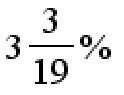
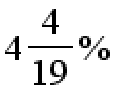
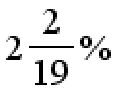
51 Profit & Loss (Mathematics) questions asked in RRB JE previous year papers, each with the correct answer and explanation. Read them free on UTpaper, or attempt the full papers as timed online tests.
By selling an article at 2/5 of its actual selling price, Ramesh incurs a loss of 16%. If he sells it at 86% of its actual selling price, then the profit percentage is:
A company earns a profit (in ₹) that is distributed among the company's three partners in the ratio of 4 : 12 : 5. If the difference between the smallest and the largest shares is ₹20208, the total profit (in ₹) of the company is:
A man sold an article for ₹360 by first giving a d% discount on its marked price, and then another discount having the same nominal value (in ₹). If the marked price of the article is ₹2250, then what is the value of d?
A, B and C invest sum in the ratio 76 : 37 : 52 respectively. If they earned total profit of ₹3850 at the end of year, then what is the difference between share of B and C?
A trader claims to sell flour at a profit of 35%, but also dishonestly uses a weight which is 16% less than what is mentioned on it. Find the total percentage of profit earned by the trader. (Round the answer to the nearest whole number.)
By selling an article at 5/14 of its actual selling price, Hitesh incurs a loss of 20%. If he sells it at 80% of its actual selling price, then the profit percentage is:
A shopkeeper sells an item for ₹770.7 after giving two successive discounts of 58% and 80% on its marked price. Had he not given any discount, he would have earned a profit of 25%. What is the cost price (in ₹) of the item?
A man sold an article for ₹687 by first giving a d% discount on its marked price, and then another discount having the same nominal value (in ₹). If the marked price of the article is ₹1145, then what is the value of d?
A trader claims to sell rice at a profit of 74%, but also dishonestly uses a weight which is 9% less than what is mentioned on it. Find the total percentage of profit earned by the trader. (Round the answer to the nearest whole number.)
Pooja and Ritu invest in a business in the ratio 4 : 1. If total profit is Rs. 1480, then what is difference between the profit (in Rs.) of Pooja and Ritu?
A shopkeeper lists the price of a fan at 25% above its cost price and offers a 10% discount on its list price. If he earns a profit of ₹117, then what is the list price (in ₹) of the fan?
A man sold an article for ₹533 by first giving a d% discount on its marked price, and then another discount having the same nominal value (in ₹). If the marked price of the article is ₹1025, then what is the value of d?
Amit purchased 10 kg of rice at the rate of ₹35 per kg and 39 kg of rice at ₹44 per kg. He sold the mixture at the rate of ₹42 per kg. Find his loss (in ₹).
A man sold an article for ₹330 by first giving a d% discount on its marked price, and then another discount having the same nominal value (in ₹). If the marked price of the article is ₹1320, then what is the value of d?
Mahesh purchased 10 kg of rice at the rate of ₹35 per kg and 38 kg of rice at ₹46 per kg. He sold the mixture at the rate of ₹43.5 per kg. Find his loss (in ₹).
A shopkeeper sells an item for ₹287.7 after giving two successive discounts of 86% and 85% on its marked price. Had he not given any discount, he would have earned a profit of 37%. What is the cost price (in ₹) of the item?
Sangeeta and Hemlata invest in a business in the ratio 1 : 3. If total profit is Rs. 2568, then what is difference between the profit (in Rs.) of Sangeeta and Hemlata?
By selling an article at 2/5 of its actual selling price, Manav incurs a loss of 27%. If he sells it at 84% of its actual selling price, then the profit percentage is:
A man sold an article for ₹390 by first giving a d% discount on its marked price, and then another discount having the same nominal value (in ₹). If the marked price of the article is ₹3900, then what is the value of d?
A man sold an article for ₹346 by first giving a d% discount on its marked price, and then another discount having the same nominal value (in ₹). If the marked price of the article is ₹1730, then what is the value of d?
A shopkeeper lists the price of a fan at 20% above its cost price and offers a 10% discount on its list price. If he earns a profit of ₹150, then what is the list price (in ₹) of the fan?
The list price of a refrigerator is ₹15,000. It is sold to a retailer after two successive
discounts of 32% and 40%. The retailer wants to earn a profit of 45% on his cost after
allowing a 49% discount (on its new list price) to the customer. At what price should he
list the refrigerator?
The ratio of the cost prices of articles X and Y is 1:2. A man earns a profit of 12% by
selling X and incurs a loss of 36% by selling Y. What is his overall gain or loss
percentage in the entire transaction?
A trader gives 8% discount on the marked price of an article and gives 3 articles free for
buying 18 articles and gains 38% in the entire transaction. Assuming a customer pays
for 18 articles, the marked price of an article is what percent more than its cost price?
The ratio of the cost prices of articles X and Y is 3 : 7. A man earns a profit of 49% by
selling X and loses 16% by selling Y. What is his gain/loss percentage in the entire
transaction?
A grocer wishes to sell a mixture of two varieties of rice worth ₹56 per kg. In what ratio
must he mix the rice to reach this selling price, when cost of one variety of rice is ₹54
per kg and the other is ₹64 per kg?
A total profit of ₹14,500 is to be distributed amongst A, B, and C such that A : B = 16 : 3
and B : C = 6 : 20. The share (in ₹) of C in the profit is:
The list price of a washing machine is ₹87,200. It is sold to a retailer after two
successive discounts of 9% and 50%. The retailer wants to earn a profit of 25% on his
cost after allowing a 48% discount (on its new list price) to the customer. At what price
should he list the washing machine?
A man bought two types of apples, one at ₹2 for 3 apples and the other at ₹6 per apple.
He purchased an equal number of each type and sold all the apples at ₹6 per apple.
Find his percentage profit.
A dishonest vendor claims that he is selling goods at their cost price. But he is
weighing 902 grams for 1000 grams. What is his profit percentage (rounded off to 2
decimal places)?
A store offers a trade discount of 16% on all items. In addition, they offer a “Buy four
get one free” scheme on specific items. If a customer purchases five items each marked
at ₹700 and the “Buy four get one free” scheme applies, what is the total discounted
price for five items, the customer has to pay?
Refer to the two statements given below and choose the CORRECT option.
Statement A: Poor storage conditions result in weight loss and discolouration of grains.
Statement B: Poor storage conditions enhance seed viability and grain texture.
AStatement A is incorrect but B is correct.
BBoth statements A and B are correct.
CBoth statements A and B are incorrect.
DStatement A is correct but B is incorrect.
Show answerHide answer
Correct answer: (D) Statement A is correct but B is incorrect.
By selling an article at 76% of its marked price, a trader makes a loss of 20%. What will
be the profit percentage, if he sells it at 99% of its marked price?
During a sale 50% of the goods are sold at 19% profit, 20% of the remaining goods are
sold at 40% profit and the still remaining goods are sold at a loss of 25%. If there is an
overall profit of x%, then what is the value of x?
A trader gives 10% discount on the marked price of an article and gives 40 articles free
for buying 112 articles and gains 26% in the entire transaction. Assuming a customer
pays for 112 articles, the marked price of an article is what percentage more than its
cost price?
In what ratio should sugar costing ₹38 per kg be mixed with sugar costing ₹55 per kg so
that by selling the mixture at ₹57.20 per kg, there is a profit of 10%?
A man bought two types of sharpeners, one at ₹18 for 9 sharpeners and the other at ₹8
per sharpener. He purchased an equal number of each type and sold all the sharpeners
at ₹8 per piece. Find his percentage profit.
A shopkeeper marks an article at ₹x and offers a discount of 50% on it. He sells it for
₹287 after charging VAT of 64% on the discounted price. What is the value of x?
A300
B200
C250
D350
Show answerHide answer
Correct answer: (D) 350
How to use these RRB JE Mathematics questions
Every question here was asked in a real RRB JE paper; the paper and shift are shown on the card, and the number opens the question on its own page. Try each one before tapping Show answer, then attempt the full RRB JE papers as timed tests to check your speed under exam conditions.