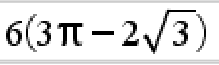
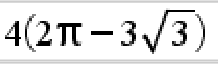
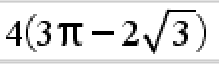
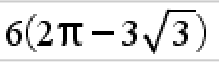
51 Mensuration (Mathematics) questions asked in RRB JE previous year papers, each with the correct answer and explanation. Read them free on UTpaper, or attempt the full papers as timed online tests.
AC is a chord of a circle. If X and Y are the two points on the circumference of the circle, lying on the same side of the chord AC such that ∠AXC = 58°, then what is the measure of 2∠AYC?
A solution has a pH of 8. If it is diluted with an equal volume of water, what will happen to its pH?
AThe pH will decrease.
BThe pH will increase.
CThe pH will remain the same.
DIt will become neutral.
Show answerHide answer
Correct answer: (D) It will become neutral.
Explanation
Official answer key: (4) It will become neutral.
Correct answer should be (1) The pH will decrease. Diluting a basic solution (pH 8) with an equal volume of water halves [OH⁻], so the pH falls to about 7.7. It moves towards 7 but does not become exactly neutral.
Scoring follows the official key.
A copper wire has a resistance of 10 Ω. If it is replaced with a wire of the same material and length but twice the cross-sectional area, its resistance will be ______.
In which year was 'Heirloom Treasures: The Cultural Tapestry of India: A Compilation of Selected Articles from India Beckons: Volume 1,' by Arunima Hoskote, published?
A wire of given material having length L and area of cross-section A has a resistance of 4 Ω. The resistance of another wire of the same material having length
L/2 will be:
The diameters of two concentric circles are 34 cm and 50 cm. A straight line, CAPF, intersects the larger circle at points C and F and intersects the smaller circle at points A and P. If AP = 16 cm, find the length of CF.
If 'M' is the smallest perfect square number, which is exactly divisible by 12, 15 and 18, then find the sum of the digits of the quotient obtained, when M is divided by 25.
What is the perimeter of a sector of a circle (in cm) if the radius of the circle is 10.5 cm and the angle subtended at the centre of the circle is 60°? (Use π = 22/7)
A cylindrical rod has an outer curved surface area of 4500 cm². If the length of the rod is 39 cm, then the outer radius (in cm) of the rod, correct to two places of decimal, is: (Take π = 22/7)
The length of each of the two equal sides of an isosceles triangle is 89 cm each and the length of its base is 78 cm. The area (in cm²) of the triangle is:
A wire has a resistance of R. If its length is increased by a factor of 8 and its cross-sectional area is decreased by a factor of 4, what is its new resistance (R')?
PN is a secant intersecting a circle at points M and N such that PN > PM. A tangent PT is drawn to the circle touching it at T. If PM = 32 cm and PT = 40 cm, what is the length (in cm) of the chord MN?
The length of each of the two equal sides of an isosceles triangle is 100 cm each and the length of its base is 56 cm. The area (in cm²) of the triangle is:
A regular hexagon is inscribed in a circle. If the length of the shortest diagonal of the
hexagon is 12 cm, find one-sixth of the area (in cm²) of the region lying between the
circle and the hexagon.
A wire of a given material has length l and cross-sectional area A , and its resistance is
9 Ω. Another wire of the same material has length l/3 and cross-sectional area 3A. What
will be the resistance of the second wire?
The lengths of the three sides of a triangle are 13 cm, 14 cm and 15 cm, respectively.
Find the area (in cm²) of the incircle of this triangle. [Use π = 3.14]
Choose the correct statements about triangles from the ones given below:
A. A triangle can be formed with sides 9 cm, 13 cm, 3 cm.
B. In ∆PQR, if ∠P =50°, ∠Q = 30°, then QR is the longest side of the triangle.
C. Area of an equilateral triangle of side 6 cm is 18√3 cm².
D. In ∆DEF and ∆PQR, ∠D = ∠P, ∠E = ∠Q and DF = PR. Then ∆DEF is congruent to
∆PQR.
The length of a cuboid is three times its height, and the breadth is twice the height. If
the height is (x² + 2) cm, find the lateral surface area of the cuboid at x = 2.
Which of the following arrangements produces a nearly uniform magnetic field in the
central region of a circular current-carrying system under steady conditions?
AUsing loops of varying radii
BUsing multiple closely wound turns of identical radius with constant current
CArranging loops in random orientations
DAllowing current to vary with time in a single loop
Show answerHide answer
Correct answer: (B) Using multiple closely wound turns of identical radius with constant current
Let C be a circle with centre O, and R be an external point to C. Let RP and RQ be two
tangents to circle C with P and Q being the points of tangency, respectively. If ∠PRQ =
60°, then find ∠POQ.
Let C be a circle with center O. Let AB be a tangent to C, such that AB touches the circle
at P. Let X and Y be any two points on C. If ∠APX = 60° and ∠BPY = 30°, find ∠PYX and
∠PXY, respectively.
A60°, 30°
B90°, 30°
C90°, 60°
D30°, 60°
Show answerHide answer
Correct answer: (A) 60°, 30°
How to use these RRB JE Mathematics questions
Every question here was asked in a real RRB JE paper; the paper and shift are shown on the card, and the number opens the question on its own page. Try each one before tapping Show answer, then attempt the full RRB JE papers as timed tests to check your speed under exam conditions.