240 Music questions asked in BPSC TRE previous year papers, each with the correct answer and explanation. Read them free on UTpaper, or attempt the full papers as timed online tests.
DMore than one of the aboveउपर्युक्त में से एक से अधिक
ENone of the aboveउपर्युक्त में से कोई नहीं
Show answerHide answer
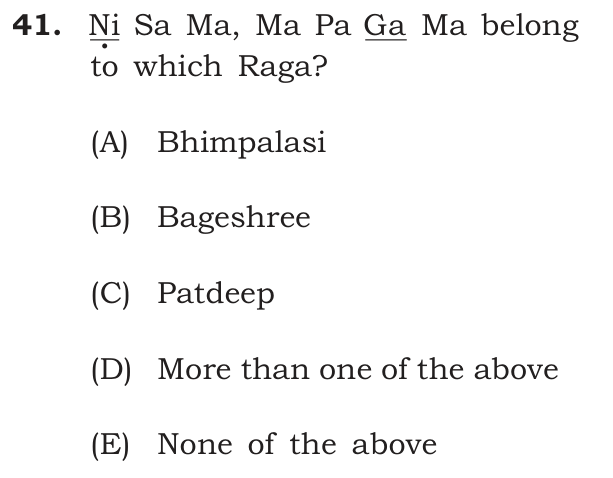
Correct answer: (A)Bhimpalasiभीमपलासी
Explanation
Bhimpalasi (Kafi thaat) uses komal Ga and komal Ni, and its characteristic phrases include mandra komal Ni Sa Ma and Ma Pa Ga Ma. Bageshree also has komal Ga-Ni but avoids this Pa-Ga-Ma movement, while Patdeep has shuddha Ni.भीमपलासी (काफ़ी थाट) में कोमल ग और कोमल नि लगते हैं, और इसके प्रमुख स्वर-समूहों में मंद्र सप्तक का कोमल नि सा म तथा म प ग म शामिल हैं। बागेश्री में भी कोमल ग-नि हैं, पर उसमें यह प-ग-म वाली चाल नहीं आती, जबकि पटदीप में शुद्ध नि होता है।
DMore than one of the aboveउपर्युक्त में से एक से अधिक
ENone of the aboveउपर्युक्त में से कोई नहीं
Show answerHide answer
Correct answer: (D)More than one of the aboveउपर्युक्त में से एक से अधिक
Explanation
Varna is the act of singing; Sanchari Varna is the mixed movement in which the melody both ascends and descends and also dwells on notes (a combination of Sthayi, Arohi and Avarohi). As it involves both ascending and descending orders of swaras, more than one option is correct.वर्ण गाने की क्रिया है; संचारी वर्ण वह मिश्रित गति है जिसमें स्वर-रचना आरोह और अवरोह दोनों में चलती है और कुछ स्वरों पर ठहरती भी है (स्थायी, आरोही और अवरोही का मेल)। इसमें स्वरों का आरोही और अवरोही दोनों क्रम आते हैं, इसलिए एक से अधिक विकल्प सही हैं।
Which Varna is found in Alankaras?अलंकार में कौन-सा वर्ण प्राप्त होता है?
AArohiआरोही
BAvarohiअवरोही
CSthayiस्थायी
DMore than one of the aboveउपर्युक्त में से एक से अधिक
ENone of the aboveउपर्युक्त में से कोई नहीं
Show answerHide answer
Correct answer: (D)More than one of the aboveउपर्युक्त में से एक से अधिक
Explanation
Alankaras (paltas) are sung first in the ascending order and then in the descending order, so both Arohi and Avarohi Varnas are found in them. Hence more than one option is correct.अलंकार (पलटे) पहले आरोह में और फिर अवरोह में गाए जाते हैं, इसलिए उनमें आरोही और अवरोही दोनों वर्ण पाए जाते हैं। अतः एक से अधिक विकल्प सही हैं।
From which Gram the Shruti arrangement 4-3-2-4-3-4-2 is related?4-3-2-4-3-4-2 श्रुति व्यवस्था किस ग्राम से सम्बन्धित है?
AShadaj Gramषडज ग्राम
BMadhyam Gramमध्यम ग्राम
CGandhar Gramगांधार ग्राम
DMore than one of the aboveउपर्युक्त में से एक से अधिक
ENone of the aboveउपर्युक्त में से कोई नहीं
Show answerHide answer
Correct answer: (B)Madhyam Gramमध्यम ग्राम
Explanation
In Madhyam Gram the shrutis are distributed as Sa 4, Re 3, Ga 2, Ma 4, Pa 3, Dha 4, Ni 2. Shadaj Gram differs only at Pa and Dha (Pa 4, Dha 3), giving 4-3-2-4-4-3-2.मध्यम ग्राम में श्रुतियों का बँटवारा इस प्रकार है: सा 4, रे 3, ग 2, म 4, प 3, ध 4, नि 2। षडज ग्राम में केवल प और ध पर अंतर है (प 4, ध 3), जिससे क्रम 4-3-2-4-4-3-2 बनता है।
Which Murchana of Madhyam Gram begins from Shadaj?मध्यम ग्राम की कौन-सी मूर्च्छना षडज से प्रारंभ हुई है?
ASauviriसौवीरी
BKalopnataकलोपनता
CShuddha Madhyamaशुद्ध मध्यमा
DMore than one of the aboveउपर्युक्त में से एक से अधिक
ENone of the aboveउपर्युक्त में से कोई नहीं
Show answerHide answer
Correct answer: (C)Shuddha Madhyamaशुद्ध मध्यमा
Explanation
The seven murchanas of Madhyam Gram are Sauviri (from Ma), Harinashva (Ga), Kalopnata (Re), Shuddha Madhya (Sa), Margi (Ni), Pauravi (Dha) and Hrishyaka (Pa). The one beginning from Shadaj is Shuddha Madhya.मध्यम ग्राम की सात मूर्च्छनाएँ हैं: सौवीरी (म से), हरिणाश्वा (ग से), कलोपनता (रे से), शुद्ध मध्या (सा से), मार्गी (नि से), पौरवी (ध से) और हृष्यका (प से)। षडज से आरंभ होने वाली मूर्च्छना शुद्ध मध्या है।
According to Sarangdev (Sangeet Ratnakar), how many types of Gamakas are there on the basis of vibration (Kampa)?शारंगदेव (संगीत रत्नाकर) के अनुसार कंप के आधार पर गमक के कितने प्रकार माने गए हैं?
A44
B66
C1515
DMore than one of the aboveउपर्युक्त में से एक से अधिक
ENone of the aboveउपर्युक्त में से कोई नहीं
Show answerHide answer
Correct answer: (B)66
Explanation
Sharangadeva describes fifteen gamakas in Sangeet Ratnakar; the official key takes the classification based on the manner of shaking or vibration (kampa) of the swara as having 6 types.शारंगदेव ने संगीत रत्नाकर में पंद्रह गमक बताए हैं; आधिकारिक उत्तर कुंजी के अनुसार स्वर के कंपन या हिलाने के ढंग पर आधारित वर्गीकरण में 6 प्रकार माने गए हैं।
If one beat in one second is called Madhya Laya, then which Layakari comes by showing one beat in four seconds?अगर मध्य लय में एक सेकंड में एक मात्रा बोली जाती है तो चार सेकंड में एक मात्रा बोलने को कौन-सी लय कहेंगे?
AVilambitविलम्बित
BMadhyaमध्य
CDrutद्रुत
DMore than one of the aboveउपर्युक्त में से एक से अधिक
ENone of the aboveउपर्युक्त में से कोई नहीं
Show answerHide answer
Correct answer: (A)Vilambitविलम्बित
Explanation
If one beat per second is Madhya Laya, one beat in four seconds is four times slower, i.e. a very slow tempo, which falls under Vilambit Laya (strictly ati-vilambit).यदि मध्य लय में एक सेकंड में एक मात्रा बोली जाती है, तो चार सेकंड में एक मात्रा उससे चार गुनी धीमी है, यानी बहुत धीमी गति, जो विलम्बित लय में आती है (सही अर्थ में अति-विलम्बित)।
Murchana depends onमूर्च्छना किस पर आश्रित होती है?
ASwarस्वर
BGramग्राम
CShrutiश्रुति
DMore than one of the aboveउपर्युक्त में से एक से अधिक
ENone of the aboveउपर्युक्त में से कोई नहीं
Show answerHide answer
Correct answer: (B)Gramग्राम
Explanation
A murchana is the ordered ascending and descending of the seven swaras starting from a particular note of a Gram, so murchanas are defined in relation to the Gram (Shadaj Gram and Madhyam Gram each have seven).मूर्च्छना किसी ग्राम के एक निश्चित स्वर से आरंभ होकर सात स्वरों का क्रमबद्ध आरोह-अवरोह है, इसलिए मूर्च्छनाएँ ग्राम के आधार पर निर्धारित होती हैं (षडज ग्राम और मध्यम ग्राम की सात-सात मूर्च्छनाएँ हैं)।
What is the name of Taal having four Vibhagas?चार विभाग वाले ताल का नाम क्या है?
ATivraतीव्रा
BSultalसूलताल
CAda Chartaalआड़ा चारताल
DMore than one of the aboveउपर्युक्त में से एक से अधिक
ENone of the aboveउपर्युक्त में से कोई नहीं
Show answerHide answer
Correct answer: (E)None of the aboveउपर्युक्त में से कोई नहीं
Explanation
Tivra has three vibhagas (3+2+2), Sultal has five (2+2+2+2+2) and Ada Chautal has seven (2 each). None of these has four vibhagas, so the answer is none of the above.तीव्रा ताल में तीन विभाग (3+2+2), सूलताल में पाँच विभाग (2+2+2+2+2) और आड़ा चौताल में सात विभाग (प्रत्येक में 2 मात्राएँ) होते हैं। इनमें से किसी में भी चार विभाग नहीं हैं, इसलिए उत्तर 'उपर्युक्त में से कोई नहीं' है।
Which Taal have different numbers of beat in every Vibhaga?किस ताल के सभी विभागों में मात्राओं की संख्या भिन्नहोती है?
ATilwadaतिलवाड़ा
BJhaptaalझपताल
CDhamarधमार
DMore than one of the aboveउपर्युक्त में से एक से अधिक
ENone of the aboveउपर्युक्त में से कोई नहीं
Show answerHide answer
Correct answer: (C)Dhamarधमार
Explanation
Dhamar has 14 beats divided as 5+2+3+4, so every vibhaga has a different number of beats. Tilwada (4+4+4+4) and Jhaptaal (2+3+2+3) repeat their division sizes.धमार में 14 मात्राएँ 5+2+3+4 के विभागों में बँटी होती हैं, अतः हर विभाग में मात्राओं की संख्या अलग है। तिलवाड़ा (4+4+4+4) और झपताल (2+3+2+3) में विभागों की संख्याएँ दोहराई जाती हैं।
The similar Raga of Bhairav isभैरव का समप्रकृति राग है
ANat Bhairavनट भैरव
BKalingadaकलिंगडा
CAhir Bhairavअहीर भैरव
DMore than one of the aboveउपर्युक्त में से एक से अधिक
ENone of the aboveउपर्युक्त में से कोई नहीं
Show answerHide answer
Correct answer: (B)Kalingadaकलिंगडा
Explanation
Kalingada belongs to Bhairav thaat and uses the same swaras (komal Re and Dha), but with a lighter, less grave treatment, so it is regarded as the raga similar to Bhairav. Nat Bhairav and Ahir Bhairav are mixed ragas.कलिंगड़ा भैरव थाट का राग है और उसमें वही स्वर (कोमल रे और ध) लगते हैं, पर उसका स्वरूप अधिक हल्का और कम गंभीर है, इसलिए उसे भैरव का समप्रकृति राग माना जाता है। नट भैरव और अहीर भैरव मिश्र राग हैं।
In Sangeet Ratnakar, what has been explained in first fourteen Shlokas?संगीत रत्नाकर के प्रारंभिक चौदह श्लोकों में किसका वर्णन किया गया है?
AAbout Sangeet Ratnakarसंगीत रत्नाकर का
BAbout Authorलेखक का
CAbout Author and Patronलेखक व आश्रयदाता का
DMore than one of the aboveउपर्युक्त में से एक से अधिक
ENone of the aboveउपर्युक्त में से कोई नहीं
Show answerHide answer
Correct answer: (C)About Author and Patronलेखक व आश्रयदाता का
Explanation
The opening fourteen shlokas of Sangeet Ratnakar describe the author Sharangadeva, his family lineage and his patron, the Yadava king Singhana of Devagiri.संगीत रत्नाकर के आरंभिक चौदह श्लोकों में लेखक शारंगदेव, उनके वंश-परिचय और उनके आश्रयदाता, देवगिरि के यादव राजा सिंघण का वर्णन है।
Which Raga is an Afternoon Raga?कौन-सा राग मध्याह्नकालीन राग है?
AKedarकेदार
BDeshदेस
CBhimpalasiभीमपलासी
DMore than one of the aboveउपर्युक्त में से एक से अधिक
ENone of the aboveउपर्युक्त में से कोई नहीं
Show answerHide answer
Correct answer: (C)Bhimpalasiभीमपलासी
Explanation
Bhimpalasi is sung in the third prahar of the day, i.e. the afternoon. Kedar and Desh are night ragas.भीमपलासी दिन के तीसरे प्रहर, यानी दोपहर बाद, गाया जाता है। केदार और देस रात्रि के राग हैं।
According to Marg Ragas mentioned in Sangeet Ratnakar, how many number of Ragas are there in category of Raga?संगीत रत्नाकर में मार्ग रागों के अंतर्गत, राग वर्ग में रागों की संख्या कितनी है?
A1010
B2020
C3030
DMore than one of the aboveउपर्युक्त में से एक से अधिक
ENone of the aboveउपर्युक्त में से कोई नहीं
Show answerHide answer
Correct answer: (B)2020
Explanation
Sangeet Ratnakar classifies the marga ragas into grama ragas, uparagas, ragas, bhashas, vibhashas and antarbhashas; the category called 'raga' contains 20 ragas.संगीत रत्नाकर में मार्ग रागों को ग्राम राग, उपराग, राग, भाषा, विभाषा और अंतरभाषा में बाँटा गया है; 'राग' नामक श्रेणी में 20 राग हैं।
In which Grantha is Nishak Veena described?निशंक वीणा का उल्लेख किस ग्रन्थ में प्राप्त होता है?
ASangeet Ratnakarसंगीत रत्नाकर
BNatyashastraनाट्यशास्त्र
CSangeet Parijatसंगीत पारिजात
DMore than one of the aboveउपर्युक्त में से एक से अधिक
ENone of the aboveउपर्युक्त में से कोई नहीं | प ध प, म स्वर किस राग के सूचक हैं?
Show answerHide answer
Correct answer: (A)Sangeet Ratnakarसंगीत रत्नाकर
Explanation
Nishank (Nihshanka) was a title of Sharangadeva, and the Nishank Veena is described in his Sangeet Ratnakar, in the chapter on instruments.निःशंक (निःशंक) शारंगदेव की उपाधि थी, और निःशंक वीणा का वर्णन उनके ग्रंथ संगीत रत्नाकर में वाद्यों वाले अध्याय में मिलता है।
DMore than one of the aboveउपर्युक्त में से एक से अधिक
ENone of the aboveउपर्युक्त में से कोई नहीं
Show answerHide answer
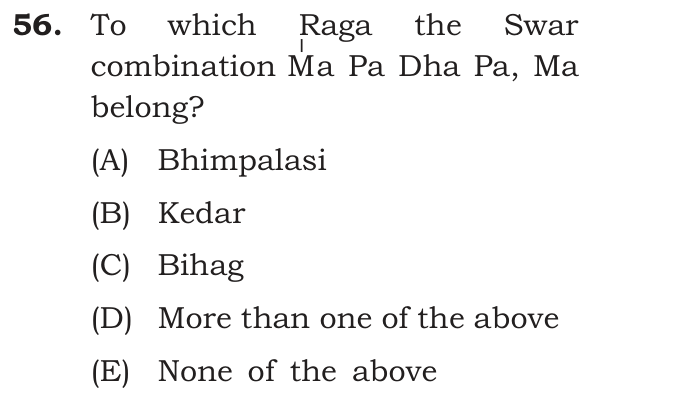
Correct answer: (B)Kedarकेदार
Explanation
Tivra Ma Pa Dha Pa followed by shuddha Ma is a characteristic phrase of Raga Kedar (Kalyan thaat), which uses both madhyams. Bhimpalasi uses only shuddha Ma.तीव्र म प ध प के बाद शुद्ध म, केदार राग (कल्याण थाट) का प्रमुख स्वर-समूह है, जिसमें दोनों मध्यम लगते हैं। भीमपलासी में केवल शुद्ध म लगता है।
From Vocal, Instrumental and Dance the description of which discipline is not found in Sangeet Parijat?संगीत पारिजात ग्रन्थ में गीत, वाद्य तथा नृत्य में से किसके अंश प्राप्त नहीं हुए हैं?
AVocalगीत
BInstrumentalवाद्य
CDanceनृत्य
DMore than one of the aboveउपर्युक्त में से एक से अधिक
ENone of the aboveउपर्युक्त में से कोई नहीं
Show answerHide answer
Correct answer: (C)Danceनृत्य
Explanation
Ahobal's Sangeet Parijat (17th century) deals with vocal music (swaras, ragas) and instrumental aspects such as fixing swaras on the veena string, but it does not describe dance.अहोबल के संगीत पारिजात (17वीं शताब्दी) में गायन (स्वर, राग) और वीणा के तार पर स्वर-स्थापना जैसे वाद्य-संबंधी विषयों का वर्णन है, पर नृत्य का वर्णन नहीं है।
Who is known as Chatur Pandit?चतुर पंडित किसे कहते हैं?
AVishnu Digambar Paluskarविष्णु दिगंबर पलुस्कर
BSharangadevaशारंगदेव
CBhatkhandeभातखंडे
DMore than one of the aboveउपर्युक्त में से एक से अधिक
ENone of the aboveउपर्युक्त में से कोई नहीं
Show answerHide answer
Correct answer: (C)Bhatkhandeभातखंडे
Explanation
Pt. Vishnu Narayan Bhatkhande wrote some of his works, such as Abhinav Raga Manjari and Lakshya Sangeet, under the pen name 'Chatur Pandit'.पं. विष्णु नारायण भातखंडे ने अपनी कुछ रचनाएँ, जैसे अभिनव राग मंजरी और लक्ष्य संगीत, 'चतुर पंडित' उपनाम से लिखीं।
Who is the author of Shrimallakshya Sangeetam?श्रीमल्लक्ष्य संगीतम्के लेखक कौन हैं?
ABhatkhandeभातखंडे
BVishnu Digambar Paluskarविष्णु दिगम्बर पलुस्कर
CRamamatyaरामामात्य
DMore than one of the aboveउपर्युक्त में से एक से अधिक
ENone of the aboveउपर्युक्त में से कोई नहीं
Show answerHide answer
Correct answer: (A)Bhatkhandeभातखंडे
Explanation
Shrimallakshya Sangeetam, the Sanskrit treatise that set out the ten-thaat system, was written by Pt. V. N. Bhatkhande under the name Chatur Pandit.श्रीमल्लक्ष्य संगीतम्, जिसमें दस थाटों की पद्धति प्रस्तुत की गई है, पं. वि. ना. भातखंडे ने 'चतुर पंडित' नाम से संस्कृत में लिखा।
Who is the annotator (Teekakaar) of Sangeet Ratnakar?संगीत रत्नाकर के टीकाकार कौन हैं?
ASingh Bhoopalसिंह भूपाल
BKallinathकल्लिनाथ
CShankukशंकुक
DMore than one of the aboveउपर्युक्त में से एक से अधिक
ENone of the aboveउपर्युक्त में से कोई नहीं
Show answerHide answer
Correct answer: (D)More than one of the aboveउपर्युक्त में से एक से अधिक
Explanation
Two well-known medieval commentaries exist on Sangeet Ratnakar: Sangeet Sudhakar by Singh Bhoopal and Kalanidhi by Kallinath. As both (A) and (B) are commentators, more than one option is correct.संगीत रत्नाकर की दो प्रसिद्ध मध्यकालीन टीकाएँ हैं: सिंह भूपाल की संगीत सुधाकर और कल्लिनाथ की कलानिधि। (A) और (B) दोनों टीकाकार हैं, इसलिए एक से अधिक विकल्प सही हैं।
In which Raga is the Komal Nishad used rarely?किस राग में कोमल निषाद का अल्प प्रयोग होता है?
ADeshदेस
BBhimpalasiभीमपलासी
CKedarकेदार
DMore than one of the aboveउपर्युक्त में से एक से अधिक
ENone of the aboveउपर्युक्त में से कोई नहीं
Show answerHide answer
Correct answer: (C)Kedarकेदार
Explanation
Raga Kedar uses both madhyams and mainly shuddha Ni; komal Ni appears only rarely, as a touch in the descent (Dha Ni Dha Pa). Desh and Bhimpalasi use komal Ni freely.केदार राग में दोनों मध्यम और मुख्यतः शुद्ध नि लगता है; कोमल नि अवरोह में (ध नि ध प) केवल स्पर्श के रूप में कभी-कभी आता है। देस और भीमपलासी में कोमल नि खुलकर प्रयोग होता है।
Ustad Abdul Karim Khan, along with Abdul Wahid Khan, is regarded as the founder and most famous singer of the Kirana Gharana. Bade Ghulam Ali Khan belonged to the Patiala Gharana.उस्ताद अब्दुल करीम खान, अब्दुल वहीद खान के साथ, किराना घराने के संस्थापक और सबसे प्रसिद्ध गायक माने जाते हैं। बड़े ग़ुलाम अली खान पटियाला घराने के थे।
Ustad Abdul Karim Khan founded the Arya Sangeet Vidyalaya in Pune in 1913. Paluskar founded the Gandharva Mahavidyalaya at Lahore (1901).उस्ताद अब्दुल करीम खान ने 1913 में पुणे में आर्य संगीत विद्यालय की स्थापना की। पलुस्कर ने लाहौर में गांधर्व महाविद्यालय (1901) की स्थापना की थी।
What is the name of famous vocalist of Agra Gharana?आगरा घराने के प्रसिद्ध गायक का नाम क्या है?
AAlladiya Khanअल्लादिया खाँ
BHafiz Ali Khanहाफ़िज़ अली खाँ
CFaiyaz Khanफैयाज़ खाँ
DMore than one of the aboveउपर्युक्त में से एक से अधिक
ENone of the aboveउपर्युक्त में से कोई नहीं
Show answerHide answer
Correct answer: (C)Faiyaz Khanफैयाज़ खाँ
Explanation
Ustad Faiyaz Khan, honoured with the title 'Aftab-e-Mausiqi', is the most famous vocalist of the Agra Gharana. Alladiya Khan founded the Jaipur-Atrauli Gharana and Hafiz Ali Khan was a sarod player.उस्ताद फ़ैयाज़ खान, जिन्हें 'आफ़ताब-ए-मौसीक़ी' की उपाधि मिली, आगरा घराने के सबसे प्रसिद्ध गायक हैं। अल्लादिया खान ने जयपुर-अतरौली घराने की स्थापना की और हाफ़िज़ अली खान सरोद वादक थे।
DMore than one of the aboveउपर्युक्त में से एक से अधिक
ENone of the aboveउपर्युक्त में से कोई नहीं
Show answerHide answer
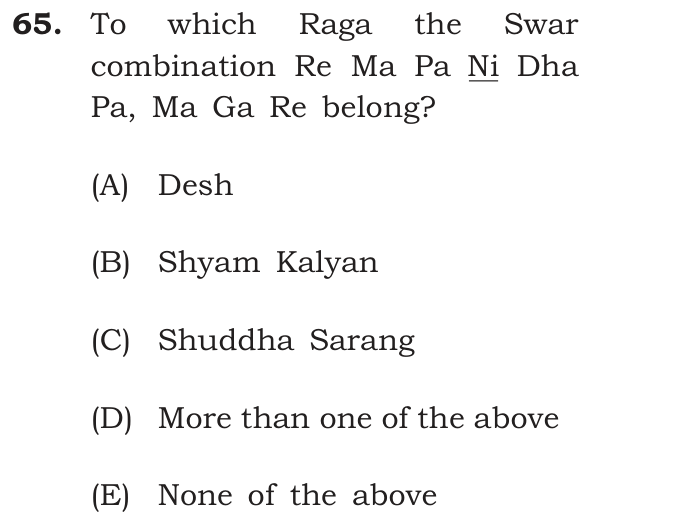
Correct answer: (A)Deshदेस
Explanation
The phrase Re Ma Pa Ni (komal) Dha Pa, Ma Ga Re is typical of Raga Desh (Khamaj thaat), which uses shuddha Ni in ascent and komal Ni in descent, with the Re-Ma-Pa and Ma-Ga-Re movements.रे म प नि (कोमल) ध प, म ग रे यह स्वर-समूह देस राग (खमाज थाट) का है, जिसमें आरोह में शुद्ध नि और अवरोह में कोमल नि लगता है, तथा रे-म-प और म-ग-रे की चाल आती है।
On which system is the Thaat classification of Bhatkhande based?भातखंडे जी की थाट पद्धति किस पर आधारित है?
AMukamमुकाम
BSansthanसंस्थान
CMelaमेल
DMore than one of the aboveउपर्युक्त में से एक से अधिक
ENone of the aboveउपर्युक्त में से कोई नहीं
Show answerHide answer
Correct answer: (C)Melaमेल
Explanation
Bhatkhande's ten-thaat system is based on the Mela system of South Indian music (Venkatamakhi's 72 melas), a thaat being the Hindustani equivalent of a mela.भातखंडे की दस थाट पद्धति दक्षिण भारतीय संगीत की मेल पद्धति (वेंकटमखी के 72 मेल) पर आधारित है; थाट हिंदुस्तानी संगीत में मेल के समान है।
In which chapter of Natyashastra is the wind instrument described?नाट्यशास्त्र में सुषिर वाद्यों का वर्णन किस अध्याय में किया गया है?
A3030
B3131
C3333
DMore than one of the aboveउपर्युक्त में से एक से अधिक
ENone of the aboveउपर्युक्त में से कोई नहीं
Show answerHide answer
Correct answer: (A)3030
Explanation
Bharata's Natyashastra discusses music in chapters 28-33; the sushir (wind) instruments such as the flute are described in chapter 30.भरत के नाट्यशास्त्र में संगीत का वर्णन अध्याय 28-33 में है; बाँसुरी जैसे सुषिर (फूँककर बजाए जाने वाले) वाद्यों का वर्णन अध्याय 30 में है।
What is the singing and playing time of Raga Desh?राग देस का गायन-वादन समय क्या है?
AFirst phase of nightरात्रि का प्रथम प्रहर
BSecond phase of nightरात्रि का दूसरा प्रहर
CThird phase of nightरात्रि का तीसरा प्रहर
DMore than one of the aboveउपर्युक्त में से एक से अधिक
ENone of the aboveउपर्युक्त में से कोई नहीं
Show answerHide answer
Correct answer: (B)Second phase of nightरात्रि का दूसरा प्रहर
Explanation
Raga Desh is performed in the second prahar of the night (about 9 p.m. to midnight).राग देस रात्रि के दूसरे प्रहर (लगभग रात 9 बजे से मध्यरात्रि तक) में गाया-बजाया जाता है।
Who is the author of Marifunnagmat?मारिफुन्नगमात के रचयिता कौन हैं?
ARaja Nawab Ali Khanरजा नवाब अली खाँ
BDaulat Ramदौलत राम
CRaja Khanरजा खाँ
DMore than one of the aboveउपर्युक्त में से एक से अधिक
ENone of the aboveउपर्युक्त में से कोई नहीं
Show answerHide answer
Correct answer: (A)Raja Nawab Ali Khanरजा नवाब अली खाँ
Explanation
Marifunnagmat, a well-known Urdu work on Hindustani music, was written by Raja Nawab Ali Khan of Akbarpur.मारिफ़ुन्नग़मात हिंदुस्तानी संगीत पर उर्दू का एक प्रसिद्ध ग्रंथ है, जिसे अकबरपुर के राजा नवाब अली खान ने लिखा।
In which King’s period the famous vocalist and Veena player Baiju became most famous?प्रसिद्ध गायक एवं वीणा वादक बैजू किस राजा के काल में अधिक प्रसिद्ध हुए?
ARaja Mansingh Tomarराजा मानसिंह तोमर
BMaharana Kumbhaमहाराणा कुम्भा
CGayasuddin Khiljiगयासुद्दीन खिलजी
DMore than one of the aboveउपर्युक्त में से एक से अधिक
Baiju (Baiju Bawra), the famous Dhrupad singer, flourished at the court of Raja Mansingh Tomar of Gwalior (late 15th to early 16th century).प्रसिद्ध ध्रुपद गायक बैजू (बैजू बावरा) ग्वालियर के राजा मानसिंह तोमर (15वीं शताब्दी के अंत से 16वीं शताब्दी के आरंभ) के दरबार में सबसे अधिक प्रसिद्ध हुए।
By what another name the Sangeet Ratnakar is known?संगीत रत्नाकर को किस अन्य नाम से जाना जाता है?
ASaptadhyayiसप्ताध्यायी
BPancham Vedपंचम वेद
CAshtadhyayiअष्टाध्यायी
DMore than one of the aboveउपर्युक्त में से एक से अधिक
ENone of the aboveउपर्युक्त में से कोई नहीं
Show answerHide answer
Correct answer: (A)Saptadhyayiसप्ताध्यायी
Explanation
Sangeet Ratnakar has seven chapters (adhyayas), so it is also called Saptadhyayi.संगीत रत्नाकर में सात अध्याय हैं, इसलिए इसे सप्ताध्यायी भी कहा जाता है।
In Dhamar Vocal form, the description of which subject is found?धमार गायन शैली में किसका वर्णन प्राप्त होता है?
AAbout Holiहोली का
BAbout Rainy Seasonवर्षा ऋतु का
CAbout Basantबसंत का
DMore than one of the aboveउपर्युक्त में से एक से अधिक
ENone of the aboveउपर्युक्त में से कोई नहीं
Show answerHide answer
Correct answer: (A)About Holiहोली का
Explanation
Dhamar compositions mainly describe Holi, the play of colours, especially of Krishna and Radha in Braj, and are sung in Dhamar taal.धमार रचनाओं में मुख्यतः होली, विशेषकर ब्रज में कृष्ण और राधा की रंग-क्रीड़ा, का वर्णन होता है और इन्हें धमार ताल में गाया जाता है।
Which of the following is called Parmel Praveshak Raga?परमेल प्रवेशक राग किसे कहते हैं?
ATo enter one Jati to another Jatiएक जाति से दूसरी जाति में प्रवेश करने वाला
BTo enter one Thaat to another Thaatएक थाट से दूसरे थाट में प्रवेश करने वाला
CTo enter one Prahar to another Praharएक प्रहर से दूसरे प्रहर में प्रवेश करने वाला
DMore than one of the aboveउपर्युक्त में से एक से अधिक
ENone of the aboveउपर्युक्त में से कोई नहीं
Show answerHide answer
Correct answer: (B)To enter one Thaat to another Thaatएक थाट से दूसरे थाट में प्रवेश करने वाला
Explanation
A Parmel Praveshak raga is a raga that leads from one thaat to the next, carrying features of both (for example Jaijaivanti between Khamaj and Kafi), so it marks the entry from one Thaat into another.परमेल प्रवेशक राग वह राग है जो एक थाट से अगले थाट में ले जाता है और दोनों के लक्षण अपने में रखता है (जैसे खमाज और काफ़ी के बीच जयजयवंती), इसलिए यह एक थाट से दूसरे थाट में प्रवेश को दर्शाता है।
To which Gharana Abdul Karim Khan belongs?अब्दुल करीम खाँ किस घराने के गायक थे?
AKiranaकिराना
BRampurरामपुर
CAgraआगरा
DMore than one of the aboveउपर्युक्त में से एक से अधिक
ENone of the aboveउपर्युक्त में से कोई नहीं
Show answerHide answer
Correct answer: (A)Kiranaकिराना
Explanation
Ustad Abdul Karim Khan was the pioneer of the Kirana Gharana, named after Kairana near Muzaffarnagar.उस्ताद अब्दुल करीम खान किराना घराने के प्रवर्तक थे, जिसका नाम मुज़फ़्फ़रनगर के पास कैराना के नाम पर पड़ा।
What is Adhvadarshak Swar?अध्वदर्शक स्वर किसे कहते हैं?
AGandharगांधार
BPanchamपंचम
CMadhyamमध्यम
DMore than one of the aboveउपर्युक्त में से एक से अधिक
ENone of the aboveउपर्युक्त में से कोई नहीं
Show answerHide answer
Correct answer: (C)Madhyamमध्यम
Explanation
In the time theory of ragas, Madhyam is called the Adhvadarshak (guiding) swara because whether tivra or shuddha Ma is used shows whether the raga belongs to the day or the night.रागों के समय सिद्धांत में मध्यम को अध्वदर्शक (मार्गदर्शक) स्वर कहा जाता है, क्योंकि तीव्र या शुद्ध म के प्रयोग से पता चलता है कि राग दिन का है या रात का।
In which year was Ustad Faiyaz Khan born?उस्ताद फैयाज़ खाँ का जन्म किस वर्ष में हुआ था?
A1868सन्1868
B1876सन्1876
C1886सन्1886
DMore than one of the aboveउपर्युक्त में से एक से अधिक
ENone of the aboveउपर्युक्त में से कोई नहीं
Show answerHide answer
Correct answer: (A)1868सन्1868
Explanation
Note: the official key gives (A) 1868; most standard references give Ustad Faiyaz Khan's birth as 8 February 1886 (option C). He was the leading singer of the Agra Gharana and died in 1950.नोट: आधिकारिक उत्तर कुंजी में (A) 1868 दिया गया है; अधिकतर मानक संदर्भों में उस्ताद फ़ैयाज़ खान का जन्म 8 फ़रवरी 1886 बताया गया है (विकल्प C)। वे आगरा घराने के प्रमुख गायक थे और 1950 में उनका निधन हुआ।
Who wrote the book, Sangeet-Pravesh?संगीत-प्रवेश नामक पुस्तक किसने लिखी?
AKrishna Rao Shankar Panditकृष्ण राव शंकर पंडित
BKumar Gandharvaकुमार गन्धर्व
COmkarnath Thakurओंकारनाथ ठाकुर
DMore than one of the aboveउपर्युक्त में से एक से अधिक
ENone of the aboveउपर्युक्त में से कोई नहीं
Show answerHide answer
Correct answer: (A)Krishna Rao Shankar Panditकृष्ण राव शंकर पंडित
Explanation
The book Sangeet-Pravesh is credited to Pt. Krishna Rao Shankar Pandit of the Gwalior Gharana, who wrote several books on music.संगीत-प्रवेश पुस्तक ग्वालियर घराने के पं. कृष्णराव शंकर पंडित की मानी जाती है, जिन्होंने संगीत पर कई पुस्तकें लिखीं।
Who is the author of the book, Bharatiya Sangeet Vadya?भारतीय संगीत वाद्य पुस्तक के लेखक कौन हैं?
ABhatkhandeभातखंडे
BHarishchandra Srivastavaहरिश्चंद्र श्रीवास्तव
CPremlata Sharmaप्रेमलता शर्मा
DMore than one of the aboveउपर्युक्त में से एक से अधिक
ENone of the aboveउपर्युक्त में से कोई नहीं
Show answerHide answer
Correct answer: (E)None of the aboveउपर्युक्त में से कोई नहीं
Explanation
The book Bharatiya Sangeet Vadya was written by Dr. Lalmani Mishra. None of the listed authors wrote it.भारतीय संगीत वाद्य पुस्तक डॉ. लालमणि मिश्र ने लिखी थी। दिए गए लेखकों में से किसी ने इसे नहीं लिखा।
What is the meaning of Sankeerna Raga in Raga classification?राग वर्गीकरण में संकीर्ण राग किसे कहते हैं?
AWhich has less number of Swarasजिसमें स्वरों की संख्या कम हो
BWhich resembles many Ragasजिसमें कई रागों की छाया दिखाई पड़े
CWhich has maximum number of Swarasजिसमें स्वरों की संख्या अधिक हो
DMore than one of the aboveउपर्युक्त में से एक से अधिक
ENone of the aboveउपर्युक्त में से कोई नहीं
Show answerHide answer
Correct answer: (B)Which resembles many Ragasजिसमें कई रागों की छाया दिखाई पड़े
Explanation
A Sankeerna raga is a mixed raga that combines the features of two or more ragas, so it resembles many ragas. Ragas are classed as Shuddha, Chhayalag and Sankeerna.संकीर्ण राग मिश्र राग होता है जिसमें दो या अधिक रागों के लक्षण मिलते हैं, यानी वह कई रागों से मिलता-जुलता है। रागों को शुद्ध, छायालग और संकीर्ण में बाँटा जाता है।
What is the birth date of Tyagraja?त्यागराज की जन्मतिथि क्या है?
A4th May, First-half of Eighteenth Century4 मई, 18वीं सदी का पूर्वार्ध
B4th May, Second-half of Eighteenth Century4 मई, 18वीं सदी का उत्तरार्ध
C4th May, First-half of Nineteenth Century4 मई, 19वीं सदी का पूर्वार्ध
DMore than one of the aboveउपर्युक्त में से एक से अधिक
ENone of the aboveउपर्युक्त में से कोई नहीं
Show answerHide answer
Correct answer: (B)4th May, Second-half of Eighteenth Century4 मई, 18वीं सदी का उत्तरार्ध
Explanation
Saint Tyagaraja was born on 4 May 1767 at Tiruvarur, which is in the second half of the eighteenth century.संत त्यागराज का जन्म 4 मई 1767 को तिरुवारूर में हुआ था, जो अठारहवीं शताब्दी का उत्तरार्ध है।
Mostly in which time period Raga with Re Dha Komal Swar played or sing?रे ध कोमल स्वर वाले रागों का गायन-वादन समय अधिकतर क्या होता है?
ASecond phase of nightरात्रि का दूसरा प्रहर
BSayankaleen Sandhiprakashसायंकालीन संधिप्रकाश
CPratahkaleen Sandhiprakashप्रातःकालीन संधिप्रकाश
DMore than one of the aboveउपर्युक्त में से एक से अधिक
ENone of the aboveउपर्युक्त में से कोई नहीं
Show answerHide answer
Correct answer: (D)More than one of the aboveउपर्युक्त में से एक से अधिक
Explanation
Ragas with komal Re and komal Dha (e.g. Bhairav, Marwa, Purvi, Shree) are Sandhiprakash ragas, sung at dawn or at dusk. Since both evening and morning Sandhiprakash apply, more than one option is correct.कोमल रे और कोमल ध वाले राग (जैसे भैरव, मारवा, पूर्वी, श्री) संधिप्रकाश राग हैं, जो प्रातः या सायं की संधि वेला में गाए जाते हैं। सायंकालीन और प्रातःकालीन दोनों संधिप्रकाश लागू होते हैं, इसलिए एक से अधिक विकल्प सही हैं।
How many ‘Bharat Ratnas’ are awarded in music field till now?संगीत के क्षेत्र में अभी तक कुल कितने ‘भारत रत्न’ पुरस्कार दिए गए हैं?
A55
B66
C77
DMore than one of the aboveउपर्युक्त में से एक से अधिक
ENone of the aboveउपर्युक्त में से कोई नहीं
Show answerHide answer
Correct answer: (B)66
Explanation
Six musicians have received the Bharat Ratna: M. S. Subbulakshmi (1998), Pt. Ravi Shankar (1999), Lata Mangeshkar (2001), Ustad Bismillah Khan (2001), Pt. Bhimsen Joshi (2009) and Bhupen Hazarika (2019).छह संगीतकारों को भारत रत्न मिला है: एम. एस. सुब्बुलक्ष्मी (1998), पं. रविशंकर (1999), लता मंगेशकर (2001), उस्ताद बिस्मिल्ला खान (2001), पं. भीमसेन जोशी (2009) और भूपेन हज़ारिका (2019)।
How many numbers of Ragang are there according to Narayan Moreshwar Khare?नारायण मोरेश्वर खरे के अनुसार रागांगों की संख्या कितनी है?
A2626
B1515
C3232
DMore than one of the aboveउपर्युक्त में से एक से अधिक
ENone of the aboveउपर्युक्त में से कोई नहीं
Show answerHide answer
Correct answer: (A)2626
Explanation
The official key credits Narayan Moreshwar Khare's Ragang classification with 26 ragangs. In the Ragang system ragas are grouped by a common characteristic melodic phrase (ang) rather than by thaat.आधिकारिक उत्तर कुंजी के अनुसार नारायण मोरेश्वर खरे के रागांग वर्गीकरण में 26 रागांग हैं। रागांग पद्धति में राग थाट के बजाय एक समान विशिष्ट स्वर-समूह (अंग) के आधार पर वर्गीकृत किए जाते हैं।
How many number of Melas are there with Shuddha Madhyam according to Mela Raga classification of Vyankatmakhi?व्यंकटमखी के मेल राग वर्गीकरण के अनुसार शुद्ध मध्यम युक्त मेलों की संख्या कितनी है?
A7272
B3636
C3232
DMore than one of the aboveउपर्युक्त में से एक से अधिक
ENone of the aboveउपर्युक्त में से कोई नहीं
Show answerHide answer
Correct answer: (B)3636
Explanation
Venkatamakhi derived 72 melas, half with shuddha Madhyam and half with prati (tivra) Madhyam, so 36 melas have shuddha Madhyam.वेंकटमखी ने 72 मेल बनाए, जिनमें आधे शुद्ध मध्यम वाले और आधे प्रति (तीव्र) मध्यम वाले हैं, इसलिए 36 मेल शुद्ध मध्यम के हैं।
In which opinion of Raga-Ragini classification the number of Raginis are 30?राग-रागिनी वर्गीकरण के अंतर्गत, किस मत में रागिनियों की संख्या 30 है?
ABharatभरत
BHanumanहनुमान
CKallinathकल्लिनाथ
DMore than one of the aboveउपर्युक्त में से एक से अधिक
ENone of the aboveउपर्युक्त में से कोई नहीं
Show answerHide answer
Correct answer: (D)More than one of the aboveउपर्युक्त में से एक से अधिक
Explanation
In the Bharat mat and the Hanuman mat there are 6 ragas each with 5 raginis, giving 30 raginis, whereas the Kallinath mat gives each raga 6 raginis (36). As two options fit, more than one option is correct.भरत मत और हनुमान मत में 6 रागों की 5-5 रागिनियाँ हैं, यानी कुल 30 रागिनियाँ, जबकि कल्लिनाथ मत में प्रत्येक राग की 6 रागिनियाँ (कुल 36) हैं। दो विकल्प सही बैठते हैं, इसलिए एक से अधिक विकल्प सही हैं।
DMore than one of the aboveउपर्युक्त में से एक से अधिक
ENone of the aboveउपर्युक्त में से कोई नहीं
Show answerHide answer
Correct answer: (D)More than one of the aboveउपर्युक्त में से एक से अधिक
Explanation
Krishna Rao Shankar Pandit learnt from his father Shankar Pandit, and the Gwalior tradition he inherited came from Haddu Khan and Nissar Hussain Khan, with whom his training is also associated. As more than one of the listed names is linked to him as guru, the key is (D).कृष्णराव शंकर पंडित ने अपने पिता शंकर पंडित से सीखा, और उन्हें मिली ग्वालियर परंपरा हद्दू खान और निसार हुसैन खान से आई थी, जिनके साथ उनकी शिक्षा भी जोड़ी जाती है। सूची के एक से अधिक नाम गुरु के रूप में उनसे जुड़े हैं, इसलिए उत्तर (D) है।
What is the Swar interval of Vivadi Swar?विवादी स्वर अंतराल का मान है
AOne Shrutiएक श्रुति
BTwo Shrutisदो श्रुति
CThree Shrutisतीन श्रुति
DMore than one of the aboveउपर्युक्त में से एक से अधिक
ENone of the aboveउपर्युक्त में से कोई नहीं
Show answerHide answer
Correct answer: (B)Two Shrutisदो श्रुति
Explanation
In ancient theory vivadi swaras are those separated by an interval of two shrutis (for example Ga and Re, or Ni and Dha in the Shadaj Gram).प्राचीन सिद्धांत में विवादी स्वर वे हैं जिनके बीच दो श्रुतियों का अंतर हो (जैसे षडज ग्राम में ग और रे, या नि और ध)।
In which vocal form mostly meaningless words are used?किस गायन विधा में निरर्थक शब्दों की प्रचुरता पायी जाती है?
ATaranaतराना
BDhrupadध्रुपद
CDhamarधमार
DMore than one of the aboveउपर्युक्त में से एक से अधिक
ENone of the aboveउपर्युक्त में से कोई नहीं
Show answerHide answer
Correct answer: (A)Taranaतराना
Explanation
Tarana uses syllables such as ta, na, dere, dir, tom and yalali, which have no lexical meaning, so it is the form mostly sung with meaningless words.तराना में ता, ना, देरे, दिर, तोम, यलाली जैसे अक्षर आते हैं जिनका कोई शब्दकोशीय अर्थ नहीं होता, इसलिए यह वह गायन शैली है जिसमें अधिकतर निरर्थक शब्द प्रयुक्त होते हैं।
In Natyashastra, how many chapters are related to music?नाट्यशास्त्र के कितने अध्याय संगीत से सम्बन्धित हैं?
A66
B77
C88
DMore than one of the aboveउपर्युक्त में से एक से अधिक
ENone of the aboveउपर्युक्त में से कोई नहीं
Show answerHide answer
Correct answer: (B)77
Explanation
In Bharata's Natyashastra, chapters 28 to 34 deal with music (swara, jati, instruments, dhruva songs), i.e. seven chapters.भरत के नाट्यशास्त्र में अध्याय 28 से 34 तक संगीत (स्वर, जाति, वाद्य, ध्रुवा गीत) का वर्णन है, यानी सात अध्याय।
What is the Vadi Swar of Raga Bihag?राग बिहाग का वादी स्वर क्या है?
AGandharगांधार
BNishadनिषाद
CRishabhऋषभ
DMore than one of the aboveउपर्युक्त में से एक से अधिक
ENone of the aboveउपर्युक्त में से कोई नहीं
Show answerHide answer
Correct answer: (A)Gandharगांधार
Explanation
In Raga Bihag (Bilawal thaat) the vadi swara is Gandhar and the samvadi is Nishad.राग बिहाग (बिलावल थाट) में वादी स्वर गांधार और संवादी स्वर निषाद है।
How to use these BPSC TRE Music questions
Every question here was asked in a real BPSC TRE paper; the paper and shift are shown on the card, and the number opens the question on its own page. Try each one before tapping Show answer, then attempt the full BPSC TRE papers as timed tests to check your speed under exam conditions.