275 Science questions asked in BPSC TRE previous year papers, each with the correct answer and explanation. Read them free on UTpaper, or attempt the full papers as timed online tests.
A rocket, set for vertical firing, weighs 50 kg and contains 450 kg of fuel. It can have a maximum exhaust velocity of 5 km/sec. What should be its minimum rate of fuel consumption to just lift it off the launching pad?ऊर्ध्वाधर फायरिंग के लिए सेट किए गए एक रॉकेट का वजन 50 कि॰ ग्रा॰ है और इसमें 450 कि॰ ग्रा॰ ईंधन है। इसका अधिकतम निकास वेग 5 कि॰ मी॰/सेकंड हो सकता है। लॉन्चिंग पैड से इसे थोड़ा ऊपर उठाने के लिए इसकी ईंधन खपत की न्यूनतम दर क्या होनी चाहिए?
A0.98 kg/sec0.98 कि॰ ग्रा॰/सेकंड
B0.098 kg/sec0.098 कि॰ ग्रा॰/सेकंड
C9.8 kg/sec9.8 कि॰ ग्रा॰/सेकंड
DMore than one of the aboveउपर्युक्त में से एक से अधिक
To just lift off, thrust must equal the total weight: thrust = (dm/dt) × v = (50 + 450) × 9.8 = 4900 N. So dm/dt = 4900 / 5000 = 0.98 kg/s.ऊपर उठने के लिए प्रणोद कुल भार के बराबर होना चाहिए: (dm/dt) × v = (50 + 450) × 9.8 = 4900 N। अतः dm/dt = 4900/5000 = 0.98 कि॰ ग्रा॰/सेकंड।
Consider circular orbits in a central force potential V(r) = −k / rⁿ, where k > 0 and 0 < n < 2. If the time period of a circular orbit of radius R is T₁ and that of radius 2R is T₂, then T₂ / T₁ isकेंद्रीय बल विभव V(r) = −k / rⁿ में वृत्तीय कक्षाओं पर विचार कीजिए, जहाँ k > 0 और 0 < n < 2 है। यदि त्रिज्या R की एक वृत्ताकार कक्षा की समयावधि T₁ है और त्रिज्या 2R की एक वृत्ताकार कक्षा की समयावधि T₂ है, तब T₂ / T₁ है
A2^(n/2)2^(n/2)
B2^(2n/3)2^(2n/3)
C2^(n/2 + 1)2^(n/2 + 1)
DMore than one of the aboveउपर्युक्त में से एक से अधिक
ENone of the aboveउपर्युक्त में से कोई नहीं
Show answerHide answer
Correct answer: (C)2^(n/2 + 1)2^(n/2 + 1)
Explanation
For V = −k/rⁿ the circular-orbit period scales as T ∝ R^(1 + n/2). Doubling the radius gives T₂/T₁ = 2^(1 + n/2).V = −k/rⁿ के लिए वृत्तीय कक्षा की समयावधि T ∝ R^(1 + n/2) होती है। त्रिज्या दोगुनी करने पर T₂/T₁ = 2^(1 + n/2)।
What is the ratio of total kinetic energies in laboratory system (T_L) and centre of mass system (T_C) in the scattering with projectile of mass m₁ and target of mass m₂?द्रव्यमान m₁ के प्रक्षेप्य और द्रव्यमान m₂ के लक्ष्य के साथ प्रकीर्णन में प्रयोगशाला तंत्र (T_L) और द्रव्यमान-केंद्र तंत्र (T_C) में कुल गतिज ऊर्जाओं का अनुपात क्या है?
Am₁ : m₂m₁ : m₂
B(m₁ + m₂) : m₂(m₁ + m₂) : m₂
C(m₁ + m₂) : m₁(m₁ + m₂) : m₁
DMore than one of the aboveउपर्युक्त में से एक से अधिक
ENone of the aboveउपर्युक्त में से कोई नहीं
Show answerHide answer
Correct answer: (B)(m₁ + m₂) : m₂(m₁ + m₂) : m₂
Explanation
Kinetic energy in the lab frame equals the centre-of-mass kinetic energy plus the kinetic energy of the moving centre of mass, which gives T_L / T_C = (m₁ + m₂) / m₂.प्रयोगशाला तंत्र की गतिज ऊर्जा = द्रव्यमान-केंद्र तंत्र की गतिज ऊर्जा + द्रव्यमान-केंद्र की गति की ऊर्जा; इससे T_L/T_C = (m₁ + m₂)/m₂ प्राप्त होता है।
In the analysis of flow velocity of a fluid for a fixed instant of time, a space curve is drawn so that it is tangent everywhere to the velocity vector. Then this curve is usually known asएक निश्चित समय के लिए किसी तरल पदार्थ के प्रवाह वेग के विश्लेषण में, एक अंतरिक्ष वक्र खींचा जाता है ताकि यह वेग सदिश के लिए हर जगह स्पर्श-रेखा हो। इस वक्र को आमतौर पर किस रूप में जाना जाता है?
Ainstantaneous curveतात्कालिक वक्र
Bmomentum curveसंवेग वक्र
Cstreamlineधारारेखा
DMore than one of the aboveउपर्युक्त में से एक से अधिक
ENone of the aboveउपर्युक्त में से कोई नहीं
Show answerHide answer
Correct answer: (C)streamlineधारारेखा
Explanation
A curve drawn tangent to the velocity vector at every point at one instant is called a streamline.किसी क्षण पर हर बिंदु पर वेग सदिश की स्पर्श-रेखा बनाने वाले वक्र को धारारेखा कहते हैं।
Two boxes A and B contain equal number of molecules of the same gas. If the volumes are V_A and V_B, and λ_A and λ_B denote respective mean free paths, thenदो बक्सों A और B में समान गैस के अणुओं की संख्या समान है। यदि आयतन V_A और V_B हैं, तथा λ_A और λ_B संबंधित माध्य मुक्त पथों को निरूपित करते हैं, तो
Mean free path is λ = V / (√2 π d² N). With the same gas and the same number of molecules, λ is proportional to V, so λ_A / V_A = λ_B / V_B.माध्य मुक्त पथ λ = V/(√2 π d² N) होता है। समान गैस और समान अणु संख्या के लिए λ ∝ V, अतः λ_A/V_A = λ_B/V_B।
Which of the following is not the characteristic of Planck’s black-body radiation distribution?निम्नलिखित में से कौन-सी प्लांक के कृष्णिका विकिरण वितरण की विशेषता नहीं है?
AAs temperature increases, the peak of the curve shifts towards higher wavelength.जैसे ही तापमान बढ़ता है, वक्र का शिखर उच्च तरंगदैर्घ्य की ओर स्थानांतरित हो जाता है।
BSpectral emissive power varies continuously with the change in wavelength.तरंगदैर्घ्य में परिवर्तन के साथ वर्णक्रमीय उत्सर्जक शक्ति लगातार बदलती रहती है।
CAt a given wavelength, as temperature increases, emissive power also increases.किसी दिए गए तरंगदैर्घ्य पर, जैसे-जैसे तापमान बढ़ता है, उत्सर्जक शक्ति भी बढ़ती है।
DMore than one of the aboveउपर्युक्त में से एक से अधिक
ENone of the aboveउपर्युक्त में से कोई नहीं
Show answerHide answer
Correct answer: (A)As temperature increases, the peak of the curve shifts towards higher wavelength.जैसे ही तापमान बढ़ता है, वक्र का शिखर उच्च तरंगदैर्घ्य की ओर स्थानांतरित हो जाता है।
Explanation
In Planck's distribution the peak shifts towards SHORTER wavelength as temperature rises (Wien's law), so statement (A) is not a characteristic.प्लांक वितरण में तापमान बढ़ने पर शिखर छोटी तरंगदैर्घ्य की ओर खिसकता है (वीन का नियम), इसलिए (A) विशेषता नहीं है।
In an interference pattern produced by two identical slits, the intensity at the site of maxima is I. If either of the slits is closed, the intensity at the same spot is I₀. What is the relation between I and I₀?दो समरूप रेखाछिद्रों द्वारा निर्मित एक व्यतिकरण प्रारूप में, उच्चिष्ठ पर तीव्रता I है। यदि कोई एक रेखाछिद्र बंद होता है, तो उसी स्थान पर तीव्रता I₀ होती है। I और I₀ के बीच क्या संबंध है?
AI = I₀I = I₀
BI = 2I₀I = 2I₀
CI = 4I₀I = 4I₀
DMore than one of the aboveउपर्युक्त में से एक से अधिक
ENone of the aboveउपर्युक्त में से कोई नहीं
Show answerHide answer
Correct answer: (C)I = 4I₀I = 4I₀
Explanation
Each slit alone gives intensity I₀. At a maximum the two amplitudes add, so the intensity is (√I₀ + √I₀)² = 4I₀.प्रत्येक रेखाछिद्र अकेले I₀ तीव्रता देता है। उच्चिष्ठ पर आयाम जुड़ते हैं, अतः तीव्रता (√I₀ + √I₀)² = 4I₀।
A light of 600 nm wavelength is incident on a single slit. The first minimum of the diffraction pattern is obtained at a distance of 4 mm from the centre. The distance between the screen and the slit is 2 m. What is the width of the slit?600 नैनोमीटर तरंगदैर्घ्य का प्रकाश एकल रेखाछिद्र पर आपतित होता है। विवर्तन प्रारूप का पहला निम्निष्ठ केंद्र से 4 मि॰ मी॰ की दूरी पर प्राप्त होता है। परदे और रेखाछिद्र के बीच की दूरी 2 मी॰ है। रेखाछिद्र की चौड़ाई क्या है?
A0.1 mm0.1 मि॰ मी॰
B0.3 mm0.3 मि॰ मी॰
C0.5 mm0.5 मि॰ मी॰
DMore than one of the aboveउपर्युक्त में से एक से अधिक
ENone of the aboveउपर्युक्त में से कोई नहीं
Show answerHide answer
Correct answer: (B)0.3 mm0.3 मि॰ मी॰
Explanation
For the first minimum a sinθ = λ, and sinθ ≈ y/D. So a = λD/y = (600 × 10⁻⁹ × 2) / (4 × 10⁻³) = 3 × 10⁻⁴ m = 0.3 mm.पहले निम्निष्ठ के लिए a sinθ = λ और sinθ ≈ y/D। अतः a = λD/y = (600 × 10⁻⁹ × 2)/(4 × 10⁻³) = 3 × 10⁻⁴ मी॰ = 0.3 मि॰ मी॰।
At what angle of incidence of plane-polarized light with quarter-wave plate, elliptically polarized light becomes circularly polarized?चतुर्थांश तरंग पट्टिका के साथ समतल ध्रुवीकृत प्रकाश के आपतन के किस कोण पर दीर्घवृत्तीय ध्रुवित प्रकाश गोलाकार ध्रुवीकृत हो जाता है?
A90°90°
B45°45°
C60°60°
DMore than one of the aboveउपर्युक्त में से एक से अधिक
ENone of the aboveउपर्युक्त में से कोई नहीं
Show answerHide answer
Correct answer: (B)45°45°
Explanation
A quarter-wave plate converts elliptically polarised light into circularly polarised light when the plane of polarisation is at 45° to its optic axis.जब समतल ध्रुवीकृत प्रकाश का ध्रुवण तल चतुर्थांश तरंग पट्टिका के प्रकाशिक अक्ष से 45° पर होता है, तब यह गोलाकार ध्रुवित प्रकाश देती है।
From the wave equation y = 0.5 sin[(2π / 3.2)(64t − x)], the frequency of the wave isतरंग समीकरण y = 0.5 sin[(2π / 3.2)(64t − x)] से तरंग की आवृत्ति है
A5 Hz5 हर्ट्ज
B15 Hz15 हर्ट्ज
C20 Hz20 हर्ट्ज
DMore than one of the aboveउपर्युक्त में से एक से अधिक
ENone of the aboveउपर्युक्त में से कोई नहीं
Show answerHide answer
Correct answer: (C)20 Hz20 हर्ट्ज
Explanation
Writing y = 0.5 sin[(2π/3.2)(64t − x)] as sin(2πft − kx) gives f = 64 / 3.2 = 20 Hz.y = 0.5 sin[(2π/3.2)(64t − x)] की तुलना sin(2πft − kx) से करने पर f = 64/3.2 = 20 हर्ट्ज।
Identify which of the following expressions is not Maxwell’s equation for time-varying fields.पहचानिए कि निम्नलिखित में से कौन-सा व्यंजक समय-परिवर्ती क्षेत्रों के लिए मैक्सवेल का समीकरण नहीं है?
A∇·J + ∂ρ/∂t = 0∇·J + ∂ρ/∂t = 0
B∇·D = ρ∇·D = ρ
C∇×E = ∂B/∂t∇×E = ∂B/∂t
DMore than one of the aboveउपर्युक्त में से एक से अधिक
ENone of the aboveउपर्युक्त में से कोई नहीं
Show answerHide answer
Correct answer: (A)∇·J + ∂ρ/∂t = 0∇·J + ∂ρ/∂t = 0
Explanation
∇·J + ∂ρ/∂t = 0 is the continuity equation of charge, not one of Maxwell's equations, so (A) is the expression that is not a Maxwell equation.∇·J + ∂ρ/∂t = 0 आवेश की सांतत्य समीकरण है, मैक्सवेल की समीकरण नहीं; इसलिए (A) सही उत्तर है।
The voltage induced across a stationary conductor in an external static magnetic fieldएक बाहरी स्थैतिक चुंबकीय क्षेत्र में एक स्थिर चालक में प्रेरित वोल्टेज
Adepends on the angle of the conductor with the magnetic fieldचुंबकीय क्षेत्र के साथ चालक के कोण पर निर्भर करता है
Bincreases with timeसमय के साथ बढ़ता है
Cis zeroशून्य होता है
DMore than one of the aboveउपर्युक्त में से एक से अधिक
ENone of the aboveउपर्युक्त में से कोई नहीं
Show answerHide answer
Correct answer: (C)is zeroशून्य होता है
Explanation
A conductor at rest in a static field sees no change in flux and no motion through the field, so no emf is induced (voltage is zero).स्थिर क्षेत्र में स्थिर चालक में फ्लक्स में कोई परिवर्तन नहीं होता, इसलिए कोई वोल्टेज प्रेरित नहीं होता (शून्य)।
A wire in the shape of an equilateral triangle with sides of length 1 m sits in a magnetic field of 2 T, pointing to the right. What is the magnitude of the magnetic flux through the triangle?1 मी॰ लंबाई की भुजाओं वाला एक समबाहु त्रिभुज के आकार का एक तार दायीं ओर इंगित करते हुए 2 T के चुंबकीय क्षेत्र में बैठता है। त्रिभुज के माध्यम से चुंबकीय प्रवाह का परिमाण क्या है?
A0 Wb0 वेबर
B1 Wb1 वेबर
C1.73 Wb1.73 वेबर
DMore than one of the aboveउपर्युक्त में से एक से अधिक
ENone of the aboveउपर्युक्त में से कोई नहीं
Show answerHide answer
Correct answer: (A)0 Wb0 वेबर
Explanation
Taking the field in the plane of the triangle (pointing right along the wire's plane), no field lines pass through its area, so the flux is B·A·cos90° = 0 Wb.क्षेत्र को त्रिभुज के तल में मानने पर उसके क्षेत्रफल से कोई क्षेत्र रेखा नहीं गुजरती, अतः फ्लक्स = BA cos90° = 0 वेबर।
Which of the following statements is/are true regarding Biot-Savart law?
(i) Magnetic field is directly proportional to the length of element.
(ii) Biot-Savart law deals with electric field.
(iii) Magnetic field is directly proportional to the current through the conductor.
Select the correct answer using the codes given below.बायो-सावर्ट के नियम के संबंध में, निम्नलिखित में से कौन-सा/से कथन सत्य है/हैं?
(i) चुंबकीय क्षेत्र, तत्त्व की लंबाई के अनुक्रमानुपाती होता है।
(ii) बायो-सावर्ट का नियम विद्युत् क्षेत्र से संबंधित है।
(iii) चुंबकीय क्षेत्र, चालक में प्रवाहित धारा के अनुक्रमानुपाती होता है।
नीचे दिए गए कूट का प्रयोग करते हुए सही उत्तर का चयन कीजिए।
A(i) onlyकेवल (i)
B(i) and (ii)(i) और (ii)
C(i) and (iii)(i) और (iii)
DMore than one of the aboveउपर्युक्त में से एक से अधिक
ENone of the aboveउपर्युक्त में से कोई नहीं
Show answerHide answer
Correct answer: (C)(i) and (iii)(i) और (iii)
Explanation
Biot-Savart law gives the magnetic field of a current element: dB ∝ I·dl, so (i) and (iii) are true; the law concerns magnetic, not electric, field.बायो-सावर्ट नियम धारा-तत्त्व के चुंबकीय क्षेत्र को देता है: dB ∝ I·dl, इसलिए (i) और (iii) सत्य हैं; यह विद्युत क्षेत्र से संबंधित नहीं है।
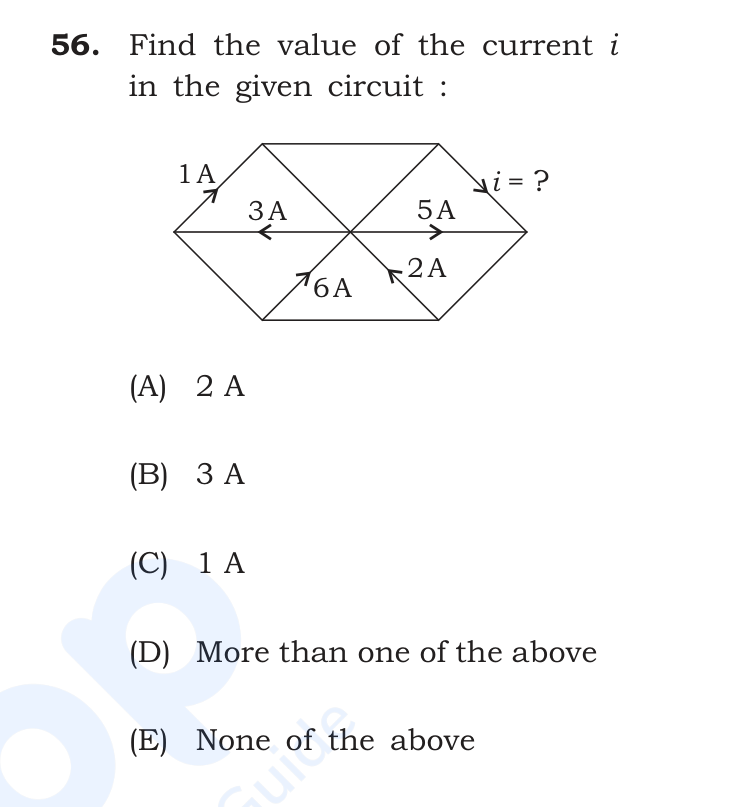
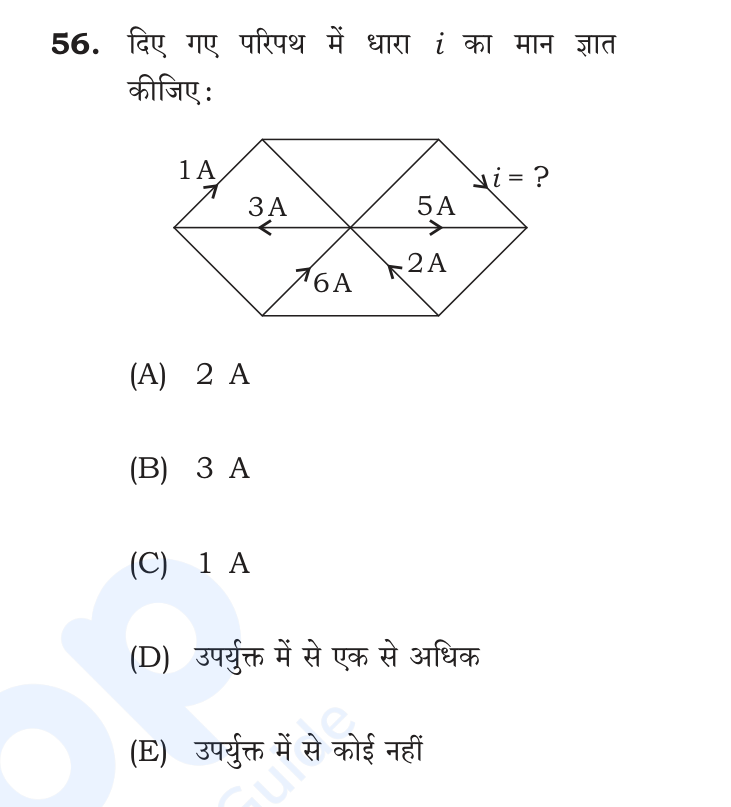
DMore than one of the aboveउपर्युक्त में से एक से अधिक
ENone of the aboveउपर्युक्त में से कोई नहीं
Show answerHide answer
Correct answer: (C)1 A1 A
Explanation
Apply Kirchhoff's current law vertex by vertex: left vertex (3 A in, 1 A out) leaves 2 A to the bottom-left vertex; there 2 A in and 6 A out means 4 A flows along the bottom edge from the right; at the bottom-right vertex 6 A then flows up to the right vertex; there 5 A + i = 6 A, so i = 1 A.प्रत्येक शीर्ष पर किरखोफ का धारा नियम लगाएँ: बायें शीर्ष से नीचे बायें शीर्ष की ओर 2 A जाती है; वहाँ 2 A अंदर और 6 A बाहर, तो तली में 4 A दायीं ओर से आती है; नीचे दायें शीर्ष से 6 A दायें शीर्ष की ओर जाती है; वहाँ 5 A + i = 6 A, अतः i = 1 A।
Which of the following statements is not correct about quality factor of a parallel resonance circuit?किसी समानांतर अनुनादी परिपथ के गुणवत्ता कारक के बारे में, निम्नलिखित में से कौन-सा कथन सही नहीं है?
AQ-factor of parallel resonance is the same as that of series resonance.समानांतर अनुनाद का Q-फैक्टर, शृंखला अनुनाद के Q-फैक्टर के समान ही है।
BQ-factor provides the current magnification.Q-फैक्टर, धारा आवर्धन प्रदान करता है।
CQ-factor provides the voltage magnification.Q-फैक्टर, वोल्टेज आवर्धन प्रदान करता है।
DMore than one of the aboveउपर्युक्त में से एक से अधिक
ENone of the aboveउपर्युक्त में से कोई नहीं
Show answerHide answer
Correct answer: (D)More than one of the aboveउपर्युक्त में से एक से अधिक
Explanation
A parallel resonance circuit gives current magnification, not voltage magnification (that is the series circuit), so (C) is incorrect; statement (A) is also not generally valid because the Q of a parallel circuit is defined differently, so more than one statement is incorrect.समानांतर अनुनादी परिपथ धारा आवर्धन देता है, वोल्टेज आवर्धन नहीं (वह श्रेणी परिपथ में होता है), इसलिए (C) गलत है; (A) भी सामान्यतः सही नहीं है, अतः एक से अधिक कथन गलत हैं।
In a photoelectric experiment, both sodium (work function = 2.3 eV) and tungsten (work function = 4.5 eV) metals are illuminated by an ultraviolet light of same wavelength. If the stopping potential for tungsten is measured to be 1.8 V, then the value of the stopping potential for sodium will beप्रकाश-विद्युत् प्रयोग में, सोडियम (कार्य फलन = 2.3 eV) और टंग्स्टन (कार्य फलन = 4.5 eV) दोनों धातुएँ समान तरंगदैर्घ्य के पराबैंगनी प्रकाश से प्रदीप्त होती हैं। यदि टंग्स्टन का निरोधी विभव 1.8 V मापा जाता है, तो सोडियम के निरोधी विभव का मान होगा
A4 V4 V
B2.2 V2.2 V
C1.8 V1.8 V
DMore than one of the aboveउपर्युक्त में से एक से अधिक
ENone of the aboveउपर्युक्त में से कोई नहीं
Show answerHide answer
Correct answer: (A)4 V4 V
Explanation
Einstein's equation: eV_s = hν − φ. For tungsten hν = 4.5 + 1.8 = 6.3 eV. For sodium V_s = 6.3 − 2.3 = 4.0 V.आइंस्टीन समीकरण eV_s = hν − φ। टंग्स्टन के लिए hν = 4.5 + 1.8 = 6.3 eV। सोडियम के लिए V_s = 6.3 − 2.3 = 4.0 V।
Fine structure of spectral lines arises from the coupling between the electron's spin and its orbital motion (spin-orbit coupling).वर्णक्रमीय रेखाओं की सूक्ष्म संरचना इलेक्ट्रॉन के स्पिन और कक्षीय गति के युग्मन (स्पिन-कक्षा युग्मन) से उत्पन्न होती है।
An atom with proton number 84 and nucleon number 216 decays into a new element. In this process, it emits an alpha particle. What is the structure of the new nucleus after the emission?प्रोटॉन संख्या 84 और न्यूक्लिऑन संख्या 216 वाले एक परमाणु का एक नए तत्त्व में क्षय होता है। इस प्रक्रिया में, यह एक अल्फा कण का उत्सर्जन करता है। उत्सर्जन के बाद नए नाभिक की संरचना क्या है?
AProton number 82, Nucleon number 212प्रोटॉन संख्या 82, न्यूक्लिऑन संख्या 212
BProton number 82, Nucleon number 214प्रोटॉन संख्या 82, न्यूक्लिऑन संख्या 214
CProton number 85, Nucleon number 215प्रोटॉन संख्या 85, न्यूक्लिऑन संख्या 215
DMore than one of the aboveउपर्युक्त में से एक से अधिक
ENone of the aboveउपर्युक्त में से कोई नहीं
Show answerHide answer
Correct answer: (A)Proton number 82, Nucleon number 212प्रोटॉन संख्या 82, न्यूक्लिऑन संख्या 212
Explanation
Alpha emission removes 2 protons and 4 nucleons: Z = 84 − 2 = 82 and A = 216 − 4 = 212.अल्फा उत्सर्जन से 2 प्रोटॉन और 4 न्यूक्लिऑन कम होते हैं: Z = 84 − 2 = 82 और A = 216 − 4 = 212।
Which of the following reactions is not allowed?निम्नलिखित में से किस अभिक्रिया की अनुमति नहीं है?
Aπ⁺ + n → K⁺ + Σ⁰π⁺ + n → K⁺ + Σ⁰
BΛ⁺ + n → Σ⁺ + pΛ⁺ + n → Σ⁺ + p
Cρ⁰ → π⁺ π⁻ρ⁰ → π⁺ π⁻
DMore than one of the aboveउपर्युक्त में से एक से अधिक
ENone of the aboveउपर्युक्त में से कोई नहीं
Show answerHide answer
Correct answer: (B)Λ⁺ + n → Σ⁺ + pΛ⁺ + n → Σ⁺ + p
Explanation
In Λ⁺ + n → Σ⁺ + p the charge is +1 on the left but +2 on the right, so charge is not conserved and the reaction is not allowed.Λ⁺ + n → Σ⁺ + p में बायीं ओर आवेश +1 और दायीं ओर +2 है; आवेश संरक्षित नहीं है, इसलिए अभिक्रिया निषिद्ध है।
Donor-type impurities are the materials ofदाता प्रकार की अशुद्धियाँ किसकी सामग्री हैं?
AV group of periodic tableआवर्त सारणी का V समूह
BIV group of periodic tableआवर्त सारणी का IV समूह
CIII group of periodic tableआवर्त सारणी का III समूह
DMore than one of the aboveउपर्युक्त में से एक से अधिक
ENone of the aboveउपर्युक्त में से कोई नहीं
Show answerHide answer
Correct answer: (A)V group of periodic tableआवर्त सारणी का V समूह
Explanation
Donor impurities are pentavalent atoms (such as P, As, Sb) from group V, which give extra electrons.दाता अशुद्धियाँ पंचसंयोजी परमाणु (P, As, Sb) होती हैं जो आवर्त सारणी के V समूह के हैं और अतिरिक्त इलेक्ट्रॉन देते हैं।
In an n-type semiconductor, the Fermi level liesएक n-प्रकार के अर्धचालक में फर्मी स्तर स्थित होता है
Aabove the top of the valence bandसंयोजी बैंड के शीर्ष के ऊपर
Bbelow the bottom of the conduction bandचालन बैंड के नीचे
Cin the middle of the forbidden gapवर्जित अंतराल के बीच में
DMore than one of the aboveउपर्युक्त में से एक से अधिक
ENone of the aboveउपर्युक्त में से कोई नहीं
Show answerHide answer
Correct answer: (B)below the bottom of the conduction bandचालन बैंड के नीचे
Explanation
In an n-type semiconductor the donor levels lie just below the conduction band, so the Fermi level sits just below the bottom of the conduction band.n-प्रकार के अर्धचालक में दाता स्तर चालन बैंड के ठीक नीचे होते हैं, इसलिए फर्मी स्तर चालन बैंड के निचले सिरे के कुछ नीचे होता है।
Consider the following types of modulation :
(i) Amplitude modulation
(ii) Frequency modulation
(iii) Phase modulation
(iv) Pulse modulation
Which of the above modulations are used for telecasting TV programs?निम्नलिखित प्रकार के मॉड्यूलेशनों पर विचार कीजिए :
(i) आयाम मॉड्यूलेशन
(ii) आवृत्ति मॉड्यूलेशन
(iii) कला मॉड्यूलेशन
(iv) स्पंद मॉड्यूलेशन
उपर्युक्त में से कौन-से मॉड्यूलेशन टी॰ वी॰ कार्यक्रमों के प्रसारण के लिए उपयोग किए जाते हैं?
A(ii) and (iii)(ii) और (iii)
B(iii) and (iv)(iii) और (iv)
C(i) and (ii)(i) और (ii)
DMore than one of the aboveउपर्युक्त में से एक से अधिक
ENone of the aboveउपर्युक्त में से कोई नहीं
Show answerHide answer
Correct answer: (C)(i) and (ii)(i) और (ii)
Explanation
TV broadcasting uses amplitude modulation for the video (picture) signal and frequency modulation for the audio (sound) signal, so (i) and (ii).टी॰ वी॰ प्रसारण में चित्र संकेत के लिए आयाम मॉड्यूलेशन और ध्वनि संकेत के लिए आवृत्ति मॉड्यूलेशन प्रयुक्त होता है, अतः (i) और (ii)।
For every 10 °C increase in temperature, the reverse saturation current of a p-n junction will be increased byप्रत्येक 10 °C तापमान में वृद्धि के लिए p-n जंक्शन की उत्क्रम संतृप्ति धारा में वृद्धि होगी
A10 times10 गुनी
B2 times2 गुनी
C4 times4 गुनी
DMore than one of the aboveउपर्युक्त में से एक से अधिक
ENone of the aboveउपर्युक्त में से कोई नहीं
Show answerHide answer
Correct answer: (B)2 times2 गुनी
Explanation
The reverse saturation current of a p-n junction roughly doubles for every 10 °C rise in temperature.प्रत्येक 10 °C तापमान वृद्धि पर p-n जंक्शन की उत्क्रम संतृप्ति धारा लगभग दोगुनी हो जाती है।
The band gap energies for silicon and germanium photodiodes are 1.1 eV and 0.67 eV respectively. Their cut-off wavelengths respectively would beसिलिकॉन और जर्मेनियम फोटोडायोड के लिए बैंड अंतराल ऊर्जाएँ क्रमशः 1.1 eV और 0.67 eV हैं। उनके कट-ऑफ तरंगदैर्घ्य, क्रमशः, होंगे
Which method can be employed to produce a high degree of homogeneity in the creation of ZnFe₂O₄ spinel?ZnFe₂O₄ स्पिनेल के निर्माण में उच्च स्तर की एकरूपता उत्पन्न करने के लिए किस विधि को नियोजित किया जा सकता है?
ADistillation methodआसवन विधि
BVaporization methodवाष्पीकरण विधि
CCoprecipitation methodसह-अवक्षेपण विधि
DMore than one of the aboveउपर्युक्त में से एक से अधिक
Coprecipitation mixes the metal ions in solution at the atomic level, giving a highly homogeneous ferrite such as ZnFe₂O₄.सह-अवक्षेपण में धातु आयन विलयन में परमाणु स्तर पर मिलते हैं, जिससे ZnFe₂O₄ जैसा अत्यंत एकरूप फेराइट बनता है।
_____ is a crystalline solid’s basic repetitive structural unit._____ एक क्रिस्टलीय ठोस की मूल दोहरावदार संरचनात्मक इकाई है।
AMonomerएकलक
BMoleculeअणु
CUnit cellएकक सेल
DMore than one of the aboveउपर्युक्त में से एक से अधिक
ENone of the aboveउपर्युक्त में से कोई नहीं
Show answerHide answer
Correct answer: (C)Unit cellएकक सेल
Explanation
The smallest repeating structural unit of a crystal lattice is called the unit cell.क्रिस्टल जालक की सबसे छोटी दोहराई जाने वाली संरचनात्मक इकाई को एकक सेल (यूनिट सेल) कहते हैं।
For all the reactions, what is the nature of the chemical dissociation?सभी अभिक्रियाओं के लिए, रासायनिक वियोजन की प्रकृति क्या होती है?
AExothermicऊष्माक्षेपी
BReversibleप्रतिवर्ती
CEndothermicऊष्माशोषी
DMore than one of the aboveउपर्युक्त में से एक से अधिक
ENone of the aboveउपर्युक्त में से कोई नहीं
Show answerHide answer
Correct answer: (D)More than one of the aboveउपर्युक्त में से एक से अधिक
Explanation
Chemical dissociation is generally reversible and, since bonds are broken, endothermic, so both (B) and (C) hold and the answer is 'more than one of the above'.रासायनिक वियोजन सामान्यतः प्रतिवर्ती और (बंध टूटने के कारण) ऊष्माशोषी होता है, अतः (B) और (C) दोनों सही हैं और उत्तर 'एक से अधिक' है।
The radius of an atomic nucleus is of the order ofपरमाणु नाभिक की त्रिज्या _____ की कोटि की होती है।
A10⁻¹⁰ cm10⁻¹⁰ से॰ मी॰
B10⁻¹³ cm10⁻¹³ से॰ मी॰
C10⁻¹⁵ cm10⁻¹⁵ से॰ मी॰
DMore than one of the aboveउपर्युक्त में से एक से अधिक
ENone of the aboveउपर्युक्त में से कोई नहीं
Show answerHide answer
Correct answer: (B)10⁻¹³ cm10⁻¹³ से॰ मी॰
Explanation
A nucleus has a radius of the order of 1 fermi = 10⁻¹³ cm (about 10⁻¹⁵ m).परमाणु नाभिक की त्रिज्या लगभग 1 फर्मी = 10⁻¹³ से॰ मी॰ (लगभग 10⁻¹⁵ मी॰) की कोटि की होती है।
Athe circular path of electronइलेक्ट्रॉन का वृत्ताकार पथ
Ban elliptical shaped orbitअंडाकार कक्षा
Cthe region in which there is a maximum possibility of finding an electronवह क्षेत्र है, जिसमें इलेक्ट्रॉन के पाए जाने की संभावना अधिकतम होती है
DMore than one of the aboveउपर्युक्त में से एक से अधिक
ENone of the aboveउपर्युक्त में से कोई नहीं
Show answerHide answer
Correct answer: (C)the region in which there is a maximum possibility of finding an electronवह क्षेत्र है, जिसमें इलेक्ट्रॉन के पाए जाने की संभावना अधिकतम होती है
Explanation
An atomic orbital is the region of space around the nucleus where the probability of finding the electron is maximum.परमाणु कक्षक नाभिक के चारों ओर का वह क्षेत्र है जहाँ इलेक्ट्रॉन के पाए जाने की संभावना अधिकतम होती है।
In the rate equation, when the concentration of reactants is unity, then the rate is equal toदर समीकरण में, जब अभिकारकों की सांद्रता एक होती है, तो दर बराबर होती है
Aspecific rate constantविशिष्ट दर स्थिरांक के
Baverage rate constantऔसत दर स्थिरांक के
Cinstantaneous rate constantतात्कालिक दर स्थिरांक के
DMore than one of the aboveउपर्युक्त में से एक से अधिक
ENone of the aboveउपर्युक्त में से कोई नहीं
Show answerHide answer
Correct answer: (A)specific rate constantविशिष्ट दर स्थिरांक के
Explanation
Rate = k[A]ⁿ; when every concentration is unity, rate = k, the specific rate constant.दर = k[A]ⁿ; जब सभी सांद्रताएँ इकाई हों तो दर = k, अर्थात् विशिष्ट दर स्थिरांक।
In the reaction 2A + B → A₂B, if the concentration of A is doubled and that of B is halved, then the rate of the reaction willअभिक्रिया 2A + B → A₂B में, यदि A की सान्द्रता दोगुनी कर दी जाए और B की सान्द्रता आधी कर दी जाए, तो अभिक्रिया की दर
Aincrease 2 times2 गुनी बढ़ जाएगी
Bincrease 4 times4 गुनी बढ़ जाएगी
Cdecrease 2 times2 गुनी कम हो जाएगी
DMore than one of the aboveउपर्युक्त में से एक से अधिक
Taking the elementary rate law rate = k[A]²[B]: doubling A multiplies the rate by 4 and halving B by 1/2, so the net effect is a 2-fold increase.प्रारंभिक अभिक्रिया मानकर दर = k[A]²[B]: A दोगुना करने से दर 4 गुनी और B आधा करने से 1/2, अतः कुल दर 2 गुनी बढ़ती है।
A substance A decomposes by a first-order reaction starting initially with [A] = 2.00 M and after 200 minutes, [A] becomes 0.15 M. For this reaction t₁/₂ isएक पदार्थ A प्रथम कोटि की अभिक्रिया से विघटित होता है, जो पहले [A] = 2.00 M के साथ शुरू होता है और 200 मिनट के बाद [A], 0.15 M हो जाता है। इस अभिक्रिया के लिए t₁/₂ है
A53.72 minutes53.72 मिनट
B50.49 minutes50.49 मिनट
C48.45 minutes48.45 मिनट
DMore than one of the aboveउपर्युक्त में से एक से अधिक
ENone of the aboveउपर्युक्त में से कोई नहीं
Show answerHide answer
Correct answer: (A)53.72 minutes53.72 मिनट
Explanation
k = (2.303/200) log(2.00/0.15) ≈ 0.01295 min⁻¹, so t½ = 0.693 / k ≈ 53.5 min; the closest option is 53.72 minutes.k = (2.303/200) log(2.00/0.15) ≈ 0.01295 मिनट⁻¹, अतः t½ = 0.693/k ≈ 53.5 मिनट; निकटतम विकल्प 53.72 मिनट है।
Which of the following assertions about the main cell is correct?मुख्य सेल के बारे में, निम्नलिखित में से कौन-सा कथन सही है?
AAn example of a primary cell is a mercury cell.पारा सेल, प्राथमिक सेल का एक उदाहरण है।
BAn example of a primary cell is a nickel-cadmium storage cell.प्राथमिक सेल का एक उदाहरण निकल-कैड्मियम स्टोरेज सेल है।
CThe electrode reactions can be reversed.इलेक्ट्रोड अभिक्रियाओं को उलटा किया जा सकता है।
DMore than one of the aboveउपर्युक्त में से एक से अधिक
ENone of the aboveउपर्युक्त में से कोई नहीं
Show answerHide answer
Correct answer: (A)An example of a primary cell is a mercury cell.पारा सेल, प्राथमिक सेल का एक उदाहरण है।
Explanation
A mercury cell is a primary (non-rechargeable) cell; the other two statements describe secondary cells, so only (A) is correct.पारा सेल प्राथमिक (पुनः आवेशित न होने वाला) सेल है; अन्य दोनों कथन द्वितीयक सेल के हैं, अतः केवल (A) सही है।
A catalyst alters which of the following in a chemical reaction?रासायनिक अभिक्रिया में उत्प्रेरक निम्नलिखित में से किसमें परिवर्तन करता है?
AEntropyएन्ट्रॉपी
BActivation energyसक्रियण ऊर्जा
CInternal energyआंतरिक ऊर्जा
DMore than one of the aboveउपर्युक्त में से एक से अधिक
ENone of the aboveउपर्युक्त में से कोई नहीं
Show answerHide answer
Correct answer: (B)Activation energyसक्रियण ऊर्जा
Explanation
A catalyst provides an alternative path with lower activation energy; it does not change entropy or internal energy.उत्प्रेरक कम सक्रियण ऊर्जा वाला वैकल्पिक पथ देता है; यह एन्ट्रॉपी या आंतरिक ऊर्जा नहीं बदलता।
Photochemistry deals with the study ofप्रकाश-रसायन किसके अध्ययन से संबंधित है?
Aphotonsफोटॉन
Bphotosतस्वीर
Creactions which proceed with absorptions of visible or UV lightअभिक्रियाएँ, जो दृश्य या UV प्रकाश के अवशोषण के साथ आगे बढ़ती हैं
DMore than one of the aboveउपर्युक्त में से एक से अधिक
ENone of the aboveउपर्युक्त में से कोई नहीं
Show answerHide answer
Correct answer: (C)reactions which proceed with absorptions of visible or UV lightअभिक्रियाएँ, जो दृश्य या UV प्रकाश के अवशोषण के साथ आगे बढ़ती हैं
Explanation
Photochemistry studies reactions that proceed by absorption of visible or ultraviolet light.प्रकाश-रसायन उन अभिक्रियाओं का अध्ययन है जो दृश्य या पराबैंगनी प्रकाश के अवशोषण से होती हैं।
The number of photons that pass through a unit area in a unit time is calledएक इकाई समय में एक इकाई क्षेत्रफल से होकर गुजरने वाले फोटॉनों की संख्या कहलाती है
Aamplitude of lightप्रकाश का आयाम
Bfrequency of lightप्रकाश की आवृत्ति
Cintensity of lightप्रकाश की तीव्रता
DMore than one of the aboveउपर्युक्त में से एक से अधिक
ENone of the aboveउपर्युक्त में से कोई नहीं
Show answerHide answer
Correct answer: (C)intensity of lightप्रकाश की तीव्रता
Explanation
The number of photons crossing unit area per unit time is the intensity of light.प्रति इकाई समय में प्रति इकाई क्षेत्रफल से गुजरने वाले फोटॉनों की संख्या प्रकाश की तीव्रता कहलाती है।
The transition without emission of radiation of a molecule from a stable excited state to an unstable excited state that leads to dissociation isस्थिर उत्तेजित अवस्था से अस्थिर उत्तेजित अवस्था में एक अणु के विकिरण के उत्सर्जन के बिना संक्रमण, जो पृथक्करण की ओर जाता है, है
Apredissociationपूर्व-पृथक्करण
Bdissociationपृथक्करण
Cphotodissociationप्रकाशिक पृथक्करण
DMore than one of the aboveउपर्युक्त में से एक से अधिक
ENone of the aboveउपर्युक्त में से कोई नहीं
Show answerHide answer
Correct answer: (A)predissociationपूर्व-पृथक्करण
Explanation
A radiationless transition from a stable excited state to an unstable (dissociative) excited state is predissociation.स्थिर उत्तेजित अवस्था से अस्थिर (वियोजक) उत्तेजित अवस्था में बिना विकिरण के संक्रमण पूर्व-पृथक्करण कहलाता है।
Which of the following products are obtained when Na₂CO₃ is added to a solution of copper sulphate?कॉपर सल्फेट के विलयन में Na₂CO₃ मिलाने पर निम्नलिखित में से कौन-से उत्पाद प्राप्त होते हैं?
ABasic copper carbonate, sodium sulphate and CO₂बेसिक कॉपर कार्बोनेट, सोडियम सल्फेट और CO₂
BCopper hydroxide, sodium sulphate and CO₂कॉपर हाइड्रॉक्साइड, सोडियम सल्फेट और CO₂
CCopper carbonate, sodium sulphate and CO₂कॉपर कार्बोनेट, सोडियम सल्फेट और CO₂
DMore than one of the aboveउपर्युक्त में से एक से अधिक
ENone of the aboveउपर्युक्त में से कोई नहीं
Show answerHide answer
Correct answer: (A)Basic copper carbonate, sodium sulphate and CO₂बेसिक कॉपर कार्बोनेट, सोडियम सल्फेट और CO₂
Explanation
Copper sulphate and sodium carbonate in water react to give basic copper carbonate, sodium sulphate and CO₂.कॉपर सल्फेट और सोडियम कार्बोनेट की अभिक्रिया से बेसिक कॉपर कार्बोनेट, सोडियम सल्फेट और CO₂ बनते हैं।
The pair that has similar atomic radii isसमान परमाणु त्रिज्याओं वाला युग्म है
AMn and ReMn और Re
BMo and WMo और W
CSc and NiSc और Ni
DMore than one of the aboveउपर्युक्त में से एक से अधिक
ENone of the aboveउपर्युक्त में से कोई नहीं
Show answerHide answer
Correct answer: (B)Mo and WMo और W
Explanation
Because of the lanthanide contraction, 4d and 5d elements of the same group such as Mo and W have almost identical atomic radii.लैन्थेनाइड संकुचन के कारण एक ही समूह के 4d और 5d तत्त्व, जैसे Mo और W, की परमाणु त्रिज्याएँ लगभग समान होती हैं।
Note: the official key gives (A); current IUPAC practice writes this complex as sodium pentacyanonitrosylferrate(II) (Fe is +2 with NO⁺), but the official key is kept. The older name used is pentacyanonitrosylferrate(III).टिप्पणी: आधिकारिक कुंजी (A) है; वर्तमान IUPAC नाम सोडियम पेंटासायनोनाइट्रोसिलफेरेट(II) है, फिर भी आधिकारिक कुंजी रखी गई है।
A substance X is used in whitewashing and is obtained by heating limestone in the absence of air. Identify X .एक पदार्थ X का उपयोग सफेदीकरण में किया जाता है और इसे हवा की अनुपस्थिति में चूनापत्थर को गर्म करके प्राप्त किया जाता है। X की पहचान कीजिए।
ACaOCl₂CaOCl₂
BCa(OH)₂Ca(OH)₂
CCaOCaO
DMore than one of the aboveउपर्युक्त में से एक से अधिक
ENone of the aboveउपर्युक्त में से कोई नहीं
Show answerHide answer
Correct answer: (C)CaOCaO
Explanation
Heating limestone (CaCO₃) in the absence of air gives quicklime CaO, the substance used for whitewashing (after slaking).चूनापत्थर (CaCO₃) को हवा की अनुपस्थिति में गर्म करने पर कैल्सियम ऑक्साइड CaO (बिना बुझा चूना) बनता है, जिसका उपयोग सफेदी में होता है।
A dilute ferrous sulphate solution is gradually added to the beaker containing acidified permanganate solution. The light purple colour of the solution fades and finally disappears. Which of the following is the correct explanation for the observation?अम्लीकृत परमैंगनेट विलयन वाले बीकर में धीरे-धीरे तनु फेरस सल्फेट का विलयन डाला गया। विलयन का हल्का बैंगनी रंग फीका पड़ जाता है और अंत में गायब हो जाता है। निम्नलिखित में से कौन-सा अवलोकन के लिए सही स्पष्टीकरण है?
AKMnO₄ is an oxidizing agent and it oxidizes FeSO₄.KMnO₄ एक ऑक्सीकारक है और यह FeSO₄ का ऑक्सीकरण करता है।
BFeSO₄ acts as an oxidizing agent and it oxidizes KMnO₄.FeSO₄ एक ऑक्सीकारक के रूप में कार्य करता है और यह KMnO₄ का ऑक्सीकरण करता है।
CThe colour disappears due to dilution, no reaction is involved.तनुकरण के कारण रंग गायब हो जाता है, कोई अभिक्रिया शामिल नहीं है।
DMore than one of the aboveउपर्युक्त में से एक से अधिक
ENone of the aboveउपर्युक्त में से कोई नहीं
Show answerHide answer
Correct answer: (A)KMnO₄ is an oxidizing agent and it oxidizes FeSO₄.KMnO₄ एक ऑक्सीकारक है और यह FeSO₄ का ऑक्सीकरण करता है।
Explanation
Acidified KMnO₄ is a strong oxidising agent; it oxidises Fe²⁺ of FeSO₄ to Fe³⁺ and is itself reduced to nearly colourless Mn²⁺, so the purple colour fades.अम्लीकृत KMnO₄ प्रबल ऑक्सीकारक है; यह FeSO₄ के Fe²⁺ को Fe³⁺ में ऑक्सीकृत करता है और स्वयं लगभग रंगहीन Mn²⁺ में अपचयित हो जाता है, इसलिए बैंगनी रंग फीका पड़ता है।
How many structural isomers are possible if one hydrogen in diphenylmethane is replaced by chlorine?डाइफेनिलमीथेन में एक हाइड्रोजन को क्लोरीन से बदलने पर कितने संरचनात्मक समावयवी संभव हैं?
A88
B44
C77
DMore than one of the aboveउपर्युक्त में से एक से अधिक
ENone of the aboveउपर्युक्त में से कोई नहीं
Show answerHide answer
Correct answer: (B)44
Explanation
Monochlorination of diphenylmethane can occur at the ortho, meta or para position of the ring (3 isomers) or at the CH₂ carbon (1 isomer): 4 in all.डाइफेनिलमीथेन का मोनोक्लोरीनीकरण वलय के ऑर्थो, मेटा, पैरा (3) या CH₂ कार्बन (1) पर हो सकता है: कुल 4 समावयवी।
Which among the following statements is/are true?
Exposure of silver chloride to sunlight for a long duration turns it grey due to the
(i) formation of silver by decomposition of silver chloride
(ii) sublimation of silver chloride
(iii) decomposition of chlorine gas from silver chloride
(iv) oxidation of silver chloride
Select the correct answer using the codes given below.निम्नलिखित में से कौन-सा/से कथन सही है/हैं?
लंबे समय तक सूर्य के प्रकाश के संपर्क में रहने के कारण सिल्वर क्लोराइड धूसर हो जाता है
(i) सिल्वर क्लोराइड के अपघटन से सिल्वर के निर्माण के कारण
(ii) सिल्वर क्लोराइड के ऊर्ध्वपातन के कारण
(iii) सिल्वर क्लोराइड से क्लोरीन गैस के अपघटन के कारण
(iv) सिल्वर क्लोराइड के ऑक्सीकरण के कारण
नीचे दिए गए कूट का प्रयोग करते हुए सही उत्तर का चयन कीजिए।
A(i) onlyकेवल (i)
B(i) and (iii)(i) और (iii)
C(ii) and (iv)(ii) और (iv)
DMore than one of the aboveउपर्युक्त में से एक से अधिक
ENone of the aboveउपर्युक्त में से कोई नहीं
Show answerHide answer
Correct answer: (B)(i) and (iii)(i) और (iii)
Explanation
Sunlight decomposes silver chloride into silver (grey) and chlorine gas, so statements (i) and (iii) as keyed describe the observation.सूर्य के प्रकाश में सिल्वर क्लोराइड सिल्वर (धूसर) और क्लोरीन गैस में अपघटित होता है, अतः (i) और (iii) कुंजी के अनुसार सही हैं।
Which of the following is a branched polymer?निम्नलिखित में से कौन-सा शाखित बहुलक है?
ALow-density polymerकम घनत्व वाला बहुलक
BPolyesterपॉलिएस्टर
CHigh-density polymerउच्च घनत्व वाला बहुलक
DMore than one of the aboveउपर्युक्त में से एक से अधिक
ENone of the aboveउपर्युक्त में से कोई नहीं
Show answerHide answer
Correct answer: (A)Low-density polymerकम घनत्व वाला बहुलक
Explanation
Low-density polyethylene is a branched polymer, whereas high-density polyethylene is linear.कम घनत्व वाला पॉलिएथिलीन शाखित बहुलक है, जबकि उच्च घनत्व वाला रैखिक होता है।
DMore than one of the aboveउपर्युक्त में से एक से अधिक
ENone of the aboveउपर्युक्त में से कोई नहीं
Show answerHide answer
Correct answer: (D)More than one of the aboveउपर्युक्त में से एक से अधिक
Explanation
Both PHBV (3-hydroxybutanoic + 3-hydroxypentanoic acid) and nylon-2-nylon-6 (glycine + aminocaproic acid) are biodegradable; polyester from ethylene glycol and phthalic acid (glyptal) is not. So (A) and (B): more than one.PHBV (3-हाइड्रॉक्सीब्यूटेनोइक + 3-हाइड्रॉक्सीपेंटेनोइक ऐसिड) और नायलॉन-2-नायलॉन-6 (ग्लाइसिन + अमीनोकैप्रोइक ऐसिड) दोनों जैव-निम्नीकरणीय हैं; एथिलीन ग्लाइकॉल + थैलिक ऐसिड वाला नहीं। अतः (A) और (B): एक से अधिक।
The correct order of increasing nucleophilicity isबढ़ते हुए न्यूक्लिओफिलिसिटी का सही क्रम है
ACl⁻ < Br⁻ < I⁻Cl⁻ < Br⁻ < I⁻
BBr⁻ < Cl⁻ < I⁻Br⁻ < Cl⁻ < I⁻
CI⁻ < Br⁻ < Cl⁻I⁻ < Br⁻ < Cl⁻
DMore than one of the aboveउपर्युक्त में से एक से अधिक
ENone of the aboveउपर्युक्त में से कोई नहीं
Show answerHide answer
Correct answer: (A)Cl⁻ < Br⁻ < I⁻Cl⁻ < Br⁻ < I⁻
Explanation
In protic solvents nucleophilicity increases down the group because larger, more polarisable ions are less solvated: Cl⁻ < Br⁻ < I⁻.प्रोटिक विलायकों में समूह में नीचे जाने पर बड़े, अधिक ध्रुवणीय आयन कम विलायकित होते हैं, इसलिए न्यूक्लिओफिलिसिटी बढ़ती है: Cl⁻ < Br⁻ < I⁻।
How to use these BPSC TRE Science questions
Every question here was asked in a real BPSC TRE paper; the paper and shift are shown on the card, and the number opens the question on its own page. Try each one before tapping Show answer, then attempt the full BPSC TRE papers as timed tests to check your speed under exam conditions.