70 Physics (Science) questions asked in BPSC TRE previous year papers, each with the correct answer and explanation. Read them free on UTpaper, or attempt the full papers as timed online tests.
A rocket, set for vertical firing, weighs 50 kg and contains 450 kg of fuel. It can have a maximum exhaust velocity of 5 km/sec. What should be its minimum rate of fuel consumption to just lift it off the launching pad?ऊर्ध्वाधर फायरिंग के लिए सेट किए गए एक रॉकेट का वजन 50 कि॰ ग्रा॰ है और इसमें 450 कि॰ ग्रा॰ ईंधन है। इसका अधिकतम निकास वेग 5 कि॰ मी॰/सेकंड हो सकता है। लॉन्चिंग पैड से इसे थोड़ा ऊपर उठाने के लिए इसकी ईंधन खपत की न्यूनतम दर क्या होनी चाहिए?
A0.98 kg/sec0.98 कि॰ ग्रा॰/सेकंड
B0.098 kg/sec0.098 कि॰ ग्रा॰/सेकंड
C9.8 kg/sec9.8 कि॰ ग्रा॰/सेकंड
DMore than one of the aboveउपर्युक्त में से एक से अधिक
To just lift off, thrust must equal the total weight: thrust = (dm/dt) × v = (50 + 450) × 9.8 = 4900 N. So dm/dt = 4900 / 5000 = 0.98 kg/s.ऊपर उठने के लिए प्रणोद कुल भार के बराबर होना चाहिए: (dm/dt) × v = (50 + 450) × 9.8 = 4900 N। अतः dm/dt = 4900/5000 = 0.98 कि॰ ग्रा॰/सेकंड।
Consider circular orbits in a central force potential V(r) = −k / rⁿ, where k > 0 and 0 < n < 2. If the time period of a circular orbit of radius R is T₁ and that of radius 2R is T₂, then T₂ / T₁ isकेंद्रीय बल विभव V(r) = −k / rⁿ में वृत्तीय कक्षाओं पर विचार कीजिए, जहाँ k > 0 और 0 < n < 2 है। यदि त्रिज्या R की एक वृत्ताकार कक्षा की समयावधि T₁ है और त्रिज्या 2R की एक वृत्ताकार कक्षा की समयावधि T₂ है, तब T₂ / T₁ है
A2^(n/2)2^(n/2)
B2^(2n/3)2^(2n/3)
C2^(n/2 + 1)2^(n/2 + 1)
DMore than one of the aboveउपर्युक्त में से एक से अधिक
ENone of the aboveउपर्युक्त में से कोई नहीं
Show answerHide answer
Correct answer: (C)2^(n/2 + 1)2^(n/2 + 1)
Explanation
For V = −k/rⁿ the circular-orbit period scales as T ∝ R^(1 + n/2). Doubling the radius gives T₂/T₁ = 2^(1 + n/2).V = −k/rⁿ के लिए वृत्तीय कक्षा की समयावधि T ∝ R^(1 + n/2) होती है। त्रिज्या दोगुनी करने पर T₂/T₁ = 2^(1 + n/2)।
In the analysis of flow velocity of a fluid for a fixed instant of time, a space curve is drawn so that it is tangent everywhere to the velocity vector. Then this curve is usually known asएक निश्चित समय के लिए किसी तरल पदार्थ के प्रवाह वेग के विश्लेषण में, एक अंतरिक्ष वक्र खींचा जाता है ताकि यह वेग सदिश के लिए हर जगह स्पर्श-रेखा हो। इस वक्र को आमतौर पर किस रूप में जाना जाता है?
Ainstantaneous curveतात्कालिक वक्र
Bmomentum curveसंवेग वक्र
Cstreamlineधारारेखा
DMore than one of the aboveउपर्युक्त में से एक से अधिक
ENone of the aboveउपर्युक्त में से कोई नहीं
Show answerHide answer
Correct answer: (C)streamlineधारारेखा
Explanation
A curve drawn tangent to the velocity vector at every point at one instant is called a streamline.किसी क्षण पर हर बिंदु पर वेग सदिश की स्पर्श-रेखा बनाने वाले वक्र को धारारेखा कहते हैं।
Which of the following is not the characteristic of Planck’s black-body radiation distribution?निम्नलिखित में से कौन-सी प्लांक के कृष्णिका विकिरण वितरण की विशेषता नहीं है?
AAs temperature increases, the peak of the curve shifts towards higher wavelength.जैसे ही तापमान बढ़ता है, वक्र का शिखर उच्च तरंगदैर्घ्य की ओर स्थानांतरित हो जाता है।
BSpectral emissive power varies continuously with the change in wavelength.तरंगदैर्घ्य में परिवर्तन के साथ वर्णक्रमीय उत्सर्जक शक्ति लगातार बदलती रहती है।
CAt a given wavelength, as temperature increases, emissive power also increases.किसी दिए गए तरंगदैर्घ्य पर, जैसे-जैसे तापमान बढ़ता है, उत्सर्जक शक्ति भी बढ़ती है।
DMore than one of the aboveउपर्युक्त में से एक से अधिक
ENone of the aboveउपर्युक्त में से कोई नहीं
Show answerHide answer
Correct answer: (A)As temperature increases, the peak of the curve shifts towards higher wavelength.जैसे ही तापमान बढ़ता है, वक्र का शिखर उच्च तरंगदैर्घ्य की ओर स्थानांतरित हो जाता है।
Explanation
In Planck's distribution the peak shifts towards SHORTER wavelength as temperature rises (Wien's law), so statement (A) is not a characteristic.प्लांक वितरण में तापमान बढ़ने पर शिखर छोटी तरंगदैर्घ्य की ओर खिसकता है (वीन का नियम), इसलिए (A) विशेषता नहीं है।
A light of 600 nm wavelength is incident on a single slit. The first minimum of the diffraction pattern is obtained at a distance of 4 mm from the centre. The distance between the screen and the slit is 2 m. What is the width of the slit?600 नैनोमीटर तरंगदैर्घ्य का प्रकाश एकल रेखाछिद्र पर आपतित होता है। विवर्तन प्रारूप का पहला निम्निष्ठ केंद्र से 4 मि॰ मी॰ की दूरी पर प्राप्त होता है। परदे और रेखाछिद्र के बीच की दूरी 2 मी॰ है। रेखाछिद्र की चौड़ाई क्या है?
A0.1 mm0.1 मि॰ मी॰
B0.3 mm0.3 मि॰ मी॰
C0.5 mm0.5 मि॰ मी॰
DMore than one of the aboveउपर्युक्त में से एक से अधिक
ENone of the aboveउपर्युक्त में से कोई नहीं
Show answerHide answer
Correct answer: (B)0.3 mm0.3 मि॰ मी॰
Explanation
For the first minimum a sinθ = λ, and sinθ ≈ y/D. So a = λD/y = (600 × 10⁻⁹ × 2) / (4 × 10⁻³) = 3 × 10⁻⁴ m = 0.3 mm.पहले निम्निष्ठ के लिए a sinθ = λ और sinθ ≈ y/D। अतः a = λD/y = (600 × 10⁻⁹ × 2)/(4 × 10⁻³) = 3 × 10⁻⁴ मी॰ = 0.3 मि॰ मी॰।
At what angle of incidence of plane-polarized light with quarter-wave plate, elliptically polarized light becomes circularly polarized?चतुर्थांश तरंग पट्टिका के साथ समतल ध्रुवीकृत प्रकाश के आपतन के किस कोण पर दीर्घवृत्तीय ध्रुवित प्रकाश गोलाकार ध्रुवीकृत हो जाता है?
A90°90°
B45°45°
C60°60°
DMore than one of the aboveउपर्युक्त में से एक से अधिक
ENone of the aboveउपर्युक्त में से कोई नहीं
Show answerHide answer
Correct answer: (B)45°45°
Explanation
A quarter-wave plate converts elliptically polarised light into circularly polarised light when the plane of polarisation is at 45° to its optic axis.जब समतल ध्रुवीकृत प्रकाश का ध्रुवण तल चतुर्थांश तरंग पट्टिका के प्रकाशिक अक्ष से 45° पर होता है, तब यह गोलाकार ध्रुवित प्रकाश देती है।
From the wave equation y = 0.5 sin[(2π / 3.2)(64t − x)], the frequency of the wave isतरंग समीकरण y = 0.5 sin[(2π / 3.2)(64t − x)] से तरंग की आवृत्ति है
A5 Hz5 हर्ट्ज
B15 Hz15 हर्ट्ज
C20 Hz20 हर्ट्ज
DMore than one of the aboveउपर्युक्त में से एक से अधिक
ENone of the aboveउपर्युक्त में से कोई नहीं
Show answerHide answer
Correct answer: (C)20 Hz20 हर्ट्ज
Explanation
Writing y = 0.5 sin[(2π/3.2)(64t − x)] as sin(2πft − kx) gives f = 64 / 3.2 = 20 Hz.y = 0.5 sin[(2π/3.2)(64t − x)] की तुलना sin(2πft − kx) से करने पर f = 64/3.2 = 20 हर्ट्ज।
Which of the following statements is/are true regarding Biot-Savart law?
(i) Magnetic field is directly proportional to the length of element.
(ii) Biot-Savart law deals with electric field.
(iii) Magnetic field is directly proportional to the current through the conductor.
Select the correct answer using the codes given below.बायो-सावर्ट के नियम के संबंध में, निम्नलिखित में से कौन-सा/से कथन सत्य है/हैं?
(i) चुंबकीय क्षेत्र, तत्त्व की लंबाई के अनुक्रमानुपाती होता है।
(ii) बायो-सावर्ट का नियम विद्युत् क्षेत्र से संबंधित है।
(iii) चुंबकीय क्षेत्र, चालक में प्रवाहित धारा के अनुक्रमानुपाती होता है।
नीचे दिए गए कूट का प्रयोग करते हुए सही उत्तर का चयन कीजिए।
A(i) onlyकेवल (i)
B(i) and (ii)(i) और (ii)
C(i) and (iii)(i) और (iii)
DMore than one of the aboveउपर्युक्त में से एक से अधिक
ENone of the aboveउपर्युक्त में से कोई नहीं
Show answerHide answer
Correct answer: (C)(i) and (iii)(i) और (iii)
Explanation
Biot-Savart law gives the magnetic field of a current element: dB ∝ I·dl, so (i) and (iii) are true; the law concerns magnetic, not electric, field.बायो-सावर्ट नियम धारा-तत्त्व के चुंबकीय क्षेत्र को देता है: dB ∝ I·dl, इसलिए (i) और (iii) सत्य हैं; यह विद्युत क्षेत्र से संबंधित नहीं है।
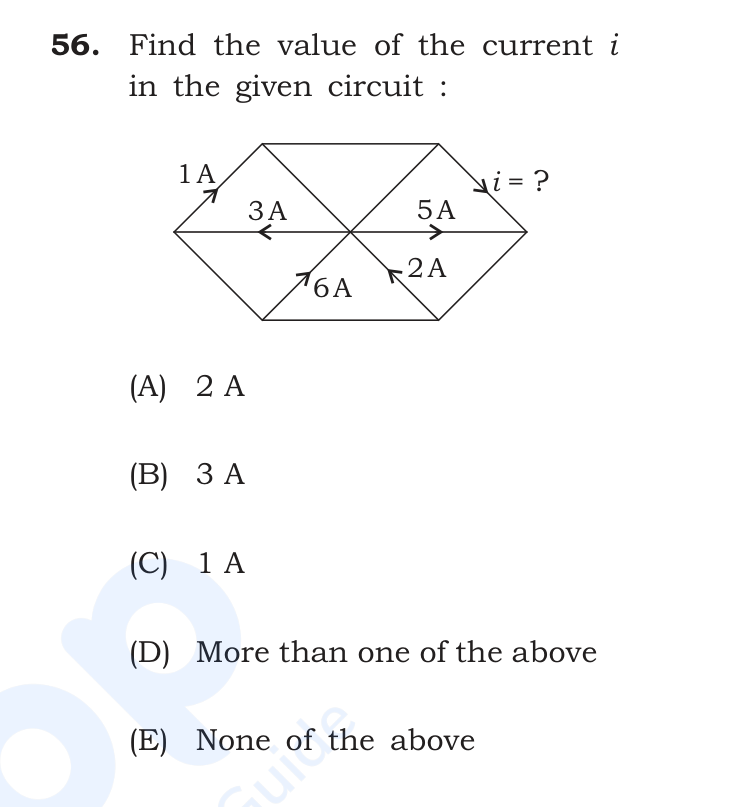
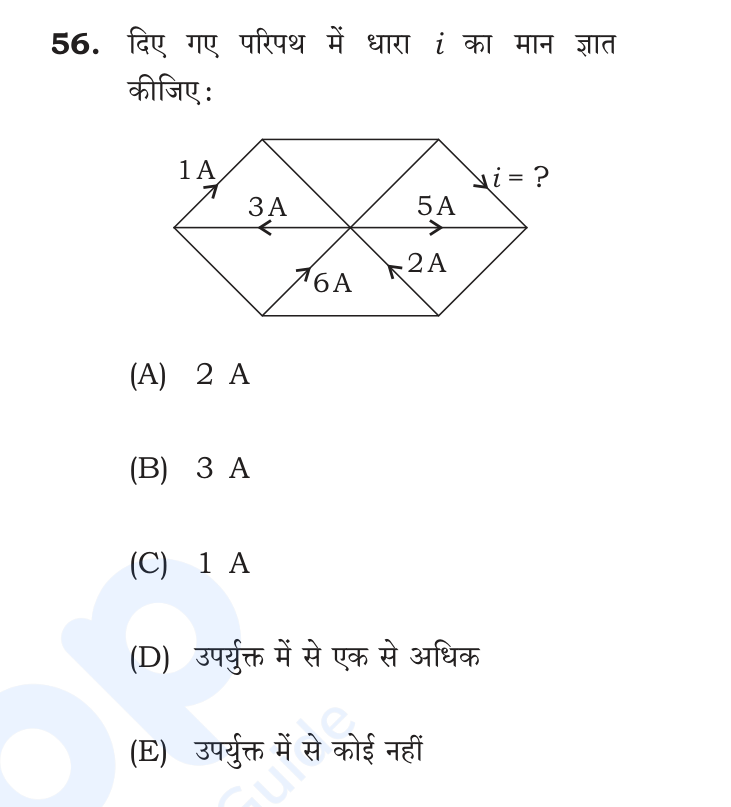
DMore than one of the aboveउपर्युक्त में से एक से अधिक
ENone of the aboveउपर्युक्त में से कोई नहीं
Show answerHide answer
Correct answer: (C)1 A1 A
Explanation
Apply Kirchhoff's current law vertex by vertex: left vertex (3 A in, 1 A out) leaves 2 A to the bottom-left vertex; there 2 A in and 6 A out means 4 A flows along the bottom edge from the right; at the bottom-right vertex 6 A then flows up to the right vertex; there 5 A + i = 6 A, so i = 1 A.प्रत्येक शीर्ष पर किरखोफ का धारा नियम लगाएँ: बायें शीर्ष से नीचे बायें शीर्ष की ओर 2 A जाती है; वहाँ 2 A अंदर और 6 A बाहर, तो तली में 4 A दायीं ओर से आती है; नीचे दायें शीर्ष से 6 A दायें शीर्ष की ओर जाती है; वहाँ 5 A + i = 6 A, अतः i = 1 A।
Which of the following statements is not correct about quality factor of a parallel resonance circuit?किसी समानांतर अनुनादी परिपथ के गुणवत्ता कारक के बारे में, निम्नलिखित में से कौन-सा कथन सही नहीं है?
AQ-factor of parallel resonance is the same as that of series resonance.समानांतर अनुनाद का Q-फैक्टर, शृंखला अनुनाद के Q-फैक्टर के समान ही है।
BQ-factor provides the current magnification.Q-फैक्टर, धारा आवर्धन प्रदान करता है।
CQ-factor provides the voltage magnification.Q-फैक्टर, वोल्टेज आवर्धन प्रदान करता है।
DMore than one of the aboveउपर्युक्त में से एक से अधिक
ENone of the aboveउपर्युक्त में से कोई नहीं
Show answerHide answer
Correct answer: (D)More than one of the aboveउपर्युक्त में से एक से अधिक
Explanation
A parallel resonance circuit gives current magnification, not voltage magnification (that is the series circuit), so (C) is incorrect; statement (A) is also not generally valid because the Q of a parallel circuit is defined differently, so more than one statement is incorrect.समानांतर अनुनादी परिपथ धारा आवर्धन देता है, वोल्टेज आवर्धन नहीं (वह श्रेणी परिपथ में होता है), इसलिए (C) गलत है; (A) भी सामान्यतः सही नहीं है, अतः एक से अधिक कथन गलत हैं।
In a photoelectric experiment, both sodium (work function = 2.3 eV) and tungsten (work function = 4.5 eV) metals are illuminated by an ultraviolet light of same wavelength. If the stopping potential for tungsten is measured to be 1.8 V, then the value of the stopping potential for sodium will beप्रकाश-विद्युत् प्रयोग में, सोडियम (कार्य फलन = 2.3 eV) और टंग्स्टन (कार्य फलन = 4.5 eV) दोनों धातुएँ समान तरंगदैर्घ्य के पराबैंगनी प्रकाश से प्रदीप्त होती हैं। यदि टंग्स्टन का निरोधी विभव 1.8 V मापा जाता है, तो सोडियम के निरोधी विभव का मान होगा
A4 V4 V
B2.2 V2.2 V
C1.8 V1.8 V
DMore than one of the aboveउपर्युक्त में से एक से अधिक
ENone of the aboveउपर्युक्त में से कोई नहीं
Show answerHide answer
Correct answer: (A)4 V4 V
Explanation
Einstein's equation: eV_s = hν − φ. For tungsten hν = 4.5 + 1.8 = 6.3 eV. For sodium V_s = 6.3 − 2.3 = 4.0 V.आइंस्टीन समीकरण eV_s = hν − φ। टंग्स्टन के लिए hν = 4.5 + 1.8 = 6.3 eV। सोडियम के लिए V_s = 6.3 − 2.3 = 4.0 V।
Consider the following types of modulation :
(i) Amplitude modulation
(ii) Frequency modulation
(iii) Phase modulation
(iv) Pulse modulation
Which of the above modulations are used for telecasting TV programs?निम्नलिखित प्रकार के मॉड्यूलेशनों पर विचार कीजिए :
(i) आयाम मॉड्यूलेशन
(ii) आवृत्ति मॉड्यूलेशन
(iii) कला मॉड्यूलेशन
(iv) स्पंद मॉड्यूलेशन
उपर्युक्त में से कौन-से मॉड्यूलेशन टी॰ वी॰ कार्यक्रमों के प्रसारण के लिए उपयोग किए जाते हैं?
A(ii) and (iii)(ii) और (iii)
B(iii) and (iv)(iii) और (iv)
C(i) and (ii)(i) और (ii)
DMore than one of the aboveउपर्युक्त में से एक से अधिक
ENone of the aboveउपर्युक्त में से कोई नहीं
Show answerHide answer
Correct answer: (C)(i) and (ii)(i) और (ii)
Explanation
TV broadcasting uses amplitude modulation for the video (picture) signal and frequency modulation for the audio (sound) signal, so (i) and (ii).टी॰ वी॰ प्रसारण में चित्र संकेत के लिए आयाम मॉड्यूलेशन और ध्वनि संकेत के लिए आवृत्ति मॉड्यूलेशन प्रयुक्त होता है, अतः (i) और (ii)।
For every 10 °C increase in temperature, the reverse saturation current of a p-n junction will be increased byप्रत्येक 10 °C तापमान में वृद्धि के लिए p-n जंक्शन की उत्क्रम संतृप्ति धारा में वृद्धि होगी
A10 times10 गुनी
B2 times2 गुनी
C4 times4 गुनी
DMore than one of the aboveउपर्युक्त में से एक से अधिक
ENone of the aboveउपर्युक्त में से कोई नहीं
Show answerHide answer
Correct answer: (B)2 times2 गुनी
Explanation
The reverse saturation current of a p-n junction roughly doubles for every 10 °C rise in temperature.प्रत्येक 10 °C तापमान वृद्धि पर p-n जंक्शन की उत्क्रम संतृप्ति धारा लगभग दोगुनी हो जाती है।
_____ is a crystalline solid’s basic repetitive structural unit._____ एक क्रिस्टलीय ठोस की मूल दोहरावदार संरचनात्मक इकाई है।
AMonomerएकलक
BMoleculeअणु
CUnit cellएकक सेल
DMore than one of the aboveउपर्युक्त में से एक से अधिक
ENone of the aboveउपर्युक्त में से कोई नहीं
Show answerHide answer
Correct answer: (C)Unit cellएकक सेल
Explanation
The smallest repeating structural unit of a crystal lattice is called the unit cell.क्रिस्टल जालक की सबसे छोटी दोहराई जाने वाली संरचनात्मक इकाई को एकक सेल (यूनिट सेल) कहते हैं।
A catalyst alters which of the following in a chemical reaction?रासायनिक अभिक्रिया में उत्प्रेरक निम्नलिखित में से किसमें परिवर्तन करता है?
AEntropyएन्ट्रॉपी
BActivation energyसक्रियण ऊर्जा
CInternal energyआंतरिक ऊर्जा
DMore than one of the aboveउपर्युक्त में से एक से अधिक
ENone of the aboveउपर्युक्त में से कोई नहीं
Show answerHide answer
Correct answer: (B)Activation energyसक्रियण ऊर्जा
Explanation
A catalyst provides an alternative path with lower activation energy; it does not change entropy or internal energy.उत्प्रेरक कम सक्रियण ऊर्जा वाला वैकल्पिक पथ देता है; यह एन्ट्रॉपी या आंतरिक ऊर्जा नहीं बदलता।
Photochemistry deals with the study ofप्रकाश-रसायन किसके अध्ययन से संबंधित है?
Aphotonsफोटॉन
Bphotosतस्वीर
Creactions which proceed with absorptions of visible or UV lightअभिक्रियाएँ, जो दृश्य या UV प्रकाश के अवशोषण के साथ आगे बढ़ती हैं
DMore than one of the aboveउपर्युक्त में से एक से अधिक
ENone of the aboveउपर्युक्त में से कोई नहीं
Show answerHide answer
Correct answer: (C)reactions which proceed with absorptions of visible or UV lightअभिक्रियाएँ, जो दृश्य या UV प्रकाश के अवशोषण के साथ आगे बढ़ती हैं
Explanation
Photochemistry studies reactions that proceed by absorption of visible or ultraviolet light.प्रकाश-रसायन उन अभिक्रियाओं का अध्ययन है जो दृश्य या पराबैंगनी प्रकाश के अवशोषण से होती हैं।
The number of photons that pass through a unit area in a unit time is calledएक इकाई समय में एक इकाई क्षेत्रफल से होकर गुजरने वाले फोटॉनों की संख्या कहलाती है
Aamplitude of lightप्रकाश का आयाम
Bfrequency of lightप्रकाश की आवृत्ति
Cintensity of lightप्रकाश की तीव्रता
DMore than one of the aboveउपर्युक्त में से एक से अधिक
ENone of the aboveउपर्युक्त में से कोई नहीं
Show answerHide answer
Correct answer: (C)intensity of lightप्रकाश की तीव्रता
Explanation
The number of photons crossing unit area per unit time is the intensity of light.प्रति इकाई समय में प्रति इकाई क्षेत्रफल से गुजरने वाले फोटॉनों की संख्या प्रकाश की तीव्रता कहलाती है।
A dilute ferrous sulphate solution is gradually added to the beaker containing acidified permanganate solution. The light purple colour of the solution fades and finally disappears. Which of the following is the correct explanation for the observation?अम्लीकृत परमैंगनेट विलयन वाले बीकर में धीरे-धीरे तनु फेरस सल्फेट का विलयन डाला गया। विलयन का हल्का बैंगनी रंग फीका पड़ जाता है और अंत में गायब हो जाता है। निम्नलिखित में से कौन-सा अवलोकन के लिए सही स्पष्टीकरण है?
AKMnO₄ is an oxidizing agent and it oxidizes FeSO₄.KMnO₄ एक ऑक्सीकारक है और यह FeSO₄ का ऑक्सीकरण करता है।
BFeSO₄ acts as an oxidizing agent and it oxidizes KMnO₄.FeSO₄ एक ऑक्सीकारक के रूप में कार्य करता है और यह KMnO₄ का ऑक्सीकरण करता है।
CThe colour disappears due to dilution, no reaction is involved.तनुकरण के कारण रंग गायब हो जाता है, कोई अभिक्रिया शामिल नहीं है।
DMore than one of the aboveउपर्युक्त में से एक से अधिक
ENone of the aboveउपर्युक्त में से कोई नहीं
Show answerHide answer
Correct answer: (A)KMnO₄ is an oxidizing agent and it oxidizes FeSO₄.KMnO₄ एक ऑक्सीकारक है और यह FeSO₄ का ऑक्सीकरण करता है।
Explanation
Acidified KMnO₄ is a strong oxidising agent; it oxidises Fe²⁺ of FeSO₄ to Fe³⁺ and is itself reduced to nearly colourless Mn²⁺, so the purple colour fades.अम्लीकृत KMnO₄ प्रबल ऑक्सीकारक है; यह FeSO₄ के Fe²⁺ को Fe³⁺ में ऑक्सीकृत करता है और स्वयं लगभग रंगहीन Mn²⁺ में अपचयित हो जाता है, इसलिए बैंगनी रंग फीका पड़ता है।
The functional unit of synthesis of protein isप्रोटीन संश्लेषण की क्रियात्मक इकाई है
Aperoxisomeपरऑक्सीसोम
Bpolysomeपॉलिसोम
Clysosomeलाइसोसोम
DMore than one of the aboveउपर्युक्त में से एक से अधिक
ENone of the aboveउपर्युक्त में से कोई नहीं
Show answerHide answer
Correct answer: (B)polysomeपॉलिसोम
Explanation
Polysomes (polyribosomes), clusters of ribosomes on one mRNA, are the functional units of protein synthesis.एक ही mRNA पर जुड़े राइबोसोमों के समूह पॉलिसोम प्रोटीन संश्लेषण की क्रियात्मक इकाई हैं।
Transfer of heat by convection can take place inसंवहन द्वारा ऊष्मा का स्थानान्तरण हो सकता है
Asolids and liquidsठोस एवं द्रव में
Bsolids and vacuumठोस एवं निर्वात में
Cgases and liquidsगैस एवं द्रव में
DMore than one of the aboveउपर्युक्त में से एक से अधिक
ENone of the aboveउपर्युक्त में से कोई नहीं
Show answerHide answer
Correct answer: (C)gases and liquidsगैस एवं द्रव में
Explanation
Convection is heat transfer by the actual movement of the heated material, so it occurs only in fluids, i.e. gases and liquids.संवहन में गर्म पदार्थ के वास्तविक गति करने से ऊष्मा स्थानान्तरित होती है, इसलिए यह केवल तरलों, अर्थात् गैस और द्रव, में होता है।
The power of a lens is measured inलेन्स की शक्ति मापी जाती है
Adioptreडाइऑप्टर में
Baeonइअन में
Ccandelaकैंडेला में
DMore than one of the aboveउपर्युक्त में से एक से अधिक
ENone of the aboveउपर्युक्त में से कोई नहीं
Show answerHide answer
Correct answer: (A)dioptreडाइऑप्टर में
Explanation
Power of a lens is the reciprocal of its focal length in metres, and its unit is the dioptre (D).लेन्स की शक्ति फोकस दूरी (मीटर में) का व्युत्क्रम होती है और इसका मात्रक डाइऑप्टर (D) है।
Lightning can even burn a tree because it contains tremendous amount ofतड़ित् से वृक्ष में आग भी लग सकती है, क्योंकि इसमें अत्यधिक मात्रा में होती है
Aheat energyऊष्मीय ऊर्जा
Belectric energyविद्युत् ऊर्जा
Cnuclear energyनाभिकीय ऊर्जा
DMore than one of the aboveउपर्युक्त में से एक से अधिक
ENone of the aboveउपर्युक्त में से कोई नहीं
Show answerHide answer
Correct answer: (B)electric energyविद्युत् ऊर्जा
Explanation
Lightning is a huge electrical discharge carrying a very large amount of electric energy, which heats and can ignite a tree.तड़ित एक विशाल विद्युत्-विसर्जन है जिसमें अत्यधिक विद्युत् ऊर्जा होती है; यही ऊर्जा वृक्ष को गर्म करके जला सकती है।
The phenomenon used in optical fibre for transmission of light energy isप्रकाश ऊर्जा का ऑप्टिकल फाइबर में संचरण किस घटना के अनुप्रयोग द्वारा किया जाता है?
Atotal internal reflectionपूर्ण आंतरिक परावर्तन
Bdiffractionविवर्तन
Crefractionअपवर्तन
DMore than one of the aboveउपर्युक्त में से एक से अधिक
Light travels along an optical fibre by repeated total internal reflection at the core-cladding boundary.प्रकाश ऑप्टिकल फाइबर में क्रोड और आवरण की सीमा पर बार-बार पूर्ण आंतरिक परावर्तन से आगे बढ़ता है।
The diffusion of light in the atmosphere takes place due toवायुमण्डल में प्रकाश के प्रसार का कारण है
Acarbon dioxideकार्बन डाइऑक्साइड
Bdust particlesधूल कण
Cwater vapourजल वाष्प
DMore than one of the aboveउपर्युक्त में से एक से अधिक
ENone of the aboveउपर्युक्त में से कोई नहीं
Show answerHide answer
Correct answer: (B)dust particlesधूल कण
Explanation
Scattering (diffusion) of light in the atmosphere is mainly caused by dust particles and other suspended particles; of the options, dust particles is the keyed answer.वायुमण्डल में प्रकाश का प्रकीर्णन (प्रसार) मुख्यतः धूल कणों जैसे निलम्बित कणों के कारण होता है; विकल्पों में धूल कण ही कुंजी का उत्तर है।
The velocity of electromagnetic waves in vacuum isविद्युत्-चुम्बकीय तरंगों का निर्वात में वेग होता है
A3 × 10⁸ m/s3 × 10⁸ m/s
B3 × 10⁷ m/s3 × 10⁷ m/s
C3 × 10⁶ m/s3 × 10⁶ m/s
DMore than one of the aboveउपर्युक्त में से एक से अधिक
ENone of the aboveउपर्युक्त में से कोई नहीं
Show answerHide answer
Correct answer: (A)3 × 10⁸ m/s3 × 10⁸ m/s
Explanation
Electromagnetic waves, including light, travel in vacuum at 3 × 10⁸ m/s.विद्युत्-चुम्बकीय तरंगें (प्रकाश सहित) निर्वात में 3 × 10⁸ m/s की चाल से चलती हैं।
Kepler’s second law is based onकेप्लर का द्वितीय नियम आधारित है
ANewton’s first lawन्यूटन के प्रथम नियम पर
BNewton’s second lawन्यूटन के द्वितीय नियम पर
Cconservation of angular momentumकोणीय संवेग के संरक्षण पर
DMore than one of the aboveउपर्युक्त में से एक से अधिक
ENone of the aboveउपर्युक्त में से कोई नहीं
Show answerHide answer
Correct answer: (C)conservation of angular momentumकोणीय संवेग के संरक्षण पर
Explanation
Kepler's second law (equal areas in equal times) expresses conservation of angular momentum of a planet under a central force.केप्लर का द्वितीय नियम (समान समय में समान क्षेत्रफल) केन्द्रीय बल में ग्रह के कोणीय संवेग के संरक्षण को व्यक्त करता है।
Which of the following is not a vector quantity?निम्नलिखित में से कौन-सी सदिश राशि नहीं है?
ASpeedगति
BDisplacementविस्थापन
CVelocityवेग
DMore than one of the aboveउपर्युक्त में से एक से अधिक
ENone of the aboveउपर्युक्त में से कोई नहीं
Show answerHide answer
Correct answer: (A)Speedगति
Explanation
Speed has only magnitude (a scalar), whereas displacement and velocity have both magnitude and direction.चाल केवल परिमाण वाली अदिश राशि है, जबकि विस्थापन और वेग में परिमाण तथा दिशा दोनों होती हैं।
A photovoltaic (solar) cell converts sunlight directly into electrical energy.फोटोवोल्टाइक (सौर) सेल सूर्य के प्रकाश को सीधे विद्युत् ऊर्जा में बदलता है।
In which of the following types of heat engine carburetor is used?निम्नलिखित प्रकार के ऊष्मा इंजनों में से किसमें कार्बुरेटर का प्रयोग किया जाता है?
APetrol engineपेट्रोल इंजन
BDiesel engineडीज़ल इंजन
CSteam engineभाप इंजन
DMore than one of the aboveउपर्युक्त में से एक से अधिक
ENone of the aboveउपर्युक्त में से कोई नहीं
Show answerHide answer
Correct answer: (A)Petrol engineपेट्रोल इंजन
Explanation
A carburetor mixes petrol vapour with air in a petrol engine; diesel engines inject fuel directly and steam engines have no carburetor.कार्बुरेटर पेट्रोल इंजन में पेट्रोल-वाष्प और वायु का मिश्रण बनाता है; डीज़ल इंजन में ईंधन सीधे अन्तःक्षेपित होता है और भाप इंजन में कार्बुरेटर नहीं होता।
Which of the following processes will not produce new magnetic poles?निम्नलिखित में से किस क्रिया से नए चुम्बकीय ध्रुव नहीं बनेंगे?
ACutting a bar magnet in halfचुम्बकीय पट्टी को आधा काटने पर
BTurning on a current in a solenoidपरिनालिका में विद्युत् प्रवाहित करने पर
CRunning a current through a straight wireसीधे तार में विद्युत् प्रवाहित करने पर
DMore than one of the aboveउपर्युक्त में से एक से अधिक
ENone of the aboveउपर्युक्त में से कोई नहीं
Show answerHide answer
Correct answer: (C)Running a current through a straight wireसीधे तार में विद्युत् प्रवाहित करने पर
Explanation
Cutting a magnet makes two new magnets with new poles, and a solenoid acts like a bar magnet with poles; a straight current-carrying wire only has circular field lines and no poles.चुम्बक को काटने पर नए ध्रुव बनते हैं और परिनालिका भी छड़ चुम्बक की तरह ध्रुव बनाती है; सीधे धारावाही तार के चारों ओर केवल वृत्ताकार क्षेत्र-रेखाएँ होती हैं, ध्रुव नहीं।
Lenz’s law is based on the conservation ofलेन्ज़ का नियम किसके संरक्षण पर आधारित है?
Aenergyऊर्जा
Bchargeआवेश
Cmomentumसंवेग
DMore than one of the aboveउपर्युक्त में से एक से अधिक
ENone of the aboveउपर्युक्त में से कोई नहीं
Show answerHide answer
Correct answer: (A)energyऊर्जा
Explanation
Lenz's law (the induced current opposes the change causing it) is a statement of conservation of energy.लेन्ज़ का नियम (प्रेरित धारा अपने कारण का विरोध करती है) ऊर्जा के संरक्षण का ही कथन है।
The poorest conductor of heat among the following isनिम्नलिखित में ऊष्मा का सबसे अधिक कुचालक है
Acopperताँबा
Bleadसीसा
Cmercuryपारा
DMore than one of the aboveउपर्युक्त में से एक से अधिक
ENone of the aboveउपर्युक्त में से कोई नहीं
Show answerHide answer
Correct answer: (B)leadसीसा
Explanation
Note: the official key gives (B) lead; in fact mercury (about 8 W/m·K) conducts heat worse than lead (about 35 W/m·K), but the key is kept. Copper is an excellent conductor.नोट: आधिकारिक कुंजी में (B) सीसा है; वास्तव में पारा (लगभग 8 W/m·K) सीसे (लगभग 35 W/m·K) से भी कम ऊष्मा-चालक है, फिर भी कुंजी रखी गई है। ताँबा बहुत अच्छा चालक है।
The unit of magnetic dipole moment isचुम्बकीय द्विध्रुव आघूर्ण का मात्रक है
Anewton/(ampere-metre)न्यूटन/(ऐम्पियर-मीटर)
Bampere/metreऐम्पियर/मीटर
Campere-metre²ऐम्पियर-मीटर²
DMore than one of the aboveउपर्युक्त में से एक से अधिक
ENone of the aboveउपर्युक्त में से कोई नहीं
Show answerHide answer
Correct answer: (C)ampere-metre²ऐम्पियर-मीटर²
Explanation
Magnetic dipole moment = current × area, so its unit is ampere × metre² (A·m²).चुम्बकीय द्विध्रुव आघूर्ण = धारा × क्षेत्रफल, इसलिए इसका मात्रक ऐम्पियर × मीटर² (A·m²) है।
DMore than one of the aboveउपर्युक्त में से एक से अधिक
ENone of the aboveउपर्युक्त में से कोई नहीं
Show answerHide answer
Correct answer: (A)ohm-secondओम-सेकण्ड
Explanation
Inductance L = emf/(dI/dt) has the unit henry = volt·second/ampere = ohm·second.प्रेरकत्व L = विद्युत्-वाहक बल/(dI/dt) का मात्रक हेनरी = वोल्ट·सेकण्ड/ऐम्पियर = ओम·सेकण्ड है।
Which of the following is not an electromagnetic wave?निम्नलिखित में से कौन-सी विद्युत्-चुम्बकीय तरंग नहीं है?
AGamma rayगामा किरण
BX-rayएक्स-किरण
CBeta rayबीटा किरण
DMore than one of the aboveउपर्युक्त में से एक से अधिक
ENone of the aboveउपर्युक्त में से कोई नहीं
Show answerHide answer
Correct answer: (C)Beta rayबीटा किरण
Explanation
Gamma rays and X-rays are electromagnetic waves, while beta rays are streams of electrons (particles).गामा किरणें और एक्स-किरणें विद्युत्-चुम्बकीय तरंगें हैं, जबकि बीटा किरणें इलेक्ट्रॉनों की धारा (कण) हैं।
Internal energy of a gas in a cyclic processचक्रीय प्रक्रम में गैस की आंतरिक ऊर्जा
Aincreasesबढ़ती है
Bdecreasesघटती है
Cremains unchangedअपरिवर्तित रहती है
DMore than one of the aboveउपर्युक्त में से एक से अधिक
ENone of the aboveउपर्युक्त में से कोई नहीं
Show answerHide answer
Correct answer: (C)remains unchangedअपरिवर्तित रहती है
Explanation
In a cyclic process the gas returns to its initial state, and internal energy is a state function, so its net change is zero.चक्रीय प्रक्रम में गैस अपनी प्रारम्भिक अवस्था में लौट आती है और आंतरिक ऊर्जा अवस्था-फलन है, इसलिए उसका कुल परिवर्तन शून्य रहता है।
If the speed of sound in air at 0 °C is 332 metres/second, then at 35 °C the speed of sound in air will beयदि 0 °C पर वायु में ध्वनि की चाल 332 मीटर/सेकण्ड है, तो 35 °C पर वायु में ध्वनि की चाल होगी
A325 metres/second325 मीटर/सेकण्ड
B353 metres/second353 मीटर/सेकण्ड
C367 metres/second367 मीटर/सेकण्ड
DMore than one of the aboveउपर्युक्त में से एक से अधिक
The basic unit of nucleic acid isन्यूक्लिक अम्ल का आधारी एकक है
Anucleotideन्यूक्लिओटाइड
Bnucleosideन्यूक्लिओसाइड
Cnucleoidन्यूक्लिऑइड
DMore than one of the aboveउपर्युक्त में से एक से अधिक
ENone of the aboveउपर्युक्त में से कोई नहीं
Show answerHide answer
Correct answer: (A)nucleotideन्यूक्लिओटाइड
Explanation
A nucleotide (sugar + base + phosphate) is the repeating basic unit of nucleic acids.न्यूक्लिओटाइड (शर्करा + क्षारक + फॉस्फेट) न्यूक्लिक अम्लों की दोहराई जाने वाली आधारी इकाई है।
Q42BPSC TRE 2.0 (2023) Mathematics and Science Class 6-8
An ideal transformer is used on 220 V line to deliver 2 A at 110 V. The current flowing in the primary of the transformer is220 V लाइन पर एक आदर्श ट्रान्सफॉर्मर का उपयोग 110 V पर 2 A धारा देने के लिए किया जाता है। इस ट्रान्सफॉर्मर की प्राथमिक कुण्डली में बहने वाली धारा है
A2 A2 A
B1 A1 A
C4.4 A4.4 A
DMore than one of the aboveउपर्युक्त में से एक से अधिक
ENone of the aboveउपर्युक्त में से कोई नहीं
Show answerHide answer
Correct answer: (B)1 A1 A
Explanation
For an ideal transformer V₁I₁ = V₂I₂, so I₁ = 110 × 2 / 220 = 1 A.आदर्श ट्रान्सफॉर्मर में V₁I₁ = V₂I₂, अतः I₁ = 110 × 2 / 220 = 1 A।
Q43BPSC TRE 2.0 (2023) Mathematics and Science Class 6-8
When a proton injected in magnetic field moves perpendicular to the lines of force, it followsचुम्बकीय क्षेत्र में अन्तःक्षेपित प्रोटॉन के बल-रेखाओं के लम्बवत् गतिमान होने पर वह अनुसरण करता है
Acircular pathवृत्तीय पथ का
Bhelical pathकुंडलित पथ का
Cparabolic pathपरवलयिक पथ का
DMore than one of the aboveउपर्युक्त में से एक से अधिक
ENone of the aboveउपर्युक्त में से कोई नहीं
Show answerHide answer
Correct answer: (A)circular pathवृत्तीय पथ का
Explanation
The magnetic force on a charge moving perpendicular to the field is perpendicular to velocity, so the proton moves on a circular path.क्षेत्र के लम्बवत् गतिशील आवेश पर चुम्बकीय बल वेग के लम्बवत् होता है, इसलिए प्रोटॉन वृत्तीय पथ पर चलता है।
Q44BPSC TRE 2.0 (2023) Mathematics and Science Class 6-8
Which of the following represents voltage?निम्नलिखित में से कौन-सा वोल्टेज का प्रतिनिधित्व करता है?
AWork done / (Current × Time)किया गया कार्य / (धारा × समय)
BWork done × Chargeकिया गया कार्य × आवेश
CWork done × (Time / Current)किया गया कार्य × (समय / धारा)
DMore than one of the aboveउपर्युक्त में से एक से अधिक
ENone of the aboveउपर्युक्त में से कोई नहीं
Show answerHide answer
Correct answer: (A)Work done / (Current × Time)किया गया कार्य / (धारा × समय)
Explanation
Potential difference = work done / charge, and charge = current × time, so voltage = work done / (current × time).विभवान्तर = कार्य / आवेश और आवेश = धारा × समय, अतः वोल्टता = कार्य / (धारा × समय)।
Q45BPSC TRE 2.0 (2023) Mathematics and Science Class 6-8
Benzene reacts with chlorine in the presence of light to yieldप्रकाश की उपस्थिति में बेंज़ीन, क्लोरीन से अभिक्रिया कर बनाती है
Achlorobenzeneक्लोरोबेंज़ीन
Btetrachlorobenzeneटेट्राक्लोरोबेंज़ीन
Cbenzene hexachlorideबेंज़ीन हेक्साक्लोराइड
DMore than one of the aboveउपर्युक्त में से एक से अधिक
Under light, benzene adds chlorine to give benzene hexachloride (C₆H₆Cl₆).प्रकाश की उपस्थिति में बेंजीन क्लोरीन से अभिक्रिया करके बेंजीन हेक्साक्लोराइड बनाता है।
Which statement is true for rate of evaporation?वाष्पीकरण की दर के लिए कौन-सा कथन सत्य है?
Adirectly proportional to temperature of liquidतरल के तापमान के सीधे आनुपातिक
Bindependent of temperature of liquidतरल के तापमान के स्वतंत्र
Cdirectly proportional to humidity of surrounding airआसपास की हवा की आर्द्रता के सीधे आनुपातिक
DMore than one of the aboveउपर्युक्त में से एक से अधिक
ENone of the aboveउपर्युक्त में से कोई नहीं
Show answerHide answer
Correct answer: (A)directly proportional to temperature of liquidतरल के तापमान के सीधे आनुपातिक
Explanation
Evaporation is faster at a higher temperature because more molecules gain enough energy to escape, so the rate rises with the temperature of the liquid.अधिक तापमान पर अधिक अणुओं को बाहर निकलने की ऊर्जा मिल जाती है, इसलिए वाष्पीकरण की दर तरल के तापमान के साथ बढ़ती है।
The melting point of a solid is an indication of:किसी ठोस का गलनांक किसका संकेत है?
AThe strength of the force of attraction between its particlesइसके कणों के बीच आकर्षण बल की ताकत
BThe weakness of the force of attraction between its particlesइसके कणों के बीच आकर्षण बल की कमजोरी
CThe equal force of attraction between its particlesइसके कणों के बीच समान आकर्षण बल
DMore than one of the aboveउपर्युक्त में से एक से अधिक
ENone of the aboveउपर्युक्त में से कोई नहीं
Show answerHide answer
Correct answer: (A)The strength of the force of attraction between its particlesइसके कणों के बीच आकर्षण बल की ताकत
Explanation
A higher melting point means more energy is needed to break the particles apart, so it shows the strength of the force of attraction between them.गलनांक जितना अधिक होता है, कणों को अलग करने के लिए उतनी अधिक ऊर्जा चाहिए; इसलिए यह कणों के बीच आकर्षण बल की ताकत दर्शाता है।
When a solid melts, its temperature:जब कोई ठोस पिघलता है, तो उसका तापमान :
AIncreasesबढ़ जाता है
BDecreasesघट जाता है
CRemains the sameवही रहता है
DMore than one of the aboveउपर्युक्त में से एक से अधिक
ENone of the aboveउपर्युक्त में से कोई नहीं
Show answerHide answer
Correct answer: (C)Remains the sameवही रहता है
Explanation
During melting the heat supplied goes into latent heat, so the temperature stays constant until the whole solid has melted.पिघलने के दौरान दी गई ऊष्मा गुप्त ऊष्मा में लगती है, इसलिए पूरा ठोस पिघलने तक तापमान स्थिर रहता है।
Scattering of a beam of light is called:प्रकाश की किरण का प्रकीर्णन कहलाता है :
AKelvin effectकेल्विन प्रभाव
BTyndall effectटिंडल प्रभाव
CNewton effectन्यूटन प्रभाव
DMore than one of the aboveउपर्युक्त में से एक से अधिक
ENone of the aboveउपर्युक्त में से कोई नहीं
Show answerHide answer
Correct answer: (B)Tyndall effectटिंडल प्रभाव
Explanation
Scattering of light by colloidal particles, which makes the beam visible, is the Tyndall effect.कोलॉइडी कणों द्वारा प्रकाश का प्रकीर्णन, जिससे किरण दिखाई देती है, टिंडल प्रभाव कहलाता है।
Which of the following elements are not in liquid state at room temperature?निम्नलिखित में से कौन-सा तत्व कमरे के तापमान पर तरल अवस्था में नहीं होता है :
ACesiumसीज़ियम
BBromineब्रोमीन
CGalliumगैलियम
DMore than one of the aboveउपर्युक्त में से एक से अधिक
ENone of the aboveउपर्युक्त में से कोई नहीं
Show answerHide answer
Correct answer: (D)More than one of the aboveउपर्युक्त में से एक से अधिक
Explanation
Caesium (melting point about 28.4 °C) and gallium (about 29.8 °C) are solid at room temperature (25 °C), while bromine is a liquid; so two of the listed elements are not liquid.सीज़ियम (गलनांक लगभग 28.4 °C) और गैलियम (लगभग 29.8 °C) कमरे के तापमान (25 °C) पर ठोस हैं, जबकि ब्रोमीन तरल है; अतः दो तत्व तरल नहीं हैं।
How to use these BPSC TRE Science questions
Every question here was asked in a real BPSC TRE paper; the paper and shift are shown on the card, and the number opens the question on its own page. Try each one before tapping Show answer, then attempt the full BPSC TRE papers as timed tests to check your speed under exam conditions.