240 Music questions asked in BPSC TRE previous year papers, each with the correct answer and explanation. Read them free on UTpaper, or attempt the full papers as timed online tests.
DMore than one of the aboveउपर्युक्त में से एक से अधिक
ENone of the aboveउपर्युक्त में से कोई नहीं
Show answerHide answer
Correct answer: (B)Samavedaसामवेद से
Explanation
Indian music is traced to the Samaveda, whose hymns were set to melodies (samagana) for singing at sacrifices.भारतीय संगीत का मूल सामवेद में माना जाता है, जिसकी ऋचाएँ यज्ञों में गाने के लिए स्वरबद्ध की गई थीं (सामगान)।
Who is the author of Natyashastra?नाट्यशास्त्र के रचयिता कौन हैं?
APt. Sharangadevaपं॰ शारंगदेव
BPt. Bhatkhandeपं॰ भातखंडे
CPt. Ahobalपं॰ अहोबल
DMore than one of the aboveउपर्युक्त में से एक से अधिक
ENone of the aboveउपर्युक्त में से कोई नहीं
Show answerHide answer
Correct answer: (E)None of the aboveउपर्युक्त में से कोई नहीं
Explanation
The Natyashastra was written by Bharata Muni. Sharangadeva wrote Sangeet Ratnakar, Bhatkhande wrote Shrimallakshya Sangeetam and Ahobal wrote Sangeet Parijat, so none of the options is correct.नाट्यशास्त्र भरतमुनि की रचना है। शारंगदेव ने संगीत रत्नाकर, भातखंडे ने श्रीमल्लक्ष्य संगीतम् और अहोबल ने संगीत पारिजात लिखा, इसलिए कोई भी विकल्प सही नहीं है।
Which of the following is a Sandhiprakash Raga?निम्नलिखित में से कौन-सा सन्धिप्रकाश राग है?
ABhairaviभैरवी
BBhairavभैरव
CKafiकाफी
DMore than one of the aboveउपर्युक्त में से एक से अधिक
ENone of the aboveउपर्युक्त में से कोई नहीं
Show answerHide answer
Correct answer: (B)Bhairavभैरव
Explanation
Bhairav, with komal Re and komal Dha, is a morning Sandhiprakash raga sung at dawn. Bhairavi and Kafi are not Sandhiprakash ragas.भैरव (कोमल रे और कोमल ध) प्रातःकालीन संधिप्रकाश राग है, जो भोर में गाया जाता है। भैरवी और काफ़ी संधिप्रकाश राग नहीं हैं।
Who belongs to Indore Gharana?इन्दौर घराने से कौन सम्बन्धित है?
AUstad Bade Ghulam Ali Khanउस्ताद बड़े गुलाम अली खाँ
BUstad Faiyaz Khanउस्ताद फैयाज़ खाँ
CUstad Amir Khanउस्ताद अमीर खाँ
DMore than one of the aboveउपर्युक्त में से एक से अधिक
ENone of the aboveउपर्युक्त में से कोई नहीं
Show answerHide answer
Correct answer: (C)Ustad Amir Khanउस्ताद अमीर खाँ
Explanation
Ustad Amir Khan founded the Indore Gharana, known for its slow, meditative khayal style. Bade Ghulam Ali Khan was of the Patiala Gharana and Faiyaz Khan of the Agra Gharana.उस्ताद अमीर खान ने इंदौर घराने की स्थापना की, जो अपनी धीमी, ध्यानमग्न ख्याल शैली के लिए जाना जाता है। बड़े ग़ुलाम अली खान पटियाला घराने के और फ़ैयाज़ खान आगरा घराने के थे।
Tappa Shaily was organized in which State?टप्पा शैली का उद्गम किस प्रान्त में हुआ?
ABiharबिहार
BTamil Naduतमिलनाडु
CPunjabपंजाब
DMore than one of the aboveउपर्युक्त में से एक से अधिक
ENone of the aboveउपर्युक्त में से कोई नहीं
Show answerHide answer
Correct answer: (C)Punjabपंजाब
Explanation
Tappa developed from the songs of camel drivers of Punjab and was refined into a classical form by Shori Mian (Ghulam Nabi).टप्पा पंजाब के ऊँट चलाने वालों के गीतों से विकसित हुआ और शोरी मियाँ (ग़ुलाम नबी) ने इसे शास्त्रीय रूप दिया।
Ustad Bismillah Khan played which instrument?उस्ताद बिस्मिल्ला खाँ कौन-सा वाद्य बजाते थे?
ASitarसितार
BShehnaiशहनाई
CBansuriबांसुरी
DMore than one of the aboveउपर्युक्त में से एक से अधिक
ENone of the aboveउपर्युक्त में से कोई नहीं
Show answerHide answer
Correct answer: (B)Shehnaiशहनाई
Explanation
Ustad Bismillah Khan of Varanasi was the legendary shehnai player who brought the instrument to the classical concert stage.वाराणसी के उस्ताद बिस्मिल्ला खान महान शहनाई वादक थे, जिन्होंने इस वाद्य को शास्त्रीय संगीत समारोहों के मंच तक पहुँचाया।
Ustad Amzad Ali Khan is regarded asउस्ताद अमज़द अली खाँ हैं
AShehnai playerशहनाई वादक
BSitar playerसितार वादक
CTabla playerतबला वादक
DMore than one of the aboveउपर्युक्त में से एक से अधिक
ENone of the aboveउपर्युक्त में से कोई नहीं
Show answerHide answer
Correct answer: (E)None of the aboveउपर्युक्त में से कोई नहीं
Explanation
Ustad Amjad Ali Khan of the Senia Bangash Gharana is a sarod player, so none of the options is correct.सेनिया बंगश घराने के उस्ताद अमजद अली खान सरोद वादक हैं, इसलिए कोई भी विकल्प सही नहीं है।
Rag commonly used in Carnatic as well as Hindustani Music isकर्नाटक तथा हिन्दुस्तानी शास्त्रीय संगीत में समान रूप से प्रयोग होने वाला राग है
AHansdhwaniहंसध्वनि
BDarbari Kanadaदरबारी कान्हड़ा
CMaru Bihagमारू बिहाग
DMore than one of the aboveउपर्युक्त में से एक से अधिक
ENone of the aboveउपर्युक्त में से कोई नहीं
Show answerHide answer
Correct answer: (A)Hansdhwaniहंसध्वनि
Explanation
Hansdhwani is a Carnatic raga (created by Ramaswami Dikshitar) that has become very popular in Hindustani music as well. Darbari Kanada and Maru Bihag are Hindustani ragas.हंसध्वनि कर्नाटक राग है (रामस्वामी दीक्षितार द्वारा रचित) जो हिंदुस्तानी संगीत में भी बहुत लोकप्रिय हो गया है। दरबारी कान्हड़ा और मारू बिहाग हिंदुस्तानी राग हैं।
A systematic arrangement of Swaras is known asस्वरों की क्रमबद्धता का नाम है
AVarnaवर्ण
BKriyaक्रिया
CAlankarअलंकार
DMore than one of the aboveउपर्युक्त में से एक से अधिक
ENone of the aboveउपर्युक्त में से कोई नहीं
Show answerHide answer
Correct answer: (C)Alankarअलंकार
Explanation
An alankar (palta) is a systematic, regular arrangement of swaras in a fixed pattern used for practice.अलंकार (पलटा) अभ्यास के लिए स्वरों की एक निश्चित रचना में सुव्यवस्थित, नियमित सजावट है।
In which of the following Taals, Sam starts with Khali?किस ताल में सम खाली से प्रारम्भ होती है?
ATeentaalतीनताल
BRupak Taalरूपक ताल
CTilwara Taalतिलवाड़ा ताल
DMore than one of the aboveउपर्युक्त में से एक से अधिक
ENone of the aboveउपर्युक्त में से कोई नहीं
Show answerHide answer
Correct answer: (B)Rupak Taalरूपक ताल
Explanation
In Rupak Taal (7 beats, 3+2+2) the first beat, the Sam, is shown with a wave of the hand (khali). In Teentaal and Tilwara the sam is a clap (tali).रूपक ताल (7 मात्राएँ, 3+2+2) में पहली मात्रा, यानी सम, खाली (हाथ की लहर) से दिखाई जाती है। तीनताल और तिलवाड़ा में सम पर ताली होती है।
What is the time of Poorvangvadi Rag according to time theory?समय सिद्धान्त के अनुसार पूर्वागंवादी रागों का समय क्या है?
AFrom 12 p.m.–12 a.m.12 p.m. से 12 a.m. तक
BFrom 12 a.m.–12 p.m.12 a.m. से 12 p.m. तक
CFrom 4 p.m.–10 p.m.4 p.m. से 10 p.m. तक
DMore than one of the aboveउपर्युक्त में से एक से अधिक
ENone of the aboveउपर्युक्त में से कोई नहीं
Show answerHide answer
Correct answer: (A)From 12 p.m.–12 a.m.12 p.m. से 12 a.m. तक
Explanation
Poorvangvadi ragas, whose vadi lies in the lower half of the saptak (Sa to Pa), are sung from 12 noon to 12 midnight.पूर्वांगवादी राग, जिनका वादी स्वर सप्तक के निचले अर्द्ध भाग (सा से प) में होता है, दोपहर 12 बजे से मध्यरात्रि 12 बजे तक गाए जाते हैं।
Which instrument is suitable for Dhrupad?ध्रुपद के लिए कौन-सा वाद्य उपयुक्त है?
APakhawajपखावज
BTablaतबला
CDholakढोलक
DMore than one of the aboveउपर्युक्त में से एक से अधिक
ENone of the aboveउपर्युक्त में से कोई नहीं
Show answerHide answer
Correct answer: (A)Pakhawajपखावज
Explanation
Dhrupad is accompanied by the Pakhawaj, whose deep, open strokes suit the grave and majestic style of Dhrupad.ध्रुपद के साथ पखावज की संगत होती है, जिसके गंभीर, खुले बोल ध्रुपद की गरिमामय शैली के अनुकूल हैं।
DMore than one of the aboveउपर्युक्त में से एक से अधिक
ENone of the aboveउपर्युक्त में से कोई नहीं
Show answerHide answer
Correct answer: (E)None of the aboveउपर्युक्त में से कोई नहीं
Explanation
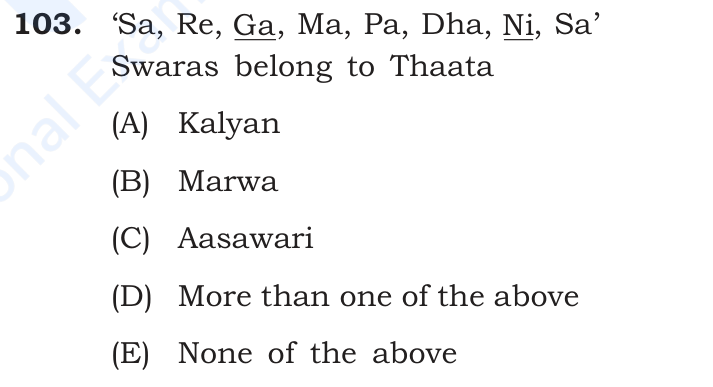
A scale with komal Ga and komal Ni and all other swaras shuddha is Kafi thaat. Kalyan has tivra Ma, Marwa has komal Re and tivra Ma, and Asavari has komal Ga, Dha and Ni, so none of the options is correct.कोमल ग और कोमल नि वाला तथा अन्य सभी शुद्ध स्वरों वाला स्वर-सप्तक काफ़ी थाट है। कल्याण में तीव्र म, मारवा में कोमल रे और तीव्र म, तथा आसावरी में कोमल ग, ध और नि होते हैं, इसलिए कोई भी विकल्प सही नहीं है।
Who is related to Thumri Gayan Shaily?ठुमरी गायन शैली का सम्बन्ध किससे है?
AUstad Amir Khanउस्ताद अमीर खाँ
BNawab Wajid Ali Shahनवाब वाजिद अली शाह
CMian Shoriमियाँ शोरी
DMore than one of the aboveउपर्युक्त में से एक से अधिक
ENone of the aboveउपर्युक्त में से कोई नहीं
Show answerHide answer
Correct answer: (B)Nawab Wajid Ali Shahनवाब वाजिद अली शाह
Explanation
Nawab Wajid Ali Shah of Awadh was a great patron and composer (pen name 'Akhtar Piya') associated with the development of the Lucknow Thumri.अवध के नवाब वाजिद अली शाह (उपनाम 'अख़्तर पिया') लखनऊ की ठुमरी के विकास से जुड़े महान संरक्षक और रचनाकार थे।
Pt. Ravi Shankar belonged to which Gharana of Sitar?पं॰ रवि शंकर सितार के किस घराने से सम्बद्ध थे?
ASenia Gharanaसेनिया घराना
BMehar Gharanaमैहर घराना
CGauripur Gharanaगौरीपुर घराना
DMore than one of the aboveउपर्युक्त में से एक से अधिक
ENone of the aboveउपर्युक्त में से कोई नहीं
Show answerHide answer
Correct answer: (B)Mehar Gharanaमैहर घराना
Explanation
Pt. Ravi Shankar was a disciple of Ustad Allauddin Khan and belonged to the Maihar (Mehar) Gharana.पं. रविशंकर उस्ताद अलाउद्दीन खान के शिष्य थे और मैहर (मेहर) घराने से संबंध रखते थे।
Which Laya is suitable for singing Bada Khayal?‘बड़ा ख्याल’ गायन के लिए कौन-सी लय उपयुक्त है?
AVilambit Layaविलम्बित लय
BDrut Layaद्रुत लय
CMadhya Layaमध्य लय
DMore than one of the aboveउपर्युक्त में से एक से अधिक
ENone of the aboveउपर्युक्त में से कोई नहीं
Show answerHide answer
Correct answer: (A)Vilambit Layaविलम्बित लय
Explanation
Bada Khayal is sung in Vilambit (slow) Laya, which gives room for the gradual unfolding of the raga.बड़ा ख्याल विलम्बित (धीमी) लय में गाया जाता है, जिससे राग के धीरे-धीरे विस्तार के लिए पर्याप्त स्थान मिलता है।
Ustad Vilayat Khan of the Imdadkhani (Etawah) Gharana is famous for the Gayaki Ang, a style of sitar playing that imitates the human voice.इमदादखानी (इटावा) घराने के उस्ताद विलायत खान 'गायकी अंग' के लिए प्रसिद्ध हैं, जो सितार बजाने की वह शैली है जो मानव स्वर की नकल करती है।
Which Raga has been developed through folk music?लोक संगीत से कौन-सा राग विकसित हुआ है?
AShyam Kalyanशाम कल्याण
BPahadiपहाड़ी
CMadhuwantiमधुवन्ती
DMore than one of the aboveउपर्युक्त में से एक से अधिक
ENone of the aboveउपर्युक्त में से कोई नहीं
Show answerHide answer
Correct answer: (B)Pahadiपहाड़ी
Explanation
Raga Pahadi grew out of the folk melodies of the hill regions, and its folk origin is reflected in its light character.राग पहाड़ी पर्वतीय क्षेत्रों की लोक धुनों से विकसित हुआ है और उसका लोक-मूल उसके हल्के स्वभाव में झलकता है।
‘Kalawant’ name stands for‘कलावन्त’ नाम से अभिप्राय है
ADhrupad singerध्रुपद गायक
BThumri singerठुमरी गायक
CTappa singerटप्पा गायक
DMore than one of the aboveउपर्युक्त में से एक से अधिक
ENone of the aboveउपर्युक्त में से कोई नहीं
Show answerHide answer
Correct answer: (A)Dhrupad singerध्रुपद गायक
Explanation
Kalawant was the title of hereditary Dhrupad singers, especially at the Mughal court.कलावंत वंशानुगत ध्रुपद गायकों की उपाधि थी, विशेषकर मुग़ल दरबार में।
DMore than one of the aboveउपर्युक्त में से एक से अधिक
ENone of the aboveउपर्युक्त में से कोई नहीं
Show answerHide answer
Correct answer: (A)North Indiaउत्तर भारत
Explanation
Kathak is the classical dance form of North India (Lucknow, Jaipur and Banaras gharanas).कथक उत्तर भारत का शास्त्रीय नृत्य है (लखनऊ, जयपुर और बनारस घराने)।
DMore than one of the aboveउपर्युक्त में से एक से अधिक
ENone of the aboveउपर्युक्त में से कोई नहीं
Show answerHide answer
Correct answer: (C)harmonyहारमनी पर
Explanation
Western music is based on harmony, the simultaneous sounding of several notes (chords), while Indian music is based on melody.पाश्चात्य संगीत हार्मनी (अनेक स्वरों के एक साथ बजने, यानी कॉर्ड) पर आधारित है, जबकि भारतीय संगीत मेलोडी (राग-धुन) पर आधारित है।
Who has been awarded ‘Bharat Ratna’?‘भारत रत्न’ सम्मान किसे मिला है?
ALata Mangeshkarलता मंगेशकर
BMohammed Rafiमोहम्मद रफी
CUstad Zakir Hussainउस्ताद जाकिर हुसैन
DMore than one of the aboveउपर्युक्त में से एक से अधिक
ENone of the aboveउपर्युक्त में से कोई नहीं
Show answerHide answer
Correct answer: (A)Lata Mangeshkarलता मंगेशकर
Explanation
Lata Mangeshkar received the Bharat Ratna in 2001. Mohammed Rafi and Ustad Zakir Hussain have not received it.लता मंगेशकर को 2001 में भारत रत्न मिला। मोहम्मद रफ़ी और उस्ताद ज़ाकिर हुसैन को यह सम्मान नहीं मिला है।
‘Ga, Ma, Pa, Ga, Ma, Ga, Re, Sa’ these Swaras are used in Raag‘ग, म, प, ग, म, ग, रे, सा’ ये स्वर किस राग में प्रयुक्त होते हैं?
AYamanयमन
BBhopaliभोपाली
CBihagबिहाग
DMore than one of the aboveउपर्युक्त में से एक से अधिक
ENone of the aboveउपर्युक्त में से कोई नहीं
Show answerHide answer
Correct answer: (C)Bihagबिहाग
Explanation
The phrase Ga Ma Pa Ga Ma Ga, Re Sa is a characteristic pakad of Raga Bihag. Bhopali omits Ma, and Yaman uses tivra Ma.ग म प ग म ग, रे सा बिहाग राग का एक विशिष्ट पकड़ है। भूपाली में म वर्जित है और यमन में तीव्र म लगता है।
Which Taal has ununiform structure of all divisions?किस ताल में सभी विभागों के रूप असमान हैं?
AAda Chartaalआड़ा चारताल
BDadraदादरा
CDhamarधमार
DMore than one of the aboveउपर्युक्त में से एक से अधिक
ENone of the aboveउपर्युक्त में से कोई नहीं
Show answerHide answer
Correct answer: (C)Dhamarधमार
Explanation
Dhamar (14 beats) is divided 5+2+3+4, so its vibhagas are all of different sizes. Ada Chautal and Dadra have equal divisions.धमार (14 मात्राएँ) 5+2+3+4 में बँटा है, इसलिए उसके सभी विभाग अलग-अलग माप के हैं। आड़ा चौताल और दादरा में विभाग बराबर होते हैं।
‘Chaiti’ is a folk song of the State of‘चैती’ किस राज्य का लोक-गीत है?
ARajasthanराजस्थान
BUttar Pradeshउत्तर प्रदेश
CWest Bengalपश्चिम बंगाल
DMore than one of the aboveउपर्युक्त में से एक से अधिक
ENone of the aboveउपर्युक्त में से कोई नहीं
Show answerHide answer
Correct answer: (B)Uttar Pradeshउत्तर प्रदेश
Explanation
Chaiti is a folk song of the month of Chaitra sung in eastern Uttar Pradesh (and Bihar), especially around Banaras.चैती चैत्र मास का लोकगीत है, जो पूर्वी उत्तर प्रदेश (और बिहार) में, विशेषकर बनारस के आसपास, गाया जाता है।
In which Rag Re and Dha Swaras are not used in Aaroh?किस राग के आरोह में ‘रे’ तथा ‘ध’ स्वर प्रयुक्त नहीं होते हैं?
AAlhaiya Bilawalअल्हैया बिलावल
BYamanयमन
CBihagबिहाग
DMore than one of the aboveउपर्युक्त में से एक से अधिक
ENone of the aboveउपर्युक्त में से कोई नहीं
Show answerHide answer
Correct answer: (C)Bihagबिहाग
Explanation
In Raga Bihag the aaroh is Ni Sa Ga Ma Pa Ni Sa, omitting Re and Dha, while they are used in the avaroh.राग बिहाग में आरोह नि सा ग म प नि सा है, जिसमें रे और ध वर्जित हैं, जबकि अवरोह में वे लगते हैं।
Which of the following took place in mediaeval period?मध्यकालीन युग में क्या हुआ?
APlacement of Swaras according to the length of wireतार की लम्बाई के आधार पर स्वर स्थापना
BRichaganरिचागान परम्परा
CUse of Raga wordराग शब्द का प्रयोग
DMore than one of the aboveउपर्युक्त में से एक से अधिक
ENone of the aboveउपर्युक्त में से कोई नहीं
Show answerHide answer
Correct answer: (A)Placement of Swaras according to the length of wireतार की लम्बाई के आधार पर स्वर स्थापना
Explanation
Fixing the positions of swaras according to the length of the vina string was done by medieval writers such as Ahobal (Sangeet Parijat) and Pt. Srinivas. Richagan belongs to the Vedic period.वीणा के तार की लंबाई के अनुसार स्वरों के स्थान निश्चित करने का कार्य अहोबल (संगीत पारिजात) और पं. श्रीनिवास जैसे मध्यकालीन लेखकों ने किया। ऋचागान वैदिक काल का है।
The total of Shuddh and Vikrit Swaras which exist in music at present isआधुनिक काल में, शुद्ध और विकृत कुल संगीत के स्वर हैं
A1010
B1111
C1212
DMore than one of the aboveउपर्युक्त में से एक से अधिक
ENone of the aboveउपर्युक्त में से कोई नहीं
Show answerHide answer
Correct answer: (C)1212
Explanation
There are 7 shuddha swaras and 5 vikrit swaras (komal Re, Ga, Dha, Ni and tivra Ma), giving 12 swaras in total.7 शुद्ध स्वर और 5 विकृत स्वर (कोमल रे, ग, ध, नि और तीव्र म) हैं, यानी कुल 12 स्वर।
Which treatise of music first mentioned the ‘Gram’?‘ग्राम’ का उल्लेख सर्वप्रथम किस संगीत-ग्रंथ में किया गया है?
ABrihaddeshiबृहद्देशी
BNatyashastraनाट्यशास्त्र
CSangita Ratnakaraसंगीतरत्नाकर
DMore than one of the aboveउपर्युक्त में से एक से अधिक
ENone of the aboveउपर्युक्त में से कोई नहीं
Show answerHide answer
Correct answer: (B)Natyashastraनाट्यशास्त्र
Explanation
Bharata's Natyashastra (c. 2nd century BCE - 2nd century CE) is the earliest treatise to describe the Grama system (Shadja and Madhyama grama) with its shrutis and murchhanas.भरत का नाट्यशास्त्र (लगभग ईसा पूर्व दूसरी शताब्दी से ईसा की दूसरी शताब्दी) ग्राम पद्धति (षडज और मध्यम ग्राम) का श्रुतियों और मूर्च्छनाओं सहित वर्णन करने वाला सबसे प्राचीन ग्रंथ है।
DMore than one of the aboveउपर्युक्त में से एक से अधिक
ENone of the aboveउपर्युक्त में से कोई नहीं
Show answerHide answer
Correct answer: (A)Swaras of Gramग्राम के स्वरों से
Explanation
A murchhana is the ascending-descending series of the seven swaras of a grama, started in turn from each note. So it belongs to the swaras of the Gram.मूर्च्छना किसी ग्राम के सात स्वरों की आरोह-अवरोह श्रेणी है, जो बारी-बारी से हर स्वर से आरंभ की जाती है। इसलिए यह ग्राम के स्वरों से संबंधित है।
What is ‘Varna’ in Music?संगीत में ‘वर्ण’ किसे कहते हैं?
AAction of Taanतान की क्रिया
BAction of singingगान की क्रिया
CAction of danceनृत्य की क्रिया
DMore than one of the aboveउपर्युक्त में से एक से अधिक
ENone of the aboveउपर्युक्त में से कोई नहीं
Show answerHide answer
Correct answer: (B)Action of singingगान की क्रिया
Explanation
Varna is the 'gana kriya', the act of singing, i.e. the way the voice moves through the notes (sthayi, arohi, avarohi, sanchari).वर्ण 'गान क्रिया' है, यानी गाने की क्रिया, अर्थात आवाज़ का स्वरों में चलने का ढंग (स्थायी, आरोही, अवरोही, संचारी)।
BSequence cluster of the Swarasस्वरों का क्रमिक समूह
CSargam Geetसरगम गीत
DMore than one of the aboveउपर्युक्त में से एक से अधिक
ENone of the aboveउपर्युक्त में से कोई नहीं
Show answerHide answer
Correct answer: (B)Sequence cluster of the Swarasस्वरों का क्रमिक समूह
Explanation
An alankar is a patterned sequence of swaras (e.g. Sa Re Ga, Re Ga Ma ...) repeated up and down the scale, used for practice and ornamentation.अलंकार स्वरों का एक निश्चित क्रमबद्ध समूह है (जैसे सा रे ग, रे ग म ...) जो सप्तक में ऊपर-नीचे दोहराया जाता है और अभ्यास तथा सजावट के लिए प्रयुक्त होता है।
DMore than one of the aboveउपर्युक्त में से एक से अधिक
ENone of the aboveउपर्युक्त में से कोई नहीं
Show answerHide answer
Correct answer: (C)Raga musicराग संगीत में
Explanation
Gamak is an oscillating, shaken ornamentation of swaras used in the rendering of ragas, in both vocal and instrumental raga music.गमक स्वरों की कंपनयुक्त, हिलती हुई अलंकरण-क्रिया है, जो गायन और वादन दोनों में राग संगीत के प्रस्तुतीकरण में प्रयुक्त होती है।
The total types of Laya areलय के कुल कितने प्रकार हैं?
Atwoदो
Bthreeतीन
Cfourचार
DMore than one of the aboveउपर्युक्त में से एक से अधिक
ENone of the aboveउपर्युक्त में से कोई नहीं
Show answerHide answer
Correct answer: (B)threeतीन
Explanation
Laya (tempo) is of three types: vilambit (slow), madhya (medium) and drut (fast).लय (गति) तीन प्रकार की है: विलम्बित (धीमी), मध्य (मध्यम) और द्रुत (तेज़)।
Which treatise mentioned the Dashavidha Raga-Vargikaran?दशविध राग-वर्गीकरण का उल्लेख किस ग्रंथ में किया गया है?
ADattilamदत्तिलम्
BRaag Darpanराग दर्पण
CSangita Ratnakaraसंगीतरत्नाकर
DMore than one of the aboveउपर्युक्त में से एक से अधिक
ENone of the aboveउपर्युक्त में से कोई नहीं
Show answerHide answer
Correct answer: (C)Sangita Ratnakaraसंगीतरत्नाकर
Explanation
Sharangdev's Sangita Ratnakara (13th century) classifies ragas into ten classes (dashavidha raga vargikaran): grama raga, uparaga, raga, bhasha, vibhasha, antarbhasha, ragang, bhashang, kriyang and upang.शारंगदेव के संगीत रत्नाकर (13वीं शताब्दी) में रागों को दस वर्गों में बाँटा गया है (दशविध राग वर्गीकरण): ग्राम राग, उपराग, राग, भाषा, विभाषा, अंतरभाषा, रागांग, भाषांग, क्रियांग और उपांग।
Which music style adopted the Mela Raga-Vargikaran?मेल राग-वर्गीकरण को किस संगीत पद्धति ने अपनाया?
AWestern musicपाश्चात्य संगीत
BCarnatic musicकर्नाटक संगीत
CHindustani musicहिंदुस्तानी संगीत
DMore than one of the aboveउपर्युक्त में से एक से अधिक
ENone of the aboveउपर्युक्त में से कोई नहीं
Show answerHide answer
Correct answer: (B)Carnatic musicकर्नाटक संगीत
Explanation
The mela system (72 melakartas, systematised by Venkatamakhin) is the raga classification of Carnatic music. Hindustani music uses thaats.मेल पद्धति (72 मेलकर्ता, जिन्हें वेंकटमखी ने व्यवस्थित किया) कर्नाटक संगीत का राग वर्गीकरण है। हिंदुस्तानी संगीत में थाट प्रयुक्त होते हैं।
DMore than one of the aboveउपर्युक्त में से एक से अधिक
ENone of the aboveउपर्युक्त में से कोई नहीं
Show answerHide answer
Correct answer: (C)vibrationकंपन से
Explanation
Gamak is produced by a shaking or vibration (kampan) of the swara. So it is related to vibration.गमक स्वर के हिलाने या कंपन (कंपन) से उत्पन्न होता है। इसलिए यह कंपन से संबंधित है।
According to the time theory of Ragas, the singing time of the Ragas having the Re, Dha Komal and Shuddha Ma isरागों के समय सिद्धान्त के अनुसार, रे, ध कोमल एवं शुद्ध म वाले रागों का गायन समय है
Afour to seven amप्रातः चार से सात बजे तक
Bseven to ten pmसायं सात से दस बजे तक
Cten pm to four amरात्रि दस से प्रातः चार बजे तक
DMore than one of the aboveउपर्युक्त में से एक से अधिक
ENone of the aboveउपर्युक्त में से कोई नहीं
Show answerHide answer
Correct answer: (A)four to seven amप्रातः चार से सात बजे तक
Explanation
Ragas with komal Re and komal Dha and shuddha Ma (e.g. Bhairav) are sandhiprakash ragas of dawn. Their time is about 4 to 7 am.कोमल रे और कोमल ध तथा शुद्ध म वाले राग (जैसे भैरव) प्रातःकाल के संधिप्रकाश राग हैं। इनका समय लगभग प्रातः 4 से 7 बजे है।
The time of Ragas with Shuddha Re, Ga, Dha isरे, ग, ध शुद्ध स्वरों वाले रागों का समय है
Afour to seven amप्रातः चार से सात बजे तक
Bseven to ten pmसायं सात से दस बजे तक
Cten pm to four amरात्रि दस से प्रातः चार बजे तक
DMore than one of the aboveउपर्युक्त में से एक से अधिक
ENone of the aboveउपर्युक्त में से कोई नहीं
Show answerHide answer
Correct answer: (B)seven to ten pmसायं सात से दस बजे तक
Explanation
Ragas with shuddha Re, Ga and Dha (e.g. Bilawal, Yaman, Kalyan) are sung after the sandhiprakash period, i.e. 7 to 10 (am or pm). The key takes 7 to 10 pm.शुद्ध रे, ग और ध वाले राग (जैसे बिलावल, यमन, कल्याण) संधिप्रकाश काल के बाद, यानी 7 से 10 (प्रातः या सायं) गाए जाते हैं। उत्तर कुंजी में सायं 7 से 10 बजे लिया गया है।
The time of the Ragas with Komal Ga-Ni isकोमल ग-नि स्वरों वाले रागों का समय है
Afour to seven amप्रातः चार से सात बजे तक
Bseven to ten pmसायं सात से दस बजे तक
Cten pm to four amरात्रि दस से प्रातः चार बजे तक
DMore than one of the aboveउपर्युक्त में से एक से अधिक
ENone of the aboveउपर्युक्त में से कोई नहीं
Show answerHide answer
Correct answer: (C)ten pm to four amरात्रि दस से प्रातः चार बजे तक
Explanation
Ragas with komal Ga and komal Ni (e.g. Kafi-group ragas like Bageshri, Malkauns) belong to the period 10 pm to 4 am (and 10 am to 4 pm).कोमल ग और कोमल नि वाले राग (जैसे काफ़ी वर्ग के राग बागेश्री, मालकौंस) रात्रि 10 बजे से प्रातः 4 बजे (और दिन 10 से 4 बजे) के समय के हैं।
Sangita Ratnakara was written in the period ofसंगीतरत्नाकर का रचना-काल है
A14th century14वीं शताब्दी
B13th century13वीं शताब्दी
C12th century12वीं शताब्दी
DMore than one of the aboveउपर्युक्त में से एक से अधिक
ENone of the aboveउपर्युक्त में से कोई नहीं
Show answerHide answer
Correct answer: (B)13th century13वीं शताब्दी
Explanation
Sangita Ratnakara was written by Sharangdev in the 13th century (c. 1210-1247) at the Yadava court of Devagiri.संगीत रत्नाकर की रचना शारंगदेव ने 13वीं शताब्दी (लगभग 1210-1247) में देवगिरि के यादव दरबार में की थी।
Who is the author of Sangita Ratnakara treatise?संगीतरत्नाकर ग्रंथ के रचयिता कौन हैं?
ABharata Muniभरत मुनि
BSharangdevशारंगदेव
CNarada Muniनारद मुनि
DMore than one of the aboveउपर्युक्त में से एक से अधिक
ENone of the aboveउपर्युक्त में से कोई नहीं
Show answerHide answer
Correct answer: (B)Sharangdevशारंगदेव
Explanation
Sangita Ratnakara was written by Sharangdev (Sharngadeva), a scholar at the Yadava court of Devagiri.संगीत रत्नाकर के रचयिता शारंगदेव हैं, जो देवगिरि के यादव दरबार के विद्वान थे।
How many chapters are there in Sangita Ratnakara text?संगीतरत्नाकर में कितने अध्याय हैं?
ANineनौ
BEightआठ
CSevenसात
DMore than one of the aboveउपर्युक्त में से एक से अधिक
ENone of the aboveउपर्युक्त में से कोई नहीं
Show answerHide answer
Correct answer: (C)Sevenसात
Explanation
Sangita Ratnakara has seven chapters (adhyayas): swaragata, ragaviveka, prakirnaka, prabandha, tala, vadya and nartana. It is therefore also called 'Saptadhyayi'.संगीत रत्नाकर में सात अध्याय हैं: स्वरगताध्याय, रागविवेकाध्याय, प्रकीर्णकाध्याय, प्रबंधाध्याय, तालाध्याय, वाद्याध्याय और नर्तनाध्याय। इसीलिए इसे 'सप्ताध्यायी' भी कहते हैं।
The author of Sangeet Parijat isसंगीत पारिजात के रचयिता हैं
APandit Lochanपंडित लोचन
BPandit Shrinivasपंडित श्रीनिवास
CPandit Ahobalपंडित अहोबल
DMore than one of the aboveउपर्युक्त में से एक से अधिक
ENone of the aboveउपर्युक्त में से कोई नहीं
Show answerHide answer
Correct answer: (C)Pandit Ahobalपंडित अहोबल
Explanation
Sangeet Parijat was written by Pandit Ahobal. It is known for fixing the positions of the shuddha and vikrit swaras on the length of the veena string.संगीत पारिजात के रचयिता पंडित अहोबल हैं। यह ग्रंथ शुद्ध और विकृत स्वरों को वीणा के तार की लंबाई के आधार पर स्थापित करने के लिए प्रसिद्ध है।
Sangeet Parijat text was written in the period ofसंगीत पारिजात का रचना-काल है
A15th century15वीं शताब्दी
B17th century17वीं शताब्दी
C16th century16वीं शताब्दी
DMore than one of the aboveउपर्युक्त में से एक से अधिक
ENone of the aboveउपर्युक्त में से कोई नहीं
Show answerHide answer
Correct answer: (B)17th century17वीं शताब्दी
Explanation
Pandit Ahobal wrote Sangeet Parijat in the 17th century (around 1650 CE). It was later translated into Persian (1724).पंडित अहोबल ने संगीत पारिजात की रचना 17वीं शताब्दी (लगभग 1650 ई.) में की थी। बाद में इसका फ़ारसी अनुवाद (1724) हुआ।
BPandit Vishnu Narayan Bhatkhandeपंडित विष्णु नारायण भातखंडे
CAacharya Brihaspatiआचार्य बृहस्पति
DMore than one of the aboveउपर्युक्त में से एक से अधिक
ENone of the aboveउपर्युक्त में से कोई नहीं
Show answerHide answer
Correct answer: (B)Pandit Vishnu Narayan Bhatkhandeपंडित विष्णु नारायण भातखंडे
Explanation
Pandit Vishnu Narayan Bhatkhande proposed the thaat-raga classification of Hindustani ragas into ten thaats.पंडित विष्णु नारायण भातखंडे ने हिंदुस्तानी रागों को दस थाटों में बाँटने वाला थाट-राग वर्गीकरण प्रस्तुत किया।
How many types of Varna are there?वर्ण के कितने प्रकार हैं?
AFourचार
BSixछह
CEightआठ
DMore than one of the aboveउपर्युक्त में से एक से अधिक
ENone of the aboveउपर्युक्त में से कोई नहीं
Show answerHide answer
Correct answer: (A)Fourचार
Explanation
There are four varnas: sthayi (staying on a note), arohi (ascending), avarohi (descending) and sanchari (a mix of all).वर्ण चार हैं: स्थायी (एक स्वर पर ठहरना), आरोही (चढ़ना), अवरोही (उतरना) और संचारी (सबका मिश्रण)।
Raga Bhimpalasi belongs to which Thaat?राग भीमपलासी किस थाट का राग है?
AKafiकाफी
BKhamajखमाज
CPoorviपूर्वी
DMore than one of the aboveउपर्युक्त में से एक से अधिक
ENone of the aboveउपर्युक्त में से कोई नहीं
Show answerHide answer
Correct answer: (A)Kafiकाफी
Explanation
Raga Bhimpalasi uses komal Ga and komal Ni, which are the notes of Kafi thaat. So it belongs to Kafi thaat.राग भीमपलासी में कोमल ग और कोमल नि लगते हैं, जो काफ़ी थाट के स्वर हैं। इसलिए यह काफ़ी थाट का राग है।
How to use these BPSC TRE Music questions
Every question here was asked in a real BPSC TRE paper; the paper and shift are shown on the card, and the number opens the question on its own page. Try each one before tapping Show answer, then attempt the full BPSC TRE papers as timed tests to check your speed under exam conditions.