240 Music questions asked in BPSC TRE previous year papers, each with the correct answer and explanation. Read them free on UTpaper, or attempt the full papers as timed online tests.
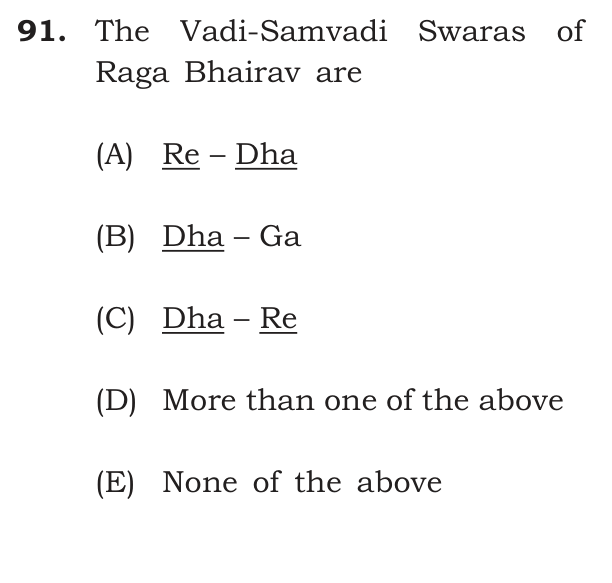
DMore than one of the aboveउपर्युक्त में से एक से अधिक
ENone of the aboveउपर्युक्त में से कोई नहीं
Show answerHide answer
Correct answer: (C)komal Dha – komal Reकोमल ध – कोमल रे
Explanation
In Raga Bhairav the vadi is komal Dha and the samvadi is komal Re, as option (C) shows.राग भैरव में वादी कोमल ध और संवादी कोमल रे है, जैसा विकल्प (C) में दिखाया गया है।
DMore than one of the aboveउपर्युक्त में से एक से अधिक
ENone of the aboveउपर्युक्त में से कोई नहीं
Show answerHide answer
Correct answer: (A)Audav – Shadavऔडव – षाडव
Explanation
In the commonly taught form of Raga Kedar, Re and Ga are omitted in the ascent (Sa Ma, Ma Pa, Dha Pa, Ni Dha Sa: five notes) and Ga is weak or omitted in the descent (six notes), so its jati is Audav-Shadav.राग केदार के प्रचलित रूप में आरोह में रे और ग वर्जित हैं (सा म, म प, ध प, नि ध सा: पाँच स्वर) और अवरोह में ग दुर्बल या वर्जित है (छह स्वर), इसलिए इसकी जाति औडव-षाडव है।
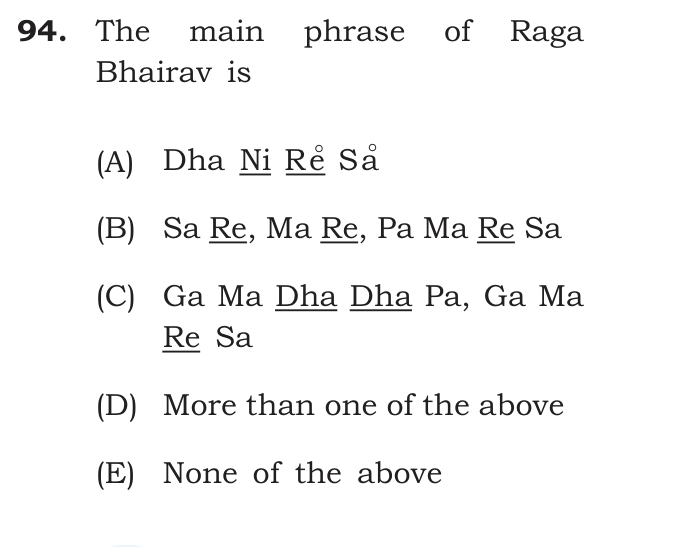
BSa komal-Re, Ma komal-Re, Pa Ma komal-Re Saसा कोमल-रे, म कोमल-रे, प म कोमल-रे सा
CGa Ma komal-Dha komal-Dha Pa, Ga Ma komal-Re Saग म कोमल-ध कोमल-ध प, ग म कोमल-रे सा
DMore than one of the aboveउपर्युक्त में से एक से अधिक
ENone of the aboveउपर्युक्त में से कोई नहीं
Show answerHide answer
Correct answer: (C)Ga Ma komal-Dha komal-Dha Pa, Ga Ma komal-Re Saग म कोमल-ध कोमल-ध प, ग म कोमल-रे सा
Explanation
The pakad of Bhairav is 'Ga Ma Dha Dha Pa, Ga Ma Re Re Sa' with komal Dha and komal Re, as in option (C).भैरव का पकड़ 'ग म ध ध प, ग म रे रे सा' है, जिसमें कोमल ध और कोमल रे हैं, जैसा विकल्प (C) में है।
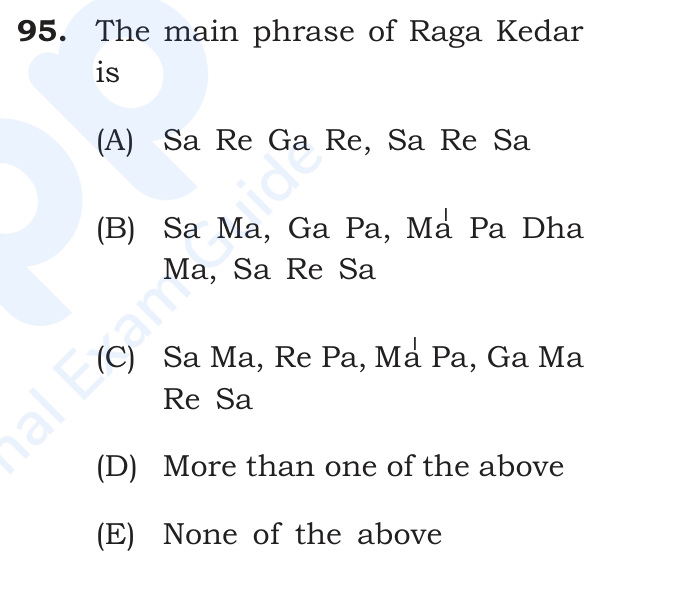
BSa Ma, Ga Pa, tivra-Ma Pa Dha Ma, Sa Re Saसा म, ग प, तीव्र-म प ध म, सा रे सा
CSa Ma, Re Pa, tivra-Ma Pa, Ga Ma Re Saसा म, रे प, तीव्र-म प, ग म रे सा
DMore than one of the aboveउपर्युक्त में से एक से अधिक
ENone of the aboveउपर्युक्त में से कोई नहीं
Show answerHide answer
Correct answer: (B)Sa Ma, Ga Pa, tivra-Ma Pa Dha Ma, Sa Re Saसा म, ग प, तीव्र-म प ध म, सा रे सा
Explanation
The characteristic phrase of Raga Kedar is 'Sa Ma, Ga Pa, tivra Ma Pa Dha Pa Ma, Sa Re Sa', which matches option (B).राग केदार का विशिष्ट स्वर-समूह 'सा म, ग प, तीव्र म प ध प म, सा रे सा' है, जो विकल्प (B) से मेल खाता है।
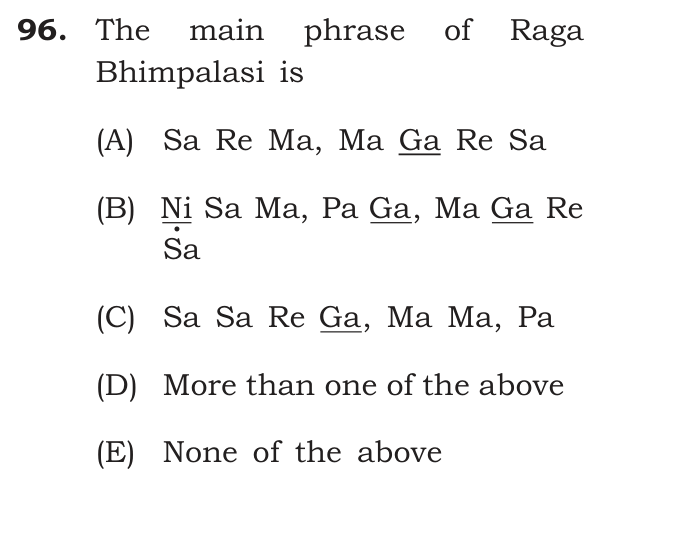
ASa Re Ma, Ma komal-Ga Re Saसा रे म, म कोमल-ग रे सा
Bmandra-komal-Ni Sa Ma, Pa komal-Ga, Ma komal-Ga Re Saमंद्र-कोमल-नि सा म, प कोमल-ग, म कोमल-ग रे सा
CSa Sa Re komal-Ga, Ma Ma, Paसा सा रे कोमल-ग, म म, प
DMore than one of the aboveउपर्युक्त में से एक से अधिक
ENone of the aboveउपर्युक्त में से कोई नहीं
Show answerHide answer
Correct answer: (B)mandra-komal-Ni Sa Ma, Pa komal-Ga, Ma komal-Ga Re Saमंद्र-कोमल-नि सा म, प कोमल-ग, म कोमल-ग रे सा
Explanation
The pakad of Bhimpalasi is 'mandra komal Ni Sa Ma, Pa komal Ga, Ma komal Ga Re Sa', as in option (B).भीमपलासी का पकड़ 'मंद्र कोमल नि सा म, प कोमल ग, म कोमल ग रे सा' है, जैसा विकल्प (B) में है।
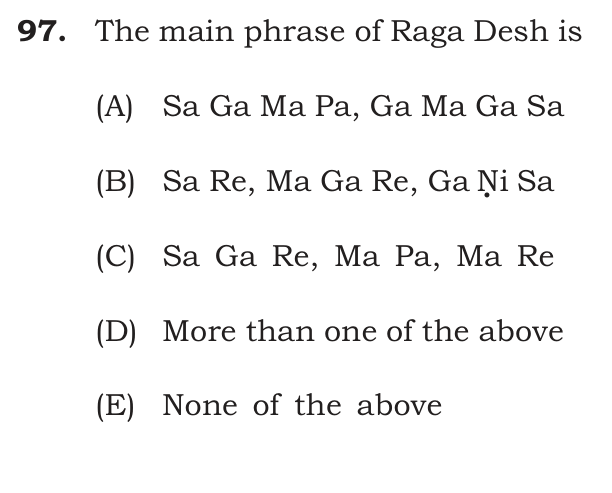
BSa Re, Ma Ga Re, Ga mandra-Ni Saसा रे, म ग रे, ग मंद्र-नि सा
CSa Ga Re, Ma Pa, Ma Reसा ग रे, म प, म रे
DMore than one of the aboveउपर्युक्त में से एक से अधिक
ENone of the aboveउपर्युक्त में से कोई नहीं
Show answerHide answer
Correct answer: (B)Sa Re, Ma Ga Re, Ga mandra-Ni Saसा रे, म ग रे, ग मंद्र-नि सा
Explanation
Raga Desh is recognised by the phrase 'Re Ma Ga Re, Ga Ni Sa' (descending Ma Ga Re and then Ga to mandra Ni Sa). Option (B) 'Sa Re, Ma Ga Re, Ga mandra-Ni Sa' is this pakad.राग देस की पहचान 'रे म ग रे, ग नि सा' स्वर-समूह से होती है (अवरोह में म ग रे और फिर ग से मंद्र नि सा)। विकल्प (B) 'सा रे, म ग रे, ग मंद्र नि सा' यही पकड़ है।
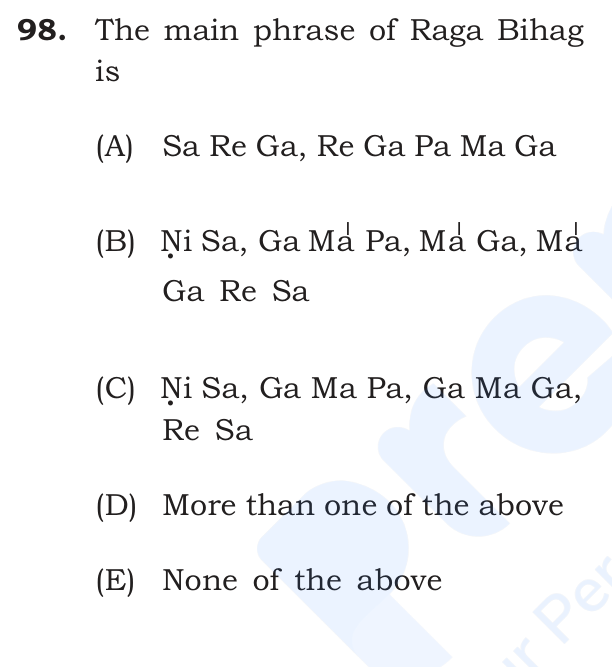
Bmandra-Ni Sa, Ga tivra-Ma Pa, tivra-Ma Ga, tivra-Ma Ga Re Saमंद्र-नि सा, ग तीव्र-म प, तीव्र-म ग, तीव्र-म ग रे सा
Cmandra-Ni Sa, Ga Ma Pa, Ga Ma Ga, Re Saमंद्र-नि सा, ग म प, ग म ग, रे सा
DMore than one of the aboveउपर्युक्त में से एक से अधिक
ENone of the aboveउपर्युक्त में से कोई नहीं
Show answerHide answer
Correct answer: (C)mandra-Ni Sa, Ga Ma Pa, Ga Ma Ga, Re Saमंद्र-नि सा, ग म प, ग म ग, रे सा
Explanation
The pakad of Bihag is 'mandra Ni Sa, Ga Ma Pa, Ga Ma Ga, Re Sa' with shuddha Ma, as in option (C).बिहाग का पकड़ 'मंद्र नि सा, ग म प, ग म ग, रे सा' है, जिसमें शुद्ध म है, जैसा विकल्प (C) में है।
How many Matras are there in Taal Tilwada?ताल तिलवाड़ा में कितनी मात्राएँ हैं?
ATwelveबारह
BFifteenपंद्रह
CSixteenसोलह
DMore than one of the aboveउपर्युक्त में से एक से अधिक
ENone of the aboveउपर्युक्त में से कोई नहीं
Show answerHide answer
Correct answer: (C)Sixteenसोलह
Explanation
Tilwada taal has 16 matras divided into four vibhags of 4 each (like Teentaal, but with a different theka).तिलवाड़ा ताल में 16 मात्राएँ हैं, जो चार-चार मात्राओं के चार विभागों में बँटी हैं (तीनताल जैसी, पर ठेका अलग)।
What is the correct sequence of the Matras in four divisions of Taal Dhamar?ताल धमार के चार विभागों में मात्राओं का सही क्रम है
A4–3–5–24–3–5–2
B5–2–3–45–2–3–4
C5–4–3–25–4–3–2
DMore than one of the aboveउपर्युक्त में से एक से अधिक
ENone of the aboveउपर्युक्त में से कोई नहीं
Show answerHide answer
Correct answer: (B)5–2–3–45–2–3–4
Explanation
Dhamar taal has 14 matras divided into four vibhags of 5, 2, 3 and 4 matras.धमार ताल में 14 मात्राएँ हैं, जो 5, 2, 3 और 4 मात्राओं के चार विभागों में बँटी हैं।
What is the synonym for Alankar in Music?संगीत में अलंकार के लिए प्रयुक्त होने वाला पर्यायी शब्द है
ATukdaटुकड़ा
BMukhdaमुखड़ा
CPaltaपलटा
DMore than one of the aboveउपर्युक्त में से एक से अधिक
ENone of the aboveउपर्युक्त में से कोई नहीं
Show answerHide answer
Correct answer: (C)Paltaपलटा
Explanation
An alankar is also called a palta: a fixed pattern of swaras practised up and down the scale.अलंकार को पलटा भी कहते हैं: स्वरों का एक निश्चित रूप, जिसका सप्तक में ऊपर-नीचे अभ्यास किया जाता है।
On which Matra is the Khali in Taal Rupak?ताल रूपक में खाली किस मात्रा पर है?
AFourthचौथी
BSixthछठी
CFirstपहली
DMore than one of the aboveउपर्युक्त में से एक से अधिक
ENone of the aboveउपर्युक्त में से कोई नहीं
Show answerHide answer
Correct answer: (C)Firstपहली
Explanation
Rupak taal has 7 matras (3-2-2) and, unusually, its first matra (sam) is shown as khali.रूपक ताल में 7 मात्राएँ (3-2-2) होती हैं और, असामान्य रूप से, इसकी पहली मात्रा (सम) खाली से दिखाई जाती है।
In whose regime the Dhrupad genre got popularized?ध्रुपद शैली का प्रसार किसके शासनकाल में हुआ?
AAkbarअक़बर
BShah Jahanशाहजहाँ
CMan Singh Tomarमान सिंह तोमर
DMore than one of the aboveउपर्युक्त में से एक से अधिक
ENone of the aboveउपर्युक्त में से कोई नहीं
Show answerHide answer
Correct answer: (C)Man Singh Tomarमान सिंह तोमर
Explanation
Dhrupad was developed and popularised in the court of Raja Man Singh Tomar of Gwalior (late 15th - early 16th century).ध्रुपद का विकास और प्रसार ग्वालियर के राजा मानसिंह तोमर (15वीं शताब्दी के अंत से 16वीं के आरंभ) के दरबार में हुआ।
How many Banis are there in Dhrupad?ध्रुपद की कितनी बानियाँ हैं?
AFourचार
BEightआठ
CTwelveबारह
DMore than one of the aboveउपर्युक्त में से एक से अधिक
ENone of the aboveउपर्युक्त में से कोई नहीं
Show answerHide answer
Correct answer: (A)Fourचार
Explanation
Dhrupad has four banis (styles): Gauhar (Gobarhari), Khandar, Nauhar and Dagar.ध्रुपद की चार बानियाँ (शैलियाँ) हैं: गौहर (गोबरहारी), खंडार, नौहार और डागर।
The alternative word for Dhamar style of singing isधमार गायन शैली का अन्य नाम है
AThumriठुमरी
BTappaटप्पा
CHoriहोरी
DMore than one of the aboveउपर्युक्त में से एक से अधिक
ENone of the aboveउपर्युक्त में से कोई नहीं
Show answerHide answer
Correct answer: (C)Horiहोरी
Explanation
Dhamar songs mostly describe Holi, Krishna and the Gopis playing with colours, so the Dhamar style is also called Hori.धमार के गीतों में अधिकतर होली, कृष्ण और गोपियों के रंग खेलने का वर्णन होता है, इसलिए धमार शैली को होरी भी कहा जाता है।
What is not included in a Tarana?तराने में क्या प्रयुक्त नहीं होता?
ALyrics of Bandishबंदिश के बोल
BSyllables of Tablaतबले के बोल
CNom-Tom, Da-Dir syllablesनोम-तोम, दा-दिर के बोल
DMore than one of the aboveउपर्युक्त में से एक से अधिक
ENone of the aboveउपर्युक्त में से कोई नहीं
Show answerHide answer
Correct answer: (A)Lyrics of Bandishबंदिश के बोल
Explanation
A tarana uses meaningless syllables like nom, tom, ta, na, dir, dani and sometimes tabla or pakhawaj bols; it does not have the meaningful lyrics of a bandish.तराना में नोम, तोम, ता, ना, दिर, दानी जैसे निरर्थक अक्षर और कभी-कभी तबला या पखावज के बोल होते हैं; इसमें बंदिश के सार्थक शब्द नहीं होते।
Who is believed to be the creator of Tarana?तराने का आविष्कारक किसे माना जाता है?
ATansenतानसेन
BAmir Khusrowअमीर ख़ुसरो
CSadarang-Adarangसदारंग-अदारंग
DMore than one of the aboveउपर्युक्त में से एक से अधिक
ENone of the aboveउपर्युक्त में से कोई नहीं
Show answerHide answer
Correct answer: (B)Amir Khusrowअमीर ख़ुसरो
Explanation
Tarana is traditionally credited to Amir Khusrow (13th-14th century), who used Persian-style syllables in place of words.तराना का रचयिता परंपरागत रूप से अमीर खुसरो (13वीं-14वीं शताब्दी) को माना जाता है, जिन्होंने शब्दों के स्थान पर फ़ारसी ढंग के अक्षरों का प्रयोग किया।
CGroup of Swaras indicating a Ragaराग दर्शक स्वरसमूह
DMore than one of the aboveउपर्युक्त में से एक से अधिक
ENone of the aboveउपर्युक्त में से कोई नहीं
Show answerHide answer
Correct answer: (C)Group of Swaras indicating a Ragaराग दर्शक स्वरसमूह
Explanation
Pakad is the small group of swaras that captures the identity of a raga, so that the raga can be recognised from it.पकड़ स्वरों का वह छोटा समूह है जो राग की पहचान करा देता है, जिससे राग को पहचाना जा सके।
How many Talis are there in Tala Kaharva?ताल कहरवा में कितनी तालियाँ हैं?
AOneएक
BTwoदो
CThreeतीन
DMore than one of the aboveउपर्युक्त में से एक से अधिक
ENone of the aboveउपर्युक्त में से कोई नहीं
Show answerHide answer
Correct answer: (A)Oneएक
Explanation
Kaharva taal has 8 matras in two vibhags (4-4): a taali on the 1st matra (sam) and a khali on the 5th. So it has one taali.कहरवा ताल में 8 मात्राएँ दो विभागों (4-4) में होती हैं: पहली मात्रा (सम) पर ताली और पाँचवीं पर खाली। इसलिए इसमें एक ताली है।
The total number of Shuddha and Vikrit Swaras in an octave isएक सप्तक में कुल शुद्ध एवं विकृत स्वरों की संख्या है
Asevenसात
Btwelveबारह
Csixteenसोलह
DMore than one of the aboveउपर्युक्त में से एक से अधिक
ENone of the aboveउपर्युक्त में से कोई नहीं
Show answerHide answer
Correct answer: (B)twelveबारह
Explanation
An octave has 7 shuddha swaras and 5 vikrit swaras (komal Re, Ga, Dha, Ni and tivra Ma), making 12 in all.एक सप्तक में 7 शुद्ध और 5 विकृत स्वर (कोमल रे, ग, ध, नि और तीव्र म) होते हैं, यानी कुल 12।
Apart from Khayal, in which genre was Ut. Bade Ghulam Ali Khan well-versed?उ॰ बड़े ग़ुलाम अली खाँ ख़्याल के अलावा किस शैली में पारंगत थे?
ANatya Sangeetनाट्य संगीत
BThumriठुमरी
CDhrupadध्रुपद
DMore than one of the aboveउपर्युक्त में से एक से अधिक
ENone of the aboveउपर्युक्त में से कोई नहीं
Show answerHide answer
Correct answer: (B)Thumriठुमरी
Explanation
Ustad Bade Ghulam Ali Khan of the Patiala gharana was famous both for khayal and for his Punjab-ang thumri.पटियाला घराने के उस्ताद बड़े ग़ुलाम अली खान ख्याल के साथ-साथ अपनी पंजाब अंग की ठुमरी के लिए भी प्रसिद्ध थे।
In which film did Ut. Bade Ghulam Ali Khan sing a song?उ॰ बड़े ग़ुलाम अली खाँ ने किस फ़िल्म के लिए गायन किया है?
ASur Sangamसुर-संगम
BMughal-E-Azamमुग़ल-ए-आज़म
CBaiju Bawraबैजू बावरा
DMore than one of the aboveउपर्युक्त में से एक से अधिक
ENone of the aboveउपर्युक्त में से कोई नहीं
Show answerHide answer
Correct answer: (B)Mughal-E-Azamमुग़ल-ए-आज़म
Explanation
Bade Ghulam Ali Khan sang 'Prem Jogan Ban Ke' and 'Shubh Din Aayo' (Raga Sohini and Rageshri) for the film Mughal-E-Azam (1960).बड़े ग़ुलाम अली खान ने फ़िल्म मुग़ल-ए-आज़म (1960) के लिए 'प्रेम जोगन बन के' और 'शुभ दिन आयो' (राग सोहनी और रागेश्री) गाए।
Raga Bihag belongs to which Thaat?राग बिहाग किस थाट का राग है?
AKafiकाफी
BPoorviपूर्वी
CBhairavभैरव
DMore than one of the aboveउपर्युक्त में से एक से अधिक
ENone of the aboveउपर्युक्त में से कोई नहीं
Show answerHide answer
Correct answer: (E)None of the aboveउपर्युक्त में से कोई नहीं
Explanation
Raga Bihag belongs to Bilawal thaat (in Bhatkhande's system). None of Kafi, Poorvi or Bhairav is correct.राग बिहाग बिलावल थाट (भातखंडे पद्धति में) का राग है। काफ़ी, पूर्वी और भैरव में से कोई विकल्प सही नहीं है।
What is the time to perform Raga Bihag?राग बिहाग की प्रस्तुति का समय क्या है?
AFirst Prahar of the nightरात्रि का प्रथम प्रहर
BFirst Prahar of the morningप्रातःकाल का प्रथम प्रहर
CFirst Prahar of the dayदिन का प्रथम प्रहर
DMore than one of the aboveउपर्युक्त में से एक से अधिक
ENone of the aboveउपर्युक्त में से कोई नहीं
Show answerHide answer
Correct answer: (E)None of the aboveउपर्युक्त में से कोई नहीं
Explanation
Raga Bihag is sung in the second prahar of the night (about 9 pm to midnight), so none of the given options is correct.राग बिहाग रात्रि के दूसरे प्रहर (लगभग रात 9 बजे से मध्यरात्रि तक) में गाया जाता है, इसलिए दिए गए विकल्पों में से कोई भी सही नहीं है।
DMore than one of the aboveउपर्युक्त में से एक से अधिक
ENone of the aboveउपर्युक्त में से कोई नहीं
Show answerHide answer
Correct answer: (B)Audav – Sampoornaऔडव – संपूर्ण
Explanation
Raga Desh omits Ga and Dha in the ascent (5 notes) and uses all seven in the descent, so its jati is Audav-Sampoorna.राग देस में आरोह में ग और ध वर्जित हैं (5 स्वर) और अवरोह में सातों स्वर लगते हैं, इसलिए इसकी जाति औडव-संपूर्ण है।
What is the Thaat of Raga Desh?राग देस का थाट कौन-सा है?
ABilawalबिलावल
BKhamajखमाज
CKafiकाफी
DMore than one of the aboveउपर्युक्त में से एक से अधिक
ENone of the aboveउपर्युक्त में से कोई नहीं
Show answerHide answer
Correct answer: (B)Khamajखमाज
Explanation
Raga Desh uses shuddha Ni in the ascent and komal Ni in the descent, and is placed in Khamaj thaat.राग देस में आरोह में शुद्ध नि और अवरोह में कोमल नि लगता है, और इसे खमाज थाट में रखा गया है।
Flautist Pannalal Ghosh received advanced training from Ustad Alauddin Khan of the Maihar gharana. The key gives (C).बाँसुरी वादक पन्नालाल घोष ने मैहर घराने के उस्ताद अलाउद्दीन खान से उच्च प्रशिक्षण प्राप्त किया। उत्तर कुंजी में (C) दिया गया है।
Ut. Faiyaz Khan belonged to which vocal Gharana?उ॰ फ़ैयाज़ खाँ किस घराने के गायक थे?
AKirana Gharanaकिराना घराना
BAgra Gharanaआगरा घराना
CPatiala Gharanaपटियाला घराना
DMore than one of the aboveउपर्युक्त में से एक से अधिक
ENone of the aboveउपर्युक्त में से कोई नहीं
Show answerHide answer
Correct answer: (B)Agra Gharanaआगरा घराना
Explanation
Ustad Faiyaz Khan ('Aftab-e-Mausiqui') was the leading singer of the Agra gharana.उस्ताद फ़ैयाज़ खान ('आफ़ताब-ए-मौसीक़ी') आगरा घराने के प्रमुख गायक थे।
Pt. Krishnarao Shankar Pandit belonged to which Gharana?पं॰ कृष्णराव शंकर पंडित किस घराने के थे?
AAgra Gharanaआगरा घराना
BRampur Gharanaरामपुर घराना
CGwalior Gharanaग्वालियर घराना
DMore than one of the aboveउपर्युक्त में से एक से अधिक
ENone of the aboveउपर्युक्त में से कोई नहीं
Show answerHide answer
Correct answer: (C)Gwalior Gharanaग्वालियर घराना
Explanation
Pandit Krishnarao Shankar Pandit was a leading singer of the Gwalior gharana, trained by his father Shankar Pandit.पंडित कृष्णराव शंकर पंडित ग्वालियर घराने के प्रमुख गायक थे, जिन्होंने अपने पिता शंकर पंडित से शिक्षा पाई।
Which one of the following is used in Tanpura making?तानपुरा वाद्य बनाने में निम्नलिखित में से किसका प्रयोग होता है?
ASoilमिट्टी
BIronलोहा
CTumbaतुंबा
DMore than one of the aboveउपर्युक्त में से एक से अधिक
ENone of the aboveउपर्युक्त में से कोई नहीं
Show answerHide answer
Correct answer: (C)Tumbaतुंबा
Explanation
The resonator of a tanpura is made from a dried gourd (tumba), joined to a wooden neck (dand).तानपुरा का अनुनादक (तुंबा) सूखी लौकी से बनता है, जो लकड़ी के डाँड से जुड़ा होता है।
Which one of the following is a part of Tanpura instrument?निम्नलिखित में से तानपुरा वाद्य से संबंधित भाग कौन-सा है?
APegखूँटी
BTuning Blockगट्टा
CMizrabमिज़राब
DMore than one of the aboveउपर्युक्त में से एक से अधिक
ENone of the aboveउपर्युक्त में से कोई नहीं
Show answerHide answer
Correct answer: (A)Pegखूँटी
Explanation
Pegs (khunti) are the tuning keys of the tanpura. A mizrab is the wire plectrum of the sitar, not a part of the tanpura.खूँटियाँ (खूँटी) तानपुरा की स्वर मिलाने की कीलें हैं। मिज़राब सितार का तार-वादन का छल्ला है, तानपुरा का भाग नहीं।
Under which one of the following is the Tabla categorized?तबला किस श्रेणी का वाद्य है?
AAvanaddha Vadyaअवनद्ध वाद्य
BGhana Vadyaघन वाद्य
CTantri Vadyaतंत्री वाद्य
DMore than one of the aboveउपर्युक्त में से एक से अधिक
ENone of the aboveउपर्युक्त में से कोई नहीं
Show answerHide answer
Correct answer: (A)Avanaddha Vadyaअवनद्ध वाद्य
Explanation
The tabla is a drum with a skin stretched over it, so it is an Avanaddha vadya (membranophone).तबला एक ऐसा ताल-वाद्य है जिस पर चमड़ा मढ़ा होता है, इसलिए यह अवनद्ध वाद्य (झिल्ली वाद्य) है।
How many major parts the Tabla has?तबले के मुख्य कितने भाग हैं?
ATwoदो
BFourचार
CEightआठ
DMore than one of the aboveउपर्युक्त में से एक से अधिक
ENone of the aboveउपर्युक्त में से कोई नहीं
Show answerHide answer
Correct answer: (A)Twoदो
Explanation
The tabla has two main parts: the dayan (right-hand drum, also called tabla) and the bayan (left-hand drum, duggi).तबले के दो मुख्य भाग हैं: दायाँ (दाहिने हाथ का, जिसे तबला भी कहते हैं) और बायाँ (बाएँ हाथ का, डुग्गी)।
DMore than one of the aboveउपर्युक्त में से एक से अधिक
ENone of the aboveउपर्युक्त में से कोई नहीं
Show answerHide answer
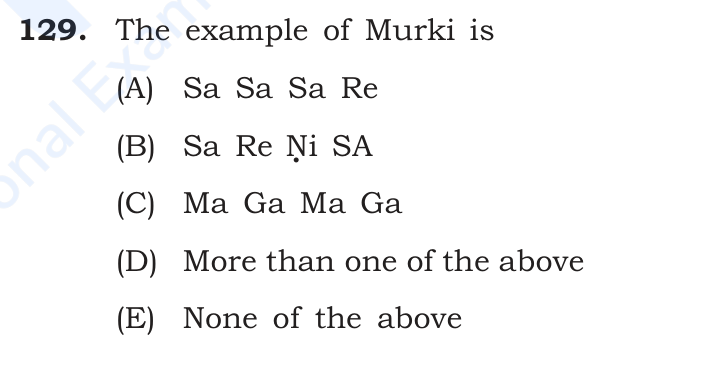
Correct answer: (B)Sa Re mandra-Ni Saसा रे मंद्र-नि सा
Explanation
Murki is a quick, light ornament in which a few swaras are touched rapidly around a note, like 'Sa Re mandra Ni Sa' in option (B).मुर्की एक तेज़, हल्का अलंकरण है जिसमें किसी स्वर के आसपास कुछ स्वरों को शीघ्रता से छुआ जाता है, जैसे विकल्प (B) में 'सा रे मंद्र नि सा'।
What is the meaning of Aalap?आलाप का क्या अर्थ है?
APeshkarपेशकार
BGroup of Swaras in slow tempoविलंबित गति के स्वरसमूह
CGroup of Swaras in fast tempoद्रुत गति के स्वरसमूह
DMore than one of the aboveउपर्युक्त में से एक से अधिक
ENone of the aboveउपर्युक्त में से कोई नहीं
Show answerHide answer
Correct answer: (B)Group of Swaras in slow tempoविलंबित गति के स्वरसमूह
Explanation
Aalap is the slow, unmetred elaboration of a raga using groups of swaras in slow tempo.आलाप राग का धीमी गति में स्वर-समूहों द्वारा किया जाने वाला, ताल-रहित विस्तार है।
The unit of measuring time in music isसंगीत में समय मापने की इकाई है
ALayaलय
BTaalताल
CGatगत
DMore than one of the aboveउपर्युक्त में से एक से अधिक
ENone of the aboveउपर्युक्त में से कोई नहीं
Show answerHide answer
Correct answer: (B)Taalताल
Explanation
The key treats Taal as the measure of time in music: a taal is a fixed cycle of matras by which musical time is measured.उत्तर कुंजी ताल को संगीत में समय मापने की इकाई मानती है: ताल मात्राओं का एक निश्चित चक्र है जिससे संगीत का समय मापा जाता है।
Which one of the following is the correct sign of Murki according to Bhatkhande Notation system?भातखंडे स्वरलिपि के अनुसार मुर्की का सही चिह्न कौन-सा है?
A“Sa”“सा”
B^Sa^^सा^
C(Sa)(सा)
DMore than one of the aboveउपर्युक्त में से एक से अधिक
ENone of the aboveउपर्युक्त में से कोई नहीं
Show answerHide answer
Correct answer: (C)(Sa)(सा)
Explanation
In Bhatkhande notation a murki is written by putting the swara in round brackets, e.g. (Sa), which stands for a quick turn around that note.भातखंडे स्वरलिपि में मुर्की स्वर को गोल कोष्ठक में रखकर लिखी जाती है, जैसे (सा), जो उस स्वर के आसपास तेज़ घुमाव को दर्शाता है।
What is the period of Sangeet Parijat text?संगीत पारिजात किस काल का ग्रंथ है?
AAadi Kaalआदि काल
BMadhya Kaalमध्य काल
CAadhunik Kaalआधुनिक काल
DMore than one of the aboveउपर्युक्त में से एक से अधिक
ENone of the aboveउपर्युक्त में से कोई नहीं
Show answerHide answer
Correct answer: (B)Madhya Kaalमध्य काल
Explanation
Sangeet Parijat (17th century) belongs to the medieval period (Madhya Kaal) of Indian music history.संगीत पारिजात (17वीं शताब्दी) भारतीय संगीत के इतिहास के मध्यकाल का ग्रंथ है।
DMore than one of the aboveउपर्युक्त में से एक से अधिक
ENone of the aboveउपर्युक्त में से कोई नहीं
Show answerHide answer
Correct answer: (A)Swarस्वर से
Explanation
Kan (kan swar or sparsh swar) is a grace note: a swara touched lightly before or after the main swara. So it is related to swar.कण (कण स्वर या स्पर्श स्वर) एक अलंकार-स्वर है: मुख्य स्वर से पहले या बाद में हल्के से छुआ जाने वाला स्वर। इसलिए यह स्वर से संबंधित है।
DMore than one of the aboveउपर्युक्त में से एक से अधिक
ENone of the aboveउपर्युक्त में से कोई नहीं
Show answerHide answer
Correct answer: (B)Ragaराग से
Explanation
Aaroh (ascent) and avaroh (descent) are features of a raga that define which notes it uses going up and down.आरोह (चढ़ाव) और अवरोह (उतार) राग के लक्षण हैं जो बताते हैं कि राग में ऊपर और नीचे जाते समय कौन-से स्वर लगते हैं।
Sangeet traditionally includes the three arts of geet (song), vadya (instrumental music) and nritya (dance).संगीत में परंपरागत रूप से तीन कलाएँ सम्मिलित हैं: गीत (गायन), वाद्य (वादन) और नृत्य।
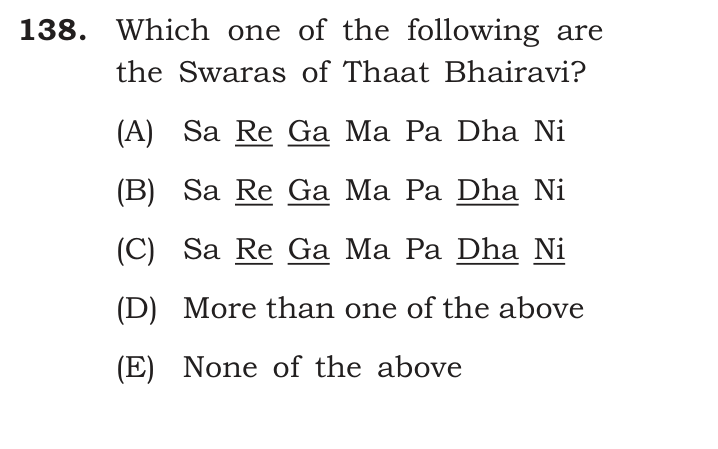
ASa komal-Re komal-Ga Ma Pa Dha Niसा कोमल-रे कोमल-ग म प ध नि
BSa komal-Re komal-Ga Ma Pa komal-Dha Niसा कोमल-रे कोमल-ग म प कोमल-ध नि
CSa komal-Re komal-Ga Ma Pa komal-Dha komal-Niसा कोमल-रे कोमल-ग म प कोमल-ध कोमल-नि
DMore than one of the aboveउपर्युक्त में से एक से अधिक
ENone of the aboveउपर्युक्त में से कोई नहीं
Show answerHide answer
Correct answer: (C)Sa komal-Re komal-Ga Ma Pa komal-Dha komal-Niसा कोमल-रे कोमल-ग म प कोमल-ध कोमल-नि
Explanation
Bhairavi thaat uses komal Re, Ga, Dha and Ni with shuddha Ma, i.e. Sa, komal Re, komal Ga, Ma, Pa, komal Dha, komal Ni, as in option (C).भैरवी थाट में कोमल रे, ग, ध और नि तथा शुद्ध म लगते हैं, यानी सा, कोमल रे, कोमल ग, म, प, कोमल ध, कोमल नि, जैसा विकल्प (C) में है।
In which style are the compositions of Saint Tyagaraja?संत त्यागराज की रचनाएँ किस शैली में हैं?
AHindustani Sangeet styleहिंदुस्तानी संगीत शैली
BCarnatic Sangeet styleकर्नाटक संगीत शैली
COdissi Sangeet styleओडिसी संगीत शैली
DMore than one of the aboveउपर्युक्त में से एक से अधिक
ENone of the aboveउपर्युक्त में से कोई नहीं
Show answerHide answer
Correct answer: (B)Carnatic Sangeet styleकर्नाटक संगीत शैली
Explanation
Saint Tyagaraja (1767-1847) was one of the trinity of Carnatic music; his kritis are in the Carnatic style.संत त्यागराज (1767-1847) कर्नाटक संगीत की त्रिमूर्ति में से एक थे; उनकी कृतियाँ कर्नाटक संगीत शैली में हैं।
Which Taal is used with Dhrupad?ध्रुपद में किस ताल का प्रयोग किया जाता है?
ARupakरूपक
BChautalचौताल
CDadraदादरा
DMore than one of the aboveउपर्युक्त में से एक से अधिक
ENone of the aboveउपर्युक्त में से कोई नहीं
Show answerHide answer
Correct answer: (B)Chautalचौताल
Explanation
Dhrupad is sung mainly in Chautal (12 matras), and also in taals like Sooltaal and Teevra.ध्रुपद मुख्यतः चौताल (12 मात्राएँ) में गाया जाता है, और सूलताल तथा तीव्रा जैसे तालों में भी।
How to use these BPSC TRE Music questions
Every question here was asked in a real BPSC TRE paper; the paper and shift are shown on the card, and the number opens the question on its own page. Try each one before tapping Show answer, then attempt the full BPSC TRE papers as timed tests to check your speed under exam conditions.