DSSSB TGT / PGT · Topic-wise previous year questions
Computer Science Previous Year Questions (page 42)
2444 Computer Science questions asked in DSSSB TGT / PGT previous year papers, each with the correct answer and explanation. Read them free on UTpaper, or attempt the full papers as timed online tests.
Which of the following belongs to the fixed and wireless configuration category of mobile devices?
AWi-Fi router
BDesktop computer
CWi-Fi Dongle
DLaptop
Show answerHide answer
Correct answer: (A) Wi-Fi router
Explanation
A Wi-Fi router is fixed in place but connects devices wirelessly, so it is a fixed and wireless device. A laptop is mobile, and a desktop is fixed and wired.
Which of the following is designed in such a way that all the stations are connected through a single cable known as a backbone cable in the computer network?
ABus topology
BMesh topology
CStar topology
DRing topology
Show answerHide answer
Correct answer: (A) Bus topology
Explanation
In a bus topology all stations connect to one common cable called the backbone.
With reference to Management Information System, which of the following categories refers to information that is concerned with long-term policy decisions that define the objectives of a business and check how well these objectives are met?
ATactical information
BStrategic information
COperational information
DPlanning information
Show answerHide answer
Correct answer: (B) Strategic information
Explanation
Strategic information supports long-term policy decisions about business objectives and how well they are being met. It is used by top management.
Which of the following effects is the phenomenon of emission of electrons from the surfaces of certain substances, mainly metals, when light of a shorter wavelength is incident upon them?
APhoto-light
BPhoto-mechanic
CPhoto-electric
DPhoto-magnetic
Show answerHide answer
Correct answer: (C) Photo-electric
Explanation
The photoelectric effect is the emission of electrons from a metal surface when light of short enough wavelength (high enough frequency) falls on it.
Which of the following is a Microsoft ActiveX control that will sort through a data file, extrapolate the necessary information and produce that information in specified areas on the web page?
ADialog Bars
BTabular Data Control
CControl Bars
DDialog Boxes
Show answerHide answer
Correct answer: (B) Tabular Data Control
Explanation
The Tabular Data Control (TDC) is a Microsoft ActiveX control that reads a delimited data file and shows the data in chosen areas of a web page.
Which of the following is true with reference to Queue Data Structure in the C programming language?
(i) Insertion can take place from the front end.
(ii) Deletion can take place from the rear end.
ANeither (i) nor (ii)
BBoth (i) and (ii)
COnly (i)
DOnly (ii)
Show answerHide answer
Correct answer: (A) Neither (i) nor (ii)
Explanation
Neither statement is true. In a queue, insertion (enqueue) happens at the rear and deletion (dequeue) at the front.
Which of the following refers to the kind of problems that require the identification of the best solution to a search problem from a given set of solutions?
ATraining
BOptimisation
CCounting
DDecision
Show answerHide answer
Correct answer: (B) Optimisation
Explanation
Optimisation problems ask for the best solution from a set of feasible solutions. Decision problems only need a yes/no answer.
Which of the following internet protocols provides a way for applications to send encapsulated IP datagrams without having to establish a connection?
ATelnet
BUnit Datagram Protocol
CTransmission Control Protocol
Drlogin
Show answerHide answer
Correct answer: (B) Unit Datagram Protocol
Explanation
UDP (User Datagram Protocol, shown as 'Unit Datagram Protocol') lets applications send encapsulated IP datagrams without setting up a connection. TCP is connection-oriented.
With reference to stakeholders of e-commerce, business organisations abbreviated by 'B' may include ______.
Agovernment
Bconsumers
Ccustomers
Dproducers
Show answerHide answer
Correct answer: (D) producers
Explanation
In e-commerce models such as B2B and B2C, 'B' stands for business organisations such as producers, manufacturers and sellers. 'C' is consumers and 'G' is government.
Which of the following refers to a planned system of collecting, storing and disseminating data in the form of information needed to carry out the functions of management?
AComputer Networks
BSoftware Engineering
CManagement Information System
DDatabase Management System
Show answerHide answer
Correct answer: (C) Management Information System
Explanation
A Management Information System is a planned system for collecting, storing and sharing information that managers need to do their work.
'As the stock of a commodity increases with the consumer, its marginal utility to the consumer decreases'. To which of the following laws does the given statement refer to?
ALaw of Diminishing Marginal Utility
BLaw of Supply
CLaw of Elasticity
DLaw of Demand
Show answerHide answer
Correct answer: (A) Law of Diminishing Marginal Utility
Explanation
The Law of Diminishing Marginal Utility says each extra unit of a commodity gives the consumer less additional satisfaction.
The class-loader hierarchy is Bootstrap (Primordial) → Extension → System (Application). The System ClassLoader is at the bottom, so by default it has no child class loaders.
The lowest cost solution to developing a KM system is:
Ain-house development
Boutsourcing
Cdevelopment by end users
Doff-the shelf solution
Show answerHide answer
Correct answer: (A) in-house development
Explanation
In-house development uses the organisation's own staff, infrastructure and knowledge, so it avoids vendor licences and outsourcing fees. That is why it is described as the lowest-cost route to a KM system.
______ is a set of interrelated components that collect (or retrieve), process, store and distribute information to support decision-making and control in an organisation.
AAn information technology
BMini model of a processed system
CMax model of a processed system
DAn information system
Show answerHide answer
Correct answer: (D) An information system
Explanation
An information system is a set of interrelated components (people, hardware, software, data, procedures) that collect, process, store and distribute information to support decision-making and control.
Which of the following services is NOT provided by the operating system?
AResource management
BInter process for communication
CTranslate source into machine code
DProgram execution
Show answerHide answer
Correct answer: (C) Translate source into machine code
Explanation
Translating source code into machine code is the job of a compiler or interpreter. The OS provides program execution, resource management and inter-process communication.
Which of the following is NOT a type of computer architecture?
AMicro Architecture
BHarvard Architecture
CSoftware Architecture
DInstruction Set Architecture
Show answerHide answer
Correct answer: (C) Software Architecture
Explanation
Computer architecture includes Instruction Set Architecture, Microarchitecture and system designs such as Harvard and von Neumann. Software architecture is a software-engineering concept, not a computer architecture type.
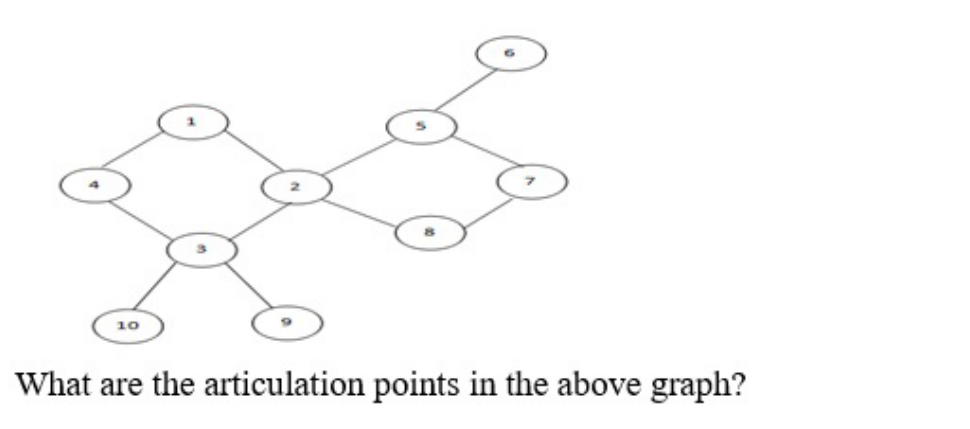
Removing vertex 2 splits {1, 3, 4, 9, 10} from {5, 6, 7, 8}, removing 3 cuts off 9 and 10, and removing 5 cuts off 6. Vertices 1, 4, 7 and 8 lie on cycles, so the articulation points are 2, 3 and 5.
______ is a code that consists of CPU and platform-independent set of instructions, which can be easily converted to the native code.
ADLL
BFCL
CJIT
DMSIL
Show answerHide answer
Correct answer: (D) MSIL
Explanation
MSIL (Microsoft Intermediate Language, also called CIL) is CPU-independent code produced by .NET compilers. The JIT compiler converts it to native code at run time.
CMM is the Capability Maturity Model from the SEI. It rates software process maturity on five levels: Initial, Repeatable, Defined, Managed and Optimizing.
ABurst Time: Time required by a process to start its execution
BTurn Around Time: Time difference between the completion time and arrival time
CCompletion Time: Time at which a process completes its execution
DArrival Time: Time at which a process arrives in the ready queue
Show answerHide answer
Correct answer: (A) Burst Time: Time required by a process to start its execution
Explanation
Burst time is the CPU time a process needs to complete its execution, not the time it takes to start. The other definitions are correct.
How to use these DSSSB TGT / PGT Computer Science questions
Every question here was asked in a real DSSSB TGT / PGT paper; the paper and shift are shown on the card, and the number opens the question on its own page. Try each one before tapping Show answer, then attempt the full DSSSB TGT / PGT papers as timed tests to check your speed under exam conditions.