BPSC TRE 1.0 (2023) Science Class 9-10 — Previous Year Paper
All 120 questions of BPSC TRE 1.0 (2023) Science Class 9-10 — Previous Year Paper with the correct answer from the official answer key and a solution, in English and Hindi. Read them free on UTpaper, or attempt the paper as a timed online test.
Q1BPSC TRE 1.0 (2023) Science Class 9-10 · General Studies
10 years ago the ratio of ages of Ramesh and Rajeev was 1 : 3. 5 years hence this ratio will become 2 : 3. What is the ratio of their ages at present?10 वर्ष पूर्व रमेश एवं राजीव की आयु का अनुपात 1 : 3 था। अब से 5 वर्ष पश्चात् यह अनुपात 2 : 3 हो जायेगा। वर्तमान में उनकी आयु का अनुपात क्या है?
A2 : 52 : 5
B3 : 53 : 5
C1 : 21 : 2
DMore than one of the aboveउपर्युक्त में से एक से अधिक
ENone of the aboveउपर्युक्त में से कोई नहीं
Show answerHide answer
Correct answer: (B)3 : 53 : 5
Explanation
Let the present ages be R and J. (R − 10) : (J − 10) = 1 : 3 gives J = 3R − 20; (R + 5) : (J + 5) = 2 : 3 gives 3R + 15 = 6R − 30, so R = 15 and J = 25. The ratio is 15 : 25 = 3 : 5.माना रमेश और राजीव की वर्तमान आयु R और J है। पहली शर्त से J = 3R − 20 और दूसरी से 3R + 15 = 6R − 30, अतः R = 15 और J = 25। अनुपात 15 : 25 = 3 : 5 है।
Q2BPSC TRE 1.0 (2023) Science Class 9-10 · General Studies
If I walk with a speed of 5 km per hour from my house to the station, my train would have left the station 7 minutes before my arrival. But, if I walk with a speed of 6 km per hour, I will reach the station 5 minutes before the departure of my train. Accordingly, what is the distance between my house and the station?यदि मैं अपने घर से 5 कि.मी. प्रति घंटा की गति से स्टेशन के लिए चलता हूँ, तो मेरी गाड़ी मेरे स्टेशन पहुँचने से 7 मिनट पहले छूट चुकी होती है। किन्तु यदि मैं 6 कि.मी. प्रति घंटा की गति से चलता हूँ, तो मैं स्टेशन पर गाड़ी के छूटने से 5 मिनट पहले पहुँच जाता हूँ। तदनुसार, मेरे घर और स्टेशन के बीच की दूरी क्या है?
A7 km7 कि.मी.
B6.5 km6.5 कि.मी.
C6 km6 कि.मी.
DMore than one of the aboveउपर्युक्त में से एक से अधिक
ENone of the aboveउपर्युक्त में से कोई नहीं
Show answerHide answer
Correct answer: (C)6 km6 कि.मी.
Explanation
The extra time between the two walks is 7 + 5 = 12 minutes = 1/5 hour. So d/5 − d/6 = 1/5, i.e. d/30 = 1/5 and d = 6 km.दोनों स्थितियों में समय का अन्तर 7 + 5 = 12 मिनट = 1/5 घंटा है। अतः d/5 − d/6 = 1/5, यानी d/30 = 1/5 और d = 6 कि.मी.।
Q3BPSC TRE 1.0 (2023) Science Class 9-10 · General Studies
The average monthly income of P and Q is ₹5,050. The average monthly income of Q and R is ₹6,250 and the average monthly income of P and R is ₹5,200. The monthly income of P isP और Q की औसत मासिक आय ₹5,050 है। Q और R की औसत मासिक आय ₹6,250 है तथा P और R की औसत मासिक आय ₹5,200 है। P की मासिक आय है
A₹3,500₹3,500
B₹4,050₹4,050
C₹4,000₹4,000
DMore than one of the aboveउपर्युक्त में से एक से अधिक
ENone of the aboveउपर्युक्त में से कोई नहीं
Show answerHide answer
Correct answer: (C)₹4,000₹4,000
Explanation
P + Q = 10,100, Q + R = 12,500 and P + R = 10,400. Adding gives P + Q + R = 16,500, so P = 16,500 − 12,500 = ₹4,000.P + Q = 10,100, Q + R = 12,500 और P + R = 10,400। जोड़ने पर P + Q + R = 16,500, अतः P = 16,500 − 12,500 = ₹4,000।
Q4BPSC TRE 1.0 (2023) Science Class 9-10 · General Studies
If 30% of P is added to 40% of Q, it becomes 80% of Q. Accordingly, what is the percentage of Q with respect to P ?यदि P का 30%, Q के 40% में जोड़ दिया जाय, तो वह Q का 80% हो जाता है। तदनुसार Q, P का कितना प्रतिशत है?
A40%40%
B50%50%
C75%75%
DMore than one of the aboveउपर्युक्त में से एक से अधिक
Q5BPSC TRE 1.0 (2023) Science Class 9-10 · General Studies
A sum of money is to be distributed among A, B, C, D in the proportion of 5 : 2 : 4 : 3. If C gets ₹1,000 more than D, what is B’s share?A, B, C, D के बीच 5 : 2 : 4 : 3 के अनुपात में धन का वितरण किया जाना है। यदि C को D से ₹1,000 अधिक मिलते हैं, तो B का हिस्सा क्या है?
A₹500₹500
B₹1,500₹1,500
C₹2,000₹2,000
DMore than one of the aboveउपर्युक्त में से एक से अधिक
ENone of the aboveउपर्युक्त में से कोई नहीं
Show answerHide answer
Correct answer: (C)₹2,000₹2,000
Explanation
C − D = (4 − 3) parts = ₹1,000, so one part is ₹1,000 and B's share is 2 parts = ₹2,000.C − D = (4 − 3) भाग = ₹1,000, इसलिए एक भाग ₹1,000 का है और B का हिस्सा 2 भाग = ₹2,000 है।
Q6BPSC TRE 1.0 (2023) Science Class 9-10 · General Studies
A shopkeeper gives a discount of 5% on the selling price of a watch. If he gives a discount of 6%, he will earn a profit which is ₹15 less than before. Accordingly, what is the marked selling price of that watch?एक दुकानदार एक घड़ी बेचते समय बिक्री मूल्य पर 5% छूट देता है। यदि वह उस पर 6% छूट दे देता है, तो उसे पहले से ₹15 कम का लाभ मिलेगा। तदनुसार, उस घड़ी का अंकित बिक्री मूल्य क्या है?
A₹1,400₹1,400
B₹1,500₹1,500
C₹1,800₹1,800
DMore than one of the aboveउपर्युक्त में से एक से अधिक
ENone of the aboveउपर्युक्त में से कोई नहीं
Show answerHide answer
Correct answer: (B)₹1,500₹1,500
Explanation
The extra 1% discount reduces the profit by ₹15, so 1% of the marked price is ₹15 and the marked price is ₹1,500.अतिरिक्त 1% छूट से लाभ ₹15 घटता है, अतः अंकित मूल्य का 1% = ₹15 और अंकित मूल्य ₹1,500 है।
Q7BPSC TRE 1.0 (2023) Science Class 9-10 · General Studies
Three numbers are in the ratio 3 : 4 : 5. The total of the largest and the smallest numbers is equal to the other number plus 52. Accordingly, which is the smallest number?तीन संख्याएँ 3 : 4 : 5 के अनुपात में हैं। उनमें सबसे बड़ी एवं सबसे छोटी संख्याओं का योग, दूसरी संख्या तथा 52 के योग के बराबर है। तदनुसार, सबसे छोटी संख्या कौन-सी है?
A2727
B3939
C5252
DMore than one of the aboveउपर्युक्त में से एक से अधिक
ENone of the aboveउपर्युक्त में से कोई नहीं
Show answerHide answer
Correct answer: (B)3939
Explanation
Let the numbers be 3k, 4k, 5k. Then 3k + 5k = 4k + 52, so k = 13 and the smallest number is 39.संख्याएँ 3k, 4k, 5k मानें। 3k + 5k = 4k + 52 से k = 13, अतः सबसे छोटी संख्या 39 है।
Q8BPSC TRE 1.0 (2023) Science Class 9-10 · General Studies
If 2²ⁿ⁻¹ = 1/8ⁿ⁻³, then the value of n isयदि 2²ⁿ⁻¹ = 1/8ⁿ⁻³, तो n का मान है
A33
B22
C–2–2
DMore than one of the aboveउपर्युक्त में से एक से अधिक
ENone of the aboveउपर्युक्त में से कोई नहीं
Show answerHide answer
Correct answer: (B)22
Explanation
2²ⁿ⁻¹ = 1/8ⁿ⁻³ = 2⁻³⁽ⁿ⁻³⁾, so 2n − 1 = −3n + 9, giving n = 2.2²ⁿ⁻¹ = 1/8ⁿ⁻³ = 2⁻³⁽ⁿ⁻³⁾, अतः 2n − 1 = −3n + 9, जिससे n = 2।
Q9BPSC TRE 1.0 (2023) Science Class 9-10 · General Studies
Which of the following photo- electric devices is the most suitable for digital applications?निम्नलिखित में से कौन-सा फोटो-इलेक्ट्रिक उपकरण डिजिटल अनुप्रयोगों के लिए सबसे उपयुक्त है?
APhoto-voltaic cellफोटो-वोल्टिक सेल
BPhoto-emissive cellफोटो-उत्सर्जक सेल
CPhoto-diodeफोटो-डायोड
DMore than one of the aboveउपर्युक्त में से एक से अधिक
Note: the official key gives (A) photo-voltaic cell; photodiodes are usually preferred for digital (switching) uses because of their very fast response, so this key is doubtful. Key kept as published.टिप्पणी: आधिकारिक कुंजी (A) फोटो-वोल्टिक सेल देती है; डिजिटल (स्विचिंग) उपयोग के लिए सामान्यतः तीव्र अनुक्रिया के कारण फोटो-डायोड को वरीयता दी जाती है, इसलिए यह कुंजी संदिग्ध है। कुंजी जस की तस रखी गई है।
Q10BPSC TRE 1.0 (2023) Science Class 9-10 · General Studies
The critical mass of a fissionable material isकिसी विखण्डनीय द्रव्य का क्रान्तिक द्रव्यमान होगा
Aone kilogram equivalentएक किलोग्राम समतुल्य
Bthe minimum mass needed for chain reactionशृंखला अभिक्रिया हेतु आवश्यक न्यूनतम द्रव्यमान
Cthe rest mass equivalent to 10¹⁰ joules10¹⁰ जूल के समतुल्य विराम द्रव्यमान
DMore than one of the aboveउपर्युक्त में से एक से अधिक
ENone of the aboveउपर्युक्त में से कोई नहीं
Show answerHide answer
Correct answer: (B)the minimum mass needed for chain reactionशृंखला अभिक्रिया हेतु आवश्यक न्यूनतम द्रव्यमान
Explanation
The critical mass is the minimum mass of fissionable material needed to sustain a chain reaction.क्रान्तिक द्रव्यमान विखण्डनीय पदार्थ का वह न्यूनतम द्रव्यमान है जो शृंखला अभिक्रिया बनाए रखने के लिए आवश्यक है।
Q11BPSC TRE 1.0 (2023) Science Class 9-10 · General Studies
Which of the following gases is used to force the ripening of fruits?फलों को जबरदस्ती पकाने के लिए निम्नलिखित में से किस गैस का उपयोग किया जाता है?
AEthaneईथेन
BEthyleneएथिलीन
CMethyleneमेथिलीन
DMore than one of the aboveउपर्युक्त में से एक से अधिक
ENone of the aboveउपर्युक्त में से कोई नहीं
Show answerHide answer
Correct answer: (B)Ethyleneएथिलीन
Explanation
Ethylene is the plant hormone/gas used to ripen fruits artificially.फलों को कृत्रिम रूप से पकाने के लिए एथिलीन गैस का उपयोग किया जाता है।
Q12BPSC TRE 1.0 (2023) Science Class 9-10 · General Studies
Which one of the following has zero octane number?निम्नलिखित में से किसकी ऑक्टेन संख्या शून्य है?
AIso-octaneआइसो-ऑक्टेन
BNeo-octaneनिओ-ऑक्टेन
Cn-octanen-ऑक्टेन
DMore than one of the aboveउपर्युक्त में से एक से अधिक
ENone of the aboveउपर्युक्त में से कोई नहीं
Show answerHide answer
Correct answer: (E)None of the aboveउपर्युक्त में से कोई नहीं
Explanation
Zero octane number is assigned to n-heptane (iso-octane is 100); none of the given options is n-heptane, so the answer is None of the above.शून्य ऑक्टेन संख्या n-हेप्टेन की मानी जाती है (आइसो-ऑक्टेन की 100); दिए गए विकल्पों में यह नहीं है, इसलिए उत्तर 'उपर्युक्त में से कोई नहीं' है।
Q13BPSC TRE 1.0 (2023) Science Class 9-10 · General Studies
The edible part of Litchis isलीची का खाद्य भाग है
Aarilएरिल
Bthalamusथैलेमस
Cseed coatबीज कोट
DMore than one of the aboveउपर्युक्त में से एक से अधिक
ENone of the aboveउपर्युक्त में से कोई नहीं
Show answerHide answer
Correct answer: (A)arilएरिल
Explanation
The edible part of the litchi is the fleshy aril around the seed.लीची का खाने योग्य भाग बीज के चारों ओर का गूदेदार एरिल है।
Q14BPSC TRE 1.0 (2023) Science Class 9-10 · General Studies
The physical process involved in the release of molecular oxygen from leaves isआणविक ऑक्सीजन का पत्तियों से निकलना कौन-सी भौतिक क्रिया है?
Adiffusionविसरण
Btranspirationवाष्पोत्सर्जन
Cosmosisपरासरण
DMore than one of the aboveउपर्युक्त में से एक से अधिक
ENone of the aboveउपर्युक्त में से कोई नहीं
Show answerHide answer
Correct answer: (A)diffusionविसरण
Explanation
Oxygen leaves the leaf through the stomata by simple diffusion along its concentration gradient.ऑक्सीजन रन्ध्रों के माध्यम से सान्द्रता प्रवणता के अनुदिश विसरण द्वारा पत्तियों से बाहर निकलती है।
Q15BPSC TRE 1.0 (2023) Science Class 9-10 · General Studies
The process of finding the relative location of genes on a chromosome is calledकिसी गुणसूत्र पर जीनों की आपेक्षिक स्थिति ज्ञात करने की प्रक्रिया कहलाती है
Agenome walkingजीनोम का चलना
Bchromosome walkingगुणसूत्र का चलना
Cgene mappingजीन मानचित्रण
DMore than one of the aboveउपर्युक्त में से एक से अधिक
ENone of the aboveउपर्युक्त में से कोई नहीं
Show answerHide answer
Correct answer: (C)gene mappingजीन मानचित्रण
Explanation
Determining the relative positions of genes on a chromosome is called gene mapping.गुणसूत्र पर जीनों की आपेक्षिक स्थिति ज्ञात करने की प्रक्रिया जीन मानचित्रण कहलाती है।
Q16BPSC TRE 1.0 (2023) Science Class 9-10 · General Studies
Spore mother cell in bryophytes isब्रायोफाइट में बीजाणु मातृ कोशिका होती है
Ahaploidअगुणित
Bdiploidद्विगुणित
Ctriploidत्रिगुणित
DMore than one of the aboveउपर्युक्त में से एक से अधिक
ENone of the aboveउपर्युक्त में से कोई नहीं
Show answerHide answer
Correct answer: (B)diploidद्विगुणित
Explanation
The spore mother cell is a diploid (2n) cell of the sporophyte which divides by meiosis to form haploid spores.बीजाणु मातृ कोशिका बीजाणुउद्भिद की द्विगुणित (2n) कोशिका होती है, जो अर्धसूत्री विभाजन से अगुणित बीजाणु बनाती है।
Q17BPSC TRE 1.0 (2023) Science Class 9-10 · General Studies
In which year was NGT (National Green Tribunal) for protection of environment and forest established by the Government of India?भारत सरकार द्वारा पर्यावरण और वन की सुरक्षा के लिए किस वर्ष NGT (नैशनल ग्रीन ट्रिब्यूनल) की स्थापना की गई थी?
A20102010
B20112011
C20122012
DMore than one of the aboveउपर्युक्त में से एक से अधिक
ENone of the aboveउपर्युक्त में से कोई नहीं
Show answerHide answer
Correct answer: (A)20102010
Explanation
The National Green Tribunal was established in 2010 under the NGT Act, 2010.राष्ट्रीय हरित अधिकरण (NGT) की स्थापना 2010 में NGT अधिनियम, 2010 के अन्तर्गत की गई थी।
Q18BPSC TRE 1.0 (2023) Science Class 9-10 · General Studies
Which city of India started first under-water metro?भारत के किस शहर ने सबसे पहले पानी के नीचे मेट्रो की शुरुआत की?
AKochiकोच्चि
BVisakhapatnamविशाखापत्तनम
CBengaluruबेंगलुरु
DMore than one of the aboveउपर्युक्त में से एक से अधिक
ENone of the aboveउपर्युक्त में से कोई नहीं
Show answerHide answer
Correct answer: (E)None of the aboveउपर्युक्त में से कोई नहीं
Explanation
India's first under-water metro section is in Kolkata (Hooghly river), which is not among options A-C, so the answer is None of the above.भारत की पहली जल-नीचे मेट्रो कोलकाता (हुगली नदी के नीचे) में है, जो विकल्प A-C में नहीं है, इसलिए उत्तर 'उपर्युक्त में से कोई नहीं' है।
Q19BPSC TRE 1.0 (2023) Science Class 9-10 · General Studies
Under India’s G20 Presidency, where was the Tourism Working Group Meeting held?भारत की G20 अध्यक्षता में पर्यटन कार्यसमूह की बैठक कहाँ हुई थी?
APatna (Bihar)पटना (बिहार)
BSrinagar (Jammu and Kashmir)श्रीनगर (जम्मू और कश्मीर)
CRamnagar (Uttarakhand)रामनगर (उत्तराखंड)
DMore than one of the aboveउपर्युक्त में से एक से अधिक
ENone of the aboveउपर्युक्त में से कोई नहीं
Show answerHide answer
Correct answer: (B)Srinagar (Jammu and Kashmir)श्रीनगर (जम्मू और कश्मीर)
Explanation
The Tourism Working Group meeting of India's G20 Presidency was held in Srinagar, Jammu and Kashmir.भारत की G20 अध्यक्षता में पर्यटन कार्यसमूह की बैठक श्रीनगर (जम्मू और कश्मीर) में हुई थी।
Q20BPSC TRE 1.0 (2023) Science Class 9-10 · General Studies
Who among the following got the Silver Medal in the National Under-17 Girls Wrestling Championship?इनमें से किसने राष्ट्रीय अंडर-17 बालिका कुश्ती चैम्पीयनशिप में रजत पदक प्राप्त किया?
ALiza Tomarलीज़ा तोमर
BNirjalaनिर्जला
CPushpa Yadavपुष्पा यादव
DMore than one of the aboveउपर्युक्त में से एक से अधिक
ENone of the aboveउपर्युक्त में से कोई नहीं
Show answerHide answer
Correct answer: (B)Nirjalaनिर्जला
Explanation
As per the official key, Nirjala won the silver medal in the National Under-17 Girls Wrestling Championship.आधिकारिक कुंजी के अनुसार राष्ट्रीय अंडर-17 बालिका कुश्ती चैम्पीयनशिप में रजत पदक निर्जला ने जीता।
Q21BPSC TRE 1.0 (2023) Science Class 9-10 · General Studies
Who won the International Booker Prize, 2022 for the novel, Tomb of Sand ?उपन्यास टॉम्ब ऑफ सैंड के लिए अन्तर्राष्ट्रीय बुकर पुरस्कार, 2022 किसने जीता?
AGeetanjali Shree and Daisy Rockwellगीतांजलि श्री और डेज़ी रॉकवेल
BDavid Diop and Anna Moschovakisडेविड डिओप और अन्ना मोस्कोवाकिस
CMarilyn Booth and Jokha Alharthiमैरीलिन बूथ और जोखा अल्हार्थी
DMore than one of the aboveउपर्युक्त में से एक से अधिक
ENone of the aboveउपर्युक्त में से कोई नहीं
Show answerHide answer
Correct answer: (A)Geetanjali Shree and Daisy Rockwellगीतांजलि श्री और डेज़ी रॉकवेल
Explanation
The International Booker Prize 2022 for 'Tomb of Sand' went to author Geetanjali Shree and translator Daisy Rockwell.‘टॉम्ब ऑफ सैंड’ के लिए अन्तर्राष्ट्रीय बुकर पुरस्कार 2022 गीतांजलि श्री और अनुवादक डेज़ी रॉकवेल को मिला।
Q22BPSC TRE 1.0 (2023) Science Class 9-10 · General Studies
Who was the Chief Guest on India’s 74th Republic Day?भारत के 74वें गणतंत्र दिवस पर कौन मुख्य अतिथि थे?
AMohammed bin Salmanमोहम्मद बिन सलमान
BAbdel Fattah El-Sisiअब्देल फतह अल-सिसी
CSheikh Mohammed bin Rashid Al Maktoumशेख मोहम्मद बिन राशिद अल मकतूम
DMore than one of the aboveउपर्युक्त में से एक से अधिक
Egyptian President Abdel Fattah El-Sisi was the Chief Guest at India's 74th Republic Day (2023).भारत के 74वें गणतंत्र दिवस (2023) पर मिस्र के राष्ट्रपति अब्देल फतह अल-सिसी मुख्य अतिथि थे।
Q23BPSC TRE 1.0 (2023) Science Class 9-10 · General Studies
In which district of Bihar, the first floating solar power plant has been built?बिहार के किस ज़िले में प्रथम तैरता हुआ सोलर ऊर्जा संयंत्र बनाया गया है?
ADarbhangaदरभंगा
BWest Champaranपश्चिम चम्पारण
CMadhubaniमधुबनी
DMore than one of the aboveउपर्युक्त में से एक से अधिक
ENone of the aboveउपर्युक्त में से कोई नहीं
Show answerHide answer
Correct answer: (A)Darbhangaदरभंगा
Explanation
Bihar's first floating solar power plant was built in Darbhanga.बिहार का पहला तैरता सोलर ऊर्जा संयंत्र दरभंगा में बनाया गया।
Q24BPSC TRE 1.0 (2023) Science Class 9-10 · General Studies
Which of the following has got GI Tag in Bihar?बिहार में निम्नलिखित में से किसे GI टैग मिला है?
AMaghai Paanमगही पान
BBasmati Riceबासमती चावल
CChanderi Sareeचंदेरी साड़ी
DMore than one of the aboveउपर्युक्त में से एक से अधिक
ENone of the aboveउपर्युक्त में से कोई नहीं
Show answerHide answer
Correct answer: (A)Maghai Paanमगही पान
Explanation
Maghai Paan (Magahi betel leaf) has the GI tag in Bihar; Basmati rice and Chanderi saree belong to other regions.बिहार में मगही पान को GI टैग मिला है; बासमती चावल और चंदेरी साड़ी अन्य क्षेत्रों से जुड़े हैं।
Q25BPSC TRE 1.0 (2023) Science Class 9-10 · General Studies
Match List–I with List–II :
List–I
a. Char
b. Kankar
c. Kayal
d. Mand
List–II
1. Punjab plain
2. Delta
3. Bangar
4. Coastal plain
Select the correct answer using the codes given below.सूची-I को सूची-II से सुमेलित कीजिए :
सूची–I
a. चार
b. कंकर
c. कायल
d. मांड
सूची–II
1. पंजाब का मैदान
2. डेल्टा
3. बांगर
4. तटीय मैदान
नीचे दिए गए कूट का प्रयोग कर सही उत्तर चुनिए।
Aa-1, b-4, c-2, d-3a-1, b-4, c-2, d-3
Ba-2, b-3, c-4, d-1a-2, b-3, c-4, d-1
Ca-3, b-1, c-4, d-2a-3, b-1, c-4, d-2
DMore than one of the aboveउपर्युक्त में से एक से अधिक
As per the official key the correct matching is a-2, b-3, c-4, d-1 (Char - Delta, Kankar - Bangar, Kayal - Coastal plain, Mand - Punjab plain).आधिकारिक कुंजी के अनुसार सही सुमेल a-2, b-3, c-4, d-1 है (चार - डेल्टा, कंकर - बांगर, कायल - तटीय मैदान, मांड - पंजाब का मैदान)।
Q26BPSC TRE 1.0 (2023) Science Class 9-10 · General Studies
Which of the following tributaries does not join Brahmaputra river from north?निम्नलिखित में से कौन-सी सहायक नदी ब्रह्मपुत्र से उत्तर दिशा से नहीं मिलती है?
ASubansiriसुबनसिरी
BBelsiriबेलसिरी
CManasमानस
DMore than one of the aboveउपर्युक्त में से एक से अधिक
ENone of the aboveउपर्युक्त में से कोई नहीं
Show answerHide answer
Correct answer: (E)None of the aboveउपर्युक्त में से कोई नहीं
Explanation
Subansiri, Belsiri and Manas all join the Brahmaputra from the north, so none of the options is a tributary that does not join from the north.सुबनसिरी, बेलसिरी और मानस तीनों ब्रह्मपुत्र से उत्तर दिशा से मिलती हैं, इसलिए कोई भी विकल्प ऐसी सहायक नदी नहीं है जो उत्तर से न मिलती हो।
Q27BPSC TRE 1.0 (2023) Science Class 9-10 · General Studies
Likhapani glacier is located in which State of India?लिखापानी हिमनद भारत के निम्नलिखित में से किस राज्य में स्थित है?
AArunachal Pradeshअरुणाचल प्रदेश
BHimachal Pradeshहिमाचल प्रदेश
CSikkimसिक्किम
DMore than one of the aboveउपर्युक्त में से एक से अधिक
ENone of the aboveउपर्युक्त में से कोई नहीं
Show answerHide answer
Correct answer: (A)Arunachal Pradeshअरुणाचल प्रदेश
Explanation
As per the official key, the Likhapani glacier is located in Arunachal Pradesh.आधिकारिक कुंजी के अनुसार लिखापानी हिमनद अरुणाचल प्रदेश में स्थित है।
Q28BPSC TRE 1.0 (2023) Science Class 9-10 · General Studies
Magadha and Anga plains are parts ofमगध एवं अंग का मैदान किसके हिस्से हैं?
Aupper Ganga plainऊपरी गंगा का मैदान
Bmiddle Ganga plainमध्य गंगा का मैदान
Clower Ganga plainनिम्न गंगा का मैदान
DMore than one of the aboveउपर्युक्त में से एक से अधिक
ENone of the aboveउपर्युक्त में से कोई नहीं
Show answerHide answer
Correct answer: (B)middle Ganga plainमध्य गंगा का मैदान
Explanation
The Magadha and Anga plains of Bihar are part of the middle Ganga plain.बिहार के मगध और अंग के मैदान मध्य गंगा मैदान के भाग हैं।
Q29BPSC TRE 1.0 (2023) Science Class 9-10 · General Studies
Which of the following pairs of waterfalls and rivers is not correctly matched?जलप्रपात और नदी के निम्नलिखित जोड़ों में से कौन-सा जोड़ा सही सुमेलित नहीं है?
AJog—Sharavatiजोग—शरावती
BKapildhara—Kaveriकपिलधारा—कावेरी
CDhuandhar—Godavariधुआँधार—गोदावरी
DMore than one of the aboveउपर्युक्त में से एक से अधिक
ENone of the aboveउपर्युक्त में से कोई नहीं
Show answerHide answer
Correct answer: (D)More than one of the aboveउपर्युक्त में से एक से अधिक
Explanation
Kapildhara and Dhuandhar are both waterfalls on the Narmada, so both pairs B and C are wrongly matched; hence more than one option is correct.कपिलधारा और धुआँधार दोनों नर्मदा नदी पर हैं, इसलिए जोड़े B और C दोनों गलत हैं; अतः एक से अधिक विकल्प सही हैं।
Q30BPSC TRE 1.0 (2023) Science Class 9-10 · General Studies
Arrange the following seaports of India from north to south :
1. Kakinada
2. Machilipatnam
3. Nagapattinam
4. Visakhapatnam
Select the correct answer using the codes given below.भारत के निम्नलिखित बंदरगाहों को उत्तर से दक्षिण दिशा में व्यवस्थित कीजिए :
1. काकीनाड़ा
2. मछलीपट्टनम
3. नागपट्टिनम
4. विशाखापत्तनम
नीचे दिए गए कूट का प्रयोग कर सही उत्तर चुनिए।
A1, 2, 3, 41, 2, 3, 4
B4, 1, 2, 34, 1, 2, 3
C1, 3, 2, 41, 3, 2, 4
DMore than one of the aboveउपर्युक्त में से एक से अधिक
ENone of the aboveउपर्युक्त में से कोई नहीं
Show answerHide answer
Correct answer: (B)4, 1, 2, 34, 1, 2, 3
Explanation
From north to south the ports are Visakhapatnam, Kakinada, Machilipatnam and Nagapattinam: 4, 1, 2, 3.उत्तर से दक्षिण क्रम: विशाखापत्तनम, काकीनाड़ा, मछलीपट्टनम और नागपट्टिनम, यानी 4, 1, 2, 3।
Q31BPSC TRE 1.0 (2023) Science Class 9-10 · General Studies
The Agreement of Kosi Irrigation and Hydroelectricity Plan in 1954 was signed between which two countries?1954 में किन दो देशों के बीच कोसी सिंचाई एवं जलविद्युत् परियोजना समझौता हस्ताक्षरित हुआ था?
AIndia and Bangladeshभारतवर्ष और बांग्लादेश
BIndia and Chinaभारतवर्ष और चीन
CIndia and Nepalभारतवर्ष और नेपाल
DMore than one of the aboveउपर्युक्त में से एक से अधिक
ENone of the aboveउपर्युक्त में से कोई नहीं
Show answerHide answer
Correct answer: (C)India and Nepalभारतवर्ष और नेपाल
Explanation
The Kosi Agreement of 1954 was signed between India and Nepal.1954 का कोसी समझौता भारत और नेपाल के बीच हुआ था।
Q32BPSC TRE 1.0 (2023) Science Class 9-10 · General Studies
In which climatic division does Bihar fall as per R. L. Singh’s classification scheme?आर.एल. सिंह के वर्गीकरण स्कीम के अनुसार, बिहार किस प्रकार के जलवायु प्रदेश में आता है?
AHumid south-eastआर्द्र दक्षिण-पूर्व
BSubhumid transitionalउपार्द्र संक्रमणकालीन
CSubhumid continentalउपार्द्र महाद्वीपीय
DMore than one of the aboveउपर्युक्त में से एक से अधिक
As per R. L. Singh's classification the Bihar plain falls in the sub-humid transitional climatic region.आर. एल. सिंह के वर्गीकरण के अनुसार बिहार का मैदान उपार्द्र संक्रमणकालीन जलवायु प्रदेश में आता है।
Q33BPSC TRE 1.0 (2023) Science Class 9-10 · General Studies
In which Session of the Indian National Congress was the resolution of ‘Purna Swaraj’ adopted?भारतीय राष्ट्रीय कांग्रेस के किस अधिवेशन में ‘पूर्ण स्वराज’ का सिद्धान्त गृहीत हुआ था?
AKanpur Session, 1925कानपुर अधिवेशन, 1925
BLahore Session, 1929लाहौर अधिवेशन, 1929
CKarachi Session, 1931कराची अधिवेशन, 1931
DMore than one of the aboveउपर्युक्त में से एक से अधिक
The 'Purna Swaraj' resolution was adopted at the Lahore Session of 1929 (Jawaharlal Nehru presiding).‘पूर्ण स्वराज’ का प्रस्ताव 1929 के लाहौर अधिवेशन (अध्यक्ष जवाहरलाल नेहरू) में पारित हुआ।
Q34BPSC TRE 1.0 (2023) Science Class 9-10 · General Studies
What was an initial objective of ‘Kuka Movement’ in Punjab?पंजाब में ‘कूका आन्दोलन’ का प्रारम्भिक उद्देश्य क्या था?
ATo purify the Sikh religionसिक्ख धर्म को परिष्कृत करना
BTo gain political power in Punjabपंजाब में राजनीतिक शक्ति प्राप्त करना
COrganization of peasant movementकृषक आन्दोलन का संगठन
DMore than one of the aboveउपर्युक्त में से एक से अधिक
ENone of the aboveउपर्युक्त में से कोई नहीं
Show answerHide answer
Correct answer: (A)To purify the Sikh religionसिक्ख धर्म को परिष्कृत करना
Explanation
The Kuka (Namdhari) Movement began as a Sikh reform movement aiming to purify the Sikh religion.कूका (नामधारी) आन्दोलन आरम्भ में सिक्ख धर्म को शुद्ध करने का सुधार आन्दोलन था।
Q35BPSC TRE 1.0 (2023) Science Class 9-10 · General Studies
Who described the Revolt of 1857 as the ‘First Indian War of Independence’?1857 के विद्रोह को किसके द्वारा ‘प्रथम भारतीय स्वतंत्रता संग्राम’ के रूप में वर्णित किया गया था?
AV. D. Savarkarवी.डी. सावरकर
BBal Gangadhar Tilakबाल गंगाधर तिलक
CBipin Chandra Palबिपिन चन्द्र पाल
DMore than one of the aboveउपर्युक्त में से एक से अधिक
ENone of the aboveउपर्युक्त में से कोई नहीं
Show answerHide answer
Correct answer: (A)V. D. Savarkarवी.डी. सावरकर
Explanation
V. D. Savarkar called the Revolt of 1857 the 'First War of Indian Independence' in his book.वी. डी. सावरकर ने अपनी पुस्तक में 1857 के विद्रोह को ‘प्रथम भारतीय स्वतंत्रता संग्राम’ कहा।
Q36BPSC TRE 1.0 (2023) Science Class 9-10 · General Studies
Where was the first instance of organized non-cooperation in the history of Indian peasantry held?भारतीय किसानों के इतिहास में संगठित असहयोग का प्रथम उदाहरण कहाँ घटित हुआ था?
ABihar and Bengalबिहार और बंगाल
BMadras Presidencyमद्रास प्रेसीडेंसी
CPunjab Provinceपंजाब प्रॉविन्स
DMore than one of the aboveउपर्युक्त में से एक से अधिक
ENone of the aboveउपर्युक्त में से कोई नहीं
Show answerHide answer
Correct answer: (A)Bihar and Bengalबिहार और बंगाल
Explanation
The first organized non-cooperation by peasants was the indigo (Neel) revolt of Bihar and Bengal.किसानों का संगठित असहयोग का पहला उदाहरण बिहार और बंगाल का नील विद्रोह था।
Q37BPSC TRE 1.0 (2023) Science Class 9-10 · General Studies
Which portfolio did Dr. Rajendra Prasad hold during the Interim Government of 1946?वर्ष 1946 में बनी अन्तरिम सरकार में डॉ. राजेन्द्र प्रसाद के पास कौन-सा विभाग था?
ADefenceरक्षा
BHomeगृह
CFood and Agricultureखाद्य एवं कृषि
DMore than one of the aboveउपर्युक्त में से एक से अधिक
ENone of the aboveउपर्युक्त में से कोई नहीं
Show answerHide answer
Correct answer: (C)Food and Agricultureखाद्य एवं कृषि
Explanation
Dr. Rajendra Prasad held the Food and Agriculture portfolio in the 1946 Interim Government.1946 की अन्तरिम सरकार में डॉ. राजेन्द्र प्रसाद के पास खाद्य एवं कृषि विभाग था।
Q38BPSC TRE 1.0 (2023) Science Class 9-10 · General Studies
Who among the following particularly urged Gandhiji to visit Champaran to witness the miseries of the Ryots?गाँधीजी को विशेष रूप से चम्पारण आने और वहाँ के कृषकों की दयनीय स्थिति को देखने हेतु किसने अनुग्रह किया था?
ABrijkishore Prasadबृजकिशोर प्रसाद
BRajkumar Shuklaराजकुमार शुक्ल
CSukhram Ganeshसुखराम गणेश
DMore than one of the aboveउपर्युक्त में से एक से अधिक
ENone of the aboveउपर्युक्त में से कोई नहीं
Show answerHide answer
Correct answer: (B)Rajkumar Shuklaराजकुमार शुक्ल
Explanation
Rajkumar Shukla, a Champaran indigo farmer, persuaded Gandhiji to visit Champaran.चम्पारण के नील कृषक राजकुमार शुक्ल ने गाँधीजी से चम्पारण आने का अनुरोध किया।
Q39BPSC TRE 1.0 (2023) Science Class 9-10 · General Studies
The ‘Day of Deliverance’ was observed by the Muslim League on which date?मुस्लिम लीग द्वारा किस तिथि को ‘मुक्ति दिवस’ मनाया गया था?
A22nd December, 193922 दिसम्बर, 1939
B17th October, 193917 अक्तूबर, 1939
C22nd December, 194022 दिसम्बर, 1940
DMore than one of the aboveउपर्युक्त में से एक से अधिक
The Muslim League observed the 'Day of Deliverance' on 22 December 1939 after the Congress ministries resigned.कांग्रेस मंत्रिमंडलों के त्यागपत्र के बाद मुस्लिम लीग ने 22 दिसम्बर 1939 को ‘मुक्ति दिवस’ मनाया।
Q40BPSC TRE 1.0 (2023) Science Class 9-10 · General Studies
Who laid the foundation stone of National College and Bihar Vidyapeeth?नैशनल कॉलेज और बिहार विद्यापीठ का शिलान्यास किसने किया था?
ADr. Rajendra Prasadडॉ. राजेन्द्र प्रसाद
BMaulana Abdul Bariमौलाना अब्दुल बारी
CMahatma Gandhiमहात्मा गाँधी
DMore than one of the aboveउपर्युक्त में से एक से अधिक
ENone of the aboveउपर्युक्त में से कोई नहीं
Show answerHide answer
Correct answer: (C)Mahatma Gandhiमहात्मा गाँधी
Explanation
Mahatma Gandhi laid the foundation stone of the National College and Bihar Vidyapeeth in Patna (1921).महात्मा गाँधी ने पटना में नैशनल कॉलेज और बिहार विद्यापीठ (1921) का शिलान्यास किया था।
A rocket, set for vertical firing, weighs 50 kg and contains 450 kg of fuel. It can have a maximum exhaust velocity of 5 km/sec. What should be its minimum rate of fuel consumption to just lift it off the launching pad?ऊर्ध्वाधर फायरिंग के लिए सेट किए गए एक रॉकेट का वजन 50 कि॰ ग्रा॰ है और इसमें 450 कि॰ ग्रा॰ ईंधन है। इसका अधिकतम निकास वेग 5 कि॰ मी॰/सेकंड हो सकता है। लॉन्चिंग पैड से इसे थोड़ा ऊपर उठाने के लिए इसकी ईंधन खपत की न्यूनतम दर क्या होनी चाहिए?
A0.98 kg/sec0.98 कि॰ ग्रा॰/सेकंड
B0.098 kg/sec0.098 कि॰ ग्रा॰/सेकंड
C9.8 kg/sec9.8 कि॰ ग्रा॰/सेकंड
DMore than one of the aboveउपर्युक्त में से एक से अधिक
To just lift off, thrust must equal the total weight: thrust = (dm/dt) × v = (50 + 450) × 9.8 = 4900 N. So dm/dt = 4900 / 5000 = 0.98 kg/s.ऊपर उठने के लिए प्रणोद कुल भार के बराबर होना चाहिए: (dm/dt) × v = (50 + 450) × 9.8 = 4900 N। अतः dm/dt = 4900/5000 = 0.98 कि॰ ग्रा॰/सेकंड।
Consider circular orbits in a central force potential V(r) = −k / rⁿ, where k > 0 and 0 < n < 2. If the time period of a circular orbit of radius R is T₁ and that of radius 2R is T₂, then T₂ / T₁ isकेंद्रीय बल विभव V(r) = −k / rⁿ में वृत्तीय कक्षाओं पर विचार कीजिए, जहाँ k > 0 और 0 < n < 2 है। यदि त्रिज्या R की एक वृत्ताकार कक्षा की समयावधि T₁ है और त्रिज्या 2R की एक वृत्ताकार कक्षा की समयावधि T₂ है, तब T₂ / T₁ है
A2^(n/2)2^(n/2)
B2^(2n/3)2^(2n/3)
C2^(n/2 + 1)2^(n/2 + 1)
DMore than one of the aboveउपर्युक्त में से एक से अधिक
ENone of the aboveउपर्युक्त में से कोई नहीं
Show answerHide answer
Correct answer: (C)2^(n/2 + 1)2^(n/2 + 1)
Explanation
For V = −k/rⁿ the circular-orbit period scales as T ∝ R^(1 + n/2). Doubling the radius gives T₂/T₁ = 2^(1 + n/2).V = −k/rⁿ के लिए वृत्तीय कक्षा की समयावधि T ∝ R^(1 + n/2) होती है। त्रिज्या दोगुनी करने पर T₂/T₁ = 2^(1 + n/2)।
What is the ratio of total kinetic energies in laboratory system (T_L) and centre of mass system (T_C) in the scattering with projectile of mass m₁ and target of mass m₂?द्रव्यमान m₁ के प्रक्षेप्य और द्रव्यमान m₂ के लक्ष्य के साथ प्रकीर्णन में प्रयोगशाला तंत्र (T_L) और द्रव्यमान-केंद्र तंत्र (T_C) में कुल गतिज ऊर्जाओं का अनुपात क्या है?
Am₁ : m₂m₁ : m₂
B(m₁ + m₂) : m₂(m₁ + m₂) : m₂
C(m₁ + m₂) : m₁(m₁ + m₂) : m₁
DMore than one of the aboveउपर्युक्त में से एक से अधिक
ENone of the aboveउपर्युक्त में से कोई नहीं
Show answerHide answer
Correct answer: (B)(m₁ + m₂) : m₂(m₁ + m₂) : m₂
Explanation
Kinetic energy in the lab frame equals the centre-of-mass kinetic energy plus the kinetic energy of the moving centre of mass, which gives T_L / T_C = (m₁ + m₂) / m₂.प्रयोगशाला तंत्र की गतिज ऊर्जा = द्रव्यमान-केंद्र तंत्र की गतिज ऊर्जा + द्रव्यमान-केंद्र की गति की ऊर्जा; इससे T_L/T_C = (m₁ + m₂)/m₂ प्राप्त होता है।
In the analysis of flow velocity of a fluid for a fixed instant of time, a space curve is drawn so that it is tangent everywhere to the velocity vector. Then this curve is usually known asएक निश्चित समय के लिए किसी तरल पदार्थ के प्रवाह वेग के विश्लेषण में, एक अंतरिक्ष वक्र खींचा जाता है ताकि यह वेग सदिश के लिए हर जगह स्पर्श-रेखा हो। इस वक्र को आमतौर पर किस रूप में जाना जाता है?
Ainstantaneous curveतात्कालिक वक्र
Bmomentum curveसंवेग वक्र
Cstreamlineधारारेखा
DMore than one of the aboveउपर्युक्त में से एक से अधिक
ENone of the aboveउपर्युक्त में से कोई नहीं
Show answerHide answer
Correct answer: (C)streamlineधारारेखा
Explanation
A curve drawn tangent to the velocity vector at every point at one instant is called a streamline.किसी क्षण पर हर बिंदु पर वेग सदिश की स्पर्श-रेखा बनाने वाले वक्र को धारारेखा कहते हैं।
Two boxes A and B contain equal number of molecules of the same gas. If the volumes are V_A and V_B, and λ_A and λ_B denote respective mean free paths, thenदो बक्सों A और B में समान गैस के अणुओं की संख्या समान है। यदि आयतन V_A और V_B हैं, तथा λ_A और λ_B संबंधित माध्य मुक्त पथों को निरूपित करते हैं, तो
Mean free path is λ = V / (√2 π d² N). With the same gas and the same number of molecules, λ is proportional to V, so λ_A / V_A = λ_B / V_B.माध्य मुक्त पथ λ = V/(√2 π d² N) होता है। समान गैस और समान अणु संख्या के लिए λ ∝ V, अतः λ_A/V_A = λ_B/V_B।
Which of the following is not the characteristic of Planck’s black-body radiation distribution?निम्नलिखित में से कौन-सी प्लांक के कृष्णिका विकिरण वितरण की विशेषता नहीं है?
AAs temperature increases, the peak of the curve shifts towards higher wavelength.जैसे ही तापमान बढ़ता है, वक्र का शिखर उच्च तरंगदैर्घ्य की ओर स्थानांतरित हो जाता है।
BSpectral emissive power varies continuously with the change in wavelength.तरंगदैर्घ्य में परिवर्तन के साथ वर्णक्रमीय उत्सर्जक शक्ति लगातार बदलती रहती है।
CAt a given wavelength, as temperature increases, emissive power also increases.किसी दिए गए तरंगदैर्घ्य पर, जैसे-जैसे तापमान बढ़ता है, उत्सर्जक शक्ति भी बढ़ती है।
DMore than one of the aboveउपर्युक्त में से एक से अधिक
ENone of the aboveउपर्युक्त में से कोई नहीं
Show answerHide answer
Correct answer: (A)As temperature increases, the peak of the curve shifts towards higher wavelength.जैसे ही तापमान बढ़ता है, वक्र का शिखर उच्च तरंगदैर्घ्य की ओर स्थानांतरित हो जाता है।
Explanation
In Planck's distribution the peak shifts towards SHORTER wavelength as temperature rises (Wien's law), so statement (A) is not a characteristic.प्लांक वितरण में तापमान बढ़ने पर शिखर छोटी तरंगदैर्घ्य की ओर खिसकता है (वीन का नियम), इसलिए (A) विशेषता नहीं है।
In an interference pattern produced by two identical slits, the intensity at the site of maxima is I. If either of the slits is closed, the intensity at the same spot is I₀. What is the relation between I and I₀?दो समरूप रेखाछिद्रों द्वारा निर्मित एक व्यतिकरण प्रारूप में, उच्चिष्ठ पर तीव्रता I है। यदि कोई एक रेखाछिद्र बंद होता है, तो उसी स्थान पर तीव्रता I₀ होती है। I और I₀ के बीच क्या संबंध है?
AI = I₀I = I₀
BI = 2I₀I = 2I₀
CI = 4I₀I = 4I₀
DMore than one of the aboveउपर्युक्त में से एक से अधिक
ENone of the aboveउपर्युक्त में से कोई नहीं
Show answerHide answer
Correct answer: (C)I = 4I₀I = 4I₀
Explanation
Each slit alone gives intensity I₀. At a maximum the two amplitudes add, so the intensity is (√I₀ + √I₀)² = 4I₀.प्रत्येक रेखाछिद्र अकेले I₀ तीव्रता देता है। उच्चिष्ठ पर आयाम जुड़ते हैं, अतः तीव्रता (√I₀ + √I₀)² = 4I₀।
A light of 600 nm wavelength is incident on a single slit. The first minimum of the diffraction pattern is obtained at a distance of 4 mm from the centre. The distance between the screen and the slit is 2 m. What is the width of the slit?600 नैनोमीटर तरंगदैर्घ्य का प्रकाश एकल रेखाछिद्र पर आपतित होता है। विवर्तन प्रारूप का पहला निम्निष्ठ केंद्र से 4 मि॰ मी॰ की दूरी पर प्राप्त होता है। परदे और रेखाछिद्र के बीच की दूरी 2 मी॰ है। रेखाछिद्र की चौड़ाई क्या है?
A0.1 mm0.1 मि॰ मी॰
B0.3 mm0.3 मि॰ मी॰
C0.5 mm0.5 मि॰ मी॰
DMore than one of the aboveउपर्युक्त में से एक से अधिक
ENone of the aboveउपर्युक्त में से कोई नहीं
Show answerHide answer
Correct answer: (B)0.3 mm0.3 मि॰ मी॰
Explanation
For the first minimum a sinθ = λ, and sinθ ≈ y/D. So a = λD/y = (600 × 10⁻⁹ × 2) / (4 × 10⁻³) = 3 × 10⁻⁴ m = 0.3 mm.पहले निम्निष्ठ के लिए a sinθ = λ और sinθ ≈ y/D। अतः a = λD/y = (600 × 10⁻⁹ × 2)/(4 × 10⁻³) = 3 × 10⁻⁴ मी॰ = 0.3 मि॰ मी॰।
At what angle of incidence of plane-polarized light with quarter-wave plate, elliptically polarized light becomes circularly polarized?चतुर्थांश तरंग पट्टिका के साथ समतल ध्रुवीकृत प्रकाश के आपतन के किस कोण पर दीर्घवृत्तीय ध्रुवित प्रकाश गोलाकार ध्रुवीकृत हो जाता है?
A90°90°
B45°45°
C60°60°
DMore than one of the aboveउपर्युक्त में से एक से अधिक
ENone of the aboveउपर्युक्त में से कोई नहीं
Show answerHide answer
Correct answer: (B)45°45°
Explanation
A quarter-wave plate converts elliptically polarised light into circularly polarised light when the plane of polarisation is at 45° to its optic axis.जब समतल ध्रुवीकृत प्रकाश का ध्रुवण तल चतुर्थांश तरंग पट्टिका के प्रकाशिक अक्ष से 45° पर होता है, तब यह गोलाकार ध्रुवित प्रकाश देती है।
From the wave equation y = 0.5 sin[(2π / 3.2)(64t − x)], the frequency of the wave isतरंग समीकरण y = 0.5 sin[(2π / 3.2)(64t − x)] से तरंग की आवृत्ति है
A5 Hz5 हर्ट्ज
B15 Hz15 हर्ट्ज
C20 Hz20 हर्ट्ज
DMore than one of the aboveउपर्युक्त में से एक से अधिक
ENone of the aboveउपर्युक्त में से कोई नहीं
Show answerHide answer
Correct answer: (C)20 Hz20 हर्ट्ज
Explanation
Writing y = 0.5 sin[(2π/3.2)(64t − x)] as sin(2πft − kx) gives f = 64 / 3.2 = 20 Hz.y = 0.5 sin[(2π/3.2)(64t − x)] की तुलना sin(2πft − kx) से करने पर f = 64/3.2 = 20 हर्ट्ज।
Identify which of the following expressions is not Maxwell’s equation for time-varying fields.पहचानिए कि निम्नलिखित में से कौन-सा व्यंजक समय-परिवर्ती क्षेत्रों के लिए मैक्सवेल का समीकरण नहीं है?
A∇·J + ∂ρ/∂t = 0∇·J + ∂ρ/∂t = 0
B∇·D = ρ∇·D = ρ
C∇×E = ∂B/∂t∇×E = ∂B/∂t
DMore than one of the aboveउपर्युक्त में से एक से अधिक
ENone of the aboveउपर्युक्त में से कोई नहीं
Show answerHide answer
Correct answer: (A)∇·J + ∂ρ/∂t = 0∇·J + ∂ρ/∂t = 0
Explanation
∇·J + ∂ρ/∂t = 0 is the continuity equation of charge, not one of Maxwell's equations, so (A) is the expression that is not a Maxwell equation.∇·J + ∂ρ/∂t = 0 आवेश की सांतत्य समीकरण है, मैक्सवेल की समीकरण नहीं; इसलिए (A) सही उत्तर है।
The voltage induced across a stationary conductor in an external static magnetic fieldएक बाहरी स्थैतिक चुंबकीय क्षेत्र में एक स्थिर चालक में प्रेरित वोल्टेज
Adepends on the angle of the conductor with the magnetic fieldचुंबकीय क्षेत्र के साथ चालक के कोण पर निर्भर करता है
Bincreases with timeसमय के साथ बढ़ता है
Cis zeroशून्य होता है
DMore than one of the aboveउपर्युक्त में से एक से अधिक
ENone of the aboveउपर्युक्त में से कोई नहीं
Show answerHide answer
Correct answer: (C)is zeroशून्य होता है
Explanation
A conductor at rest in a static field sees no change in flux and no motion through the field, so no emf is induced (voltage is zero).स्थिर क्षेत्र में स्थिर चालक में फ्लक्स में कोई परिवर्तन नहीं होता, इसलिए कोई वोल्टेज प्रेरित नहीं होता (शून्य)।
A wire in the shape of an equilateral triangle with sides of length 1 m sits in a magnetic field of 2 T, pointing to the right. What is the magnitude of the magnetic flux through the triangle?1 मी॰ लंबाई की भुजाओं वाला एक समबाहु त्रिभुज के आकार का एक तार दायीं ओर इंगित करते हुए 2 T के चुंबकीय क्षेत्र में बैठता है। त्रिभुज के माध्यम से चुंबकीय प्रवाह का परिमाण क्या है?
A0 Wb0 वेबर
B1 Wb1 वेबर
C1.73 Wb1.73 वेबर
DMore than one of the aboveउपर्युक्त में से एक से अधिक
ENone of the aboveउपर्युक्त में से कोई नहीं
Show answerHide answer
Correct answer: (A)0 Wb0 वेबर
Explanation
Taking the field in the plane of the triangle (pointing right along the wire's plane), no field lines pass through its area, so the flux is B·A·cos90° = 0 Wb.क्षेत्र को त्रिभुज के तल में मानने पर उसके क्षेत्रफल से कोई क्षेत्र रेखा नहीं गुजरती, अतः फ्लक्स = BA cos90° = 0 वेबर।
Which of the following statements is/are true regarding Biot-Savart law?
(i) Magnetic field is directly proportional to the length of element.
(ii) Biot-Savart law deals with electric field.
(iii) Magnetic field is directly proportional to the current through the conductor.
Select the correct answer using the codes given below.बायो-सावर्ट के नियम के संबंध में, निम्नलिखित में से कौन-सा/से कथन सत्य है/हैं?
(i) चुंबकीय क्षेत्र, तत्त्व की लंबाई के अनुक्रमानुपाती होता है।
(ii) बायो-सावर्ट का नियम विद्युत् क्षेत्र से संबंधित है।
(iii) चुंबकीय क्षेत्र, चालक में प्रवाहित धारा के अनुक्रमानुपाती होता है।
नीचे दिए गए कूट का प्रयोग करते हुए सही उत्तर का चयन कीजिए।
A(i) onlyकेवल (i)
B(i) and (ii)(i) और (ii)
C(i) and (iii)(i) और (iii)
DMore than one of the aboveउपर्युक्त में से एक से अधिक
ENone of the aboveउपर्युक्त में से कोई नहीं
Show answerHide answer
Correct answer: (C)(i) and (iii)(i) और (iii)
Explanation
Biot-Savart law gives the magnetic field of a current element: dB ∝ I·dl, so (i) and (iii) are true; the law concerns magnetic, not electric, field.बायो-सावर्ट नियम धारा-तत्त्व के चुंबकीय क्षेत्र को देता है: dB ∝ I·dl, इसलिए (i) और (iii) सत्य हैं; यह विद्युत क्षेत्र से संबंधित नहीं है।
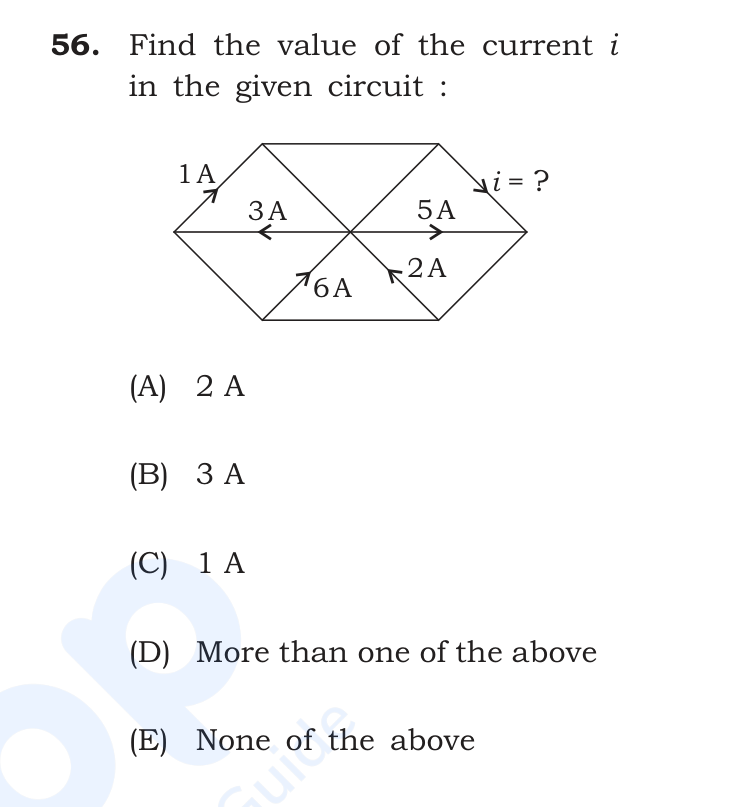
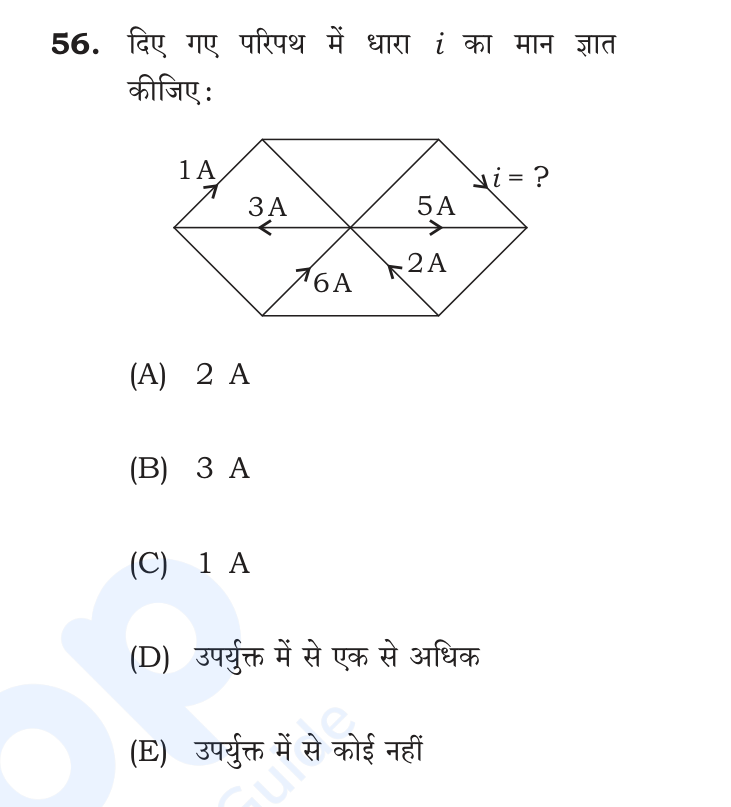
DMore than one of the aboveउपर्युक्त में से एक से अधिक
ENone of the aboveउपर्युक्त में से कोई नहीं
Show answerHide answer
Correct answer: (C)1 A1 A
Explanation
Apply Kirchhoff's current law vertex by vertex: left vertex (3 A in, 1 A out) leaves 2 A to the bottom-left vertex; there 2 A in and 6 A out means 4 A flows along the bottom edge from the right; at the bottom-right vertex 6 A then flows up to the right vertex; there 5 A + i = 6 A, so i = 1 A.प्रत्येक शीर्ष पर किरखोफ का धारा नियम लगाएँ: बायें शीर्ष से नीचे बायें शीर्ष की ओर 2 A जाती है; वहाँ 2 A अंदर और 6 A बाहर, तो तली में 4 A दायीं ओर से आती है; नीचे दायें शीर्ष से 6 A दायें शीर्ष की ओर जाती है; वहाँ 5 A + i = 6 A, अतः i = 1 A।
Which of the following statements is not correct about quality factor of a parallel resonance circuit?किसी समानांतर अनुनादी परिपथ के गुणवत्ता कारक के बारे में, निम्नलिखित में से कौन-सा कथन सही नहीं है?
AQ-factor of parallel resonance is the same as that of series resonance.समानांतर अनुनाद का Q-फैक्टर, शृंखला अनुनाद के Q-फैक्टर के समान ही है।
BQ-factor provides the current magnification.Q-फैक्टर, धारा आवर्धन प्रदान करता है।
CQ-factor provides the voltage magnification.Q-फैक्टर, वोल्टेज आवर्धन प्रदान करता है।
DMore than one of the aboveउपर्युक्त में से एक से अधिक
ENone of the aboveउपर्युक्त में से कोई नहीं
Show answerHide answer
Correct answer: (D)More than one of the aboveउपर्युक्त में से एक से अधिक
Explanation
A parallel resonance circuit gives current magnification, not voltage magnification (that is the series circuit), so (C) is incorrect; statement (A) is also not generally valid because the Q of a parallel circuit is defined differently, so more than one statement is incorrect.समानांतर अनुनादी परिपथ धारा आवर्धन देता है, वोल्टेज आवर्धन नहीं (वह श्रेणी परिपथ में होता है), इसलिए (C) गलत है; (A) भी सामान्यतः सही नहीं है, अतः एक से अधिक कथन गलत हैं।
In a photoelectric experiment, both sodium (work function = 2.3 eV) and tungsten (work function = 4.5 eV) metals are illuminated by an ultraviolet light of same wavelength. If the stopping potential for tungsten is measured to be 1.8 V, then the value of the stopping potential for sodium will beप्रकाश-विद्युत् प्रयोग में, सोडियम (कार्य फलन = 2.3 eV) और टंग्स्टन (कार्य फलन = 4.5 eV) दोनों धातुएँ समान तरंगदैर्घ्य के पराबैंगनी प्रकाश से प्रदीप्त होती हैं। यदि टंग्स्टन का निरोधी विभव 1.8 V मापा जाता है, तो सोडियम के निरोधी विभव का मान होगा
A4 V4 V
B2.2 V2.2 V
C1.8 V1.8 V
DMore than one of the aboveउपर्युक्त में से एक से अधिक
ENone of the aboveउपर्युक्त में से कोई नहीं
Show answerHide answer
Correct answer: (A)4 V4 V
Explanation
Einstein's equation: eV_s = hν − φ. For tungsten hν = 4.5 + 1.8 = 6.3 eV. For sodium V_s = 6.3 − 2.3 = 4.0 V.आइंस्टीन समीकरण eV_s = hν − φ। टंग्स्टन के लिए hν = 4.5 + 1.8 = 6.3 eV। सोडियम के लिए V_s = 6.3 − 2.3 = 4.0 V।
Fine structure of spectral lines arises from the coupling between the electron's spin and its orbital motion (spin-orbit coupling).वर्णक्रमीय रेखाओं की सूक्ष्म संरचना इलेक्ट्रॉन के स्पिन और कक्षीय गति के युग्मन (स्पिन-कक्षा युग्मन) से उत्पन्न होती है।
An atom with proton number 84 and nucleon number 216 decays into a new element. In this process, it emits an alpha particle. What is the structure of the new nucleus after the emission?प्रोटॉन संख्या 84 और न्यूक्लिऑन संख्या 216 वाले एक परमाणु का एक नए तत्त्व में क्षय होता है। इस प्रक्रिया में, यह एक अल्फा कण का उत्सर्जन करता है। उत्सर्जन के बाद नए नाभिक की संरचना क्या है?
AProton number 82, Nucleon number 212प्रोटॉन संख्या 82, न्यूक्लिऑन संख्या 212
BProton number 82, Nucleon number 214प्रोटॉन संख्या 82, न्यूक्लिऑन संख्या 214
CProton number 85, Nucleon number 215प्रोटॉन संख्या 85, न्यूक्लिऑन संख्या 215
DMore than one of the aboveउपर्युक्त में से एक से अधिक
ENone of the aboveउपर्युक्त में से कोई नहीं
Show answerHide answer
Correct answer: (A)Proton number 82, Nucleon number 212प्रोटॉन संख्या 82, न्यूक्लिऑन संख्या 212
Explanation
Alpha emission removes 2 protons and 4 nucleons: Z = 84 − 2 = 82 and A = 216 − 4 = 212.अल्फा उत्सर्जन से 2 प्रोटॉन और 4 न्यूक्लिऑन कम होते हैं: Z = 84 − 2 = 82 और A = 216 − 4 = 212।
Which of the following reactions is not allowed?निम्नलिखित में से किस अभिक्रिया की अनुमति नहीं है?
Aπ⁺ + n → K⁺ + Σ⁰π⁺ + n → K⁺ + Σ⁰
BΛ⁺ + n → Σ⁺ + pΛ⁺ + n → Σ⁺ + p
Cρ⁰ → π⁺ π⁻ρ⁰ → π⁺ π⁻
DMore than one of the aboveउपर्युक्त में से एक से अधिक
ENone of the aboveउपर्युक्त में से कोई नहीं
Show answerHide answer
Correct answer: (B)Λ⁺ + n → Σ⁺ + pΛ⁺ + n → Σ⁺ + p
Explanation
In Λ⁺ + n → Σ⁺ + p the charge is +1 on the left but +2 on the right, so charge is not conserved and the reaction is not allowed.Λ⁺ + n → Σ⁺ + p में बायीं ओर आवेश +1 और दायीं ओर +2 है; आवेश संरक्षित नहीं है, इसलिए अभिक्रिया निषिद्ध है।
Donor-type impurities are the materials ofदाता प्रकार की अशुद्धियाँ किसकी सामग्री हैं?
AV group of periodic tableआवर्त सारणी का V समूह
BIV group of periodic tableआवर्त सारणी का IV समूह
CIII group of periodic tableआवर्त सारणी का III समूह
DMore than one of the aboveउपर्युक्त में से एक से अधिक
ENone of the aboveउपर्युक्त में से कोई नहीं
Show answerHide answer
Correct answer: (A)V group of periodic tableआवर्त सारणी का V समूह
Explanation
Donor impurities are pentavalent atoms (such as P, As, Sb) from group V, which give extra electrons.दाता अशुद्धियाँ पंचसंयोजी परमाणु (P, As, Sb) होती हैं जो आवर्त सारणी के V समूह के हैं और अतिरिक्त इलेक्ट्रॉन देते हैं।
In an n-type semiconductor, the Fermi level liesएक n-प्रकार के अर्धचालक में फर्मी स्तर स्थित होता है
Aabove the top of the valence bandसंयोजी बैंड के शीर्ष के ऊपर
Bbelow the bottom of the conduction bandचालन बैंड के नीचे
Cin the middle of the forbidden gapवर्जित अंतराल के बीच में
DMore than one of the aboveउपर्युक्त में से एक से अधिक
ENone of the aboveउपर्युक्त में से कोई नहीं
Show answerHide answer
Correct answer: (B)below the bottom of the conduction bandचालन बैंड के नीचे
Explanation
In an n-type semiconductor the donor levels lie just below the conduction band, so the Fermi level sits just below the bottom of the conduction band.n-प्रकार के अर्धचालक में दाता स्तर चालन बैंड के ठीक नीचे होते हैं, इसलिए फर्मी स्तर चालन बैंड के निचले सिरे के कुछ नीचे होता है।
Consider the following types of modulation :
(i) Amplitude modulation
(ii) Frequency modulation
(iii) Phase modulation
(iv) Pulse modulation
Which of the above modulations are used for telecasting TV programs?निम्नलिखित प्रकार के मॉड्यूलेशनों पर विचार कीजिए :
(i) आयाम मॉड्यूलेशन
(ii) आवृत्ति मॉड्यूलेशन
(iii) कला मॉड्यूलेशन
(iv) स्पंद मॉड्यूलेशन
उपर्युक्त में से कौन-से मॉड्यूलेशन टी॰ वी॰ कार्यक्रमों के प्रसारण के लिए उपयोग किए जाते हैं?
A(ii) and (iii)(ii) और (iii)
B(iii) and (iv)(iii) और (iv)
C(i) and (ii)(i) और (ii)
DMore than one of the aboveउपर्युक्त में से एक से अधिक
ENone of the aboveउपर्युक्त में से कोई नहीं
Show answerHide answer
Correct answer: (C)(i) and (ii)(i) और (ii)
Explanation
TV broadcasting uses amplitude modulation for the video (picture) signal and frequency modulation for the audio (sound) signal, so (i) and (ii).टी॰ वी॰ प्रसारण में चित्र संकेत के लिए आयाम मॉड्यूलेशन और ध्वनि संकेत के लिए आवृत्ति मॉड्यूलेशन प्रयुक्त होता है, अतः (i) और (ii)।
For every 10 °C increase in temperature, the reverse saturation current of a p-n junction will be increased byप्रत्येक 10 °C तापमान में वृद्धि के लिए p-n जंक्शन की उत्क्रम संतृप्ति धारा में वृद्धि होगी
A10 times10 गुनी
B2 times2 गुनी
C4 times4 गुनी
DMore than one of the aboveउपर्युक्त में से एक से अधिक
ENone of the aboveउपर्युक्त में से कोई नहीं
Show answerHide answer
Correct answer: (B)2 times2 गुनी
Explanation
The reverse saturation current of a p-n junction roughly doubles for every 10 °C rise in temperature.प्रत्येक 10 °C तापमान वृद्धि पर p-n जंक्शन की उत्क्रम संतृप्ति धारा लगभग दोगुनी हो जाती है।
The band gap energies for silicon and germanium photodiodes are 1.1 eV and 0.67 eV respectively. Their cut-off wavelengths respectively would beसिलिकॉन और जर्मेनियम फोटोडायोड के लिए बैंड अंतराल ऊर्जाएँ क्रमशः 1.1 eV और 0.67 eV हैं। उनके कट-ऑफ तरंगदैर्घ्य, क्रमशः, होंगे
Which method can be employed to produce a high degree of homogeneity in the creation of ZnFe₂O₄ spinel?ZnFe₂O₄ स्पिनेल के निर्माण में उच्च स्तर की एकरूपता उत्पन्न करने के लिए किस विधि को नियोजित किया जा सकता है?
ADistillation methodआसवन विधि
BVaporization methodवाष्पीकरण विधि
CCoprecipitation methodसह-अवक्षेपण विधि
DMore than one of the aboveउपर्युक्त में से एक से अधिक
Coprecipitation mixes the metal ions in solution at the atomic level, giving a highly homogeneous ferrite such as ZnFe₂O₄.सह-अवक्षेपण में धातु आयन विलयन में परमाणु स्तर पर मिलते हैं, जिससे ZnFe₂O₄ जैसा अत्यंत एकरूप फेराइट बनता है।
_____ is a crystalline solid’s basic repetitive structural unit._____ एक क्रिस्टलीय ठोस की मूल दोहरावदार संरचनात्मक इकाई है।
AMonomerएकलक
BMoleculeअणु
CUnit cellएकक सेल
DMore than one of the aboveउपर्युक्त में से एक से अधिक
ENone of the aboveउपर्युक्त में से कोई नहीं
Show answerHide answer
Correct answer: (C)Unit cellएकक सेल
Explanation
The smallest repeating structural unit of a crystal lattice is called the unit cell.क्रिस्टल जालक की सबसे छोटी दोहराई जाने वाली संरचनात्मक इकाई को एकक सेल (यूनिट सेल) कहते हैं।
For all the reactions, what is the nature of the chemical dissociation?सभी अभिक्रियाओं के लिए, रासायनिक वियोजन की प्रकृति क्या होती है?
AExothermicऊष्माक्षेपी
BReversibleप्रतिवर्ती
CEndothermicऊष्माशोषी
DMore than one of the aboveउपर्युक्त में से एक से अधिक
ENone of the aboveउपर्युक्त में से कोई नहीं
Show answerHide answer
Correct answer: (D)More than one of the aboveउपर्युक्त में से एक से अधिक
Explanation
Chemical dissociation is generally reversible and, since bonds are broken, endothermic, so both (B) and (C) hold and the answer is 'more than one of the above'.रासायनिक वियोजन सामान्यतः प्रतिवर्ती और (बंध टूटने के कारण) ऊष्माशोषी होता है, अतः (B) और (C) दोनों सही हैं और उत्तर 'एक से अधिक' है।
The radius of an atomic nucleus is of the order ofपरमाणु नाभिक की त्रिज्या _____ की कोटि की होती है।
A10⁻¹⁰ cm10⁻¹⁰ से॰ मी॰
B10⁻¹³ cm10⁻¹³ से॰ मी॰
C10⁻¹⁵ cm10⁻¹⁵ से॰ मी॰
DMore than one of the aboveउपर्युक्त में से एक से अधिक
ENone of the aboveउपर्युक्त में से कोई नहीं
Show answerHide answer
Correct answer: (B)10⁻¹³ cm10⁻¹³ से॰ मी॰
Explanation
A nucleus has a radius of the order of 1 fermi = 10⁻¹³ cm (about 10⁻¹⁵ m).परमाणु नाभिक की त्रिज्या लगभग 1 फर्मी = 10⁻¹³ से॰ मी॰ (लगभग 10⁻¹⁵ मी॰) की कोटि की होती है।
Athe circular path of electronइलेक्ट्रॉन का वृत्ताकार पथ
Ban elliptical shaped orbitअंडाकार कक्षा
Cthe region in which there is a maximum possibility of finding an electronवह क्षेत्र है, जिसमें इलेक्ट्रॉन के पाए जाने की संभावना अधिकतम होती है
DMore than one of the aboveउपर्युक्त में से एक से अधिक
ENone of the aboveउपर्युक्त में से कोई नहीं
Show answerHide answer
Correct answer: (C)the region in which there is a maximum possibility of finding an electronवह क्षेत्र है, जिसमें इलेक्ट्रॉन के पाए जाने की संभावना अधिकतम होती है
Explanation
An atomic orbital is the region of space around the nucleus where the probability of finding the electron is maximum.परमाणु कक्षक नाभिक के चारों ओर का वह क्षेत्र है जहाँ इलेक्ट्रॉन के पाए जाने की संभावना अधिकतम होती है।
In the rate equation, when the concentration of reactants is unity, then the rate is equal toदर समीकरण में, जब अभिकारकों की सांद्रता एक होती है, तो दर बराबर होती है
Aspecific rate constantविशिष्ट दर स्थिरांक के
Baverage rate constantऔसत दर स्थिरांक के
Cinstantaneous rate constantतात्कालिक दर स्थिरांक के
DMore than one of the aboveउपर्युक्त में से एक से अधिक
ENone of the aboveउपर्युक्त में से कोई नहीं
Show answerHide answer
Correct answer: (A)specific rate constantविशिष्ट दर स्थिरांक के
Explanation
Rate = k[A]ⁿ; when every concentration is unity, rate = k, the specific rate constant.दर = k[A]ⁿ; जब सभी सांद्रताएँ इकाई हों तो दर = k, अर्थात् विशिष्ट दर स्थिरांक।
In the reaction 2A + B → A₂B, if the concentration of A is doubled and that of B is halved, then the rate of the reaction willअभिक्रिया 2A + B → A₂B में, यदि A की सान्द्रता दोगुनी कर दी जाए और B की सान्द्रता आधी कर दी जाए, तो अभिक्रिया की दर
Aincrease 2 times2 गुनी बढ़ जाएगी
Bincrease 4 times4 गुनी बढ़ जाएगी
Cdecrease 2 times2 गुनी कम हो जाएगी
DMore than one of the aboveउपर्युक्त में से एक से अधिक
Taking the elementary rate law rate = k[A]²[B]: doubling A multiplies the rate by 4 and halving B by 1/2, so the net effect is a 2-fold increase.प्रारंभिक अभिक्रिया मानकर दर = k[A]²[B]: A दोगुना करने से दर 4 गुनी और B आधा करने से 1/2, अतः कुल दर 2 गुनी बढ़ती है।
A substance A decomposes by a first-order reaction starting initially with [A] = 2.00 M and after 200 minutes, [A] becomes 0.15 M. For this reaction t₁/₂ isएक पदार्थ A प्रथम कोटि की अभिक्रिया से विघटित होता है, जो पहले [A] = 2.00 M के साथ शुरू होता है और 200 मिनट के बाद [A], 0.15 M हो जाता है। इस अभिक्रिया के लिए t₁/₂ है
A53.72 minutes53.72 मिनट
B50.49 minutes50.49 मिनट
C48.45 minutes48.45 मिनट
DMore than one of the aboveउपर्युक्त में से एक से अधिक
ENone of the aboveउपर्युक्त में से कोई नहीं
Show answerHide answer
Correct answer: (A)53.72 minutes53.72 मिनट
Explanation
k = (2.303/200) log(2.00/0.15) ≈ 0.01295 min⁻¹, so t½ = 0.693 / k ≈ 53.5 min; the closest option is 53.72 minutes.k = (2.303/200) log(2.00/0.15) ≈ 0.01295 मिनट⁻¹, अतः t½ = 0.693/k ≈ 53.5 मिनट; निकटतम विकल्प 53.72 मिनट है।
Which of the following assertions about the main cell is correct?मुख्य सेल के बारे में, निम्नलिखित में से कौन-सा कथन सही है?
AAn example of a primary cell is a mercury cell.पारा सेल, प्राथमिक सेल का एक उदाहरण है।
BAn example of a primary cell is a nickel-cadmium storage cell.प्राथमिक सेल का एक उदाहरण निकल-कैड्मियम स्टोरेज सेल है।
CThe electrode reactions can be reversed.इलेक्ट्रोड अभिक्रियाओं को उलटा किया जा सकता है।
DMore than one of the aboveउपर्युक्त में से एक से अधिक
ENone of the aboveउपर्युक्त में से कोई नहीं
Show answerHide answer
Correct answer: (A)An example of a primary cell is a mercury cell.पारा सेल, प्राथमिक सेल का एक उदाहरण है।
Explanation
A mercury cell is a primary (non-rechargeable) cell; the other two statements describe secondary cells, so only (A) is correct.पारा सेल प्राथमिक (पुनः आवेशित न होने वाला) सेल है; अन्य दोनों कथन द्वितीयक सेल के हैं, अतः केवल (A) सही है।
A catalyst alters which of the following in a chemical reaction?रासायनिक अभिक्रिया में उत्प्रेरक निम्नलिखित में से किसमें परिवर्तन करता है?
AEntropyएन्ट्रॉपी
BActivation energyसक्रियण ऊर्जा
CInternal energyआंतरिक ऊर्जा
DMore than one of the aboveउपर्युक्त में से एक से अधिक
ENone of the aboveउपर्युक्त में से कोई नहीं
Show answerHide answer
Correct answer: (B)Activation energyसक्रियण ऊर्जा
Explanation
A catalyst provides an alternative path with lower activation energy; it does not change entropy or internal energy.उत्प्रेरक कम सक्रियण ऊर्जा वाला वैकल्पिक पथ देता है; यह एन्ट्रॉपी या आंतरिक ऊर्जा नहीं बदलता।
Photochemistry deals with the study ofप्रकाश-रसायन किसके अध्ययन से संबंधित है?
Aphotonsफोटॉन
Bphotosतस्वीर
Creactions which proceed with absorptions of visible or UV lightअभिक्रियाएँ, जो दृश्य या UV प्रकाश के अवशोषण के साथ आगे बढ़ती हैं
DMore than one of the aboveउपर्युक्त में से एक से अधिक
ENone of the aboveउपर्युक्त में से कोई नहीं
Show answerHide answer
Correct answer: (C)reactions which proceed with absorptions of visible or UV lightअभिक्रियाएँ, जो दृश्य या UV प्रकाश के अवशोषण के साथ आगे बढ़ती हैं
Explanation
Photochemistry studies reactions that proceed by absorption of visible or ultraviolet light.प्रकाश-रसायन उन अभिक्रियाओं का अध्ययन है जो दृश्य या पराबैंगनी प्रकाश के अवशोषण से होती हैं।
The number of photons that pass through a unit area in a unit time is calledएक इकाई समय में एक इकाई क्षेत्रफल से होकर गुजरने वाले फोटॉनों की संख्या कहलाती है
Aamplitude of lightप्रकाश का आयाम
Bfrequency of lightप्रकाश की आवृत्ति
Cintensity of lightप्रकाश की तीव्रता
DMore than one of the aboveउपर्युक्त में से एक से अधिक
ENone of the aboveउपर्युक्त में से कोई नहीं
Show answerHide answer
Correct answer: (C)intensity of lightप्रकाश की तीव्रता
Explanation
The number of photons crossing unit area per unit time is the intensity of light.प्रति इकाई समय में प्रति इकाई क्षेत्रफल से गुजरने वाले फोटॉनों की संख्या प्रकाश की तीव्रता कहलाती है।
The transition without emission of radiation of a molecule from a stable excited state to an unstable excited state that leads to dissociation isस्थिर उत्तेजित अवस्था से अस्थिर उत्तेजित अवस्था में एक अणु के विकिरण के उत्सर्जन के बिना संक्रमण, जो पृथक्करण की ओर जाता है, है
Apredissociationपूर्व-पृथक्करण
Bdissociationपृथक्करण
Cphotodissociationप्रकाशिक पृथक्करण
DMore than one of the aboveउपर्युक्त में से एक से अधिक
ENone of the aboveउपर्युक्त में से कोई नहीं
Show answerHide answer
Correct answer: (A)predissociationपूर्व-पृथक्करण
Explanation
A radiationless transition from a stable excited state to an unstable (dissociative) excited state is predissociation.स्थिर उत्तेजित अवस्था से अस्थिर (वियोजक) उत्तेजित अवस्था में बिना विकिरण के संक्रमण पूर्व-पृथक्करण कहलाता है।
Which of the following products are obtained when Na₂CO₃ is added to a solution of copper sulphate?कॉपर सल्फेट के विलयन में Na₂CO₃ मिलाने पर निम्नलिखित में से कौन-से उत्पाद प्राप्त होते हैं?
ABasic copper carbonate, sodium sulphate and CO₂बेसिक कॉपर कार्बोनेट, सोडियम सल्फेट और CO₂
BCopper hydroxide, sodium sulphate and CO₂कॉपर हाइड्रॉक्साइड, सोडियम सल्फेट और CO₂
CCopper carbonate, sodium sulphate and CO₂कॉपर कार्बोनेट, सोडियम सल्फेट और CO₂
DMore than one of the aboveउपर्युक्त में से एक से अधिक
ENone of the aboveउपर्युक्त में से कोई नहीं
Show answerHide answer
Correct answer: (A)Basic copper carbonate, sodium sulphate and CO₂बेसिक कॉपर कार्बोनेट, सोडियम सल्फेट और CO₂
Explanation
Copper sulphate and sodium carbonate in water react to give basic copper carbonate, sodium sulphate and CO₂.कॉपर सल्फेट और सोडियम कार्बोनेट की अभिक्रिया से बेसिक कॉपर कार्बोनेट, सोडियम सल्फेट और CO₂ बनते हैं।
The pair that has similar atomic radii isसमान परमाणु त्रिज्याओं वाला युग्म है
AMn and ReMn और Re
BMo and WMo और W
CSc and NiSc और Ni
DMore than one of the aboveउपर्युक्त में से एक से अधिक
ENone of the aboveउपर्युक्त में से कोई नहीं
Show answerHide answer
Correct answer: (B)Mo and WMo और W
Explanation
Because of the lanthanide contraction, 4d and 5d elements of the same group such as Mo and W have almost identical atomic radii.लैन्थेनाइड संकुचन के कारण एक ही समूह के 4d और 5d तत्त्व, जैसे Mo और W, की परमाणु त्रिज्याएँ लगभग समान होती हैं।
Note: the official key gives (A); current IUPAC practice writes this complex as sodium pentacyanonitrosylferrate(II) (Fe is +2 with NO⁺), but the official key is kept. The older name used is pentacyanonitrosylferrate(III).टिप्पणी: आधिकारिक कुंजी (A) है; वर्तमान IUPAC नाम सोडियम पेंटासायनोनाइट्रोसिलफेरेट(II) है, फिर भी आधिकारिक कुंजी रखी गई है।
A substance X is used in whitewashing and is obtained by heating limestone in the absence of air. Identify X .एक पदार्थ X का उपयोग सफेदीकरण में किया जाता है और इसे हवा की अनुपस्थिति में चूनापत्थर को गर्म करके प्राप्त किया जाता है। X की पहचान कीजिए।
ACaOCl₂CaOCl₂
BCa(OH)₂Ca(OH)₂
CCaOCaO
DMore than one of the aboveउपर्युक्त में से एक से अधिक
ENone of the aboveउपर्युक्त में से कोई नहीं
Show answerHide answer
Correct answer: (C)CaOCaO
Explanation
Heating limestone (CaCO₃) in the absence of air gives quicklime CaO, the substance used for whitewashing (after slaking).चूनापत्थर (CaCO₃) को हवा की अनुपस्थिति में गर्म करने पर कैल्सियम ऑक्साइड CaO (बिना बुझा चूना) बनता है, जिसका उपयोग सफेदी में होता है।
A dilute ferrous sulphate solution is gradually added to the beaker containing acidified permanganate solution. The light purple colour of the solution fades and finally disappears. Which of the following is the correct explanation for the observation?अम्लीकृत परमैंगनेट विलयन वाले बीकर में धीरे-धीरे तनु फेरस सल्फेट का विलयन डाला गया। विलयन का हल्का बैंगनी रंग फीका पड़ जाता है और अंत में गायब हो जाता है। निम्नलिखित में से कौन-सा अवलोकन के लिए सही स्पष्टीकरण है?
AKMnO₄ is an oxidizing agent and it oxidizes FeSO₄.KMnO₄ एक ऑक्सीकारक है और यह FeSO₄ का ऑक्सीकरण करता है।
BFeSO₄ acts as an oxidizing agent and it oxidizes KMnO₄.FeSO₄ एक ऑक्सीकारक के रूप में कार्य करता है और यह KMnO₄ का ऑक्सीकरण करता है।
CThe colour disappears due to dilution, no reaction is involved.तनुकरण के कारण रंग गायब हो जाता है, कोई अभिक्रिया शामिल नहीं है।
DMore than one of the aboveउपर्युक्त में से एक से अधिक
ENone of the aboveउपर्युक्त में से कोई नहीं
Show answerHide answer
Correct answer: (A)KMnO₄ is an oxidizing agent and it oxidizes FeSO₄.KMnO₄ एक ऑक्सीकारक है और यह FeSO₄ का ऑक्सीकरण करता है।
Explanation
Acidified KMnO₄ is a strong oxidising agent; it oxidises Fe²⁺ of FeSO₄ to Fe³⁺ and is itself reduced to nearly colourless Mn²⁺, so the purple colour fades.अम्लीकृत KMnO₄ प्रबल ऑक्सीकारक है; यह FeSO₄ के Fe²⁺ को Fe³⁺ में ऑक्सीकृत करता है और स्वयं लगभग रंगहीन Mn²⁺ में अपचयित हो जाता है, इसलिए बैंगनी रंग फीका पड़ता है।
How many structural isomers are possible if one hydrogen in diphenylmethane is replaced by chlorine?डाइफेनिलमीथेन में एक हाइड्रोजन को क्लोरीन से बदलने पर कितने संरचनात्मक समावयवी संभव हैं?
A88
B44
C77
DMore than one of the aboveउपर्युक्त में से एक से अधिक
ENone of the aboveउपर्युक्त में से कोई नहीं
Show answerHide answer
Correct answer: (B)44
Explanation
Monochlorination of diphenylmethane can occur at the ortho, meta or para position of the ring (3 isomers) or at the CH₂ carbon (1 isomer): 4 in all.डाइफेनिलमीथेन का मोनोक्लोरीनीकरण वलय के ऑर्थो, मेटा, पैरा (3) या CH₂ कार्बन (1) पर हो सकता है: कुल 4 समावयवी।
Which among the following statements is/are true?
Exposure of silver chloride to sunlight for a long duration turns it grey due to the
(i) formation of silver by decomposition of silver chloride
(ii) sublimation of silver chloride
(iii) decomposition of chlorine gas from silver chloride
(iv) oxidation of silver chloride
Select the correct answer using the codes given below.निम्नलिखित में से कौन-सा/से कथन सही है/हैं?
लंबे समय तक सूर्य के प्रकाश के संपर्क में रहने के कारण सिल्वर क्लोराइड धूसर हो जाता है
(i) सिल्वर क्लोराइड के अपघटन से सिल्वर के निर्माण के कारण
(ii) सिल्वर क्लोराइड के ऊर्ध्वपातन के कारण
(iii) सिल्वर क्लोराइड से क्लोरीन गैस के अपघटन के कारण
(iv) सिल्वर क्लोराइड के ऑक्सीकरण के कारण
नीचे दिए गए कूट का प्रयोग करते हुए सही उत्तर का चयन कीजिए।
A(i) onlyकेवल (i)
B(i) and (iii)(i) और (iii)
C(ii) and (iv)(ii) और (iv)
DMore than one of the aboveउपर्युक्त में से एक से अधिक
ENone of the aboveउपर्युक्त में से कोई नहीं
Show answerHide answer
Correct answer: (B)(i) and (iii)(i) और (iii)
Explanation
Sunlight decomposes silver chloride into silver (grey) and chlorine gas, so statements (i) and (iii) as keyed describe the observation.सूर्य के प्रकाश में सिल्वर क्लोराइड सिल्वर (धूसर) और क्लोरीन गैस में अपघटित होता है, अतः (i) और (iii) कुंजी के अनुसार सही हैं।
Which of the following is a branched polymer?निम्नलिखित में से कौन-सा शाखित बहुलक है?
ALow-density polymerकम घनत्व वाला बहुलक
BPolyesterपॉलिएस्टर
CHigh-density polymerउच्च घनत्व वाला बहुलक
DMore than one of the aboveउपर्युक्त में से एक से अधिक
ENone of the aboveउपर्युक्त में से कोई नहीं
Show answerHide answer
Correct answer: (A)Low-density polymerकम घनत्व वाला बहुलक
Explanation
Low-density polyethylene is a branched polymer, whereas high-density polyethylene is linear.कम घनत्व वाला पॉलिएथिलीन शाखित बहुलक है, जबकि उच्च घनत्व वाला रैखिक होता है।
DMore than one of the aboveउपर्युक्त में से एक से अधिक
ENone of the aboveउपर्युक्त में से कोई नहीं
Show answerHide answer
Correct answer: (D)More than one of the aboveउपर्युक्त में से एक से अधिक
Explanation
Both PHBV (3-hydroxybutanoic + 3-hydroxypentanoic acid) and nylon-2-nylon-6 (glycine + aminocaproic acid) are biodegradable; polyester from ethylene glycol and phthalic acid (glyptal) is not. So (A) and (B): more than one.PHBV (3-हाइड्रॉक्सीब्यूटेनोइक + 3-हाइड्रॉक्सीपेंटेनोइक ऐसिड) और नायलॉन-2-नायलॉन-6 (ग्लाइसिन + अमीनोकैप्रोइक ऐसिड) दोनों जैव-निम्नीकरणीय हैं; एथिलीन ग्लाइकॉल + थैलिक ऐसिड वाला नहीं। अतः (A) और (B): एक से अधिक।
The correct order of increasing nucleophilicity isबढ़ते हुए न्यूक्लिओफिलिसिटी का सही क्रम है
ACl⁻ < Br⁻ < I⁻Cl⁻ < Br⁻ < I⁻
BBr⁻ < Cl⁻ < I⁻Br⁻ < Cl⁻ < I⁻
CI⁻ < Br⁻ < Cl⁻I⁻ < Br⁻ < Cl⁻
DMore than one of the aboveउपर्युक्त में से एक से अधिक
ENone of the aboveउपर्युक्त में से कोई नहीं
Show answerHide answer
Correct answer: (A)Cl⁻ < Br⁻ < I⁻Cl⁻ < Br⁻ < I⁻
Explanation
In protic solvents nucleophilicity increases down the group because larger, more polarisable ions are less solvated: Cl⁻ < Br⁻ < I⁻.प्रोटिक विलायकों में समूह में नीचे जाने पर बड़े, अधिक ध्रुवणीय आयन कम विलायकित होते हैं, इसलिए न्यूक्लिओफिलिसिटी बढ़ती है: Cl⁻ < Br⁻ < I⁻।
Select the correct statement from the following options.निम्नलिखित विकल्पों में से सही कथन का चयन कीजिए।
ASpectroscopic methods require less time and more amount of sample than classical methods.शास्त्रीय विधियों की तुलना में स्पेक्ट्रोस्कोपिक विधियों में कम समय और नमूने की अधिक मात्रा की आवश्यकता होती है।
BSpectroscopic methods require more time and more amount of sample than classical methods.शास्त्रीय विधियों की तुलना में स्पेक्ट्रोस्कोपिक विधियों में अधिक समय और नमूने की अधिक मात्रा की आवश्यकता होती है।
CSpectroscopic methods require less time and less amount of sample than classical methods.शास्त्रीय विधियों की तुलना में स्पेक्ट्रोस्कोपिक विधियों में कम समय और नमूने की कम मात्रा की आवश्यकता होती है।
DMore than one of the aboveउपर्युक्त में से एक से अधिक
ENone of the aboveउपर्युक्त में से कोई नहीं
Show answerHide answer
Correct answer: (C)Spectroscopic methods require less time and less amount of sample than classical methods.शास्त्रीय विधियों की तुलना में स्पेक्ट्रोस्कोपिक विधियों में कम समय और नमूने की कम मात्रा की आवश्यकता होती है।
Explanation
Spectroscopic methods are faster and need only a very small sample compared with classical methods.शास्त्रीय विधियों की तुलना में स्पेक्ट्रोस्कोपिक विधियाँ कम समय लेती हैं और बहुत कम नमूना चाहिए।
A carbonyl group will cause a sharp dip at about _____ cm⁻¹.लगभग _____ से॰ मी॰⁻¹ पर कार्बोनिल समूह तीव्र गिरावट का कारण बनेगा।
A17001700
B28002800
C34003400
DMore than one of the aboveउपर्युक्त में से एक से अधिक
ENone of the aboveउपर्युक्त में से कोई नहीं
Show answerHide answer
Correct answer: (A)17001700
Explanation
The C=O stretching vibration gives a strong, sharp IR absorption near 1700 cm⁻¹.कार्बोनिल (C=O) समूह का तानन कंपन IR में लगभग 1700 से॰ मी॰⁻¹ पर तीव्र अवशोषण देता है।
Which is the best suited method for the separation of para- and ortho-nitrophenols from 1 : 1 mixture?1 : 1 मिश्रण से पैरा- और ऑर्थो-नाइट्रोफिनॉल को अलग करने के लिए सबसे उपयुक्त तरीका कौन-सा है?
ACrystallizationक्रिस्टलीकरण
BChromatographyक्रोमैटोग्राफी
CSteam distillationभाप आसवन
DMore than one of the aboveउपर्युक्त में से एक से अधिक
ENone of the aboveउपर्युक्त में से कोई नहीं
Show answerHide answer
Correct answer: (C)Steam distillationभाप आसवन
Explanation
o-Nitrophenol is intramolecularly hydrogen bonded and steam volatile, while p-nitrophenol is not, so steam distillation separates them.o-नाइट्रोफिनॉल में अंतःआण्विक हाइड्रोजन बंध होने से यह भाप वाष्पशील है, p-नाइट्रोफिनॉल नहीं; इसलिए भाप आसवन से इन्हें अलग किया जाता है।
Find the compound which undergoes nucleophilic substitution reaction exclusively by an SN1 mechanism.उस यौगिक का पता लगाइए, जो विशेष रूप से एक SN1 तंत्र द्वारा न्यूक्लियोफिलिक प्रतिस्थापन अभिक्रिया से गुजरता है।
ABenzyl chlorideबेंजाइल क्लोराइड
BChlorobenzeneक्लोरोबेंजीन
CEthyl chlorideएथिल क्लोराइड
DMore than one of the aboveउपर्युक्त में से एक से अधिक
Benzyl chloride gives a stable benzyl carbocation and so reacts by the SN1 route; chlorobenzene does not undergo SN1 and ethyl chloride prefers SN2.बेंजाइल क्लोराइड स्थिर बेंजाइल कार्बधनायन बनाता है, इसलिए SN1 से अभिक्रिया करता है; क्लोरोबेंजीन SN1 नहीं करता और एथिल क्लोराइड SN2 पसंद करता है।
One of the purposes of secondary treatment of wastewater and sewage isअपशिष्ट जल और सीवेज के द्वितीयक उपचार के उद्देश्यों में से एक है
Ato increase the chlorine contentक्लोरीन की मात्रा बढ़ाना
Bto reduce the BODबी॰ ओ॰ डी॰ कम करना
Cto encourage the formation of PCBsपी॰ सी॰ बी॰ के गठन को प्रोत्साहित करना
DMore than one of the aboveउपर्युक्त में से एक से अधिक
ENone of the aboveउपर्युक्त में से कोई नहीं
Show answerHide answer
Correct answer: (B)to reduce the BODबी॰ ओ॰ डी॰ कम करना
Explanation
Secondary (biological) treatment of wastewater reduces the biochemical oxygen demand (BOD) of the effluent.अपशिष्ट जल के द्वितीयक (जैविक) उपचार का एक उद्देश्य जैव रासायनिक ऑक्सीजन माँग (BOD) कम करना है।
Most bacteria that cause plant diseases are members of the group ofअधिकांश बैक्टीरिया, जो पौधों की बीमारियों का कारण बनते हैं, वे किस समूह के सदस्य हैं?
Arod-shaped and gram-positive bacteriaछड़ के आकार के और ग्राम-पॉजिटिव बैक्टीरिया
Brod-shaped and gram-negative bacteriaछड़ के आकार के और ग्राम-नेगेटिव बैक्टीरिया
Cfilament-shaped and gram-positive bacteriaतंतु के आकार के और ग्राम-पॉजिटिव बैक्टीरिया
DMore than one of the aboveउपर्युक्त में से एक से अधिक
ENone of the aboveउपर्युक्त में से कोई नहीं
Show answerHide answer
Correct answer: (B)rod-shaped and gram-negative bacteriaछड़ के आकार के और ग्राम-नेगेटिव बैक्टीरिया
Explanation
Most plant-pathogenic bacteria are rod-shaped Gram-negative bacteria (e.g. Pseudomonas, Xanthomonas, Erwinia).पौधों में रोग उत्पन्न करने वाले अधिकांश जीवाणु छड़ के आकार के ग्राम-नेगेटिव होते हैं (जैसे स्यूडोमोनास, ज़ैन्थोमोनास, इर्विनिया)।
Albugo (white rust) is an obligate parasite that can grow only on a living host.अल्बुगो (सफेद रतुआ) अनिवार्य परजीवी है जो केवल जीवित पोषक पर ही वृद्धि कर सकता है।
Which of the following is incorrect statement?निम्नलिखित में से कौन-सा कथन गलत है?
AIn Liliaceae, some plants have underground parts.लिलिएसी में, कुछ पौधों में भूमिगत भाग होते हैं।
BFibre-yielding plants are found in Malvaceae.मालवेसी में, रेशा देने वाले पौधे पाए जाते हैं।
CTrees with large flowers and seeds are found in Compositae.कंपोजिटी में, बड़े फूल और बीज वाले पेड़ पाए जाते हैं।
DMore than one of the aboveउपर्युक्त में से एक से अधिक
ENone of the aboveउपर्युक्त में से कोई नहीं
Show answerHide answer
Correct answer: (C)Trees with large flowers and seeds are found in Compositae.कंपोजिटी में, बड़े फूल और बीज वाले पेड़ पाए जाते हैं।
Explanation
Compositae (Asteraceae) are mostly herbs and shrubs; large trees with large flowers and seeds are not typical, so (C) is incorrect.कंपोजिटी (ऐस्टेरेसी) में अधिकांशतः शाक और झाड़ियाँ होती हैं; बड़े फूल और बीज वाले वृक्ष इसमें प्रारूपिक नहीं हैं, इसलिए (C) गलत है।
One of the major Basmati rice-producing States in our country isहमारे देश में प्रमुख बासमती चावल उत्पादक राज्यों में से एक है
AKeralaकेरल
BAndhra Pradeshआंध्र प्रदेश
CUttar Pradeshउत्तर प्रदेश
DMore than one of the aboveउपर्युक्त में से एक से अधिक
ENone of the aboveउपर्युक्त में से कोई नहीं
Show answerHide answer
Correct answer: (C)Uttar Pradeshउत्तर प्रदेश
Explanation
Uttar Pradesh (with Punjab and Haryana) is a major Basmati-producing State; Kerala and Andhra Pradesh are not.उत्तर प्रदेश (पंजाब और हरियाणा के साथ) बासमती चावल का प्रमुख उत्पादक राज्य है; केरल और आंध्र प्रदेश नहीं।
APlant which is chemically identical to the source plantपौधे, जो रासायनिक रूप से स्रोत पौधे के समान होते हैं
BPlant which is morphologically similar to the original plantपौधे, जो आकारिकी रूप से मूल पौधे के समान होते हैं
CPlant which is automatically identical to the original plantपौधे, जो स्वतः ही मूल पौधे के समान होते हैं
DMore than one of the aboveउपर्युक्त में से एक से अधिक
ENone of the aboveउपर्युक्त में से कोई नहीं
Show answerHide answer
Correct answer: (E)None of the aboveउपर्युक्त में से कोई नहीं
Explanation
Somaclones are plants regenerated from somatic cells in tissue culture that show genetic variation (somaclonal variation); none of the three given descriptions is correct.सोमाक्लोन ऊतक संवर्धन में कायिक कोशिकाओं से बने पौधे हैं जिनमें आनुवंशिक विविधता (सोमाक्लोनल विविधता) होती है; दिए गए तीनों कथन सही नहीं हैं।
The functional unit of synthesis of protein isप्रोटीन संश्लेषण की क्रियात्मक इकाई है
Aperoxisomeपरऑक्सीसोम
Bpolysomeपॉलिसोम
Clysosomeलाइसोसोम
DMore than one of the aboveउपर्युक्त में से एक से अधिक
ENone of the aboveउपर्युक्त में से कोई नहीं
Show answerHide answer
Correct answer: (B)polysomeपॉलिसोम
Explanation
Polysomes (polyribosomes), clusters of ribosomes on one mRNA, are the functional units of protein synthesis.एक ही mRNA पर जुड़े राइबोसोमों के समूह पॉलिसोम प्रोटीन संश्लेषण की क्रियात्मक इकाई हैं।
Aagainst concentration gradient and requires ATPसांद्रण प्रवणता के विरुद्ध होता है और इसमें ए॰ टी॰ पी॰ की आवश्यकता होती है
Bagainst concentration gradient and does not require ATPसांद्रण प्रवणता के विरुद्ध होता है और इसमें ए॰ टी॰ पी॰ की आवश्यकता नहीं होती है
Cwith concentration gradient and does not require ATPसांद्रण प्रवणता के साथ होता है और इसमें ए॰ टी॰ पी॰ की आवश्यकता नहीं होती है
DMore than one of the aboveउपर्युक्त में से एक से अधिक
ENone of the aboveउपर्युक्त में से कोई नहीं
Show answerHide answer
Correct answer: (A)against concentration gradient and requires ATPसांद्रण प्रवणता के विरुद्ध होता है और इसमें ए॰ टी॰ पी॰ की आवश्यकता होती है
Explanation
Active transport moves substances against their concentration gradient and therefore needs energy in the form of ATP.सक्रिय परिवहन में पदार्थ सांद्रण प्रवणता के विरुद्ध जाते हैं, इसलिए ATP के रूप में ऊर्जा आवश्यक होती है।
Tropical evergreen forests are found in which of the following States of India?भारत के निम्नलिखित में से किस राज्य में उष्णकटिबंधीय सदाबहार वन पाए जाते हैं?
ATamil Naduतमिलनाडु
BAssamअसम
CMadhya Pradeshमध्य प्रदेश
DMore than one of the aboveउपर्युक्त में से एक से अधिक
ENone of the aboveउपर्युक्त में से कोई नहीं
Show answerHide answer
Correct answer: (D)More than one of the aboveउपर्युक्त में से एक से अधिक
Explanation
Tropical evergreen forests occur in both Tamil Nadu (Western Ghats) and Assam, so more than one option is correct.उष्णकटिबंधीय सदाबहार वन तमिलनाडु (पश्चिमी घाट) और असम दोनों में पाए जाते हैं, अतः एक से अधिक विकल्प सही हैं।
Adecrease in ozone concentration in stratosphereसमतापमंडल में ओज़ोन सांद्रता में कमी
Bdecrease in the thickness of ozone layer in stratosphereसमतापमंडल में ओज़ोन परत की मोटाई में कमी
Cincrease in the thick layer of ozone in stratosphereसमतापमंडल में ओज़ोन की मोटी परत में वृद्धि
DMore than one of the aboveउपर्युक्त में से एक से अधिक
ENone of the aboveउपर्युक्त में से कोई नहीं
Show answerHide answer
Correct answer: (B)decrease in the thickness of ozone layer in stratosphereसमतापमंडल में ओज़ोन परत की मोटाई में कमी
Explanation
The ozone hole is a marked thinning (depletion) of the ozone layer in the stratosphere, especially over Antarctica.ओज़ोन छिद्र समतापमंडल में ओज़ोन परत की मोटाई में भारी कमी है, विशेषकर अंटार्कटिका के ऊपर।
The component of food that does not provide any nutrient to our body and yet is essential in our food isभोजन का वह घटक, जो हमारे शरीर को कोई पोषक तत्त्व प्रदान नहीं करता है और फिर भी हमारे भोजन में आवश्यक है, है
Afatवसा
Bcarbohydrateकार्बोहाइड्रेट
Croughageचारा
DMore than one of the aboveउपर्युक्त में से एक से अधिक
ENone of the aboveउपर्युक्त में से कोई नहीं
Show answerHide answer
Correct answer: (C)roughageचारा
Explanation
Roughage (dietary fibre) provides no nutrient but is essential for the movement of food and prevention of constipation.रुक्षांश (चारा/आहारीय रेशा) कोई पोषक तत्त्व नहीं देता, फिर भी भोजन के संचलन और कब्ज रोकने के लिए आवश्यक है।
Plasma membrane is built up ofप्लाज़्मा झिल्ली किससे बनी होती है?
Aproteinप्रोटीन
Blipidलिपिड
Ccarbohydrateकार्बोहाइड्रेट
DMore than one of the aboveउपर्युक्त में से एक से अधिक
ENone of the aboveउपर्युक्त में से कोई नहीं
Show answerHide answer
Correct answer: (D)More than one of the aboveउपर्युक्त में से एक से अधिक
Explanation
The plasma membrane is made of lipids (phospholipids), proteins and some carbohydrates, so more than one option is right.प्लाज़्मा झिल्ली लिपिड (फॉस्फोलिपिड), प्रोटीन और कुछ कार्बोहाइड्रेट से बनी होती है, अतः एक से अधिक विकल्प सही हैं।
Mendel’s principle of inheritance is based onमेंडलीय वंशागति सिद्धान्त किस पर आधारित है?
Avegetative reproductionवानस्पतिक जनन
Basexual reproductionअलैंगिक जनन
Csexual reproductionलैंगिक जनन
DMore than one of the aboveउपर्युक्त में से एक से अधिक
ENone of the aboveउपर्युक्त में से कोई नहीं
Show answerHide answer
Correct answer: (C)sexual reproductionलैंगिक जनन
Explanation
Mendel's laws of inheritance describe how traits pass through gametes in sexual reproduction.मेंडल के वंशागति नियम लैंगिक जनन में युग्मकों द्वारा लक्षणों के संचरण को बताते हैं।
When there is a decrease in the concentration of oxygen in the blood, the rate of breathingयदि रक्त में ऑक्सीजन की सान्द्रता घटती है, तो साँस लेने की दर
Adecreasesघटती है
Bincreasesबढ़ती है
Cdoes not changeकोई परिवर्तन नहीं होता है
DMore than one of the aboveउपर्युक्त में से एक से अधिक
ENone of the aboveउपर्युक्त में से कोई नहीं
Show answerHide answer
Correct answer: (B)increasesबढ़ती है
Explanation
Low oxygen in the blood stimulates the chemoreceptors, so the breathing rate increases.रक्त में ऑक्सीजन घटने पर रसायन-संवेदी ग्राही उत्तेजित होते हैं, इसलिए साँस की दर बढ़ती है।
In human body, which one of the following hormones regulates blood calcium and phosphate?मनुष्य में कौन-सा हार्मोन, रक्त में कैल्सियम एवं फॉस्फेट को नियन्त्रित करता है?
AGlucagonग्लूकागॉन
BGrowth hormoneवृद्धि हार्मोन
CParathyroid hormoneपैराथायरॉयड हार्मोन
DMore than one of the aboveउपर्युक्त में से एक से अधिक
Parathyroid hormone (PTH) regulates blood calcium and phosphate levels.पैराथायरॉयड हार्मोन (PTH) रक्त में कैल्सियम और फॉस्फेट के स्तर को नियंत्रित करता है।
Quick response towards stress is done byतनाव के प्रति त्वरित प्रतिक्रिया निम्नलिखित में से किससे संचालित होती है?
Aandrogenएंड्रोजेन
Bepinephrineएपिनेफ्रीन
Ccorticosteroidकॉर्टिकोस्टेरॉयड
DMore than one of the aboveउपर्युक्त में से एक से अधिक
ENone of the aboveउपर्युक्त में से कोई नहीं
Show answerHide answer
Correct answer: (B)epinephrineएपिनेफ्रीन
Explanation
Epinephrine (adrenaline) from the adrenal medulla gives the rapid response to stress; corticosteroids act more slowly.अधिवृक्क मेड्यूला का एपिनेफ्रीन (एड्रेनलिन) तनाव के प्रति त्वरित प्रतिक्रिया देता है; कॉर्टिकोस्टेरॉयड धीमे काम करते हैं।
The embryonic respiratory organ in chick isचूज़े का भ्रूणीय श्वसन अंग कौन-सा है?
Aamnionएम्निऑन
Bchorionकॉरिऑन
Callantoisऐलेन्टॉइस
DMore than one of the aboveउपर्युक्त में से एक से अधिक
ENone of the aboveउपर्युक्त में से कोई नहीं
Show answerHide answer
Correct answer: (C)allantoisऐलेन्टॉइस
Explanation
The allantois is the embryonic respiratory (and excretory) organ of a chick, lying just under the porous shell.ऐलेन्टॉइस चूज़े का भ्रूणीय श्वसन (और उत्सर्जन) अंग है जो छिद्रयुक्त खोल के ठीक नीचे होता है।
Which of the following characterizes aging?निम्नलिखित में से कौन-सी स्थिति बुढ़ापा दर्शाती है?
AAn increase in the consumption of oxygenऑक्सीजन की खपत में वृद्धि
BIncreased anabolismउपचय का बढ़ना
CIncreased metabolic activityउपापचयी क्रिया का बढ़ना
DMore than one of the aboveउपर्युक्त में से एक से अधिक
ENone of the aboveउपर्युक्त में से कोई नहीं
Show answerHide answer
Correct answer: (E)None of the aboveउपर्युक्त में से कोई नहीं
Explanation
Ageing is marked by decreased oxygen consumption, reduced anabolism and slower metabolism, so none of the listed changes characterises it.बुढ़ापे में ऑक्सीजन की खपत, उपचय और उपापचय घटते हैं, इसलिए दिए गए परिवर्तनों में से कोई भी इसे नहीं दर्शाता।
Eugenics is the study ofसुजननिकी _____ का अध्ययन है।
Adifferent racesविभिन्न जातियों
Bpeople of European originयूरोपियन मूल के लोगों
Caltering human beings by changing the genetic componentsआनुवंशिक घटक के परिवर्तन से मनुष्य जाति के उत्थान
DMore than one of the aboveउपर्युक्त में से एक से अधिक
ENone of the aboveउपर्युक्त में से कोई नहीं
Show answerHide answer
Correct answer: (C)altering human beings by changing the genetic componentsआनुवंशिक घटक के परिवर्तन से मनुष्य जाति के उत्थान
Explanation
Eugenics is the study of improving the human race by altering its genetic components, through selective breeding.सुजननिकी आनुवंशिक घटकों में परिवर्तन द्वारा मनुष्य जाति के उत्थान का अध्ययन है।
In some animal groups, the body is found divided into compartments with at least some organs serially repeated. This feature is named asकुछ जन्तु वर्गों में, शरीर खण्डों में विभाजित होता है, जिसमें कम-से-कम कुछ अंगों की क्रमिक पुनरावृत्ति होती है। इस लक्षण को क्या कहते हैं?
Asegmentationविखण्डन
Bmetamerismमध्यावयवता
Cmetagenesisपीढ़ी एकान्तरण
DMore than one of the aboveउपर्युक्त में से एक से अधिक
ENone of the aboveउपर्युक्त में से कोई नहीं
Show answerHide answer
Correct answer: (B)metamerismमध्यावयवता
Explanation
Serial repetition of body parts in segments is called metamerism.शरीर खण्डों में अंगों की क्रमिक पुनरावृत्ति को मध्यावयवता (मेटामेरिज़्म) कहते हैं।
Which type of larva is found in majority of Crustacea?क्रस्टेशिया वर्ग के अधिकांश भाग में, निम्नलिखित में से कौन-सा लार्वा पाया जाता है?
ATornariaटोर्नेरिया
BBipinnariaबाइपिन्नेरिया
CNaupliusनॉपलियस
DMore than one of the aboveउपर्युक्त में से एक से अधिक
ENone of the aboveउपर्युक्त में से कोई नहीं
Show answerHide answer
Correct answer: (C)Naupliusनॉपलियस
Explanation
Nauplius is the characteristic larva of most Crustacea; Tornaria and Bipinnaria belong to hemichordates and echinoderms.नॉपलियस अधिकांश क्रस्टेशिया का विशिष्ट लार्वा है; टोर्नेरिया और बाइपिन्नेरिया क्रमशः हेमीकॉर्डेटा और एकाइनोडर्म के हैं।
According to Oparin, which of the following was not present in the primitive atmosphere of the Earth?ओपैरिन के अनुसार, पृथ्वी के आदिम (पूर्वस्थ) वातावरण में निम्नलिखित में से क्या उपलब्ध नहीं था?
AOxygenऑक्सीजन
BHydrogenहाइड्रोजन
CWater vapourजलवाष्प
DMore than one of the aboveउपर्युक्त में से एक से अधिक
ENone of the aboveउपर्युक्त में से कोई नहीं
Show answerHide answer
Correct answer: (A)Oxygenऑक्सीजन
Explanation
Oparin proposed a reducing primitive atmosphere of methane, ammonia, hydrogen and water vapour; free oxygen was absent.ओपैरिन के अनुसार आदिम वातावरण अपचायक था (मीथेन, अमोनिया, हाइड्रोजन, जलवाष्प); मुक्त ऑक्सीजन उपलब्ध नहीं थी।