238 Physics questions asked in BPSC TRE previous year papers, each with the correct answer and explanation. Read them free on UTpaper, or attempt the full papers as timed online tests.
For a given dielectric, the electronic polarizability αₑकिसी दिए गए परवैद्युत के लिए, इलेक्ट्रॉनिक ध्रुवीकरण αₑ
AIncreases with temperatureतापमान के साथ बढ़ता है
BDecreases with temperatureतापमान के साथ घटता है
CIndependent of temperatureतापमान से स्वतंत्र
DMore than one of the aboveउपर्युक्त में से एक से अधिक
ENone of the aboveउपर्युक्त में से कोई नहीं
Show answerHide answer
Correct answer: (C)Independent of temperatureतापमान से स्वतंत्र
Explanation
Electronic polarizability comes from the displacement of the electron cloud relative to the nucleus, αₑ = 4πε₀R³. It depends only on atomic size, not on thermal motion, so it is independent of temperature (unlike orientational polarizability).इलेक्ट्रॉनिक ध्रुवणता नाभिक के सापेक्ष इलेक्ट्रॉन-बादल के विस्थापन से उत्पन्न होती है, αₑ = 4πε₀R³। यह केवल परमाणु के आकार पर निर्भर करती है, ऊष्मीय गति पर नहीं, इसलिए यह ताप से स्वतंत्र है (अभिविन्यास ध्रुवणता के विपरीत)।
A changing current in the primary coil produces a changing flux that links the secondary and induces an emf in it. This is mutual induction.प्राथमिक कुण्डली में बदलती धारा परिवर्ती फ्लक्स उत्पन्न करती है जो द्वितीयक कुण्डली से जुड़ता है और उसमें विद्युत वाहक बल प्रेरित करता है। यही अन्योन्य प्रेरण है।
When speed of a dc motor increases, current flowing through the armatureजब डीसी मोटर की गति बढ़ती है, तो आर्मचेयर से विद्युत प्रवाह
ADecreasesकम हो जाती है
BIncreasesबढ़ती है
CRemains sameवही रहती है
DMore than one of the aboveउपर्युक्त में से एक से अधिक
ENone of the aboveउपर्युक्त में से कोई नहीं
Show answerHide answer
Correct answer: (A)Decreasesकम हो जाती है
Explanation
Armature current I = (V − E_b)/R, and the back emf E_b is proportional to the speed. As speed increases, E_b increases, so the armature current decreases. (The booklet misprints "armature" as "armchair".)आर्मेचर धारा I = (V − E_b)/R, और पश्च विद्युत वाहक बल E_b चाल के समानुपाती होता है। चाल बढ़ने पर E_b बढ़ता है, इसलिए आर्मेचर धारा घटती है। (पुस्तिका में 'armature' की जगह भूल से 'armchair' छपा है।)
In optical fibre, the refractive index of the material of the core isऑप्टिकल फाइबर में कोर के पदार्थ का अपवर्तनांक होता है
AEqual to that of the claddingक्लैडिंग के बराबर
BLess than that of the claddingक्लैडिंग से कम
CHigher than that of the claddingक्लैडिंग की तुलना में अधिक
DMore than one of the aboveउपर्युक्त में से एक से अधिक
ENone of the aboveउपर्युक्त में से कोई नहीं
Show answerHide answer
Correct answer: (C)Higher than that of the claddingक्लैडिंग की तुलना में अधिक
Explanation
Light is guided by total internal reflection at the core-cladding boundary, which needs light going from a denser to a rarer medium. So the core must have a higher refractive index than the cladding.प्रकाश क्रोड-आवरण सीमा पर पूर्ण आंतरिक परावर्तन से निर्देशित होता है, जिसके लिए प्रकाश का सघन से विरल माध्यम में जाना आवश्यक है। इसलिए क्रोड का अपवर्तनांक आवरण से अधिक होना चाहिए।
Which of the following do not have zero average value in plane electromagnetic wave?समतल विद्युत चुम्बकीय तरंग में निम्नलिखित में से किसका औसत मान शून्य नहीं होता है?
AElectric energyविद्युत ऊर्जा
BMagnetic energyचुंबकीय ऊर्जा
CMagnetic fieldचुंबकीय क्षेत्र
DMore than one of the aboveउपर्युक्त में से एक से अधिक
ENone of the aboveउपर्युक्त में से कोई नहीं
Show answerHide answer
Correct answer: (D)More than one of the aboveउपर्युक्त में से एक से अधिक
Explanation
E and B vary sinusoidally, so their average values are zero. The energy densities ½ε₀E² and B²/(2μ₀) depend on squares of the fields and have non-zero averages. So (A) and (B) are correct.E और B ज्यावक्रीय रूप से बदलते हैं, इसलिए उनके औसत मान शून्य होते हैं। ऊर्जा घनत्व ½ε₀E² और B²/(2μ₀) क्षेत्रों के वर्गों पर निर्भर करते हैं और उनके औसत शून्येतर होते हैं। अतः (A) और (B) सही हैं।
Maxwell's equations represents fundamental laws ofमैक्सवेल के समीकरण किसके मौलिक नियमों का प्रतिनिधित्व करते हैं
AElectricityविद्युत
BMagnetismचुंबकत्व
CMechanicsयांत्रिकी
DMore than one of the aboveउपर्युक्त में से एक से अधिक
ENone of the aboveउपर्युक्त में से कोई नहीं
Show answerHide answer
Correct answer: (D)More than one of the aboveउपर्युक्त में से एक से अधिक
Explanation
Maxwell's four equations (Gauss's laws for E and B, Faraday's law and the Ampere-Maxwell law) sum up the fundamental laws of electricity and magnetism. They are not laws of mechanics, so (A) and (B) are correct.मैक्सवेल के चार समीकरण (E और B के लिए गॉस के नियम, फैराडे का नियम और ऐम्पियर-मैक्सवेल नियम) विद्युत और चुम्बकत्व के मूलभूत नियमों का सार हैं। ये यांत्रिकी के नियम नहीं हैं, इसलिए (A) और (B) सही हैं।
A dc voltage of 10 volts is applied to an RC series circuit, in which R is 50 Ω and C is 2000 μF. The time constant of the circuit is10 वोल्ट का एक डीसी वोल्टेज RC श्रृंखला सर्किट पर लगाया जाता है, जिसमें R 50 Ω है और C 2000 μF है। सर्किट का समय स्थिरांक है
A0.1 s0.1 s
B10 s10 s
C0.01 s0.01 s
DMore than one of the aboveउपर्युक्त में से एक से अधिक
ENone of the aboveउपर्युक्त में से कोई नहीं
Show answerHide answer
Correct answer: (A)0.1 s0.1 s
Explanation
Time constant τ = RC = 50 Ω × 2000 × 10⁻⁶ F = 0.1 s. The applied voltage does not affect it.समय-स्थिरांक τ = RC = 50 Ω × 2000 × 10⁻⁶ F = 0.1 s। आरोपित वोल्टता इसे प्रभावित नहीं करती।
An ac voltage v = vₘ sin ωt is applied to an inductor of inductive reactance X_L. The current i in the inductor will beएक एसी वोल्टेज v = vₘ sin ωt को X_L प्रेरक प्रतिक्रिया के एक प्रेरक पर लगाया जाता है। प्रेरक में विद्युत प्रवाह, i होगा।
In a purely inductive circuit the current lags the voltage by π/2 and its amplitude is Vₘ/X_L, so i = (Vₘ/X_L) sin(ωt − π/2).विशुद्ध प्रेरकीय परिपथ में धारा वोल्टता से π/2 पीछे रहती है और उसका आयाम Vₘ/X_L होता है, इसलिए i = (Vₘ/X_L) sin(ωt − π/2)।
If an ac electric current i = Iₘ sin ωt flows through a resistor Rयदि एक एसी विद्युत धारा i = Iₘ sin ωt एक प्रतिरोधक R से प्रवाहित होती है
APower loss does not take place in RR में बिजली हानि नहीं होती है
BThe average power loss will be Iₘ² × R / 2औसत बिजली हानि Iₘ² × R / 2 होगी
CPower loss changes from instant to instantबिजली की हानि क्षण क्षण में बदलती रहती है
DMore than one of the aboveउपर्युक्त में से एक से अधिक
ENone of the aboveउपर्युक्त में से कोई नहीं
Show answerHide answer
Correct answer: (D)More than one of the aboveउपर्युक्त में से एक से अधिक
Explanation
Instantaneous power p = i²R = Iₘ²R sin²ωt changes from instant to instant, and its average is Iₘ²R/2 (since the average of sin²ωt is ½). So (B) and (C) are both correct.तात्क्षणिक शक्ति p = i²R = Iₘ²R sin²ωt क्षण-क्षण बदलती है, और इसका औसत Iₘ²R/2 है (क्योंकि sin²ωt का औसत ½ है)। अतः (B) और (C) दोनों सही हैं।
In an LCR circuit the discharge will be oscillatory ifLCR सर्किट में डिस्चार्ज ऑसिलेटरी होगा यदि
AR² = 4L/CR² = 4L/C
BR² > 4L/CR² > 4L/C
CR² < 4L/CR² < 4L/C
DMore than one of the aboveउपर्युक्त में से एक से अधिक
ENone of the aboveउपर्युक्त में से कोई नहीं
Show answerHide answer
Correct answer: (C)R² < 4L/CR² < 4L/C
Explanation
The discharge equation L d²q/dt² + R dq/dt + q/C = 0 gives oscillatory (underdamped) solutions when R²/(4L²) < 1/(LC), i.e. R² < 4L/C. R² = 4L/C is critical damping and R² > 4L/C is overdamped.विसर्जन समीकरण L d²q/dt² + R dq/dt + q/C = 0 दोलनी (अवमंदित) हल देता है जब R²/(4L²) < 1/(LC), अर्थात R² < 4L/C। R² = 4L/C क्रांतिक अवमंदन है और R² > 4L/C अतिअवमंदन है।
In a simple circuit containing an inductance L and resistance R, and having a steady value of the current I₀, the rate of increase of current isएक सरल सर्किट में जिसमें प्रेरकत्व L और प्रतिरोध R होता है, और धारा I₀ का स्थिर मान होता है, धारा की वृद्धि की दर होती है
AConstantस्थिर होती है
BProportional to R/LR/L के समानुपाती होती है
CProportional to L/RL/R के समानुपाती होती है
DMore than one of the aboveउपर्युक्त में से एक से अधिक
ENone of the aboveउपर्युक्त में से कोई नहीं
Show answerHide answer
Correct answer: (B)Proportional to R/LR/L के समानुपाती होती है
Explanation
For growth of current, i = I₀(1 − e^(−Rt/L)), so di/dt = (I₀R/L)e^(−Rt/L). The rate of increase (initially I₀R/L) is proportional to R/L.धारा की वृद्धि के लिए i = I₀(1 − e^(−Rt/L)), अतः di/dt = (I₀R/L)e^(−Rt/L)। वृद्धि की दर (आरंभ में I₀R/L) R/L के समानुपाती है।
Alternating current or voltage can be generated byप्रत्यावर्ती धारा या वोल्टेज किसके द्वारा उत्पन्न किया जा सकता है?
ARotating a magnetic field in a stationary coilएक स्थिर कुंडल में चुंबकीय क्षेत्र को घुमाना
BRotating a coil in a steady magnetic fieldकिसी कुंडली को स्थिर चुंबकीय क्षेत्र में घुमाना
CRectifier circuitरेक्टिफायर सर्किट
DMore than one of the aboveउपर्युक्त में से एक से अधिक
ENone of the aboveउपर्युक्त में से कोई नहीं
Show answerHide answer
Correct answer: (D)More than one of the aboveउपर्युक्त में से एक से अधिक
Explanation
An ac emf is induced whenever the flux linking a coil changes sinusoidally, which happens either by rotating a coil in a fixed field (simple generator) or by rotating the field around a fixed coil (alternator). A rectifier converts ac to dc, so (A) and (B) are correct.प्रत्यावर्ती विद्युत वाहक बल तब प्रेरित होता है जब किसी कुण्डली से जुड़ा फ्लक्स ज्यावक्रीय रूप से बदलता है, जो या तो स्थिर क्षेत्र में कुण्डली को घुमाने (साधारण जनित्र) या स्थिर कुण्डली के चारों ओर क्षेत्र को घुमाने (प्रत्यावर्तक) से होता है। दिष्टकारी a.c. को d.c. में बदलता है, इसलिए (A) और (B) सही हैं।
A parallel LC circuit works as a rejector for a frequency f_r, then f_r =एक समानांतर LC सर्किट एक आवृत्ति f_r के लिए रिजेक्टर के रूप में काम करता है, तो f_r =
A1/(2π√(LC))1/(2π√(LC))
B1/√(LC)1/√(LC)
C2π√(LC)2π√(LC)
DMore than one of the aboveउपर्युक्त में से एक से अधिक
ENone of the aboveउपर्युक्त में से कोई नहीं
Show answerHide answer
Correct answer: (A)1/(2π√(LC))1/(2π√(LC))
Explanation
A parallel LC circuit has maximum impedance (rejects current) at resonance, where X_L = X_C, i.e. 2πfL = 1/(2πfC), giving f_r = 1/(2π√(LC)).समानांतर LC परिपथ की प्रतिबाधा अनुनाद पर अधिकतम होती है (धारा को अस्वीकार करता है), जहाँ X_L = X_C, अर्थात 2πfL = 1/(2πfC), जिससे f_r = 1/(2π√(LC)) प्राप्त होता है।
The form factor in an ac circuit isac सर्किट में फॉर्म फैक्टर होता है
AThe ratio of rms to average valueऔसत मूल्य से आरएमएस का अनुपात
BThe ratio of average to rms valueऔसत और आरएमएस मूल्य का अनुपात
CThe ratio of rms to maximum valueअधिकतम मान से आरएमएस का अनुपात
DMore than one of the aboveउपर्युक्त में से एक से अधिक
ENone of the aboveउपर्युक्त में से कोई नहीं
Show answerHide answer
Correct answer: (A)The ratio of rms to average valueऔसत मूल्य से आरएमएस का अनुपात
Explanation
Form factor = rms value / average value (1.11 for a sine wave). The ratio of peak to rms value is the crest (peak) factor.रूप गुणांक = वर्ग माध्य मूल मान / औसत मान (ज्या तरंग के लिए 1.11)। शिखर मान और वर्ग माध्य मूल मान का अनुपात शिखर गुणांक कहलाता है।
AImage distance is ≤ focal lengthछवि दूरी ≤ नाभीय दूरी है
BImage distance is ≥ focal lengthछवि दूरी ≥ नाभीय दूरी है
CImage is imaginaryछवि काल्पनिक है
DMore than one of the aboveउपर्युक्त में से एक से अधिक
ENone of the aboveउपर्युक्त में से कोई नहीं
Show answerHide answer
Correct answer: (D)More than one of the aboveउपर्युक्त में से एक से अधिक
Explanation
A convex mirror always forms a virtual ("imaginary") image located between the pole and the focus behind the mirror, so the image distance is never more than the focal length. Hence (A) and (C) are correct.उत्तल दर्पण सदैव दर्पण के पीछे ध्रुव और फोकस के बीच आभासी प्रतिबिम्ब बनाता है, इसलिए प्रतिबिम्ब दूरी कभी फोकस दूरी से अधिक नहीं होती। अतः (A) और (C) सही हैं।
If v₁ and v₂ are the velocities of light in medium 1 and medium 2 respectively, then refractive index of medium 2 with respect to medium 1 isयदि v₁ और v₂ क्रमशः माध्यम 1 और माध्यम 2 में प्रकाश के वेग हैं, तो माध्यम 1 के संबंध में माध्यम 2 का अपवर्तनांक है
Av₁/v₂v₁/v₂
Bv₂/v₁v₂/v₁
Cv₁v₂v₁v₂
DMore than one of the aboveउपर्युक्त में से एक से अधिक
ENone of the aboveउपर्युक्त में से कोई नहीं
Show answerHide answer
Correct answer: (A)v₁/v₂v₁/v₂
Explanation
Refractive index of medium 2 with respect to medium 1 is n₂₁ = n₂/n₁ = (c/v₂)/(c/v₁) = v₁/v₂.माध्यम 1 के सापेक्ष माध्यम 2 का अपवर्तनांक n₂₁ = n₂/n₁ = (c/v₂)/(c/v₁) = v₁/v₂।
Laws of reflection are true forपरावर्तन के नियम सत्य है
APlane mirrorसमतल दर्पण
BCurved reflective surfaceघुमावदार परावर्तक सतह
CTotal internal reflectionकुल आंतरिक प्रतिबिंब
DMore than one of the aboveउपर्युक्त में से एक से अधिक
ENone of the aboveउपर्युक्त में से कोई नहीं
Show answerHide answer
Correct answer: (D)More than one of the aboveउपर्युक्त में से एक से अधिक
Explanation
The laws of reflection (angle of incidence = angle of reflection; incident ray, reflected ray and normal coplanar) hold for every reflecting surface, at each point of a curved surface, and in total internal reflection as well. So more than one option is correct.परावर्तन के नियम (आपतन कोण = परावर्तन कोण; आपतित किरण, परावर्तित किरण और अभिलम्ब एक तल में) प्रत्येक परावर्तक सतह पर, वक्र सतह के प्रत्येक बिंदु पर और पूर्ण आंतरिक परावर्तन में भी लागू होते हैं। अतः एक से अधिक विकल्प सही हैं।
If a prism is arranged in a position of minimum deviation angle, thenयदि एक प्रिज्म को न्यूनतम विचलन कोण की स्थिति में व्यवस्थित किया जाए, तो
AAngle of incidence < angle of emergenceआपतन कोण < उद्भव कोण
BAngle of incidence > angle of emergenceआपतन कोण > उद्भव कोण
CAngle of incidence = angle of emergenceआपतन कोण = उद्भव कोण
DMore than one of the aboveउपर्युक्त में से एक से अधिक
ENone of the aboveउपर्युक्त में से कोई नहीं
Show answerHide answer
Correct answer: (C)Angle of incidence = angle of emergenceआपतन कोण = उद्भव कोण
Explanation
At minimum deviation the ray passes symmetrically through the prism: the angle of incidence equals the angle of emergence and the ray inside is parallel to the base.न्यूनतम विचलन पर किरण प्रिज्म से सममित रूप से गुजरती है: आपतन कोण निर्गत कोण के बराबर होता है और प्रिज्म के अंदर किरण आधार के समानांतर होती है।
In Rayleigh scattering wavelength of the incident light wave isरेले प्रकीर्णन में आपतित प्रकाश तरंग की तरंगदैर्ध्य होती है
ALess than the dimension of the particleकण के आयाम से कम
BGreater than the dimension of the particleकण के आयाम से अधिक
CEqual to the dimension of the particleकण के आयाम के बराबर
DMore than one of the aboveउपर्युक्त में से एक से अधिक
ENone of the aboveउपर्युक्त में से कोई नहीं
Show answerHide answer
Correct answer: (B)Greater than the dimension of the particleकण के आयाम से अधिक
Explanation
Rayleigh scattering (intensity ∝ 1/λ⁴) happens when the scattering particles are much smaller than the wavelength, i.e. the wavelength is greater than the particle size.रेले प्रकीर्णन (तीव्रता ∝ 1/λ⁴) तब होता है जब प्रकीर्णक कण तरंगदैर्घ्य से बहुत छोटे हों, अर्थात तरंगदैर्घ्य कण के आकार से अधिक हो।
In Young's double-slit experiment, distance between two successive fringes isयंग के डबल-स्लिट प्रयोग में, दो क्रमिक फ्रिजों के बीच की दूरी
AProportional to the frequency of the light waveप्रकाश तरंग की आवृत्ति के समानुपाती है
BDependent on intensity of lightप्रकाश की तीव्रता पर निर्भर है
CEqualसमान है
DMore than one of the aboveउपर्युक्त में से एक से अधिक
ENone of the aboveउपर्युक्त में से कोई नहीं
Show answerHide answer
Correct answer: (C)Equalसमान है
Explanation
Fringe width β = λD/d is the same for all fringes, so successive fringes are equally spaced. β is proportional to wavelength (inversely to frequency) and does not depend on intensity.फ्रिंज की चौड़ाई β = λD/d सभी फ्रिंजों के लिए समान होती है, इसलिए क्रमागत फ्रिंज समान दूरी पर होते हैं। β तरंगदैर्घ्य के समानुपाती (आवृत्ति के व्युत्क्रमानुपाती) है और तीव्रता पर निर्भर नहीं करता।
In polarization of light, which property of light changes?प्रकाश के ध्रुवीकरण में प्रकाश का कौन सा गुण बदलता है?
AFrequencyआवृत्ति
BWavelengthतरंगदैर्ध्य
CPhaseफ़े ज़
DMore than one of the aboveउपर्युक्त में से एक से अधिक
ENone of the aboveउपर्युक्त में से कोई नहीं
Show answerHide answer
Correct answer: (E)None of the aboveउपर्युक्त में से कोई नहीं
Explanation
Polarization restricts the direction of vibration of the electric vector (and reduces the intensity); frequency, wavelength and phase are unchanged. So none of (A)-(C) is correct: (E).ध्रुवण विद्युत सदिश के कम्पन की दिशा को सीमित करता है (और तीव्रता घटाता है); आवृत्ति, तरंगदैर्घ्य और कला अपरिवर्तित रहती हैं। इसलिए (A)-(C) में से कोई सही नहीं है: (E)।
From the Brewster's law of polarization it can be said that the polarization angle depends onब्रूस्टर के ध्रुवीकरण के नियम से यह कहा जा सकता है कि ध्रुवीकरण कोण निर्भर करता है
AWavelength of lightप्रकाश की तरंगदैर्ध्य
BRefractive index of the mediumमाध्यम का अपवर्तनांक
CRotation of plane of polarizationध्रुवीकरण के तल का घूर्णन
DMore than one of the aboveउपर्युक्त में से एक से अधिक
ENone of the aboveउपर्युक्त में से कोई नहीं
Show answerHide answer
Correct answer: (D)More than one of the aboveउपर्युक्त में से एक से अधिक
Explanation
Brewster's law says tan i_p = n. So the polarizing angle depends on the refractive index of the medium, and since n varies with wavelength (dispersion), it also depends on the wavelength. Hence (A) and (B).ब्रूस्टर के नियम के अनुसार tan i_p = n। अतः ध्रुवण कोण माध्यम के अपवर्तनांक पर निर्भर करता है, और चूँकि n तरंगदैर्घ्य के साथ बदलता है (विक्षेपण), यह तरंगदैर्घ्य पर भी निर्भर करता है। अतः (A) और (B)।
Human body at its normal temperatureमानव शरीर अपने सामान्य तापमान पर
ARadiates most strongly in the visible part of the spectrumस्पेक्ट्रम के दृश्य भाग में सबसे अधिक तीव्रता से विकिर्णन करता है
BRadiates most strongly in the infrared part of the spectrumस्पेक्ट्रम के अवरक्त भाग में सबसे अधिक तीव्रता से विकिर्णन करता है
CRadiates most strongly in the radio wave part of the spectrumस्पेक्ट्रम के रेडियो तरंग भाग में सबसे अधिक तीव्रता से विकिर्णन करता है
DMore than one of the aboveउपर्युक्त में से एक से अधिक
ENone of the aboveउपर्युक्त में से कोई नहीं
Show answerHide answer
Correct answer: (B)Radiates most strongly in the infrared part of the spectrumस्पेक्ट्रम के अवरक्त भाग में सबसे अधिक तीव्रता से विकिर्णन करता है
Explanation
By Wien's law λ_max = b/T = 2.9 × 10⁻³ / 310 ≈ 9.4 × 10⁻⁶ m ≈ 9.4 μm, which lies in the infrared.वीन के नियम से λ_max = b/T = 2.9 × 10⁻³ / 310 ≈ 9.4 × 10⁻⁶ m ≈ 9.4 μm, जो अवरक्त क्षेत्र में है।
Work function of a metal depends onकिसी धातु का वर्क फंक्शन निर्भर करता है
AType of metalधातु के प्रकार पर
BType of the surface of the metalधातु की सतह के प्रकार पर
CType of radiation incident on the metalधातु पर आपतित विकिरण के प्रकार पर
DMore than one of the aboveउपर्युक्त में से एक से अधिक
ENone of the aboveउपर्युक्त में से कोई नहीं
Show answerHide answer
Correct answer: (D)More than one of the aboveउपर्युक्त में से एक से अधिक
Explanation
Work function is a property of the metal and of its surface condition (cleanliness, coatings, crystal face). It does not depend on the radiation falling on it. So (A) and (B) are correct.कार्य-फलन धातु और उसकी सतह की स्थिति (स्वच्छता, लेप, क्रिस्टल फलक) का गुण है। यह उस पर पड़ने वाले विकिरण पर निर्भर नहीं करता। अतः (A) और (B) सही हैं।
Bohr's model can be applied toबोर का मॉडल लागू किया जा सकता है
AHydrogen atomहाइड्रोजन परमाणु
BHe⁺ ionHe⁺ आयन
CAll ions with unit electric chargeइकाई विद्युत आवेश वाले सभी आयन
DMore than one of the aboveउपर्युक्त में से एक से अधिक
ENone of the aboveउपर्युक्त में से कोई नहीं
Show answerHide answer
Correct answer: (D)More than one of the aboveउपर्युक्त में से एक से अधिक
Explanation
Bohr's model works only for one-electron (hydrogen-like) systems such as H, He⁺ and Li²⁺. Ions with unit charge in general can have many electrons, so (C) is wrong, while (A) and (B) are correct.बोर का मॉडल केवल एक-इलेक्ट्रॉन (हाइड्रोजन-सदृश) निकायों जैसे H, He⁺ और Li²⁺ के लिए काम करता है। सामान्यतः इकाई आवेश वाले आयनों में कई इलेक्ट्रॉन हो सकते हैं, इसलिए (C) गलत है, जबकि (A) और (B) सही हैं।
Principal quantum number decidesसिद्धांत क्वांटम संख्या तय करता है
AEnergy of electron in an atomएक परमाणु में इलेक्ट्रॉन की ऊर्जा
BDistance of electron from nucleusनाभिक से इलेक्ट्रॉन की दूरी
CTotal angular momentumकुल कोणीय गति
DMore than one of the aboveउपर्युक्त में से एक से अधिक
ENone of the aboveउपर्युक्त में से कोई नहीं
Show answerHide answer
Correct answer: (D)More than one of the aboveउपर्युक्त में से एक से अधिक
Explanation
The principal quantum number n fixes the shell, and so the energy (Eₙ ∝ −1/n²) and the average distance of the electron from the nucleus (rₙ ∝ n²). Total angular momentum depends on l and j, so (A) and (B) are correct.मुख्य क्वांटम संख्या n कोश निर्धारित करती है, और इसलिए ऊर्जा (Eₙ ∝ −1/n²) तथा इलेक्ट्रॉन की नाभिक से औसत दूरी (rₙ ∝ n²) भी। कुल कोणीय संवेग l और j पर निर्भर करता है, अतः (A) और (B) सही हैं।
In a hydrogen atom radius of second Bohr orbit in terms of Bohr's radius a₀ is given byएक हाइड्रोजन परमाणु की दूसरी बोर की कक्षा की त्रिज्या, बोर त्रिज्या a₀ के संबंध में होती है
A√2 a₀√2 a₀ है
B8a₀8a₀ है
C4a₀4a₀ है
DMore than one of the aboveउपर्युक्त में से एक से अधिक
ENone of the aboveउपर्युक्त में से कोई नहीं
Show answerHide answer
Correct answer: (C)4a₀4a₀ है
Explanation
Bohr orbit radius rₙ = n²a₀ (for Z = 1). For n = 2, r₂ = 4a₀.बोर कक्षा की त्रिज्या rₙ = n²a₀ (Z = 1 के लिए)। n = 2 के लिए r₂ = 4a₀।
DMore than one of the aboveउपर्युक्त में से एक से अधिक
ENone of the aboveउपर्युक्त में से कोई नहीं
Show answerHide answer
Correct answer: (D)More than one of the aboveउपर्युक्त में से एक से अधिक
Explanation
Pu-239 is a radioactive alpha emitter and is a fissile (fissionable) material used in nuclear reactors and weapons; it is not stable. So (B) and (C) are correct.Pu-239 रेडियोधर्मी ऐल्फा उत्सर्जक और विखंडनीय पदार्थ है जिसका उपयोग नाभिकीय रिएक्टरों और हथियारों में होता है; यह स्थिर नहीं है। अतः (B) और (C) सही हैं।
Complete the nuclear process: ₆C¹¹ → ₅B¹¹ + β⁺ + ______परमाणु प्रक्रिया पूरी करें : ₆C¹¹ → ₅B¹¹ + β⁺ + ______
AElectronइलेक्ट्रॉन
BProtonप्रोटोन
CAnti-neutrinoविरोधी न्यूट्रिनो
DMore than one of the aboveउपर्युक्त में से एक से अधिक
ENone of the aboveउपर्युक्त में से कोई नहीं
Show answerHide answer
Correct answer: (E)None of the aboveउपर्युक्त में से कोई नहीं
Explanation
This is β⁺ decay (a proton changes into a neutron), which emits a positron and a neutrino (not an anti-neutrino; that accompanies β⁻ decay). Since neutrino is not among (A)-(C), the answer is (E).यह β⁺ क्षय है (प्रोटॉन न्यूट्रॉन में बदलता है), जिसमें पॉज़िट्रॉन और न्यूट्रिनो उत्सर्जित होते हैं (प्रति-न्यूट्रिनो नहीं; वह β⁻ क्षय के साथ आता है)। चूँकि न्यूट्रिनो (A)-(C) में नहीं है, उत्तर (E) है।
Which element can be used to make P-type semiconductor?P-प्रकार अर्धचालक बनाने के लिए किस तत्व का उपयोग किया जा सकता है?
APhosphorousफ़ास्फ़रोस
BAntimonyएंटीमनी
CArsenicआर्सेनिक
DMore than one of the aboveउपर्युक्त में से एक से अधिक
ENone of the aboveउपर्युक्त में से कोई नहीं
Show answerHide answer
Correct answer: (E)None of the aboveउपर्युक्त में से कोई नहीं
Explanation
P-type semiconductors are made by doping with trivalent acceptors such as boron, aluminium, gallium or indium. Phosphorus, antimony and arsenic are pentavalent and give n-type, so (E).P-प्रकार के अर्धचालक बोरॉन, ऐलुमिनियम, गैलियम या इंडियम जैसी त्रिसंयोजी ग्राही अशुद्धियाँ मिलाकर बनाए जाते हैं। फॉस्फोरस, ऐंटिमनी और आर्सेनिक पंचसंयोजी हैं और n-प्रकार देते हैं, अतः (E)।
With increase in temperature resistivity of metalsतापमान में वृद्धि के साथ धातुओं की प्रतिरोधकता
AIncreasesबढ़ती है
BDecreasesकम हो जाती है
CRemains sameवही रहती है
DMore than one of the aboveउपर्युक्त में से एक से अधिक
ENone of the aboveउपर्युक्त में से कोई नहीं
Show answerHide answer
Correct answer: (A)Increasesबढ़ती है
Explanation
In metals, higher temperature increases lattice vibrations and so the collision frequency of electrons, reducing relaxation time. Hence resistivity increases, ρ = ρ₀(1 + αΔT).धातुओं में ताप बढ़ने से जालक कम्पन बढ़ते हैं और इसलिए इलेक्ट्रॉनों की संघट्ट आवृत्ति बढ़ती है, जिससे श्रांति काल घटता है। अतः प्रतिरोधकता बढ़ती है, ρ = ρ₀(1 + αΔT)।
In rectification processरेक्टिफिकेशन प्रक्रिया में
Aac voltage (or current) is converted into dc voltage (or current)एसी वोल्टेज (या करंट) को डीसी वोल्टेज (या करंट) में परिवर्तित किया जाता है
Bdc voltage (or current) is converted into ac voltage (or current)डीसी वोल्टेज (या करंट) को एसी वोल्टेज (या करंट) में परिवर्तित किया जाता है
Cac voltage (or current) is amplifiedएसी वोल्टेज (या करंट) को बढ़ाया जाता है
DMore than one of the aboveउपर्युक्त में से एक से अधिक
ENone of the aboveउपर्युक्त में से कोई नहीं
Show answerHide answer
Correct answer: (A)ac voltage (or current) is converted into dc voltage (or current)एसी वोल्टेज (या करंट) को डीसी वोल्टेज (या करंट) में परिवर्तित किया जाता है
Explanation
A rectifier (e.g. a diode circuit) converts alternating voltage or current into unidirectional (dc) voltage or current. Converting dc to ac is inversion.दिष्टकारी (जैसे डायोड परिपथ) प्रत्यावर्ती वोल्टता या धारा को एकदिशीय (d.c.) वोल्टता या धारा में बदलता है। d.c. को a.c. में बदलना प्रतिलोमन (इन्वर्शन) है।
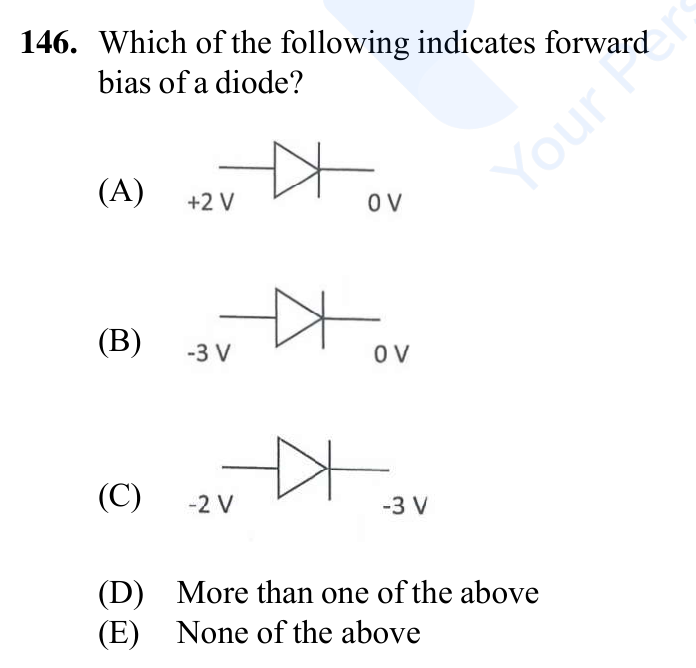
AAnode at +2 V, cathode at 0 Vऐनोड +2 V पर, कैथोड 0 V पर
BAnode at −3 V, cathode at 0 Vऐनोड −3 V पर, कैथोड 0 V पर
CAnode at −2 V, cathode at −3 Vऐनोड −2 V पर, कैथोड −3 V पर
DMore than one of the aboveउपर्युक्त में से एक से अधिक
ENone of the aboveउपर्युक्त में से कोई नहीं
Show answerHide answer
Correct answer: (D)More than one of the aboveउपर्युक्त में से एक से अधिक
Explanation
A diode is forward biased when its anode (p-side) is at a higher potential than its cathode (n-side). In (A) +2 V > 0 V and in (C) −2 V > −3 V, so both are forward biased; in (B) −3 V < 0 V is reverse bias. Hence (D).डायोड अग्र अभिनत तब होता है जब उसका ऐनोड (p-पक्ष) कैथोड (n-पक्ष) से उच्च विभव पर हो। (A) में +2 V > 0 V और (C) में −2 V > −3 V है, इसलिए दोनों अग्र अभिनत हैं; (B) में −3 V < 0 V पश्च अभिनति है। अतः (D)।
In common base amplifier the phase difference between the input and the output voltages isसामान्य बेस एम्पलीफायर में इनपुट और आउटपुट वोल्टेज के बीच कला अंतर
Aππ होता है
Bπ/2π/2 होता है
C00 होता है
DMore than one of the aboveउपर्युक्त में से एक से अधिक
ENone of the aboveउपर्युक्त में से कोई नहीं
Show answerHide answer
Correct answer: (C)00 होता है
Explanation
In a common-base amplifier, an increase in input voltage increases the collector current and so the output voltage, so the output is in phase with the input: the phase difference is 0 (unlike the common-emitter amplifier, where it is π).उभयनिष्ठ आधार प्रवर्धक में निवेश वोल्टता बढ़ने से संग्राहक धारा और इसलिए निर्गत वोल्टता बढ़ती है, अतः निर्गत निवेश के साथ समान कला में होता है: कलान्तर 0 है (उभयनिष्ठ उत्सर्जक प्रवर्धक के विपरीत, जहाँ यह π होता है)।
In a common emitter transistor amplifier, current gain of the transistor is 100, input resistance rᵢ = 1 kΩ, and load resistance is 10 kΩ. What will be the voltage gain of the amplifier?एक सामान्य उत्सर्जक ट्रांजिस्टर एम्प्लीफायर में, ट्रांजिस्टर की धारा लब्धि 100 है, इनपुट प्रतिरोध rᵢ = 1 kΩ है और लोड प्रतिरोध 10 kΩ है। एम्प्लीफायर की वोल्टेज लब्धि क्या होगी?
A500500
B10001000
C100100
DMore than one of the aboveउपर्युक्त में से एक से अधिक
A NOR gate has two inputs A and B. Its output Y can be given asएक NOR गेट में दो इनपुट A और B हैं। इसका आउटपुट Y इस प्रकार दिया जा सकता है
AY = A + BY = A + B
BY = (A + B)‾ (complement of A + B)Y = (A + B)‾ (A + B का पूरक)
CY = A‾ · B‾ (product of the complements of A and B)Y = A‾ · B‾ (A और B के पूरकों का गुणनफल)
DMore than one of the aboveउपर्युक्त में से एक से अधिक
ENone of the aboveउपर्युक्त में से कोई नहीं
Show answerHide answer
Correct answer: (D)More than one of the aboveउपर्युक्त में से एक से अधिक
Explanation
A NOR gate is an OR followed by NOT, so Y = (A + B)‾. By De Morgan's theorem (A + B)‾ = A‾ · B‾. So (B) and (C) are both correct.NOR गेट OR के बाद NOT होता है, इसलिए Y = (A + B)‾। डी मॉर्गन प्रमेय से (A + B)‾ = A‾ · B‾। अतः (B) और (C) दोनों सही हैं।
In a logic gate when all the inputs are one, the output is zero. The logic gate isलॉजिक गेट में जब सभी इनपुट एक होते हैं, तो आउटपुट शून्य होता है। वह लॉजिक गेट है
Aa NAND gateNAND गेट
Ban OR gateOR गेट
Can AND gateAND गेट
DMore than one of the aboveउपर्युक्त में से एक से अधिक
ENone of the aboveउपर्युक्त में से कोई नहीं
Show answerHide answer
Correct answer: (A)a NAND gateNAND गेट
Explanation
For a NAND gate Y = (A·B)‾, so with all inputs 1 the output is 0. OR and AND gates both give 1 when all inputs are 1.NAND गेट के लिए Y = (A·B)‾, इसलिए सभी निवेश 1 होने पर निर्गत 0 होता है। OR और AND गेट दोनों सभी निवेश 1 होने पर 1 देते हैं।
How to use these BPSC TRE Physics questions
Every question here was asked in a real BPSC TRE paper; the paper and shift are shown on the card, and the number opens the question on its own page. Try each one before tapping Show answer, then attempt the full BPSC TRE papers as timed tests to check your speed under exam conditions.