238 Physics questions asked in BPSC TRE previous year papers, each with the correct answer and explanation. Read them free on UTpaper, or attempt the full papers as timed online tests.
DMore than one of the aboveउपर्युक्त में से एक से अधिक
ENone of the aboveउपर्युक्त में से कोई नहीं
Show answerHide answer
Correct answer: (B)R/2 ΩR/2 Ω
Explanation
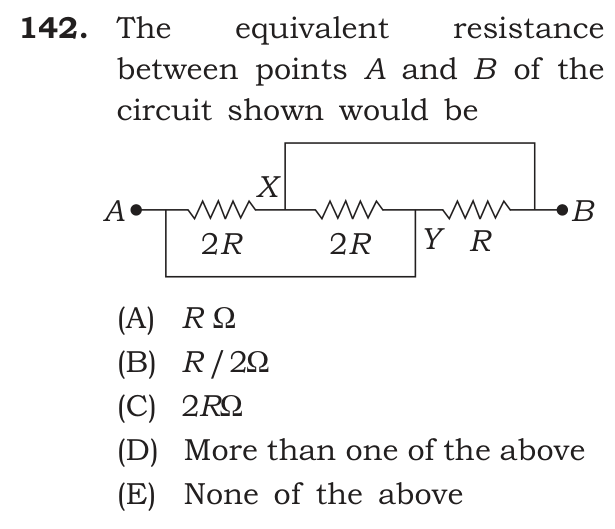
The connecting wires make point Y the same as A and point X the same as B. Then the 2R between A and X, the 2R between X and Y, and the R between Y and B all lie directly between A and B, i.e. in parallel: 1/Rₑ = 1/2R + 1/2R + 1/R = 2/R, so Rₑ = R/2.संयोजक तार बिंदु Y को A के समान और बिंदु X को B के समान बना देते हैं। तब A और X के बीच का 2R, X और Y के बीच का 2R, तथा Y और B के बीच का R, सभी सीधे A और B के बीच हैं, अर्थात समानांतर क्रम में: 1/Rₑ = 1/2R + 1/2R + 1/R = 2/R, अतः Rₑ = R/2।
Which factor is immaterial for the wire used in electric fuse?विद्युत्परिपथ में प्रयुक्त फ्यूज के लिए कौन-सा अवयव महत्त्वहीन है?
ALengthलंबाई
BRadiusअर्द्धव्यास
CMaterialपदार्थ
DMore than one of the aboveउपर्युक्त में से एक से अधिक
ENone of the aboveउपर्युक्त में से कोई नहीं
Show answerHide answer
Correct answer: (A)Lengthलंबाई
Explanation
The current at which a fuse wire melts depends on its material (resistivity, melting point) and its radius, but not on its length, because both the heat produced and the heat lost scale with length. So length is immaterial.जिस धारा पर फ्यूज तार पिघलता है वह उसके पदार्थ (प्रतिरोधकता, गलनांक) और त्रिज्या पर निर्भर करती है, पर लंबाई पर नहीं, क्योंकि उत्पन्न ऊष्मा और खोई ऊष्मा दोनों लंबाई के अनुपात में बदलती हैं। इसलिए लंबाई महत्त्वहीन है।
Find the resistance between the points A and B situated on the circle of diameter AB, 2 meters shown in the figure below. Both the halves of the circle and diameter are made of uniform wire of resistance 1 × 10⁻⁴ Ω m⁻¹ isनीचे दिए हुए चित्र में समान प्रकृति के पदार्थ के तार, जिसका प्रतिरोध 1 × 10⁻⁴ Ω m⁻¹ है, को वृत्ताकार आकृति में ढाला गया है। इसके व्यास AB की लंबाई 2 मीटर है। A तथा B बिन्दु के मध्य प्रतिरोध का मान क्या होगा?
A2/3 × 10⁻⁴ Ω2/3 × 10⁻⁴ Ω
B2π × 10⁻⁴ Ω2π × 10⁻⁴ Ω
C0·88 × 10⁻⁴ Ω0·88 × 10⁻⁴ Ω
DMore than one of the aboveउपर्युक्त में से एक से अधिक
ENone of the aboveउपर्युक्त में से कोई नहीं
Show answerHide answer
Correct answer: (C)0·88 × 10⁻⁴ Ω0·88 × 10⁻⁴ Ω
Explanation
Each semicircle is πr = π m long (π × 10⁻⁴ Ω) and the diameter is 2 m (2 × 10⁻⁴ Ω). The three are in parallel between A and B: 1/R = (1/π + 1/π + 1/2) × 10⁴ = 1·137 × 10⁴, so R ≈ 0·88 × 10⁻⁴ Ω.प्रत्येक अर्द्धवृत्त की लंबाई πr = π m है (π × 10⁻⁴ Ω) और व्यास 2 m (2 × 10⁻⁴ Ω) है। तीनों A और B के बीच समानांतर क्रम में हैं: 1/R = (1/π + 1/π + 1/2) × 10⁴ = 1·137 × 10⁴, अतः R ≈ 0·88 × 10⁻⁴ Ω।
Two parallel wires in free space are 10 cm apart and each carries a current of 10 amperes in the same direction. The force on the wire exerts on the other, per meter of lengthमुक्त क्षेत्र में स्थित दो समानांतर तार एक-दूसरे से 10 से॰ मी॰ की दूरी पर स्थित हैं। इनमें से एक ही दिशा में प्रवाहित धारा का मान 10 ऐम्पियर है। दोनों चालक एक-दूसरे पर बल आरोपित करते हैं। चालक की प्रति इकाई लम्बाई पर लगने वाले बल का मान क्या होगा?
A2 × 10⁻⁴ N attractive2 × 10⁻⁴ N आकर्षण बल
B2 × 10⁻⁷ N attractive2 × 10⁻⁷ N आकर्षण बल
C2 × 10⁻⁴ N repulsive2 × 10⁻⁴ N विकर्षण बल
DMore than one of the aboveउपर्युक्त में से एक से अधिक
ENone of the aboveउपर्युक्त में से कोई नहीं
Show answerHide answer
Correct answer: (A)2 × 10⁻⁴ N attractive2 × 10⁻⁴ N आकर्षण बल
Explanation
F/l = μ₀I₁I₂/(2πd) = 2 × 10⁻⁷ × 10 × 10/0·1 = 2 × 10⁻⁴ N/m. Currents in the same direction attract each other.F/l = μ₀I₁I₂/(2πd) = 2 × 10⁻⁷ × 10 × 10/0·1 = 2 × 10⁻⁴ N/m। एक ही दिशा की धाराएँ एक-दूसरे को आकर्षित करती हैं।
A motor generates a 210 back e.m.f., when the applied voltage is 240 volts and armature current is 50 amperes. The power dissipated in the motor isएक मोटर 210 वोल्ट का बैक इ. एम. एफ. उत्पन्न करती है, जबकि इस पर आरोपित विभव का मान 240 वोल्ट है और आर्मेचर से प्रवाहित धारा 50 ऐम्पियर है। मोटर द्वारा खर्च की गयी ऊर्जा का मान क्या होगा?
A150 watt150 वाट
B50 watt50 वाट
C100 watt100 वाट
DMore than one of the aboveउपर्युक्त में से एक से अधिक
ENone of the aboveउपर्युक्त में से कोई नहीं
Show answerHide answer
Correct answer: (E)None of the aboveउपर्युक्त में से कोई नहीं
Explanation
Input power = 240 × 50 = 12000 W and power converted to mechanical work = back e.m.f. × current = 210 × 50 = 10500 W. Power dissipated as heat = (240 − 210) × 50 = 1500 W, which is not among the options, so the answer is none of the above.निवेश शक्ति = 240 × 50 = 12000 W और यांत्रिक कार्य में परिवर्तित शक्ति = पश्च विद्युत वाहक बल × धारा = 210 × 50 = 10500 W। ऊष्मा के रूप में क्षयित शक्ति = (240 − 210) × 50 = 1500 W, जो विकल्पों में नहीं है, अतः उत्तर 'उपर्युक्त में से कोई नहीं' है।
In a series L-C-R circuit, the potential difference between terminal of inductance is 60 volts, between terminals of capacitance is 30 volts and between the terminals of resistance is 40 volts. The supply voltage would beएक L-C-R परिपथ में, चालक के सिरों पर विभवान्तर 60 वोल्ट, संधारित्र के सिरों पर विभवान्तर 30 वोल्ट तथा प्रतिरोध के सिरों पर विभवान्तर 40 वोल्ट है। परिपथ के सिरों पर लगाये गये विभव का मान होगा
A130 volts130 वोल्ट
B10 volts10 वोल्ट
C50 volts50 वोल्ट
DMore than one of the aboveउपर्युक्त में से एक से अधिक
ENone of the aboveउपर्युक्त में से कोई नहीं
Show answerHide answer
Correct answer: (C)50 volts50 वोल्ट
Explanation
V_L and V_C are opposite in phase and both are 90° out of phase with V_R, so V = √(V_R² + (V_L − V_C)²) = √(40² + 30²) = √2500 = 50 V.V_L और V_C कला में विपरीत हैं और दोनों V_R से 90° की कला-भिन्नता पर हैं, इसलिए V = √(V_R² + (V_L − V_C)²) = √(40² + 30²) = √2500 = 50 V।
A transformer has efficiency of 80%. It works at 4 kW and 100 volts. If the secondary voltage is 240 volts, the current in primary coil would beएक ट्रांसफॉर्मर की दक्षता 80 प्रतिशत है। यह 4 किलोवाट तथा 100 वोल्ट पर कार्य करता है। अगर द्वितीयक कुण्डली का विभव 240 वोल्ट हो, तो प्राथमिक कुण्डली में प्रवाहित धारा का मान क्या होगा?
A10 amperes10 ऐम्पियर
B4 amperes4 ऐम्पियर
C40 amperes40 ऐम्पियर
DMore than one of the aboveउपर्युक्त में से एक से अधिक
ENone of the aboveउपर्युक्त में से कोई नहीं
Show answerHide answer
Correct answer: (C)40 amperes40 ऐम्पियर
Explanation
The transformer takes 4 kW at 100 V on the primary side, so the primary current = P/V = 4000/100 = 40 A. (The secondary then delivers 80% of 4 kW = 3200 W at 240 V, about 13·3 A.)ट्रांसफॉर्मर प्राथमिक पक्ष पर 100 V पर 4 kW लेता है, इसलिए प्राथमिक धारा = P/V = 4000/100 = 40 A। (तब द्वितीयक 4 kW का 80% = 3200 W, 240 V पर देता है, लगभग 13·3 A।)
The photoelectric threshold frequency of a metal is γ. When a light of frequency 4γ is incident on the metal, the maximum KE of emitted photoelectron will beएक धातु की प्रकाश-विद्युत् की सीमांत आवृत्ति का मान γ है। अगर 4γ आवृत्ति का प्रकाश इस धातु पर आपतित होता है, तो उत्सर्जित फोटोइलेक्ट्रॉन की अधिकतम गतिज ऊर्जा का मान होगा
A5/2 hγ5/2 hγ
B3 hγ3 hγ
C4 hγ4 hγ
DMore than one of the aboveउपर्युक्त में से एक से अधिक
ENone of the aboveउपर्युक्त में से कोई नहीं
Show answerHide answer
Correct answer: (B)3 hγ3 hγ
Explanation
By Einstein's equation, KE_max = hν − hν₀ = h(4γ) − hγ = 3hγ.आइंस्टीन के समीकरण से KE_max = hν − hν₀ = h(4γ) − hγ = 3hγ।
An electron and proton possess same KE. Their de Broglie wavelength will beअगर इलेक्ट्रॉन तथा प्रोटॉन की गतिज ऊर्जा समान हो, तो इनकी डी ब्रोग्ली तरंगदैर्घ्य का मान होगा
Agreater the electronइलेक्ट्रॉन से ज्यादा
Bgreater the protonप्रोटॉन से ज्यादा
Cboth electron and proton have same valueइलेक्ट्रॉन तथा प्रोटॉन के बराबर
DMore than one of the aboveउपर्युक्त में से एक से अधिक
ENone of the aboveउपर्युक्त में से कोई नहीं
Show answerHide answer
Correct answer: (A)greater the electronइलेक्ट्रॉन से ज्यादा
Explanation
λ = h/p = h/√(2mK). For equal kinetic energy, the lighter particle has the smaller momentum and so the longer wavelength; the electron's de Broglie wavelength is greater.λ = h/p = h/√(2mK)। समान गतिज ऊर्जा के लिए हल्के कण का संवेग कम होता है और इसलिए तरंगदैर्घ्य अधिक होती है; इलेक्ट्रॉन की डी ब्रॉग्ली तरंगदैर्घ्य अधिक है।
Dimensions of elasticity constant isलोच का आयाम स्थिरांक है
AMLT⁻¹MLT⁻¹
BML⁻¹T⁻²ML⁻¹T⁻²
CML²T⁻¹ML²T⁻¹
DMore than one of the aboveउपर्युक्त में से एक से अधिक
ENone of the aboveउपर्युक्त में से कोई नहीं
Show answerHide answer
Correct answer: (B)ML⁻¹T⁻²ML⁻¹T⁻²
Explanation
An elastic constant (e.g. Young's modulus) is stress/strain; strain is dimensionless, so it has the dimensions of stress = force/area = MLT⁻²/L² = ML⁻¹T⁻².प्रत्यास्थता स्थिरांक (जैसे यंग गुणांक) = प्रतिबल/विकृति है; विकृति विमाहीन होती है, इसलिए इसकी विमाएँ प्रतिबल = बल/क्षेत्रफल = MLT⁻²/L² = ML⁻¹T⁻² हैं।
The electric current in a charging RC circuit is given by i = i₀e^(−t/RC), where i₀, R and C are constant parameters of the circuit and t is the time. The rate of change of current at t = 0 isचार्जिंग RC सर्किट में विद्युत धारा i = i₀e^(−t/RC) द्वारा दी जाती है, जहां i₀, R और C सर्किट के स्थिर पैरामीटर है और t समय है। t = 0 पर धारा परिवर्तन की दर है
Ai₀/RCi₀/RC
Bi₀i₀
C−i₀/RC−i₀/RC
DMore than one of the aboveउपर्युक्त में से एक से अधिक
ENone of the aboveउपर्युक्त में से कोई नहीं
Show answerHide answer
Correct answer: (C)−i₀/RC−i₀/RC
Explanation
di/dt = −(i₀/RC)e^(−t/RC). At t = 0, e⁰ = 1, so di/dt = −i₀/RC (the current is decreasing).di/dt = −(i₀/RC)e^(−t/RC)। t = 0 पर e⁰ = 1, अतः di/dt = −i₀/RC (धारा घट रही है)।
A projectile is fired with a speed u at an angle θ with the horizontal. Its speed when its direction of motion makes an angle α with the horizontal will beएक प्रक्षेप्य क्षैतिज के साथ कोण θ पर u गति से दागा जाता है। जब इसकी गति की दिशा क्षैतिज के साथ कोण α बनाती है तो इसकी गति होगी
Au cosθ / cosαu cosθ / cosα
Bu cosα / cosθu cosα / cosθ
Cu cosθu cosθ
DMore than one of the aboveउपर्युक्त में से एक से अधिक
ENone of the aboveउपर्युक्त में से कोई नहीं
Show answerHide answer
Correct answer: (A)u cosθ / cosαu cosθ / cosα
Explanation
The horizontal component of velocity stays constant at u cosθ. When the velocity v makes angle α with the horizontal, v cosα = u cosθ, so v = u cosθ / cosα.वेग का क्षैतिज घटक u cosθ पर स्थिर रहता है। जब वेग v क्षैतिज से कोण α बनाता है, तब v cosα = u cosθ, अतः v = u cosθ / cosα।
Which of the following exerts nuclear force onlyनिम्नलिखित में से कौन सा केवल परमाणु बल लगाता है?
Aneutron on protonप्रोटॉन पर न्यूट्रॉन
Bproton on protonप्रोटॉन पर प्रोटॉन
Cneutron on neutronन्यूट्रॉन पर न्यूट्रॉन
DMore than one of the aboveउपर्युक्त में से एक से अधिक
ENone of the aboveउपर्युक्त में से कोई नहीं
Show answerHide answer
Correct answer: (D)More than one of the aboveउपर्युक्त में से एक से अधिक
Explanation
Nuclear force is charge-independent and acts between n-p, p-p and n-n pairs. Between two protons there is also Coulomb repulsion, so only the n-p and n-n pairs interact through the nuclear force alone; (A) and (C) are both correct.नाभिकीय बल आवेश-निरपेक्ष होता है और n-p, p-p तथा n-n युग्मों के बीच कार्य करता है। दो प्रोटॉनों के बीच कूलॉम प्रतिकर्षण भी होता है, इसलिए केवल n-p और n-n युग्म ही अकेले नाभिकीय बल से अन्योन्य क्रिया करते हैं; (A) और (C) दोनों सही हैं।
DMore than one of the aboveउपर्युक्त में से एक से अधिक
ENone of the aboveउपर्युक्त में से कोई नहीं
Show answerHide answer
Correct answer: (A)10⁹10⁹
Explanation
1 micrometer = 10⁻⁶ m and 1 femtometer = 10⁻¹⁵ m, so the ratio is 10⁻⁶/10⁻¹⁵ = 10⁹.1 माइक्रोमीटर = 10⁻⁶ m और 1 फेम्टोमीटर = 10⁻¹⁵ m, अतः अनुपात 10⁻⁶/10⁻¹⁵ = 10⁹ है।
Percentage error in (250 ± 0.5) cm distance is(250 ± 0.5) सेमी दूरी में प्रतिशत त्रुटि है
A4%4%
B0.04%0.04%
C5%5%
DMore than one of the aboveउपर्युक्त में से एक से अधिक
ENone of the aboveउपर्युक्त में से कोई नहीं
Show answerHide answer
Correct answer: (E)None of the aboveउपर्युक्त में से कोई नहीं
Explanation
Percentage error = (0.5/250) × 100 = 0.2%. This value is not among (A)-(C), so the answer is (E).प्रतिशत त्रुटि = (0.5/250) × 100 = 0.2%। यह मान (A)-(C) में नहीं है, इसलिए उत्तर (E) है।
Velocity of a boat with respect to land is (3î + 4ĵ) m s⁻¹ and velocity of water with respect to land is (−3î − 4ĵ) m s⁻¹, then velocity of boat with respect to water isभूमि के सन्दर्भ में एक नाव का वेग (3î + 4ĵ) m s⁻¹ है और भूमि के सन्दर्भ में पानी का वेग (−3î − 4ĵ) m s⁻¹ है, तो पानी के सन्दर्भ में नाव का वेग है
A8ĵ m s⁻¹8ĵ m s⁻¹
B−6î − 8ĵ m s⁻¹−6î − 8ĵ m s⁻¹
C6î + 8ĵ m s⁻¹6î + 8ĵ m s⁻¹
DMore than one of the aboveउपर्युक्त में से एक से अधिक
A body of mass m₁ moving with velocity v collides with another stationary body of mass m₂. They get embedded. The velocity of the resultant body after the collision will bem₁ द्रव्यमान का एक पिंड v वेग से चलते हुए m₂ द्रव्यमान के दूसरे स्थिर पिंड से टकराता है। वे अन्तर्निहित हो जाते है। टक्कर के बाद परिणामी पिंड का वेग होगा
A(m₁ + m₂)v / m₂(m₁ + m₂)v / m₂
Bm₂v / (m₁ + m₂)m₂v / (m₁ + m₂)
Cm₁v / m₂m₁v / m₂
DMore than one of the aboveउपर्युक्त में से एक से अधिक
ENone of the aboveउपर्युक्त में से कोई नहीं
Show answerHide answer
Correct answer: (E)None of the aboveउपर्युक्त में से कोई नहीं
Explanation
Momentum is conserved in this perfectly inelastic collision: m₁v = (m₁ + m₂)V, so V = m₁v/(m₁ + m₂). This expression is not among (A)-(C), so the answer is (E).इस पूर्णतः अप्रत्यास्थ टक्कर में संवेग संरक्षित रहता है: m₁v = (m₁ + m₂)V, अतः V = m₁v/(m₁ + m₂)। यह व्यंजक (A)-(C) में नहीं है, इसलिए उत्तर (E) है।
Vulcanized rubber is an example ofवल्कनीकृत रबर इसका एक उदाहरण है
ADuctileतन्य
BBrittleनाजुक
CElastomerइलास्टोमेर
DMore than one of the aboveउपर्युक्त में से एक से अधिक
ENone of the aboveउपर्युक्त में से कोई नहीं
Show answerHide answer
Correct answer: (C)Elastomerइलास्टोमेर
Explanation
Vulcanized rubber can be stretched to several times its length and returns to its original shape; such materials, which have no well-defined plastic region, are called elastomers.वल्कनीकृत रबर को अपनी लंबाई के कई गुना तक खींचा जा सकता है और वह अपनी मूल आकृति में लौट आता है; जिन पदार्थों में कोई सुपरिभाषित सुघट्य क्षेत्र नहीं होता, उन्हें प्रत्यास्थलक (इलास्टोमर) कहते हैं।
What should be the velocity of a person of weight 60 kg, so that his kinetic energy becomes 270 J?60 किलोग्राम वजन वाले व्यक्ति का वेग कितना होना चाहिए, ताकि उसकी गतिज ऊर्जा 270 J हो जाए?
A10 m s⁻¹10 m s⁻¹
B20 m s⁻¹20 m s⁻¹
C3 m s⁻¹3 m s⁻¹
DMore than one of the aboveउपर्युक्त में से एक से अधिक
ENone of the aboveउपर्युक्त में से कोई नहीं
Show answerHide answer
Correct answer: (C)3 m s⁻¹3 m s⁻¹
Explanation
KE = ½mv², so v² = 2 × 270/60 = 9 and v = 3 m s⁻¹.KE = ½mv², अतः v² = 2 × 270/60 = 9 और v = 3 m s⁻¹।
A piece of ice is floating in the water in a container. When the ice is completely melted in the water, height of the water willएक बर्तन में बर्फ का टुकड़ा पानी में तैर रहा है। जब बर्फ पानी में पूरी तरह पिघल जाएगी तो पानी की ऊँचाई
ARemains sameवही रहेंगी
BIncreaseबढ़ जाएगी
CDecreaseघट जाएगी
DMore than one of the aboveउपर्युक्त में से एक से अधिक
ENone of the aboveउपर्युक्त में से कोई नहीं
Show answerHide answer
Correct answer: (A)Remains sameवही रहेंगी
Explanation
Floating ice displaces water equal to its own weight. On melting it turns into exactly that weight, hence that volume, of water, so it fills the space it displaced and the water level stays the same.तैरती बर्फ अपने भार के बराबर पानी विस्थापित करती है। पिघलने पर वह ठीक उतने ही भार, और इसलिए उतने ही आयतन, के पानी में बदल जाती है, अतः वह विस्थापित स्थान को भर देती है और पानी का स्तर वही रहता है।
Value of Reynolds number is less for the fluid whoseजिस द्रव के लिए रेनॉल्ड्स संख्या का मान कम होता है इसका
AVelocity is lessवेग कम है
BDensity is lessघनत्व कम है
CCoefficient of viscosity is highश्यानता का गुणांक उच्च है
DMore than one of the aboveउपर्युक्त में से एक से अधिक
ENone of the aboveउपर्युक्त में से कोई नहीं
Show answerHide answer
Correct answer: (D)More than one of the aboveउपर्युक्त में से एक से अधिक
Explanation
Reynolds number Re = ρvD/η. It is smaller when velocity v is less, when density ρ is less, and when viscosity η is high, so all of (A), (B) and (C) are correct.रेनॉल्ड्स संख्या Re = ρvD/η। यह तब कम होती है जब वेग v कम हो, घनत्व ρ कम हो और श्यानता η अधिक हो, इसलिए (A), (B) और (C) तीनों सही हैं।
Weight of a metal in air is 210 g and in water it is 140 g. Density of water is 1 g cm⁻³. The specific density of the metal isहवा में एक धातु का वजन 210 ग्राम है, और पानी में यह 140 ग्राम है। पानी का घनत्व 1 g सेमी⁻³ है। धातु का विशिष्ट घनत्व है
A7/47/4
B7/67/6
C7/27/2
DMore than one of the aboveउपर्युक्त में से एक से अधिक
ENone of the aboveउपर्युक्त में से कोई नहीं
Show answerHide answer
Correct answer: (E)None of the aboveउपर्युक्त में से कोई नहीं
Explanation
Loss of weight in water = 210 − 140 = 70 g = weight of equal volume of water. Specific gravity = 210/70 = 3, which is not among (A)-(C), so the answer is (E).पानी में भार की हानि = 210 − 140 = 70 g = समान आयतन के पानी का भार। विशिष्ट गुरुत्व = 210/70 = 3, जो (A)-(C) में नहीं है, इसलिए उत्तर (E) है।
A sphere of mass m and radius r is falling freely in a viscous medium. Its terminal velocity isद्रव्यमान m और त्रिज्या r का एक गोला एक चिपचिपे माध्यम में स्वतंत्र रूप से गिर रहा है। इसका टर्मिनल वेग है
ADirectly proportional to mm के सीधे आनुपातिक
BInversely proportional to rr के व्युत्क्रमानुपाती
CInversely proportional to √r√r के व्युत्क्रमानुपाती
DMore than one of the aboveउपर्युक्त में से एक से अधिक
ENone of the aboveउपर्युक्त में से कोई नहीं
Show answerHide answer
Correct answer: (D)More than one of the aboveउपर्युक्त में से एक से अधिक
Explanation
At terminal velocity, weight is balanced by Stokes' drag (neglecting buoyancy): mg = 6πηrv, so v = mg/(6πηr). Thus v is directly proportional to m and inversely proportional to r, so (A) and (B) are both correct.सीमांत वेग पर भार स्टोक्स के कर्षण से संतुलित होता है (उत्प्लावन की उपेक्षा करने पर): mg = 6πηrv, अतः v = mg/(6πηr)। इस प्रकार v, m के सीधे समानुपाती और r के व्युत्क्रमानुपाती है, इसलिए (A) और (B) दोनों सही हैं।
A barometer kept in an elevator accelerating upward reads 76 cm. The air pressure in the elevator isएक लिफ्ट में ऊपर की ओर गति करते हुए रखा गया बैरोमीटर 76 सेमी दर्शाता है। लिफ्ट में हवा का दबाव है
A76 cm76 cm
B< 76 cm< 76 cm
C> 76 cm> 76 cm
DMore than one of the aboveउपर्युक्त में से एक से अधिक
ENone of the aboveउपर्युक्त में से कोई नहीं
Show answerHide answer
Correct answer: (C)> 76 cm> 76 cm
Explanation
In an elevator accelerating upward, the effective gravity is g + a, so the pressure balanced by a 76 cm column is P = ρ(g + a)h, which is more than the pressure of 76 cm of mercury under normal gravity. So the actual pressure is greater than 76 cm.ऊपर की ओर त्वरित लिफ्ट में प्रभावी गुरुत्व g + a होता है, इसलिए 76 cm स्तंभ द्वारा संतुलित दाब P = ρ(g + a)h होता है, जो सामान्य गुरुत्व में 76 cm पारे के दाब से अधिक है। अतः वास्तविक दाब 76 cm से अधिक है।
Working of Venturi meter is based onवेंचुरी मीटर की कार्यप्रणाली आधारित है
ABernoulli's principleबर्नौली का सिद्धांत पर
BTorricelli's lawटोरिसेली का नियम पर
CStokes' lawस्टोक्स के नियम पर
DMore than one of the aboveउपर्युक्त में से एक से अधिक
ENone of the aboveउपर्युक्त में से कोई नहीं
Show answerHide answer
Correct answer: (A)Bernoulli's principleबर्नौली का सिद्धांत पर
Explanation
A Venturi meter measures flow speed from the pressure drop in a constriction, using Bernoulli's principle (higher speed means lower pressure) together with continuity.वेंचुरीमीटर संकरे भाग में दाब-पतन से प्रवाह की चाल मापता है, जिसमें बर्नूली सिद्धांत (अधिक चाल पर कम दाब) और सांतत्य का उपयोग होता है।
Observations on Celsius and Fahrenheit scale becomes equal atसेल्सियस और फारेनहाइट पैमाने पर अवलोकन बराबर हो जाते हैं
A−273.15°C–273.15°C पर
B−100°C–100°C पर
C0°C0°C पर
DMore than one of the aboveउपर्युक्त में से एक से अधिक
ENone of the aboveउपर्युक्त में से कोई नहीं
Show answerHide answer
Correct answer: (E)None of the aboveउपर्युक्त में से कोई नहीं
Explanation
F = 9C/5 + 32. Setting F = C gives C − 9C/5 = 32, so C = −40. Thus the scales read the same at −40°, which is not among (A)-(C), so (E).F = 9C/5 + 32। F = C रखने पर C − 9C/5 = 32, अतः C = −40। इस प्रकार पैमाने −40° पर समान पाठ्यांक देते हैं, जो (A)-(C) में नहीं है, इसलिए (E)।
In an adiabatic process relationship between pressure and temperature for an ideal gas isरूद्धोष्म प्रक्रिया में एक आदर्श गैस के लिए दबाव और तापमान के बीच संबंध होता है
AP^(1−γ) T^γ = constantP^(1−γ) T^γ = स्थिरांक
BP^(γ−1) T^γ = constantP^(γ−1) T^γ = स्थिरांक
CP^γ T^(1−γ) = constantP^γ T^(1−γ) = स्थिरांक
DMore than one of the aboveउपर्युक्त में से एक से अधिक
For an adiabatic process PV^γ = constant. Substituting V = nRT/P gives P^(1−γ) T^γ = constant.रुद्धोष्म प्रक्रिया के लिए PV^γ = नियतांक। V = nRT/P रखने पर P^(1−γ) T^γ = नियतांक प्राप्त होता है।
For a process in an ideal gas dW = 0 and dQ < 0, then for that gasएक आदर्श गैस में एक प्रक्रिया के लिए dW = 0 और dQ < 0, तो उस गैस के लिए
ATemperature will increaseतापमान बढ़ेगा
BTemperature will decreaseतापमान में कमी आएगी
CPressure remains constantदबाव वही रहेंगा
DMore than one of the aboveउपर्युक्त में से एक से अधिक
ENone of the aboveउपर्युक्त में से कोई नहीं
Show answerHide answer
Correct answer: (B)Temperature will decreaseतापमान में कमी आएगी
Explanation
From the first law dQ = dU + dW. With dW = 0, dU = dQ < 0, so the internal energy, and hence the temperature, of the ideal gas decreases (at constant volume the pressure also falls).ऊष्मागतिकी के प्रथम नियम से dQ = dU + dW। dW = 0 होने पर dU = dQ < 0, अतः आदर्श गैस की आंतरिक ऊर्जा, और इसलिए ताप, घटता है (नियत आयतन पर दाब भी घटता है)।
A Carnot engine works between 1000 K and 500 K. The engine does 210 J mechanical work per cycle. The amount of heat required by the engine per cycle from the heat source will beएक कार्नोट इंजन 1000 K और 500 K के बीच कार्य करता है। इंजन प्रति चक्र 210 J यांत्रिक कार्य करता है। ऊष्मा स्रोत से प्रति चक्र इंजन को आवश्यक ऊष्मा की मात्रा होगी
A500 Cal500 Cal
B200 Cal200 Cal
C100 Cal100 Cal
DMore than one of the aboveउपर्युक्त में से एक से अधिक
ENone of the aboveउपर्युक्त में से कोई नहीं
Show answerHide answer
Correct answer: (C)100 Cal100 Cal
Explanation
Efficiency η = 1 − 500/1000 = 0.5. Heat taken from the source Q = W/η = 210/0.5 = 420 J = 420/4.2 = 100 cal.दक्षता η = 1 − 500/1000 = 0.5। स्रोत से ली गई ऊष्मा Q = W/η = 210/0.5 = 420 J = 420/4.2 = 100 cal।
Performance coefficient of a heat pumpताप पंप का प्रदर्शन गुणांक
AIs greater than 11 से बड़ा है
BIs less than 11 से कम है
CCan not be infinityअनंत नहीं हो सकता
DMore than one of the aboveउपर्युक्त में से एक से अधिक
ENone of the aboveउपर्युक्त में से कोई नहीं
Show answerHide answer
Correct answer: (D)More than one of the aboveउपर्युक्त में से एक से अधिक
Explanation
COP of a heat pump = Q_hot/W = Q_hot/(Q_hot − Q_cold), which is always greater than 1. It cannot be infinite, because that would need zero work (or a zero temperature difference), which the second law forbids. So (A) and (C) are both correct.ऊष्मा पंप का COP = Q_गर्म/W = Q_गर्म/(Q_गर्म − Q_ठंडा), जो सदैव 1 से अधिक होता है। यह अनंत नहीं हो सकता, क्योंकि इसके लिए शून्य कार्य (या शून्य ताप-अंतर) चाहिए, जिसे ऊष्मागतिकी का द्वितीय नियम निषिद्ध करता है। अतः (A) और (C) दोनों सही हैं।
In order to make volume of a gas four timesकिसी गैस का आयतन चार गुना करने के लिए
AIts temperature should be made four timesइसका तापमान चार गुना कर देना चाहिए
BIts pressure should be made four timesइसका दबाव चार गुना बनाना चाहिए
CIts temperature should be made four times at a constant pressureइसका तापमान स्थिर दबाव पर चार गुना कर देना चाहिए
DMore than one of the aboveउपर्युक्त में से एक से अधिक
ENone of the aboveउपर्युक्त में से कोई नहीं
Show answerHide answer
Correct answer: (C)Its temperature should be made four times at a constant pressureइसका तापमान स्थिर दबाव पर चार गुना कर देना चाहिए
Explanation
By Charles's law V ∝ T at constant pressure, so the volume becomes four times when the absolute temperature is made four times keeping pressure constant. (A) alone is incomplete, and increasing pressure would reduce the volume.चार्ल्स के नियम से नियत दाब पर V ∝ T, इसलिए दाब नियत रखकर परम ताप चार गुना करने पर आयतन चार गुना हो जाता है। (A) अकेला अपूर्ण है, और दाब बढ़ाने से आयतन घटेगा।
In a small closed room, if the fan is kept on, then the temperature of the roomएक छोटे से बंद कमरे में अगर पंखा चालू रखा जाए तो कमरे का तापमान
ADecreasesकम होता है
BIncreasesबढ़ता है
CRemains sameवही रहता है
DMore than one of the aboveउपर्युक्त में से एक से अधिक
ENone of the aboveउपर्युक्त में से कोई नहीं
Show answerHide answer
Correct answer: (B)Increasesबढ़ता है
Explanation
A fan only circulates air; it does not remove heat from a closed room. The electrical energy used by the motor and the work done on the air finally turn into heat, so the room temperature rises slightly.पंखा केवल हवा को घुमाता है; वह बंद कमरे से ऊष्मा नहीं हटाता। मोटर द्वारा प्रयुक्त विद्युत ऊर्जा और हवा पर किया गया कार्य अंततः ऊष्मा में बदल जाते हैं, इसलिए कमरे का ताप थोड़ा बढ़ जाता है।
Mean free path of gas molecules isगैस अणुओं का माध्य मुक्त पथ
ADirectly proportional to the diameter of the moleculeअणु के व्यास के सीधे आनुपातिक है
BInversely proportional to the square of the diameterअणु के व्यास के वर्ग के व्युत्क्रमानुपाती है
CInversely proportional to the square root of the diameterअणु के व्यास के वर्गमूल के व्युत्क्रमानुपाती है
DMore than one of the aboveउपर्युक्त में से एक से अधिक
ENone of the aboveउपर्युक्त में से कोई नहीं
Show answerHide answer
Correct answer: (B)Inversely proportional to the square of the diameterअणु के व्यास के वर्ग के व्युत्क्रमानुपाती है
Explanation
Mean free path λ = 1/(√2 π d² n), so it is inversely proportional to the square of the molecular diameter d.माध्य मुक्त पथ λ = 1/(√2 π d² n), इसलिए यह अणु के व्यास d के वर्ग के व्युत्क्रमानुपाती है।
A particle moves in a circular path with uniform speed. Its motion isएक कण एक समान गति से वृत्ताकार पथ पर चलता है। इसकी गति है
ASimple harmonicसरल हार्मोनिक
BOscillatoryदोलक
CPeriodicआवधिक
DMore than one of the aboveउपर्युक्त में से एक से अधिक
ENone of the aboveउपर्युक्त में से कोई नहीं
Show answerHide answer
Correct answer: (C)Periodicआवधिक
Explanation
Uniform circular motion repeats after equal intervals of time, so it is periodic. It is not to-and-fro about a mean position, so it is neither oscillatory nor simple harmonic (only its projection on a diameter is SHM).एकसमान वृत्तीय गति समान समय-अंतरालों के बाद दोहराई जाती है, इसलिए यह आवर्ती है। यह किसी माध्य स्थिति के दोनों ओर आगे-पीछे की गति नहीं है, अतः यह न दोलनी है और न सरल आवर्त (केवल व्यास पर इसका प्रक्षेप सरल आवर्त गति है)।
A pendulum clock that keeps correct time on the earth is taken to the moon. It will runपृथ्वी पर सही समय बताने वाली एक पेंडुलम घड़ी को चंद्रमा पर ले जाया जाता है। यह चलेगा
A6 times faster6 गुना तेज
B√6 times faster√6 गुना तेज
C√6 times slower√6 गुना धीमा
DMore than one of the aboveउपर्युक्त में से एक से अधिक
ENone of the aboveउपर्युक्त में से कोई नहीं
Show answerHide answer
Correct answer: (C)√6 times slower√6 गुना धीमा
Explanation
T = 2π√(l/g) and g on the moon is about g/6, so the time period becomes √6 times larger. The clock therefore runs √6 times slower.T = 2π√(l/g) और चंद्रमा पर g लगभग g/6 है, इसलिए आवर्तकाल √6 गुना बढ़ जाता है। अतः घड़ी √6 गुना धीमी चलती है।
The resultant force acting on a particle executing simple harmonic motion is 4 N when it is 10 cm away from the centre of oscillation. The spring constant will beसरल आवर्त गति करते हुए एक कण पर लगने वाला परिणामी बल 4 N है जब यह दोलन के केंद्र से 10 सेमी दूर है। कमानी स्थिरांक होगा
A40 N m⁻¹40 N m⁻¹
B80 N m⁻¹80 N m⁻¹
C0.4 N m⁻¹0.4 N m⁻¹
DMore than one of the aboveउपर्युक्त में से एक से अधिक
ENone of the aboveउपर्युक्त में से कोई नहीं
Show answerHide answer
Correct answer: (A)40 N m⁻¹40 N m⁻¹
Explanation
In SHM F = kx, so k = F/x = 4 N / 0.1 m = 40 N m⁻¹.सरल आवर्त गति में F = kx, अतः k = F/x = 4 N / 0.1 m = 40 N m⁻¹।
AAll the particles of the medium vibrate in phaseमाध्यम के सभी कण चरण में कंपन करते हैं
BAll the particles between consecutive nodes vibrate in phaseक्रमागत नोड्स के बीच के सभी कण चरण में कंपन करते हैं
CThe alternate antinodes vibrate in phaseवैकल्पिक एंटीनोड्स चरण में कंपन करते हैं
DMore than one of the aboveउपर्युक्त में से एक से अधिक
ENone of the aboveउपर्युक्त में से कोई नहीं
Show answerHide answer
Correct answer: (D)More than one of the aboveउपर्युक्त में से एक से अधिक
Explanation
In a stationary wave all particles within one loop (between two consecutive nodes) vibrate in the same phase, and particles in adjacent loops are in opposite phase. Alternate antinodes are two loops apart, so they are in phase. (B) and (C) are correct, (A) is not.अप्रगामी तरंग में एक लूप (दो क्रमागत निस्पंदों के बीच) के सभी कण समान कला में कम्पन करते हैं, और आसन्न लूपों के कण विपरीत कला में होते हैं। एकान्तर प्रस्पंद दो लूप की दूरी पर होते हैं, इसलिए वे समान कला में होते हैं। (B) और (C) सही हैं, (A) नहीं।
Velocity of sound in air is 332 m s⁻¹. Its velocity in vacuum will beवायु में ध्वनि का वेग 332 m s⁻¹ है। निर्वात में इसका वेग होगा
A> 332 m s⁻¹> 332 m s⁻¹
B< 332 m s⁻¹< 332 m s⁻¹
C= 332 m s⁻¹= 332 m s⁻¹
DMore than one of the aboveउपर्युक्त में से एक से अधिक
ENone of the aboveउपर्युक्त में से कोई नहीं
Show answerHide answer
Correct answer: (E)None of the aboveउपर्युक्त में से कोई नहीं
Explanation
Sound is a mechanical wave and needs a material medium; it cannot travel through vacuum, so its speed there is zero. None of (A)-(C) is correct, so (E).ध्वनि यांत्रिक तरंग है और इसे भौतिक माध्यम चाहिए; यह निर्वात में नहीं चल सकती, इसलिए वहाँ इसकी चाल शून्य है। (A)-(C) में से कोई सही नहीं है, अतः (E)।
Which of the following is a mechanical wave?निम्नलिखित में से कौन यांत्रिक तरंग है?
ARadio waveरेडियो तरंग
BMicrowaveमाइक्रोवेव
CLight waveप्रकाश तरंग
DMore than one of the aboveउपर्युक्त में से एक से अधिक
ENone of the aboveउपर्युक्त में से कोई नहीं
Show answerHide answer
Correct answer: (E)None of the aboveउपर्युक्त में से कोई नहीं
Explanation
Radio waves, microwaves and light are all electromagnetic waves, which need no medium. None of them is a mechanical wave, so (E).रेडियो तरंगें, सूक्ष्म तरंगें और प्रकाश सभी विद्युत्-चुम्बकीय तरंगें हैं, जिन्हें माध्यम की आवश्यकता नहीं होती। इनमें से कोई भी यांत्रिक तरंग नहीं है, अतः (E)।
Mechanical waves transfersयांत्रिक तरंगों में स्थानांतरण होता है
AEnergyऊर्जा का
BMatterद्रव्य का
CFrequencyआवृत्ति का
DMore than one of the aboveउपर्युक्त में से एक से अधिक
ENone of the aboveउपर्युक्त में से कोई नहीं
Show answerHide answer
Correct answer: (A)Energyऊर्जा का
Explanation
In a mechanical wave the particles of the medium only oscillate about their mean positions; the wave carries energy (and momentum) from one place to another, not matter.यांत्रिक तरंग में माध्यम के कण केवल अपनी माध्य स्थितियों के इर्द-गिर्द दोलन करते हैं; तरंग ऊर्जा (और संवेग) को एक स्थान से दूसरे स्थान तक ले जाती है, पदार्थ को नहीं।
Electric field at a distance r from an infinite thin plane sheet of uniform surface charge density σ isएक समान सतह आवेश घनत्व σ धारित अनंत पतली समतल शीट से दूरी r पर विद्युत क्षेत्र
AInversely proportional to rr के व्युत्क्रमानुपाती है
BIs independent of rr से स्वतंत्र है
CIs independent of σσ से स्वतंत्र है
DMore than one of the aboveउपर्युक्त में से एक से अधिक
ENone of the aboveउपर्युक्त में से कोई नहीं
Show answerHide answer
Correct answer: (B)Is independent of rr से स्वतंत्र है
Explanation
By Gauss's law the field of an infinite plane sheet is E = σ/(2ε₀). It depends on σ but not on the distance r from the sheet.गॉस के नियम से अनंत समतल चादर का क्षेत्र E = σ/(2ε₀) होता है। यह σ पर निर्भर करता है, परंतु चादर से दूरी r पर नहीं।
The electric displacement vector D⃗विद्युत विस्थापन वेक्टर D⃗
ARelates the electric field to free charge in vacuumविद्युत क्षेत्र को निर्वात में मुक्त आवेश से संबंधित करता है
BRelates the electric field to free charge in dielectric mediumविद्युत क्षेत्र को अचालक माध्यम में मुक्त आवेश से संबंधित करता है
CIs related to electric field in vacuum by relation D⃗ = ε₀E⃗D⃗ = ε₀E⃗ संबंध द्वारा निर्वात में विद्युत क्षेत्र से संबंधित है
DMore than one of the aboveउपर्युक्त में से एक से अधिक
ENone of the aboveउपर्युक्त में से कोई नहीं
Show answerHide answer
Correct answer: (C)Is related to electric field in vacuum by relation D⃗ = ε₀E⃗D⃗ = ε₀E⃗ संबंध द्वारा निर्वात में विद्युत क्षेत्र से संबंधित है
Explanation
D⃗ is defined as D⃗ = ε₀E⃗ + P⃗, where P⃗ (polarisation) accounts for the bound charges. In vacuum P⃗ = 0, so D⃗ = ε₀E⃗, which is statement (C). The official key gives (C) only.D⃗ की परिभाषा D⃗ = ε₀E⃗ + P⃗ है, जहाँ P⃗ (ध्रुवण) बद्ध आवेशों को दर्शाता है। निर्वात में P⃗ = 0, अतः D⃗ = ε₀E⃗, जो कथन (C) है। आधिकारिक उत्तर कुंजी में केवल (C) दिया है।
No current flows between two charged bodies when connected by a conducting wire, if they have sameकिसी प्रवाहकीय तार से जुड़ने पर दो आवेशित पिंडों के बीच कोई धारा प्रवाहित नहीं होती, यदि उनमें समान
ACapacityक्षमता हो
BChargeआवेश हो
CPotentialपोटेंशियल हो
DMore than one of the aboveउपर्युक्त में से एक से अधिक
ENone of the aboveउपर्युक्त में से कोई नहीं
Show answerHide answer
Correct answer: (C)Potentialपोटेंशियल हो
Explanation
Charge flows through a conductor only because of a potential difference. If the two bodies are at the same potential, no current flows, whatever their charges or capacities.चालक में आवेश केवल विभवांतर के कारण प्रवाहित होता है। यदि दोनों पिंड समान विभव पर हों, तो उनके आवेश या धारिताएँ कुछ भी हों, कोई धारा प्रवाहित नहीं होती।
The direction of the magnetic field of a long straight wire carrying current isविद्युत धारा प्रवाहित करने वाले एक लंबे सीधे तार के चुंबकीय क्षेत्र की दिशा है
AIn the direction of the currentधारा की दिशा में
BRadially outwardरेडियल रूप से बाहर की ओर
CRadially inwardरेडियल रूप से अंदर की ओर
DMore than one of the aboveउपर्युक्त में से एक से अधिक
ENone of the aboveउपर्युक्त में से कोई नहीं
Show answerHide answer
Correct answer: (E)None of the aboveउपर्युक्त में से कोई नहीं
Explanation
The magnetic field lines of a long straight current are concentric circles around the wire (right-hand thumb rule), so the field is tangential (circumferential), not along the current or radial. Hence (E).लंबी सीधी धारा की चुम्बकीय बलरेखाएँ तार के चारों ओर संकेन्द्री वृत्त होती हैं (दाहिने हाथ का अँगूठा नियम), इसलिए क्षेत्र स्पर्शरेखीय (परिधीय) होता है, धारा के अनुदिश या अरीय नहीं। अतः (E)।
The permeability of a paramagnetic substance isअनुचुम्बकीय पदार्थ की पारगम्यता होती है
ASlightly less than that of vacuumनिर्वात की तुलना में थोड़ी कम
BSlightly more than that of vacuumनिर्वात की तुलना में थोड़ी अधिक
CMuch more than that of vacuumनिर्वात की तुलना से कहीं अधिक
DMore than one of the aboveउपर्युक्त में से एक से अधिक
ENone of the aboveउपर्युक्त में से कोई नहीं
Show answerHide answer
Correct answer: (B)Slightly more than that of vacuumनिर्वात की तुलना में थोड़ी अधिक
Explanation
Paramagnetic materials have a small positive susceptibility χ, so μ = μ₀(1 + χ) is slightly greater than μ₀. Diamagnetics have μ slightly less, and ferromagnetics much more, than μ₀.अनुचुम्बकीय पदार्थों की प्रवृत्ति χ छोटी धनात्मक होती है, इसलिए μ = μ₀(1 + χ), μ₀ से थोड़ा अधिक होता है। प्रतिचुम्बकीय पदार्थों में μ, μ₀ से थोड़ा कम और लौहचुम्बकीय पदार्थों में बहुत अधिक होता है।
If a charged particle q enters parallel to the magnetic field B with velocity v, then the magnetic force on the charged particle isयदि कोई आवेशित कण q चुंबकीय क्षेत्र B के समानांतर v वेग से प्रवेश करता है, तो आवेश कण पर चुंबकीय बल होता है
A00
BqvBqvB
CqBqB
DMore than one of the aboveउपर्युक्त में से एक से अधिक
ENone of the aboveउपर्युक्त में से कोई नहीं
Show answerHide answer
Correct answer: (A)00
Explanation
Magnetic force F = qvB sinθ. For motion parallel to the field θ = 0, so sinθ = 0 and the force is zero.चुम्बकीय बल F = qvB sinθ। क्षेत्र के समानांतर गति के लिए θ = 0, अतः sinθ = 0 और बल शून्य होता है।
Soft iron is used to manufacture electromagnets because itsविद्युत चुम्बक के निर्माण में नरम लोहे का उपयोग किया जाता है क्योंकि -
AArea of hysteresis is largeहिस्टैरिसीस का क्षेत्र बड़ा है
BRetentivity is highप्रतिधारणशीलता अधिक है
CCoercive force is highकोअर्सिव बल अधिक है
DMore than one of the aboveउपर्युक्त में से एक से अधिक
ENone of the aboveउपर्युक्त में से कोई नहीं
Show answerHide answer
Correct answer: (E)None of the aboveउपर्युक्त में से कोई नहीं
Explanation
Soft iron is chosen for electromagnets because it has high permeability, low coercivity and a small hysteresis loop area (low energy loss), so it magnetises and demagnetises easily. All three listed properties are the opposite, so (E).विद्युत-चुम्बकों के लिए नरम लोहा चुना जाता है क्योंकि उसमें उच्च पारगम्यता, निम्न निग्राहिता और छोटा शैथिल्य लूप क्षेत्रफल (कम ऊर्जा हानि) होता है, जिससे वह आसानी से चुम्बकित और विचुम्बकित होता है। सूचीबद्ध तीनों गुण इसके विपरीत हैं, अतः (E)।
Two long straight parallel conductors carrying equal steady currents in same directionदो लंबे सीधे समानांतर कंडक्टर एक ही दिशा में समान स्थिर धाराएँ प्रवाहित करते हैं वह
AAttract each otherएक दूसरे को आकर्षित करेंगें
BRepel each otherएक दूसरे को प्रतिकर्षित करेंगें
CNeither attract nor repel each otherन तो एक दूसरे को आकर्षित करेंगे और न ही प्रतिकर्षित करेंगे
DMore than one of the aboveउपर्युक्त में से एक से अधिक
ENone of the aboveउपर्युक्त में से कोई नहीं
Show answerHide answer
Correct answer: (A)Attract each otherएक दूसरे को आकर्षित करेंगें
Explanation
Each wire lies in the magnetic field of the other. Applying F = IL × B shows the force per unit length μ₀I₁I₂/(2πd) is attractive for currents in the same direction and repulsive for opposite currents.प्रत्येक तार दूसरे के चुम्बकीय क्षेत्र में स्थित है। F = IL × B लगाने पर प्रति इकाई लंबाई बल μ₀I₁I₂/(2πd) प्राप्त होता है, जो एक ही दिशा की धाराओं के लिए आकर्षी और विपरीत धाराओं के लिए प्रतिकर्षी होता है।
Which is the incorrect statement about the electromagnetic wave?विद्युत चुम्बकीय तरंग के बारे में कौन सा कथन गलत है?
AThe electromagnetic field vectors E and B are mutually perpendicular.विद्युत चुम्बकीय क्षेत्र सदिश E और B परस्पर लंबवत हैं
BThe electromagnetic field vectors E and B are in same phase.विद्युत चुम्बकीय क्षेत्र वेक्टर E और B एक ही चरण में हैं
CThe electromagnetic waves are transverse.विद्युत चुम्बकीय तरंगें अनुप्रस्थ होती हैं
DMore than one of the aboveउपर्युक्त में से एक से अधिक
ENone of the aboveउपर्युक्त में से कोई नहीं
Show answerHide answer
Correct answer: (E)None of the aboveउपर्युक्त में से कोई नहीं
Explanation
In a plane electromagnetic wave E and B are perpendicular to each other and to the direction of propagation (transverse), and they oscillate in phase. All three statements are correct, so none is incorrect: (E).समतल विद्युत्-चुम्बकीय तरंग में E और B एक-दूसरे के तथा संचरण की दिशा के लम्बवत् (अनुप्रस्थ) होते हैं, और वे समान कला में दोलन करते हैं। तीनों कथन सही हैं, इसलिए कोई गलत नहीं है: (E)।
The electric field intensity on the surface of a charged conductor isआवेशित चालक की सतह पर विद्युत क्षेत्र की तीव्रता
ADirected normally to the surfaceसतह पर सीधी खड़ी निर्देशित होती है
BDirected tangentially to the surfaceसतह पर स्पर्श रेखीय रूप से निर्देशित होती है
CZeroशून्य होती है
DMore than one of the aboveउपर्युक्त में से एक से अधिक
ENone of the aboveउपर्युक्त में से कोई नहीं
Show answerHide answer
Correct answer: (A)Directed normally to the surfaceसतह पर सीधी खड़ी निर्देशित होती है
Explanation
In electrostatic equilibrium a tangential field would move charges along the surface, so the field just outside a conductor must be normal to its surface, with magnitude σ/ε₀.स्थिर-वैद्युत साम्य में स्पर्शरेखीय क्षेत्र आवेशों को सतह के अनुदिश गति करा देगा, इसलिए चालक के ठीक बाहर क्षेत्र उसकी सतह के अभिलम्बवत् होना चाहिए, जिसका परिमाण σ/ε₀ है।
How to use these BPSC TRE Physics questions
Every question here was asked in a real BPSC TRE paper; the paper and shift are shown on the card, and the number opens the question on its own page. Try each one before tapping Show answer, then attempt the full BPSC TRE papers as timed tests to check your speed under exam conditions.