238 Physics questions asked in BPSC TRE previous year papers, each with the correct answer and explanation. Read them free on UTpaper, or attempt the full papers as timed online tests.
A cricket ball is thrown at a speed of 28 m/s in a direction 30° above horizontal. The maximum height attained by the ball would beक्रिकेट की एक गेंद क्षितिज से 30 डिग्री कोण बनाते हुए 28 मी॰ प्रति सेकण्ड की गति से फेंकी जाती है। गेंद द्वारा तय की जाने वाली अधिकतम ऊँचाई होगी
A10 m10 मी॰
B100 m100 मी॰
C1000 m1000 मी॰
DMore than one of the aboveउपर्युक्त में से एक से अधिक
ENone of the aboveउपर्युक्त में से कोई नहीं
Show answerHide answer
Correct answer: (A)10 m10 मी॰
Explanation
H = (u sin θ)²/(2g) = (28 × sin 30°)²/(2 × 9·8) = 14²/19·6 = 196/19·6 = 10 m.H = (u sin θ)²/(2g) = (28 × sin 30°)²/(2 × 9·8) = 14²/19·6 = 196/19·6 = 10 m।
A rocket of mass 0·1 kg has fuel of mass 0·02 kg, which burns out in 3 seconds. It starts from rest on horizontal smooth track and attains speed of 20 m/s after the fuel is burn out. The thrust on the rocket due to the burning of fuel would beएक रॉकेट, जिसका भार 0·1 कि॰ ग्रा॰ है, में 0·02 कि॰ ग्रा॰ ईंधन भरा हुआ है, जो कि 3 सेकण्ड में जल जाता है। अगर वह चिकने क्षितिज ट्रैक पर विराम अवस्था से चलना शुरू करे, तो सम्पूर्ण ईंधन जलने पर उसके द्वारा प्राप्त वेग का मान 20 मी॰ प्रति सेकण्ड है। ईंधन के जलने पर रॉकेट को प्राप्त उछाल का मान होगा
A2 newton2 न्यूटन
B2/3 newton2/3 न्यूटन
C3/2 newton3/2 न्यूटन
DMore than one of the aboveउपर्युक्त में से एक से अधिक
ENone of the aboveउपर्युक्त में से कोई नहीं
Show answerHide answer
Correct answer: (B)2/3 newton2/3 न्यूटन
Explanation
The rocket gains 20 m/s in 3 s, so its average acceleration is 20/3 m/s². Taking the rocket mass as 0·1 kg, thrust F = ma = 0·1 × 20/3 = 2/3 N.रॉकेट 3 s में 20 m/s की वृद्धि पाता है, इसलिए उसका औसत त्वरण 20/3 m/s² है। रॉकेट का द्रव्यमान 0·1 kg मानने पर प्रणोद F = ma = 0·1 × 20/3 = 2/3 N।
A block of 8 kg, initially at rest is pulled to right along a frictionless horizontal surface by a constant force of 12 N. The velocity of the block after it has moved 3 meters would be8 कि॰ ग्रा॰ भार का एक ब्लॉक शुरू में स्थिर अवस्था में है। इसको 12 न्यूटन बल लगाकर घर्षणरहित क्षितिज सतह पर खींचा जाता है। 3 मी॰ की दूरी चलने के पश्चात्ब्लॉक द्वारा प्राप्त की गई गति होगी
A3 m/s3 मी॰ प्रति सेकण्ड
B30 m/s30 मी॰ प्रति सेकण्ड
C0·3 m/s0·3 मी॰ प्रति सेकण्ड
DMore than one of the aboveउपर्युक्त में से एक से अधिक
ENone of the aboveउपर्युक्त में से कोई नहीं
Show answerHide answer
Correct answer: (A)3 m/s3 मी॰ प्रति सेकण्ड
Explanation
Work done = F × s = 12 × 3 = 36 J, which equals the kinetic energy gained: ½ × 8 × v² = 36, so v² = 9 and v = 3 m/s. (Equivalently a = 12/8 = 1·5 m/s², v² = 2 × 1·5 × 3 = 9.)किया गया कार्य = F × s = 12 × 3 = 36 J, जो प्राप्त गतिज ऊर्जा के बराबर है: ½ × 8 × v² = 36, अतः v² = 9 और v = 3 m/s। (समतुल्य रूप से a = 12/8 = 1·5 m/s², v² = 2 × 1·5 × 3 = 9।)
A small pebble drop of mass 1 gram falling from a cliff of height 1 km hits the ground with a speed of 50 m/s. The work done by the resistive force would be1 कि॰ मी॰ ऊँचाई के एक टीले से कंकड़ समान 1 ग्राम की 1 बूँद 50 मी॰ प्रति सेकण्ड के वेग से धरती से टकराती है। प्रतिरोधी बलों द्वारा किया गया कार्य का मान होगा
A8·75 joules8·75 जूल
B−8·75 joules−8·75 जूल
C−87·5 joules−87·5 जूल
DMore than one of the aboveउपर्युक्त में से एक से अधिक
ENone of the aboveउपर्युक्त में से कोई नहीं
Show answerHide answer
Correct answer: (B)−8·75 joules−8·75 जूल
Explanation
Loss of potential energy = mgh = 0·001 × 10 × 1000 = 10 J; final kinetic energy = ½ × 0·001 × 50² = 1·25 J. By the work-energy theorem W_gravity + W_resistive = ΔKE, so W_resistive = 1·25 − 10 = −8·75 J (negative because the force opposes the motion).स्थितिज ऊर्जा में हानि = mgh = 0·001 × 10 × 1000 = 10 J; अंतिम गतिज ऊर्जा = ½ × 0·001 × 50² = 1·25 J। कार्य-ऊर्जा प्रमेय से W_गुरुत्व + W_प्रतिरोधी = ΔKE, अतः W_प्रतिरोधी = 1·25 − 10 = −8·75 J (ऋणात्मक क्योंकि बल गति का विरोध करता है)।
A body of mass m released from rest, from the top of a smooth inclined plane of height h. Just before it hits the ground, its speed is given ash ऊँचाई पर झुके हुए तल के उच्चतम बिंदु से m मात्रा के एक पिण्ड को छोड़ा जाता है। धरती से टकराने के एकदम पहले, पिण्ड द्वारा प्राप्त वेग का मान होगा
A2gh2gh
B(2gh)^½(2gh)^½
C2(g/h)^½2(g/h)^½
DMore than one of the aboveउपर्युक्त में से एक से अधिक
ENone of the aboveउपर्युक्त में से कोई नहीं
Show answerHide answer
Correct answer: (B)(2gh)^½(2gh)^½
Explanation
On a smooth incline no energy is lost, so mgh = ½mv², giving v = √(2gh) = (2gh)^½, independent of the angle of the incline.चिकने आनत तल पर कोई ऊर्जा नष्ट नहीं होती, इसलिए mgh = ½mv², जिससे v = √(2gh) = (2gh)^½, जो आनत तल के कोण से स्वतंत्र है।
If a spring force is expressed as the difference between the initial and final value of potential energy function, then the spring force is said to beअगर स्प्रिंग बल को, प्रारम्भिक एवं अन्तिम स्थितिज ऊर्जा के मान के अन्तर से व्यक्त किया जाए, तो स्प्रिंग बल को कह सकते हैं
Aconservativeअविनाशी (संरक्षी) बल
Bnon-conservativeविनाशी बल
Crelaxationविश्राम बल
DMore than one of the aboveउपर्युक्त में से एक से अधिक
ENone of the aboveउपर्युक्त में से कोई नहीं
Show answerHide answer
Correct answer: (A)conservativeअविनाशी (संरक्षी) बल
Explanation
A force whose work equals the difference between the initial and final values of a potential energy function (W = Uᵢ − U_f) is path-independent, which is the definition of a conservative force.जिस बल द्वारा किया गया कार्य किसी स्थितिज ऊर्जा फलन के प्रारंभिक और अंतिम मानों के अंतर (W = Uᵢ − U_f) के बराबर हो, वह पथ से स्वतंत्र होता है; यही संरक्षी बल की परिभाषा है।
The principle of conservation of mechanical energy states that if only conservation forces do work, the mechanical energyयांत्रिक ऊर्जा संरक्षण नियम के अनुसार, यदि कार्य केवल संरक्षण बलों द्वारा किया जाता है, तो यांत्रिक ऊर्जा का मान
Aremains constantनियत रहता है
Bdecreasesकम होता है
Cincreasesबढ़ता है
DMore than one of the aboveउपर्युक्त में से एक से अधिक
ENone of the aboveउपर्युक्त में से कोई नहीं
Show answerHide answer
Correct answer: (A)remains constantनियत रहता है
Explanation
When only conservative forces act, any loss in potential energy equals the gain in kinetic energy, so the total mechanical energy (K + U) remains constant.जब केवल संरक्षी बल लगते हैं, तब स्थितिज ऊर्जा में कोई भी हानि गतिज ऊर्जा की वृद्धि के बराबर होती है, इसलिए कुल यांत्रिक ऊर्जा (K + U) नियत रहती है।
A block of mass m is extended to a position xₘ and released from rest. If the maximum velocity is at any point x, and x lies in between −xₘ and xₘ, then x would be equal tom मात्रा के एक ब्लॉक को xₘ स्थिति तक खींचकर, विराम अवस्था से छोड़ा जाता है। अगर x बिन्दु पर वेग का मान अधिकतम हो तथा x, −xₘ तथा xₘ के मध्य स्थित हो, तो x का मान होगा
Azeroशून्य
B−xₘ−xₘ
C+xₘ+xₘ
DMore than one of the aboveउपर्युक्त में से एक से अधिक
ENone of the aboveउपर्युक्त में से कोई नहीं
Show answerHide answer
Correct answer: (A)zeroशून्य
Explanation
In simple harmonic motion v = ω√(xₘ² − x²), which is maximum when x = 0, the equilibrium position, where all the energy is kinetic. At ±xₘ the block is momentarily at rest.सरल आवर्त गति में v = ω√(xₘ² − x²), जो x = 0 अर्थात साम्य स्थिति पर अधिकतम होता है, जहाँ सारी ऊर्जा गतिज होती है। ±xₘ पर ब्लॉक क्षणभर के लिए विराम में होता है।
A person trying to lose weight, lifts a 100 kg mass up to 0·5 meter, 1000 times. If the potential energy lost each time, he lowers the mass, is dissipated, the work done against the gravitational force isएक आदमी अपना भार कम करना चाहता है। वह 1000 बार 100 कि॰ ग्रा॰ के एक पिण्ड को 0·5 मी॰ तक उठाता है। यदि प्रत्येक बार भार को नीचा करने पर संचित स्थितिज ऊर्जा खर्च हो जाए, तो गुरुत्वाकर्षण बल के विरुद्ध किया गया कार्य होगा
A49000 joules49000 जूल
B49 joules49 जूल
C490 joules490 जूल
DMore than one of the aboveउपर्युक्त में से एक से अधिक
ENone of the aboveउपर्युक्त में से कोई नहीं
Show answerHide answer
Correct answer: (E)None of the aboveउपर्युक्त में से कोई नहीं
Explanation
Work in one lift = mgh = 100 × 9·8 × 0·5 = 490 J. For 1000 lifts the work against gravity is 490 × 1000 = 4·9 × 10⁵ J, which is not among the options, so the answer is none of the above.एक बार उठाने में कार्य = mgh = 100 × 9·8 × 0·5 = 490 J। 1000 बार उठाने पर गुरुत्व के विरुद्ध कार्य 490 × 1000 = 4·9 × 10⁵ J है, जो विकल्पों में नहीं है, अतः उत्तर 'उपर्युक्त में से कोई नहीं' है।
A child of mass 20 kg takes a ride on a curved slide of height 6 meters. The child starts from rest at the top. The speed of the child at the bottom would be20 कि॰ ग्रा॰ भार का एक बच्चा 6 मी॰ ऊँचाई की घुमावदार फिसलपट्टी पर फिसलता है। अगर वह स्थिर अवस्था से फिसलपट्टी के उच्चतम बिन्दु से फिसलना शुरू करे, तो फिसलपट्टी की सतह पर पहुँचने पर तय वेग का मान होगा
A11 m/s11 मी॰ प्रति सेकण्ड
B10 km/s10 कि॰ मी॰ प्रति सेकण्ड
C1 m/s1 मी॰ प्रति सेकण्ड
DMore than one of the aboveउपर्युक्त में से एक से अधिक
ENone of the aboveउपर्युक्त में से कोई नहीं
Show answerHide answer
Correct answer: (A)11 m/s11 मी॰ प्रति सेकण्ड
Explanation
Ignoring friction, mgh = ½mv², so v = √(2gh) = √(2 × 9·8 × 6) = √117·6 ≈ 10·8 ≈ 11 m/s. The mass and the shape of the slide do not matter.घर्षण की उपेक्षा करने पर mgh = ½mv², अतः v = √(2gh) = √(2 × 9·8 × 6) = √117·6 ≈ 10·8 ≈ 11 m/s। द्रव्यमान और स्लाइड की आकृति मायने नहीं रखती।
A spring is cut into two equal halves. The spring constant of each half will beएक स्प्रिंग को दो बराबर भागों में काट दिया जाता है। प्रत्येक भाग का स्प्रिंग स्थिरांक का मान होगा
Asame as that of original springपूर्व स्प्रिंग के स्थिरांक के बराबर
Btwice, as that of original springपूर्व स्प्रिंग के स्थिरांक का दुगुना
Cone-half, as that of original springपूर्व स्प्रिंग के स्थिरांक का आधा
DMore than one of the aboveउपर्युक्त में से एक से अधिक
ENone of the aboveउपर्युक्त में से कोई नहीं
Show answerHide answer
Correct answer: (B)twice, as that of original springपूर्व स्प्रिंग के स्थिरांक का दुगुना
Explanation
The spring constant is inversely proportional to the length of the spring (k × l = constant). Each half has half the length, so its spring constant is 2k, twice the original.स्प्रिंग स्थिरांक स्प्रिंग की लंबाई के व्युत्क्रमानुपाती होता है (k × l = नियतांक)। प्रत्येक आधे भाग की लंबाई आधी होती है, इसलिए उसका स्प्रिंग स्थिरांक 2k, अर्थात मूल का दुगुना, होता है।
If the momentum of a body increased by 300%, then percentage increase in momentum would beअगर किसी पिण्ड के संवेग को 300% बढ़ा दिया जाए, तो संवेग में प्रतिशत वृद्धि होगी
A300%300%
B400%400%
C100%100%
DMore than one of the aboveउपर्युक्त में से एक से अधिक
ENone of the aboveउपर्युक्त में से कोई नहीं
Show answerHide answer
Correct answer: (A)300%300%
Explanation
As printed, the question states that the momentum increases by 300%, so the percentage increase in momentum is simply 300%. (Had it said kinetic energy increased by 300%, i.e. became 4 times, momentum p = √(2mK) would double, a 100% increase.)जैसा छपा है, प्रश्न में संवेग में 300% वृद्धि बताई गई है, इसलिए संवेग में प्रतिशत वृद्धि सीधे 300% है। (यदि प्रश्न में गतिज ऊर्जा में 300% वृद्धि, अर्थात 4 गुना होना, कहा गया होता, तो संवेग p = √(2mK) दुगुना होता, यानी 100% वृद्धि।)
An electron and a proton are detected in a cosmic-ray experiment, the first with kinetic energy of 10 keV and second with 100 keV, respectively. How are their velocities related?कॉस्मिक किरणों का एक प्रयोग करते समय 10 किलो-इलेक्ट्रॉन वोल्ट के एक इलेक्ट्रॉन तथा 100 किलो-इलेक्ट्रॉन वोल्ट के एक प्रोटॉन का पता चलता है। उनके वेग में क्या संबंध होगा?
AProton moving fasterप्रोटॉन का वेग अधिक होगा
BElectron moving fasterइलेक्ट्रॉन का वेग अधिक होगा
CBoth electron and proton move with same velocityइलेक्ट्रॉन और प्रोटॉन दोनों का वेग समान होगा
DMore than one of the aboveउपर्युक्त में से एक से अधिक
ENone of the aboveउपर्युक्त में से कोई नहीं
Show answerHide answer
Correct answer: (B)Electron moving fasterइलेक्ट्रॉन का वेग अधिक होगा
Explanation
v = √(2K/m), so vₑ/vₚ = √((Kₑ/Kₚ) × (mₚ/mₑ)) = √((10/100) × 1836) ≈ √183·6 ≈ 13·5. The much lighter electron moves about 13·5 times faster than the proton.v = √(2K/m), अतः vₑ/vₚ = √((Kₑ/Kₚ) × (mₚ/mₑ)) = √((10/100) × 1836) ≈ √183·6 ≈ 13·5। बहुत हल्का इलेक्ट्रॉन प्रोटॉन से लगभग 13·5 गुना तेज चलता है।
The casing of a rocket in its flight from earth to moon burns due to friction. The required heat energy for burning comes fromएक रॉकेट का बाहरी आवरण पृथ्वी से चन्द्रमा की सतह पर उड़ान के दौरान घर्षण के कारण जल जाता है। जलने के लिए आवश्यक तापीय ऊर्जा कहाँ से प्राप्त होती है?
Arocketरॉकेट
Batmosphereवायुमण्डल
Csunसूर्य
DMore than one of the aboveउपर्युक्त में से एक से अधिक
ENone of the aboveउपर्युक्त में से कोई नहीं
Show answerHide answer
Correct answer: (A)rocketरॉकेट
Explanation
The heat produced by air friction comes at the expense of the rocket's own mechanical (kinetic) energy, which is converted to heat. So the energy for burning comes from the rocket itself, not from the atmosphere or the sun.वायु-घर्षण से उत्पन्न ऊष्मा रॉकेट की अपनी यांत्रिक (गतिज) ऊर्जा की कीमत पर आती है, जो ऊष्मा में बदल जाती है। इसलिए जलने की ऊर्जा रॉकेट से ही आती है, वायुमंडल या सूर्य से नहीं।
A comet moves around the sun in an elliptical orbit. The work done by the gravitational force due to sun over every complete orbit of the comet would beपुच्छलतारा सूर्य के परितः दीर्घवृत्तीय कक्षा में भ्रमण करता है। सूर्य के गुरुत्वाकर्षण बल द्वारा कॉमेट के प्रत्येक पूर्ण कक्षा के भ्रमण के दौरान किया गया कार्य होगा
Ainfiniteअनन्त
Bfiniteपरिमित
Czeroशून्य
DMore than one of the aboveउपर्युक्त में से एक से अधिक
ENone of the aboveउपर्युक्त में से कोई नहीं
Show answerHide answer
Correct answer: (C)zeroशून्य
Explanation
Gravity is a conservative force, so the work it does around any closed path is zero. After a complete orbit the comet returns to the same point with the same potential energy, so the net work is zero.गुरुत्व संरक्षी बल है, इसलिए किसी भी बंद पथ पर उसके द्वारा किया गया कार्य शून्य होता है। पूरी परिक्रमा के बाद धूमकेतु उसी बिंदु पर उसी स्थितिज ऊर्जा के साथ लौटता है, इसलिए कुल कार्य शून्य है।
A boy of mass 40 kg walks up a flight stair to a vertical distance of 12 meters in a time interval of 40 seconds. The rate of doing work against the force of gravity, g = 10, would be40 कि॰ ग्रा॰ भार का एक बालक ज़ीने पर चढ़ते समय 12 मीटर की लम्बवत्दूरी 40 सेकण्ड में तय करता है। गुरुत्वाकर्षण बल के विरुद्ध इकाई समय में किया गया कार्य क्या होगा, अगर g = 10 है?
A120 watt120 वाट
B12 watt12 वाट
C100 watt100 वाट
DMore than one of the aboveउपर्युक्त में से एक से अधिक
ENone of the aboveउपर्युक्त में से कोई नहीं
Show answerHide answer
Correct answer: (A)120 watt120 वाट
Explanation
Work against gravity = mgh = 40 × 10 × 12 = 4800 J. Power = work/time = 4800/40 = 120 W.गुरुत्व के विरुद्ध कार्य = mgh = 40 × 10 × 12 = 4800 J। शक्ति = कार्य/समय = 4800/40 = 120 W।
In an elastic collision in between two bodies of equal mass, the kinetic energy is conservedसमान मात्रा के दो पिण्डों के मध्य प्रत्यास्थ संघट्ट होने पर, गतिज ऊर्जा संरक्षित रहती है
Aafter the collisionसंघट्ट के पश्चात्
Bduring the collisionसंघट्ट के दौरान
Cbefore the collisionसंघट्ट के पहले
DMore than one of the aboveउपर्युक्त में से एक से अधिक
ENone of the aboveउपर्युक्त में से कोई नहीं
Show answerHide answer
Correct answer: (D)More than one of the aboveउपर्युक्त में से एक से अधिक
Explanation
In an elastic collision the total kinetic energy before the collision equals the total kinetic energy after it. During the brief contact some kinetic energy is temporarily stored as deformation energy, so it is not conserved during the collision. Hence (A) and (C) together, i.e. more than one of the above.प्रत्यास्थ टक्कर में टक्कर से पहले की कुल गतिज ऊर्जा टक्कर के बाद की कुल गतिज ऊर्जा के बराबर होती है। संपर्क के संक्षिप्त क्षण में कुछ गतिज ऊर्जा अस्थायी रूप से विकृति ऊर्जा के रूप में संचित रहती है, इसलिए टक्कर के दौरान वह संरक्षित नहीं रहती। अतः (A) और (C) दोनों सही हैं, अर्थात एक से अधिक।
A railway carriage having mass 8000 kg moving with a velocity 54 km/hour collides with another stationary carriage of same mass. The loss of kinetic energy would beरेल का एक डिब्बा, जिसकी मात्रा 8000 कि॰ ग्रा॰ है, 54 कि॰ ग्रा॰ प्रति घण्टा के वेग से चलते हुए समान मात्रा के एक दूसरे स्थिर डिब्बे से टकराता है। गतिज ऊर्जा के मान में कमी होगी
A450 kilojoules450 किलोजूल
B250 kilojoules250 किलोजूल
C45 kilojoules45 किलोजूल
DMore than one of the aboveउपर्युक्त में से एक से अधिक
ENone of the aboveउपर्युक्त में से कोई नहीं
Show answerHide answer
Correct answer: (A)450 kilojoules450 किलोजूल
Explanation
54 km/h = 15 m/s. Taking the carriages to couple (perfectly inelastic collision), the common velocity is 15/2 = 7·5 m/s. Initial KE = ½ × 8000 × 15² = 900 kJ; final KE = ½ × 16000 × 7·5² = 450 kJ, so the loss is 450 kJ.54 km/h = 15 m/s। डिब्बों को जुड़ने वाला (पूर्णतः अप्रत्यास्थ टक्कर) मानने पर उभयनिष्ठ वेग 15/2 = 7·5 m/s है। प्रारंभिक KE = ½ × 8000 × 15² = 900 kJ; अंतिम KE = ½ × 16000 × 7·5² = 450 kJ, अतः हानि 450 kJ है।
The power of a motor capable of raising 2000 litres of water from a well of 120 meters deep in 5 minutes would be (g = 9·8, density of water 1 kg/litre)120 मीटर गहरे कुएँ से 2000 लीटर पानी को 5 मिनट में ऊपर लाने के लिए आवश्यक मोटर की ऊर्जा होगी (g = 9·8, पानी का घनत्व 1 कि॰ ग्रा॰ प्रति लीटर)
A7·840 kW7·840 किलोवाट
B78·40 kW78·40 किलोवाट
C784 kW784 किलोवाट
DMore than one of the aboveउपर्युक्त में से एक से अधिक
ENone of the aboveउपर्युक्त में से कोई नहीं
Show answerHide answer
Correct answer: (A)7·840 kW7·840 किलोवाट
Explanation
Mass = 2000 kg. Work = mgh = 2000 × 9·8 × 120 = 2·352 × 10⁶ J. Power = work/time = 2·352 × 10⁶/300 = 7840 W = 7·840 kW.द्रव्यमान = 2000 kg। कार्य = mgh = 2000 × 9·8 × 120 = 2·352 × 10⁶ J। शक्ति = कार्य/समय = 2·352 × 10⁶/300 = 7840 W = 7·840 kW।
A pump on the ground floor of a building can pump water to fill a tank of volume 30 m³ in 15 minutes. If the tank is 40 meters above the ground and efficiency of pump is 30%, then the electric power consumed isएक मोटर (पम्प) बिल्डिंग के भूतल से 40 मीटर ऊपर स्थित एक 30 घन मी॰ आयतन के टैंक को भरने में 15 मिनट का समय लेता है। अगर मोटर की दक्षता 30% हो, तो खर्च हुई बिजली की मात्रा होगी
A43·57 kW43·57 किलोवाट
B435·7 kW435·7 किलोवाट
C4·35 kW4·35 किलोवाट
DMore than one of the aboveउपर्युक्त में से एक से अधिक
ENone of the aboveउपर्युक्त में से कोई नहीं
Show answerHide answer
Correct answer: (A)43·57 kW43·57 किलोवाट
Explanation
Mass of water = 30 m³ × 1000 kg/m³ = 30000 kg. Useful power = mgh/t = 30000 × 9·8 × 40/900 ≈ 13067 W. Electric power = useful power/efficiency = 13067/0·30 ≈ 43·56 kW, i.e. about 43·57 kW.पानी का द्रव्यमान = 30 m³ × 1000 kg/m³ = 30000 kg। उपयोगी शक्ति = mgh/t = 30000 × 9·8 × 40/900 ≈ 13067 W। विद्युत शक्ति = उपयोगी शक्ति/दक्षता = 13067/0·30 ≈ 43·56 kW, अर्थात लगभग 43·57 kW।
In an atom, electron revolves in a circular orbit of radius 0·53 Å with a velocity 2·2 × 10⁶ m/s with an angle 30°. If the mass of electron is 9 × 10⁻³¹ kg, the angular momentum of the electron would beएक एटम में एक इलेक्ट्रॉन 2·2 × 10⁶ मी॰ प्रति सेकण्ड वेग से 0·53 Å अर्द्धव्यास की वृत्तीय कक्षा में 30 डिग्री के कोण पर गति कर रहा है। अगर इलेक्ट्रॉन की मात्रा 9 × 10⁻³¹ कि॰ ग्रा॰ हो, तो इलेक्ट्रॉन का कोणीय संवेग होगा
A52·47 × 10⁻³⁴ kg m²/s52·47 × 10⁻³⁴ कि॰ ग्रा॰ वर्ग मी॰ प्रति सेकण्ड
B5·247 × 10⁻³⁴ kg m²/s5·247 × 10⁻³⁴ कि॰ ग्रा॰ वर्ग मी॰ प्रति सेकण्ड
C524·7 × 10⁻³⁴ kg m²/s524·7 × 10⁻³⁴ कि॰ ग्रा॰ वर्ग मी॰ प्रति सेकण्ड
DMore than one of the aboveउपर्युक्त में से एक से अधिक
ENone of the aboveउपर्युक्त में से कोई नहीं
Show answerHide answer
Correct answer: (E)None of the aboveउपर्युक्त में से कोई नहीं
Explanation
L = mvr sin θ = 9 × 10⁻³¹ × 2·2 × 10⁶ × 0·53 × 10⁻¹⁰ × sin 30° = 5·247 × 10⁻³⁵ kg m²/s (= 0·5247 × 10⁻³⁴). None of the given values matches, so the answer is none of the above.L = mvr sin θ = 9 × 10⁻³¹ × 2·2 × 10⁶ × 0·53 × 10⁻¹⁰ × sin 30° = 5·247 × 10⁻³⁵ kg m²/s (= 0·5247 × 10⁻³⁴)। दिए गए मानों में से कोई मेल नहीं खाता, अतः उत्तर 'उपर्युक्त में से कोई नहीं' है।
If the linear and angular momentum of a rigid body are not changing with time, the body is said to be inअगर किसी दृढ़ पिण्ड के रेखीय तथा कोणीय संवेग का मान समय के साथ अपरिवर्तित रहता हो, तो पिण्ड की स्थिति _____ में होगी।
Aequilibriumसंतुलन
Bunstable equilibriumअस्थायी संतुलन
Cfinite equilibriumपरिमित संतुलन
DMore than one of the aboveउपर्युक्त में से एक से अधिक
ENone of the aboveउपर्युक्त में से कोई नहीं
Show answerHide answer
Correct answer: (A)equilibriumसंतुलन
Explanation
Constant linear momentum means zero net force, and constant angular momentum means zero net torque. These are exactly the conditions for (mechanical) equilibrium of a rigid body.नियत रैखिक संवेग का अर्थ है कुल बल शून्य, और नियत कोणीय संवेग का अर्थ है कुल बल-आघूर्ण शून्य। यही दृढ़ पिंड के (यांत्रिक) संतुलन की शर्तें हैं।
The bottom of ship is made heavy to keep centre of gravityपानी के जहाज के अधस्तल (पेंदे) को भारी बनाया जाता है, गुरुत्व-केन्द्र को
Aat low levelनीचे रखने के लिए
Bat high levelऊँचा रखने के लिए
Cat medium levelबीच में रखने के लिए
DMore than one of the aboveउपर्युक्त में से एक से अधिक
ENone of the aboveउपर्युक्त में से कोई नहीं
Show answerHide answer
Correct answer: (A)at low levelनीचे रखने के लिए
Explanation
A heavy bottom lowers the ship's centre of gravity. A low centre of gravity (below the metacentre) makes the ship stable, so it rights itself instead of capsizing when tilted.भारी तली जहाज के गुरुत्व केंद्र को नीचे कर देती है। मेटासेंटर से नीचे स्थित निम्न गुरुत्व केंद्र जहाज को स्थायी बनाता है, इसलिए झुकाने पर वह पलटने के बजाय स्वयं सीधा हो जाता है।
A particle on a rotating disc has initial and final angular positions as
(i) −2 rad, +6 rad
(ii) −4 rad, −8 rad
(iii) +6 rad, +2 rad
In which case the particle undergoes a negative displacement?घूर्णन करती एक चकती पर स्थित एक कण की प्रारम्भिक तथा अंतिम कोणीय स्थिति को निम्नानुसार दर्शाया जाता है :
(i) −2 rad, +6 rad
(ii) −4 rad, −8 rad
(iii) +6 rad, +2 rad
उपरोक्त में से किस अवस्था में कण का विस्थापन ऋणात्मक होगा?
A(i)(i)
B(ii)(ii)
C(iii)(iii)
DMore than one of the aboveउपर्युक्त में से एक से अधिक
ENone of the aboveउपर्युक्त में से कोई नहीं
Show answerHide answer
Correct answer: (D)More than one of the aboveउपर्युक्त में से एक से अधिक
Explanation
Angular displacement = final − initial. (i) 6 − (−2) = +8 rad; (ii) −8 − (−4) = −4 rad; (iii) 2 − 6 = −4 rad. Both (ii) and (iii) are negative, so more than one option is correct.कोणीय विस्थापन = अंतिम − प्रारंभिक। (i) 6 − (−2) = +8 rad; (ii) −8 − (−4) = −4 rad; (iii) 2 − 6 = −4 rad। (ii) और (iii) दोनों ऋणात्मक हैं, इसलिए एक से अधिक विकल्प सही हैं।
The moment of inertia I of a rigid body about an axis of rotation and rotational kinetic energy (KE) of the body rotating with unit angular velocity about that axis is related asकिसी दृढ़ पिण्ड का किसी अक्ष के परितः जड़त्व-आघूर्ण ( ) I तथा उसी पिण्ड की उसी अक्ष के परितः इकाई कोणीय वेग से गति करने पर घूर्णन गतिज ऊर्जा ( ) KE के मान में संबंध होगा
AI = 2KEI = 2KE
BI = KEI = KE
CI = KE/2I = KE/2
DMore than one of the aboveउपर्युक्त में से एक से अधिक
ENone of the aboveउपर्युक्त में से कोई नहीं
Show answerHide answer
Correct answer: (A)I = 2KEI = 2KE
Explanation
Rotational KE = ½Iω². With ω = 1 rad/s, KE = I/2, so I = 2KE.घूर्णी KE = ½Iω²। ω = 1 rad/s पर KE = I/2, अतः I = 2KE।
An energy of 484 joules is spent in increasing the speed of a flywheel from 60 r.p.m. to 360 r.p.m. The moment of inertia of the flywheel would beएक फ्लाइव्हील की गति को 60 r.p.m. से 360 r.p.m. बढ़ाने पर 484 जूल ऊर्जा खर्च होती है। फ्लाइव्हील का जड़त्व-आघूर्ण होगा
A0·7 kg-m²0·7 कि॰ ग्रा॰-वर्ग मी॰
B7·0 kg-m²7·0 कि॰ ग्रा॰-वर्ग मी॰
C70 kg-m²70 कि॰ ग्रा॰-वर्ग मी॰
DMore than one of the aboveउपर्युक्त में से एक से अधिक
The angular speed of a motor wheel is increased from 1200 r.p.m. to 3120 r.p.m. in 16 seconds. Its uniform angular acceleration would beएक मोटर के व्हील की कोणीय गति 16 सेकण्ड में 1200 r.p.m. से 3120 r.p.m. तक बढ़ जाती है। इसके समान कोणीय त्वरण का मान होगा
A4π rad/s²4π rad/s²
B0·4π rad/s²0·4π rad/s²
C40π rad/s²40π rad/s²
DMore than one of the aboveउपर्युक्त में से एक से अधिक
A wheel has a constant angular acceleration of 3·0 rad/s². During 4·0 seconds interval, it turns through an angle of 120 rad. Its initial angular speed at t = 0 would beएक पहिया 3·0 rad/s² के समान कोणीय त्वरण के साथ घूम रहा है। यह 4·0 सेकण्ड के अंतराल में यह 120 rad तक के कोण से घूम जाता है। इसके t = 0 समय पर प्रारम्भिक कोणीय वेग का मान होगा
A2·4 rad/s2·4 rad/s
B24 rad/s24 rad/s
C0·24 rad/s0·24 rad/s
DMore than one of the aboveउपर्युक्त में से एक से अधिक
The maximum and minimum distances of a comet from sun are 1·4 × 10¹² meter and 7 × 10¹⁰ meter. If the velocity nearest to sun is 6 × 10⁴ m/s, its velocity farthest from the sun would beपुच्छलतारे की सूर्य से अधिकतम तथा न्यूनतम दूरियाँ क्रमशः 1·4 × 10¹² मी॰ एवं 7 × 10¹⁰ मी॰ हैं। अगर सूर्य से निकटतम बिन्दु पर वेग का मान 6 × 10⁴ मी॰ प्रति सेकण्ड हो, तो दूरस्थ बिन्दु पर वेग का मान होगा
A3000 m/s3000 मी॰ प्रति सेकण्ड
B300 m/s300 मी॰ प्रति सेकण्ड
C3 m/s3 मी॰ प्रति सेकण्ड
DMore than one of the aboveउपर्युक्त में से एक से अधिक
ENone of the aboveउपर्युक्त में से कोई नहीं
Show answerHide answer
Correct answer: (A)3000 m/s3000 मी॰ प्रति सेकण्ड
Explanation
Angular momentum is conserved, and at the nearest and farthest points the velocity is perpendicular to the radius, so v₁r₁ = v₂r₂. v₂ = 6 × 10⁴ × 7 × 10¹⁰/(1·4 × 10¹²) = 3000 m/s.कोणीय संवेग संरक्षित रहता है, और निकटतम तथा दूरतम बिंदुओं पर वेग त्रिज्या के लम्बवत् होता है, इसलिए v₁r₁ = v₂r₂। v₂ = 6 × 10⁴ × 7 × 10¹⁰/(1·4 × 10¹²) = 3000 m/s।
A mass M is broken into two parts, m and M − m. How are m and M related so that the gravitational force between the two parts is maximum?एक पदार्थ, जिसकी मात्रा M है, को दो भागों m तथा M m - में तोड़ा जाता है। m और M किस प्रकार से संबंधित हों कि उनके मध्य लगने वाला गुरुत्वाकर्षण बल अधिकतम हो?
Am = M/2m = M/2
Bm = 3Mm = 3M
CM = m/2M = m/2
DMore than one of the aboveउपर्युक्त में से एक से अधिक
ENone of the aboveउपर्युक्त में से कोई नहीं
Show answerHide answer
Correct answer: (A)m = M/2m = M/2
Explanation
F = Gm(M − m)/r². Setting dF/dm = G(M − 2m)/r² = 0 gives m = M/2, i.e. the force is greatest when the mass is split into two equal halves.F = Gm(M − m)/r²। dF/dm = G(M − 2m)/r² = 0 रखने पर m = M/2, अर्थात द्रव्यमान को दो बराबर भागों में बाँटने पर बल अधिकतम होता है।
A saturn year is 29·5 times the earth year. How far is the saturn from the sun, when the earth is 1·5 × 10⁸ km away from the sun?शनि ग्रह पर एक साल, पृथ्वी के एक साल के 29·5 गुना के बराबर है। शनि की सूर्य से दूरी क्या होगी, अगर पृथ्वी से सूर्य की दूरी 1·5 × 10⁸ कि॰ मी॰ हो?
A14·3 × 10⁸ km14·3 × 10⁸ कि॰ मी॰
B143 × 10⁸ km143 × 10⁸ कि॰ मी॰
C14·3 × 10¹⁰ km14·3 × 10¹⁰ कि॰ मी॰
DMore than one of the aboveउपर्युक्त में से एक से अधिक
Pascal's law to calculate the pressure of a liquid is applicable when the fluid isकिसी द्रव द्वारा आरोपित दाब की गणना करने के लिए प्रयुक्त पास्कल का नियम लागू होता है, जब द्रव
Astaticस्थिर अवस्था में हो
Bdynamicगतिमान अवस्था में हो
Cstatic and dynamicस्थिर एवं गतिमान, किसी भी अवस्था में हो
DMore than one of the aboveउपर्युक्त में से एक से अधिक
ENone of the aboveउपर्युक्त में से कोई नहीं
Show answerHide answer
Correct answer: (A)staticस्थिर अवस्था में हो
Explanation
Pascal's law states that pressure applied to an enclosed fluid at rest is transmitted equally in all directions. It is a law of fluid statics, so it applies when the fluid is static.पास्कल का नियम कहता है कि बंद स्थिर तरल पर लगाया गया दाब सभी दिशाओं में समान रूप से संचरित होता है। यह तरल स्थैतिकी का नियम है, इसलिए यह तब लागू होता है जब तरल स्थिर हो।
The equation which gives relation among the temperature measured in Centigrade, Fahrenheit and Reaumur scale can be written asसमीकरण, जो कि सेन्टीग्रेड, फॉरेनहाइट तथा रियुमर तापक्रम स्केल में संबंध व्यक्त करता है, है
Between the ice point and steam point the Celsius scale has 100 divisions (0 to 100), Fahrenheit 180 (32 to 212) and Reaumur 80 (0 to 80). So C/100 = (F − 32)/180 = R/80.हिमांक और भाप-बिंदु के बीच सेल्सियस पैमाने में 100 भाग (0 से 100), फारेनहाइट में 180 (32 से 212) और रियूमर में 80 (0 से 80) होते हैं। अतः C/100 = (F − 32)/180 = R/80।
An average induced e.m.f. of 0·2 V appears in a coil when the current in it is changed from 5·0 A in one direction to 5·0 A in the opposite direction in 0·2 s. The self-inductance of the coil isएक कुंडली में 0·2 V का औसत प्रेरित इ॰ एम॰ एफ॰ तब दिखाई देता है, जब इसमें धारा को 0·2 s में एक दिशा में 5·0 A से विपरीत दिशा में 5·0 A में बदल दिया जाता है। कुंडली का स्वप्रेरकत्व है
A4·0 mH4·0 mH
B0·4 mH0·4 mH
C5·0 mH5·0 mH
DMore than one of the aboveउपर्युक्त में से एक से अधिक
ENone of the aboveउपर्युक्त में से कोई नहीं
Show answerHide answer
Correct answer: (A)4·0 mH4·0 mH
Explanation
The change in current is 5 − (−5) = 10 A in 0·2 s, so dI/dt = 50 A/s. L = e/(dI/dt) = 0·2/50 = 4 × 10⁻³ H = 4·0 mH.धारा में परिवर्तन 5 − (−5) = 10 A, 0·2 s में, अतः dI/dt = 50 A/s। L = e/(dI/dt) = 0·2/50 = 4 × 10⁻³ H = 4·0 mH।
A glass block has volume 15000 cm³. On heating from temperature 20 °C to 45 °C, its volume increases by 5 cm³. The linear expansion coefficient would beएक ग्लास के ब्लॉक का आयतन 15000 घन से॰ मी॰ है। इसको 20 डिग्री सेन्टीग्रेड से 45 डिग्री सेन्टीग्रेड तक गर्म करने पर इसके आयतन में 5 घन से॰ मी॰ की वृद्धि होती है। ब्लॉक के रेखीय प्रसार गुणांक का मान क्या होगा?
A4·4 × 10⁻⁶ °C⁻¹4·4 × 10⁻⁶ °C⁻¹
B44 × 10⁻⁶ °C⁻¹44 × 10⁻⁶ °C⁻¹
C440 × 10⁻⁶ °C⁻¹440 × 10⁻⁶ °C⁻¹
DMore than one of the aboveउपर्युक्त में से एक से अधिक
The temperature of water at the top of waterfall and at its bottom remainsवाटरफॉल के उच्चतम बिन्दु तथा न्यूनतम बिन्दु पर पानी का तापक्रम होता है
Aequalसमान
Bdifferentअसमान
CNothing can be saidकुछ भी नहीं कहा जा सकता
DMore than one of the aboveउपर्युक्त में से एक से अधिक
ENone of the aboveउपर्युक्त में से कोई नहीं
Show answerHide answer
Correct answer: (B)differentअसमान
Explanation
As water falls, its potential energy is converted to kinetic energy and, on striking the bottom, partly into heat. So the water at the bottom is slightly warmer; the temperatures are different.पानी गिरते समय उसकी स्थितिज ऊर्जा गतिज ऊर्जा में और तली से टकराने पर आंशिक रूप से ऊष्मा में बदल जाती है। इसलिए तली का पानी थोड़ा गर्म होता है; तापमान भिन्न होते हैं।
When thermodynamic system undergoes physical change at constant pressure, then such thermodynamic process is calledनिश्चित दाब पर, किसी ऊष्मागतिक निकाय में होने वाले भौतिक परिवर्तन को कहते हैं
Aisobaric processसमदाब रेखीय प्रक्रम
Bisothermal processसमतापीय प्रक्रम
Cadiabatic processरुद्धोष्म प्रक्रम
DMore than one of the aboveउपर्युक्त में से एक से अधिक
A process at constant pressure is called isobaric. Isothermal means constant temperature and adiabatic means no heat exchange.नियत दाब पर होने वाली प्रक्रिया को समदाबी कहते हैं। समतापी का अर्थ है नियत ताप और रुद्धोष्म का अर्थ है ऊष्मा का आदान-प्रदान न होना।
70 calories of heat is required to raise the temperature of 2 mol of an ideal gas at constant pressure from 30 °C to 35 °C. If R = 2 cal/mol-K, the increase in internal energy of the gas would beनियत दाब पर, एक आदर्श गैस के 2 मोल गैस का तापक्रम 30 डिग्री सेन्टीग्रेड से 35 डिग्री सेन्टीग्रेड तक बढ़ाने में आवश्यक ऊष्मा का मान 70 कैलोरी है, यदि R = 2 cal/mol-K, तो गैस की आंतरिक ऊर्जा में परिवर्तन का मान होगा
A5 calories5 कैलोरी
B50 calories50 कैलोरी
C500 calories500 कैलोरी
DMore than one of the aboveउपर्युक्त में से एक से अधिक
In a process, where after interchange of heat and work, the system restored to its initial state is known asउस प्रक्रिया को, जिसमें ऊष्मा एवं कार्य के परस्पर लेनदेन के पश्चात्निकाय अपने पूर्व अवस्था में आ जाता है, कहते हैं
Alinear processरेखीय प्रक्रिया
Bcyclic processचक्रीय प्रक्रिया
Cnon-cyclic processअचक्रीय प्रक्रिया
DMore than one of the aboveउपर्युक्त में से एक से अधिक
ENone of the aboveउपर्युक्त में से कोई नहीं
Show answerHide answer
Correct answer: (B)cyclic processचक्रीय प्रक्रिया
Explanation
A process in which the system, after exchanging heat and work, returns to its initial state is a cyclic process; for it the change in internal energy is zero.जिस प्रक्रिया में निकाय ऊष्मा और कार्य का आदान-प्रदान करके अपनी प्रारंभिक अवस्था में लौट आता है, वह चक्रीय प्रक्रिया है; इसमें आंतरिक ऊर्जा में परिवर्तन शून्य होता है।
When air quickly leaks out of a balloon, it becomesगुब्बारे से अचानक हवा निकलने पर गुब्बारा हो जाता है
Ahotगरम
Bcoolठण्डा
CNo change in heatताप अपरिवर्तित रहता है
DMore than one of the aboveउपर्युक्त में से एक से अधिक
ENone of the aboveउपर्युक्त में से कोई नहीं
Show answerHide answer
Correct answer: (B)coolठण्डा
Explanation
The sudden escape of air is a rapid (nearly adiabatic) expansion. The gas does work at the expense of its internal energy, so its temperature falls and it becomes cool.हवा का अचानक निकलना तीव्र (लगभग रुद्धोष्म) प्रसार है। गैस अपनी आंतरिक ऊर्जा की कीमत पर कार्य करती है, इसलिए उसका ताप गिरता है और वह ठंडी हो जाती है।
The first law of thermodynamics, ΔQ = ΔU + ΔW, for an isothermal expansion of an ideal gas becomesआदर्श गैस के समतापीय प्रसार के लिए, ऊष्मागतिकीय के प्रथम नियम का समीकरण ΔQ = ΔU + ΔW हो जाता है
AΔQ = ΔWΔQ = ΔW
BΔQ = ΔUΔQ = ΔU
CΔQ = 0ΔQ = 0
DMore than one of the aboveउपर्युक्त में से एक से अधिक
ENone of the aboveउपर्युक्त में से कोई नहीं
Show answerHide answer
Correct answer: (A)ΔQ = ΔWΔQ = ΔW
Explanation
The internal energy of an ideal gas depends only on temperature. In an isothermal process ΔT = 0, so ΔU = 0 and the first law reduces to ΔQ = ΔW.आदर्श गैस की आंतरिक ऊर्जा केवल ताप पर निर्भर करती है। समतापी प्रक्रिया में ΔT = 0, अतः ΔU = 0 और प्रथम नियम ΔQ = ΔW रह जाता है।
During driving a car, the air pressure in car tyresकार के चलते समय टायरों में हवा का दबाव
Adecreasesकम हो जाता है
Bincreasesबढ़ जाता है
Cremains constantअपरिवर्तित रहता है
DMore than one of the aboveउपर्युक्त में से एक से अधिक
ENone of the aboveउपर्युक्त में से कोई नहीं
Show answerHide answer
Correct answer: (B)increasesबढ़ जाता है
Explanation
While driving, friction with the road and flexing of the tyre heat the air inside. At nearly constant volume, pressure rises with temperature (P ∝ T), so the tyre pressure increases.गाड़ी चलाते समय सड़क से घर्षण और टायर के मुड़ने से अंदर की हवा गर्म हो जाती है। लगभग नियत आयतन पर ताप के साथ दाब बढ़ता है (P ∝ T), इसलिए टायर का दाब बढ़ जाता है।
The volume of a given mass of a gas at 27 °C, 1 atmosphere pressure is 100 cc. Its volume at 327 °C would be27 डिग्री सेन्टीग्रेड ताप एवं 1 वायुमंडलीय दबाव पर किसी गैस की दी गयी मात्रा का आयतन 100 सी॰ सी॰ है। 327 डिग्री सेन्टीग्रेड तापक्रम पर उसका आयतन होगा
A200 cc200 सी॰ सी॰
B20 cc20 सी॰ सी॰
C2 cc2 सी॰ सी॰
DMore than one of the aboveउपर्युक्त में से एक से अधिक
ENone of the aboveउपर्युक्त में से कोई नहीं
Show answerHide answer
Correct answer: (A)200 cc200 सी॰ सी॰
Explanation
At constant pressure V ∝ T (Charles's law). V₂ = 100 × (327 + 273)/(27 + 273) = 100 × 600/300 = 200 cc.नियत दाब पर V ∝ T (चार्ल्स का नियम)। V₂ = 100 × (327 + 273)/(27 + 273) = 100 × 600/300 = 200 cc।
The average distance travelled by a molecule between two successive collisions is known asकिसी अणु द्वारा दो क्रमानुगत संघट्टों के मध्य चली गयी औसत दूरी कहलाती है
Amean free pathऔसत मुक्त पथ
Btotal free pathकुल मुक्त पथ
Cexponential free pathचरघातांकी मुक्त पथ
DMore than one of the aboveउपर्युक्त में से एक से अधिक
ENone of the aboveउपर्युक्त में से कोई नहीं
Show answerHide answer
Correct answer: (A)mean free pathऔसत मुक्त पथ
Explanation
The mean free path is defined as the average distance a gas molecule travels between two successive collisions.माध्य मुक्त पथ वह औसत दूरी है जो गैस का अणु दो क्रमागत टक्करों के बीच तय करता है।
Eight dipoles of magnitude ±e is placed inside a cube. What will be the total flux coming out of the cube?±e आवेश के आठ द्विध्रुवों को एक घन के अंदर रखा गया है। घन से निकलने वाले कुल फ्लक्स का मान होगा
AZeroशून्य
BInfiniteअनंत
Cee
DMore than one of the aboveउपर्युक्त में से एक से अधिक
ENone of the aboveउपर्युक्त में से कोई नहीं
Show answerHide answer
Correct answer: (A)Zeroशून्य
Explanation
Each dipole has net charge +e − e = 0, so the total charge enclosed by the cube is zero. By Gauss's law the total flux out of the cube is q/ε₀ = 0.प्रत्येक द्विध्रुव का कुल आवेश +e − e = 0 है, इसलिए घन द्वारा परिबद्ध कुल आवेश शून्य है। गॉस के नियम से घन से बाहर निकलने वाला कुल फ्लक्स q/ε₀ = 0 है।
A semicircle arch of radius a is charged uniformly and charge per unit length is λ, the electric field at the centre would bea अर्द्धव्यास के एक अर्द्धवृत्त आकार की घुमावदार आकृति को समान रूप से आवेशित करने पर इकाई लम्बाई पर आवेश की मात्रा λ हो जाती है। आकृति के केन्द्र पर विद्युत्क्षेत्र का मान होगा
Aλ/2πε₀a²λ/2πε₀a²
Bλ/4πε₀aλ/4πε₀a
Cλ/4ε₀aλ/4ε₀a
DMore than one of the aboveउपर्युक्त में से एक से अधिक
ENone of the aboveउपर्युक्त में से कोई नहीं
Show answerHide answer
Correct answer: (E)None of the aboveउपर्युक्त में से कोई नहीं
Explanation
By symmetry the components along the diameter cancel and the perpendicular components add: E = ∫(kλ/a) sin θ dθ from 0 to π = 2kλ/a = λ/(2πε₀a). This does not match any of (A), (B) or (C), so the answer is none of the above.समरूपता से व्यास के अनुदिश घटक निरस्त हो जाते हैं और लम्बवत् घटक जुड़ते हैं: E = ∫(kλ/a) sin θ dθ (0 से π तक) = 2kλ/a = λ/(2πε₀a)। यह (A), (B) या (C) में से किसी से मेल नहीं खाता, अतः उत्तर 'उपर्युक्त में से कोई नहीं' है।
Two point charges separated by a distance d repel each other with a force of 9 N. If the separation between them becomes 3d, the force of repulsion will beदो बिन्दु आवेश, जो एक-दूसरे से d दूरी पर स्थित हैं, 9 N बल द्वारा एक-दूसरे को विकर्षित करते हैं। अगर इस दूरी को d से बढ़ाकर 3d कर दिया जाए, तो दोनों के मध्य लगने वाला विकर्षण-बल होगा
A1 N1 N
B3 N3 N
C6 N6 N
DMore than one of the aboveउपर्युक्त में से एक से अधिक
ENone of the aboveउपर्युक्त में से कोई नहीं
Show answerHide answer
Correct answer: (A)1 N1 N
Explanation
Coulomb's force varies as 1/r². Tripling the separation reduces the force by 3² = 9 times: 9 N/9 = 1 N.कूलॉम बल 1/r² के अनुसार बदलता है। दूरी तिगुनी करने पर बल 3² = 9 गुना घट जाता है: 9 N/9 = 1 N।
The net charge on a current-carrying conductor remainsएक चालक, जिसमें से धारा प्रवाहित हो रही है, पर कुल आवेश (नेट चार्ज) की प्रकृति होगी
Apositiveधनात्मक
Bnegativeऋणात्मक
Czeroशून्य
DMore than one of the aboveउपर्युक्त में से एक से अधिक
ENone of the aboveउपर्युक्त में से कोई नहीं
Show answerHide answer
Correct answer: (C)zeroशून्य
Explanation
In a current-carrying conductor, as many electrons enter one end as leave the other, and the drifting electrons are balanced by the fixed positive ions. So the conductor stays electrically neutral; its net charge is zero.धारावाही चालक में जितने इलेक्ट्रॉन एक सिरे से प्रवेश करते हैं उतने ही दूसरे सिरे से निकलते हैं, और अपवाहित इलेक्ट्रॉन स्थिर धनायनों से संतुलित रहते हैं। इसलिए चालक विद्युत रूप से उदासीन रहता है; उसका कुल आवेश शून्य है।
DMore than one of the aboveउपर्युक्त में से एक से अधिक
ENone of the aboveउपर्युक्त में से कोई नहीं
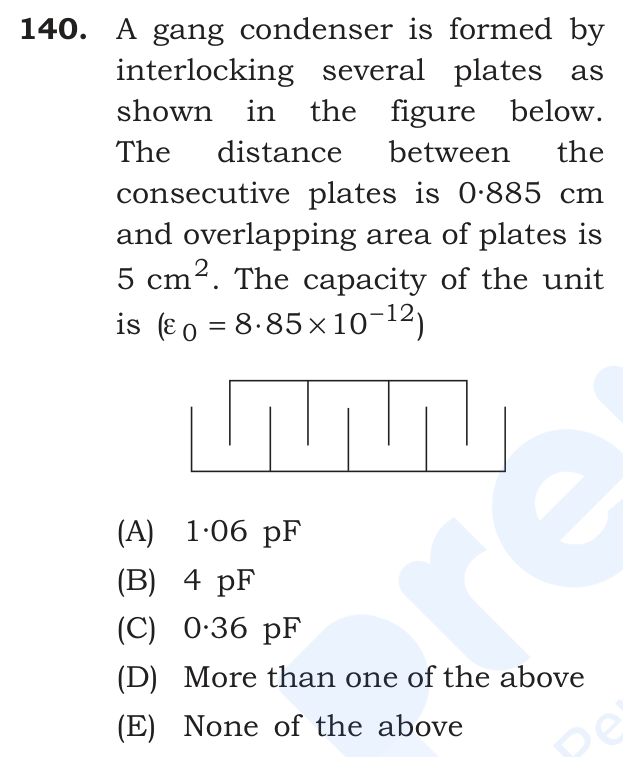
Show answerHide answer
Correct answer: (B)4 pF4 pF
Explanation
The figure has 9 interlocking plates, forming 9 − 1 = 8 capacitors in parallel. Each has C = ε₀A/d = 8·85 × 10⁻¹² × 5 × 10⁻⁴/(0·885 × 10⁻²) = 0·5 pF, so the total is 8 × 0·5 = 4 pF.चित्र में 9 परस्पर गुँथी प्लेटें हैं, जो 9 − 1 = 8 संधारित्र समानांतर क्रम में बनाती हैं। प्रत्येक की C = ε₀A/d = 8·85 × 10⁻¹² × 5 × 10⁻⁴/(0·885 × 10⁻²) = 0·5 pF, इसलिए कुल 8 × 0·5 = 4 pF।
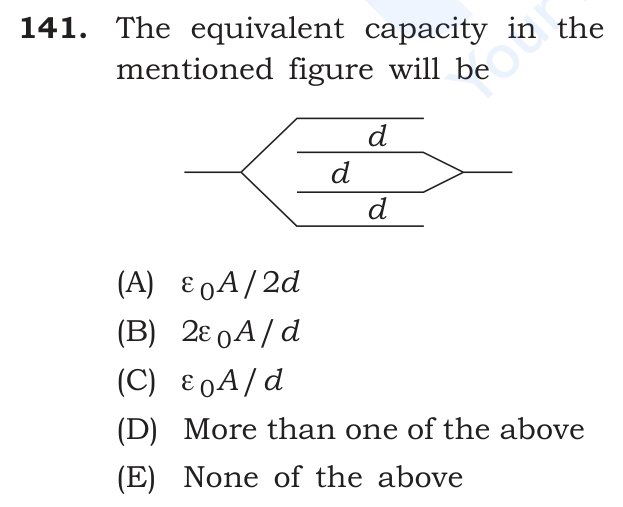
DMore than one of the aboveउपर्युक्त में से एक से अधिक
ENone of the aboveउपर्युक्त में से कोई नहीं
Show answerHide answer
Correct answer: (B)2ε₀A/d2ε₀A/d
Explanation
The middle plate goes to one terminal and both outer plates to the other, so the arrangement is two capacitors, each ε₀A/d, connected in parallel. C = ε₀A/d + ε₀A/d = 2ε₀A/d.बीच की प्लेट एक टर्मिनल से और दोनों बाहरी प्लेटें दूसरे टर्मिनल से जुड़ी हैं, इसलिए व्यवस्था दो संधारित्रों की है, प्रत्येक ε₀A/d, जो समानांतर क्रम में जुड़े हैं। C = ε₀A/d + ε₀A/d = 2ε₀A/d।
How to use these BPSC TRE Physics questions
Every question here was asked in a real BPSC TRE paper; the paper and shift are shown on the card, and the number opens the question on its own page. Try each one before tapping Show answer, then attempt the full BPSC TRE papers as timed tests to check your speed under exam conditions.